Have you ever written an email, essay, caption, or report and noticed that you keep using the word “unnecessary”? Finding another word for unnecessary can make your writing more precise, natural, and persuasive.
The best replacement depends on what you actually mean. You might need a formal word such as “superfluous,” a professional choice such as “nonessential,” or a stronger option such as “pointless.”
This guide explains synonyms for unnecessary by meaning, tone, intensity, and situation, so you can choose the word that fits your sentence instead of simply replacing one word with another.
What Does “Unnecessary” Mean?
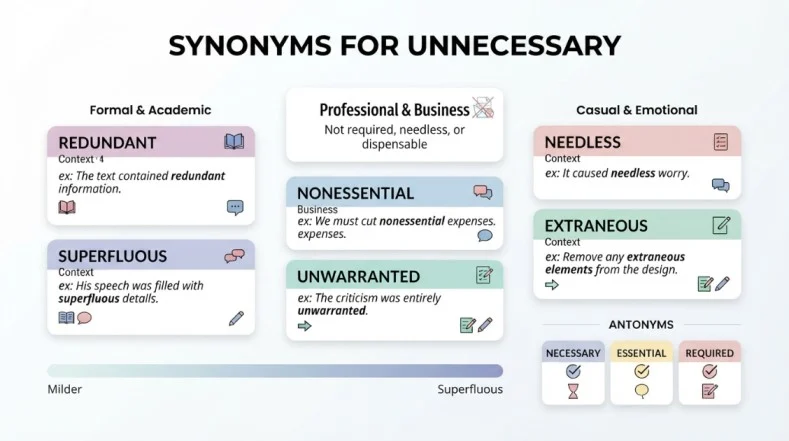
“Unnecessary” means not needed, required, or useful for a particular purpose. Common synonyms include needless, nonessential, superfluous, redundant, extraneous, dispensable, and unwarranted, depending on context and tone.
Meaning, Tone and Context
Simple Definition
“Unnecessary” describes something that is not needed or required for a particular purpose.
For example:
“The extra paragraph was unnecessary.”
This means the paragraph was not needed to communicate the main idea.
Part of Speech
“Unnecessary” is an adjective.
It describes a person, object, action, detail, expense, rule, effort, or situation that is not needed.
Related forms include:
- • Necessity, a noun meaning something that is needed.
- • Necessarily, an adverb meaning as a necessary result or requirement.
- • Unnecessarily, an adverb meaning in a way that is not needed.
Tone
“Unnecessary” is usually neutral, but it can sound critical when used to describe someone’s actions or decisions.
Compare these sentences:
“The additional information was unnecessary.”
“The additional information was pointless.”
The first sounds relatively neutral. The second is more strongly critical.
Formality Level
“Unnecessary” works well in casual conversation, academic writing, professional communication, emails, reports, and general writing.
More formal alternatives include “superfluous,” “extraneous,” “dispensable,” and “nonessential.”
Common Use Cases
You can use “unnecessary” when discussing:
- • Extra information
- • Avoidable expenses
- • Repeated explanations
- • Additional work
- • Excessive details
- • Unneeded procedures
- • Avoidable conflict
- • Extra items
- • Irrelevant material
- • Actions that serve no useful purpose
When and How to Use “Unnecessary”
“Unnecessary” is useful when something is not required for achieving a particular goal. It is especially useful when you want to sound clear without using an overly emotional word.
Professional
“The meeting included several unnecessary topics.”
This suggests that some topics did not contribute to the meeting’s purpose.
Personal
“I packed several unnecessary items for the trip.”
The items were not needed for the journey.
Academic
“Some sentences contain unnecessary repetition.”
This is useful when giving objective writing feedback.
Emotional
“There was no need for unnecessary criticism.”
Here, the word emphasizes that the criticism could have been avoided.
Creative
“The story loses momentum because of unnecessary details.”
This tells the writer that certain details do not strengthen the story.
Social Media
“Skip the unnecessary drama and focus on what matters.”
Here, “unnecessary” has a conversational and slightly critical tone.
“Please remove any unnecessary information before submitting the document.”
This is professional, direct, and relatively neutral.
Another Word for “Unnecessary”
The best single replacement depends on what you want to emphasize.
Professional Writing
Nonessential works well when something is not required but may still have some value.
Example:
“Please remove nonessential information from the summary.”
Academic Writing
Extraneous is useful when information is outside the main subject or adds no useful value.
Example:
“Remove extraneous details from the discussion.”
Casual Conversation
Needless sounds natural and straightforward.
Example:
“That argument was completely needless.”
Emotional Writing
Unwarranted works when something is unjustified or not reasonably called for.
Example:
“Her unwarranted criticism upset the team.”
Creative Writing
Superfluous can describe details that add little or nothing to a piece of writing.
Example:
“The editor removed several superfluous descriptions.”
Resume or Workplace Use
Nonessential is generally safer than strongly negative alternatives.
Example:
“Consolidated nonessential tasks to improve workflow.”
Social Media Captions
Needless or pointless can sound more natural in conversational posts.
Example:
“Life is too short for pointless arguments.”
Stronger Meaning
Pointless suggests that something has little or no useful purpose.
Example:
“Continuing the discussion became pointless.”
Softer Meaning
Nonessential is a gentler choice because it says something is not required without strongly criticizing it.
Example:
“The additional feature is nonessential for most users.”
When Not to Use “Unnecessary”
“Unnecessary” is broad, so it may not always communicate the exact idea you intend.
- If something is repeated, “redundant” may be more precise.
- If information does not belong to the subject, “extraneous” may work better.
- If something is not justified, “unwarranted” is more accurate.
- If something has no useful purpose, “pointless” may communicate the idea more strongly.
Compare:
“The report contains unnecessary information.”
“The report contains extraneous information.”
The second sentence more clearly suggests that the information is outside the main focus.
Words Commonly Confused With “Unnecessary”
Unnecessary vs. Redundant
“Unnecessary” means not needed. “Redundant” often means unnecessarily repeated or duplicated.
Example:
“The final paragraph was unnecessary.”
“The final paragraph was redundant because it repeated the conclusion.”
Unnecessary vs. Irrelevant
“Unnecessary” means not needed. “Irrelevant” means not connected to the subject or issue.
Example:
“The extra explanation was unnecessary.”
“The discussion about weekend plans was irrelevant to the meeting.”
Unnecessary vs. Excessive
“Unnecessary” focuses on lack of need. “Excessive” focuses on an amount that is too large.
Example:
“The additional step was unnecessary.”
“The report contained excessive detail.”
Unnecessary vs. Pointless
“Unnecessary” can be neutral. “Pointless” usually suggests that something has little or no purpose.
Example:
“The extra meeting was unnecessary.”
“The argument became pointless.”
Unnecessary vs. Useless
“Unnecessary” means something is not needed. “Useless” suggests that something provides little or no practical benefit.
Example:
“The extra tool was unnecessary.”
“The broken tool was useless.”
Unnecessary vs. Unwarranted
“Unnecessary” means not needed. “Unwarranted” means not justified, appropriate, or reasonably called for.
Example:
“The extra explanation was unnecessary.”
“His harsh response was unwarranted.”
Best Synonym by Context for “Unnecessary”
| Context | Best Synonym | Why It Works | Example |
|---|---|---|---|
| Formal writing | Superfluous | Clearly suggests something is more than needed | The editor removed superfluous details. |
| Academic writing | Extraneous | Precisely describes material outside the central focus | Remove extraneous information from the analysis. |
| Professional or business use | Nonessential | Neutral and workplace friendly | The form contains several nonessential fields. |
| Resume | Redundant | Useful for describing repeated tasks or information | Removed redundant reporting steps. |
| Casual conversation | Needless | Natural and easy to understand | That argument was needless. |
| Creative writing | Superfluous | Helps identify details that do not strengthen the work | The revision eliminated superfluous descriptions. |
| Emotional tone | Unwarranted | Suggests criticism or action lacks justification | The accusation was unwarranted. |
| Strong intensity | Pointless | Emphasizes a lack of useful purpose | Continuing the argument was pointless. |
| Soft or moderate tone | Nonessential | Sounds less critical | The feature is nonessential for basic use. |
| Social media captions | Needless | Short, conversational, and direct | No need for needless drama. |
| Technical writing | Nonessential | Clearly separates required and optional elements | The update removes several nonessential settings. |
| Editing | Redundant | Directly addresses repeated content | Delete redundant sentences. |
| Expenses | Dispensable | Indicates something can be removed without affecting the essential result | Several expenses were considered dispensable. |
| Rules or actions | Unwarranted | Works when something lacks sufficient reason | The additional restriction was unwarranted. |
| US usage | Unnecessary | Common, clear, and widely understood | The extra step is unnecessary. |
| UK usage | Unnecessary | Also natural and widely understood in British English | The additional procedure is unnecessary. |
Which Synonym Should You Choose?
Start by identifying exactly why something is unnecessary.
- If it is simply not needed, use needless or unneeded.
- If it is optional rather than required, use nonessential or dispensable.
- If it repeats something already stated, use redundant.
- If it falls outside the main topic, use extraneous.
- If it is excessive or more than necessary, use superfluous.
- If it lacks a useful purpose, use pointless or purposeless.
- If it is not justified, use unwarranted or unjustified.
For professional communication, softer choices such as “nonessential” can sound more constructive. For direct criticism, “pointless” or “needless” may sound stronger.
Real Life Examples of “Unnecessary” in Sentences
School
“The teacher asked us to remove unnecessary details from the essay.”
Workplace
“We identified several unnecessary steps in the approval process.”
Writing
“Cutting unnecessary words made the article easier to read.”
Conversation
“There is no reason for an unnecessary argument.”
Social Media
“Sometimes an unnecessary comment can turn a simple discussion into a conflict.”
Resume
“Reduced unnecessary administrative steps and improved document organization.”
“Please avoid including unnecessary attachments in future emails.”
Storytelling
“The author removed unnecessary scenes to improve the story’s pace.”
25 Synonyms for “Unnecessary”
| Synonym | Simple Meaning | Best Used For | Example Sentence |
|---|---|---|---|
| Needless | Not needed | General and conversational use | The extra discussion was needless. |
| Unneeded | Not required | Everyday and straightforward writing | The package included several unneeded items. |
| Nonessential | Not essential | Professional and academic contexts | The optional feature is nonessential. |
| Inessential | Not essential or necessary | Formal and precise writing | These details are inessential to the argument. |
| Superfluous | More than necessary | Formal writing and editing | The editor removed superfluous phrases. |
| Extraneous | Outside what is needed or relevant | Academic and professional writing | The report contains extraneous information. |
| Redundant | Repeated or unnecessarily duplicated | Editing and workplace processes | We eliminated redundant approval steps. |
| Dispensable | Able to be removed without serious effect | Formal and professional contexts | Several older procedures are now dispensable. |
| Unwarranted | Not justified or reasonably called for | Criticism, actions, restrictions | The complaint was unwarranted. |
| Unjustified | Not supported by a good reason | Formal and analytical writing | The additional charge seemed unjustified. |
| Pointless | Having no useful purpose | Casual and strongly critical contexts | The argument became pointless. |
| Purposeless | Lacking a purpose | Formal, creative, and descriptive writing | The repeated exercise felt purposeless. |
| Useless | Providing little or no practical benefit | Stronger everyday criticism | The broken device was useless. |
| Avoidable | Able to be prevented or avoided | Problems, costs, conflict, mistakes | The delay was avoidable. |
| Excessive | More than a reasonable amount | Quantity, detail, spending, effort | The report included excessive detail. |
| Surplus | More than what is needed | Resources, supplies, inventory | The company sold its surplus equipment. |
| Supernumerary | More than the required number | Formal or specialized contexts | The department removed several supernumerary positions. |
| Otiose | Serving no practical purpose | Highly formal writing | The lengthy explanation was otiose. |
| Gratuitous | Unnecessary and often unwelcome | Remarks, criticism, actions | The speaker made a gratuitous comment. |
| Overdone | Excessive or carried too far | Creative and conversational contexts | The dramatic ending felt overdone. |
| Uncalled for | Not necessary or justified | Conversation and criticism | That rude comment was uncalled for. |
| Not needed | Not required | Simple everyday language | The extra equipment is not needed. |
| Not required | Not necessary for a purpose | Instructions and professional writing | Additional documentation is not required. |
| More than necessary | Beyond what is needed | Quantity and amount | The explanation was more than necessary. |
| Excess | An amount beyond what is needed | Resources and quantities | The warehouse contained an excess of supplies. |
Synonym Groups and Usage Differences
Professional vs. Personal Synonyms
Professional writing often benefits from neutral terms such as “nonessential,” “extraneous,” and “redundant.”
Personal communication can use more direct words such as “needless,” “pointless,” or “unneeded.”
For example:
Professional:
“Several nonessential steps were removed from the process.”
Personal:
“That extra argument was completely needless.”
Formal vs. Conversational Synonyms
Formal writing can use “superfluous,” “extraneous,” “inessential,” and “dispensable.”
Conversational English usually favors “needless,” “unneeded,” “pointless,” and “not needed.”
Choose the word that matches the expected reader and situation.
Academic Synonyms
Academic writing usually benefits from precision rather than emotional language.
“Extraneous,” “redundant,” “nonessential,” and “superfluous” can help explain why certain material should be removed.
For example:
“Several extraneous examples were removed to maintain the focus of the study.”
Professional and Business Synonyms
Workplace communication should generally avoid language that sounds unnecessarily harsh.
“Nonessential,” “redundant,” “dispensable,” and “avoidable” can describe process problems without sounding overly personal.
For example:
“We identified several redundant steps in the workflow.”
Creative or Literary Synonyms
Creative writing gives you more freedom to choose words based on tone.
“Superfluous” works well for editorial analysis, while “purposeless” can create a more reflective tone.
“Overdone” is useful when describing a creative choice that feels excessive.
Slang or Modern Synonyms
There are few true slang synonyms for “unnecessary” that work across contexts.
Expressions such as “extra” can sometimes communicate the idea of excessive or unwanted behavior in informal American English.
For example:
“That comment was extra.”
However, “extra” does not always mean unnecessary. It can also mean dramatic, excessive, or attention seeking, depending on context.
Avoid it in academic papers, resumes, formal reports, and professional communication.
Strongest vs. Weaker Synonyms
A useful intensity scale is:
Mild: nonessential, inessential, not needed
Moderate: unnecessary, needless, unneeded, avoidable
Stronger: redundant, superfluous, extraneous
Very critical: pointless, useless, purposeless
Justification focused: unwarranted, unjustified, uncalled for
The strongest option is not automatically the best option. Choose the word that accurately describes the problem.
Emotional vs. Neutral Synonyms
Neutral choices include “unnecessary,” “nonessential,” “inessential,” and “unneeded.”
More emotional choices include “pointless,” “useless,” “needless,” and “uncalled for.”
When giving workplace feedback, neutral language can help keep the focus on the action rather than the person.
Antonyms of “Unnecessary”
| Antonym | Meaning | Example Sentence |
|---|---|---|
| Necessary | Required or needed | Regular maintenance is necessary. |
| Essential | Absolutely needed | Water is essential for life. |
| Required | Officially or practically needed | A valid password is required. |
| Needed | Wanted or required for a purpose | Additional evidence is needed. |
| Important | Having significant value or effect | This detail is important to the argument. |
| Indispensable | So important that it cannot be removed | Her expertise was indispensable to the project. |
| Vital | Extremely important or necessary | Clear communication is vital to teamwork. |
| Crucial | Extremely important to an outcome | Timing was crucial to the success of the launch. |
| Fundamental | Forming a basic or essential part | Trust is fundamental to a healthy relationship. |
| Essential | Absolutely necessary | Accurate records are essential for the audit. |
| Useful | Providing practical value | The guide offers useful advice. |
| Valuable | Worthwhile or beneficial | Her feedback was valuable to the team. |
| Beneficial | Producing a helpful result | Exercise can be beneficial for overall well being. |
| Appropriate | Suitable for the situation | The additional explanation was appropriate. |
| Relevant | Directly connected to the subject | The researcher included only relevant evidence. |
Comparison: “Unnecessary” vs. Similar Words
Unnecessary vs. Redundant
The main difference is repetition.
“Unnecessary” means something is not needed. “Redundant” often means something repeats information or duplicates a function.
“An extra meeting was unnecessary.”
“The second meeting was redundant because nothing had changed.”
“Redundant” is more specific when repetition is the problem.
Unnecessary vs. Irrelevant
“Unnecessary” focuses on whether something is needed.
“Irrelevant” focuses on whether something relates to the subject.
“The extra explanation was unnecessary.”
“The discussion about vacation plans was irrelevant to the meeting.”
“Irrelevant” is more precise when the issue is connection to the topic.
Unnecessary vs. Excessive
“Unnecessary” means not needed.
“Excessive” means more than a reasonable amount.
“The additional paragraph was unnecessary.”
“The article contained excessive detail.”
“Excessive” is stronger when quantity is the main concern.
Unnecessary vs. Pointless
“Unnecessary” can remain neutral.
“Pointless” suggests that something has little or no useful purpose.
“The additional step was unnecessary.”
“Continuing the argument was pointless.”
“Pointless” is more critical and conversational.
Unnecessary vs. Superfluous
Both can describe something beyond what is needed.
“Superfluous” is more formal and is especially common in editing, academic discussion, and professional analysis.
“The report included unnecessary information.”
“The report included superfluous information.”
The second sentence sounds more formal.
Unnecessary vs. Unwarranted
“Unwarranted” focuses on justification.
“The additional question was unnecessary.”
“The accusation was unwarranted.”
Use “unwarranted” when something is not reasonably justified, rather than merely not needed.
Common Phrases and Expressions with “Unnecessary”
1. Unnecessary expense
Meaning:
A cost that could be avoided or is not needed.
Example sentence:
“The company reduced unnecessary expenses during the budget review.”
2. Unnecessary delay
Meaning:
A delay that does not need to happen.
Example sentence:
“We want to prevent unnecessary delays in processing applications.”
3. Unnecessary risk
Meaning:
A risk that can reasonably be avoided.
Example sentence:
“Good planning can help prevent unnecessary risk.”
4. Unnecessary details
Meaning:
Information that does not contribute enough to the main point.
Example sentence:
“Remove unnecessary details to make the explanation easier to follow.”
5. Unnecessary complication
Meaning:
An added difficulty that does not provide enough benefit.
Example sentence:
“The new procedure created an unnecessary complication.”
6. Unnecessary conflict
Meaning:
Disagreement or tension that could have been avoided.
Example sentence:
“Clear communication can prevent unnecessary conflict.”
7. Unnecessary pressure
Meaning:
Pressure that is not required or helpful.
Example sentence:
“Students should not face unnecessary pressure during the exam period.”
Common Mistakes to Avoid
1. Using “Unnecessary” When a More Precise Synonym Is Better
“Unnecessary” is broad.
If repetition is the issue, use “redundant.” If the information is outside the subject, use “extraneous.”
2. Confusing “Unnecessary” With “Irrelevant”
Something can be relevant but unnecessary.
For example, background information may relate to the topic but still be optional.
3. Using a Casual Synonym in Formal Writing
Words such as “extra” may work in conversation but can sound vague in academic or professional writing.
Choose “nonessential,” “extraneous,” or another precise alternative when appropriate.
4. Using an Overly Dramatic Synonym
Calling a minor extra detail “useless” can sound unnecessarily harsh.
Use “nonessential” when you want a measured tone.
5. Repeating the Same Word Too Often
Using “unnecessary” repeatedly can make an article, essay, or report feel monotonous.
Vary your vocabulary only when the alternative preserves the exact meaning.
6. Choosing the Wrong Emotional Tone
“Pointless” is more critical than “unnecessary.”
“Unwarranted” focuses on justification, while “redundant” focuses on repetition.
7. Using Slang in Academic or Professional Writing
Informal expressions such as “extra” may not communicate the intended meaning clearly in a formal setting.
Use precise vocabulary instead.
FAQs
What is the best synonym for “unnecessary”?
“Needless” is a strong general synonym, while “nonessential” is better for professional writing and “superfluous” suits more formal contexts.
What is a formal synonym for “unnecessary”?
“Superfluous” is a formal synonym for unnecessary. “Extraneous,” “inessential,” and “dispensable” can also work depending on the sentence.
What is an informal synonym for “unnecessary”?
“Needless” and “not needed” are natural informal alternatives. “Pointless” is stronger and suggests a lack of useful purpose.
What is another word for “unnecessary” in professional writing?
“Nonessential” is often a useful professional alternative because it communicates that something is optional without sounding unnecessarily harsh.
What is the difference between “unnecessary” and “redundant”?
“Unnecessary” means not needed, while “redundant” often describes information, actions, or processes that unnecessarily repeat something already present.
What is the opposite of “unnecessary”?
Common antonyms include necessary, essential, required, indispensable, vital, crucial, needed, useful, valuable, and relevant.
Conclusion
“Unnecessary” describes something that is not needed, required, or useful for a particular purpose. The best synonym depends on exactly what you want to communicate.
Use “needless” for straightforward language, “nonessential” for professional writing, “extraneous” for academic contexts, “redundant” for repetition, “superfluous” for formal writing, and “unwarranted” when something lacks justification.
The key vocabulary tip is simple: do not replace a word merely to sound sophisticated. Choose the synonym that preserves your intended meaning while matching the tone and situation.
When you understand the difference between similar words, your writing becomes clearer, more precise, and more natural.
Discover More Post:
- 25+ Synonyms for Shadow | Meanings, Examples, and Best …
- 25+ Synonyms for Dream | Meanings, Examples, and Best …
- 25+ Synonyms for Potential | Meanings and Examples