Calling someone a “cool person” works in everyday conversation, but it can feel repetitive when you are writing a caption, email, essay, review, story, or professional message.
The phrase can describe someone who is likable, confident, stylish, relaxed, interesting, admirable, or enjoyable to be around. The best alternative depends on exactly what you mean.
This guide explains synonyms for cool person by tone and situation, so you can choose a word that sounds natural rather than simply replacing one expression with another.
What Does “Cool Person” Mean?
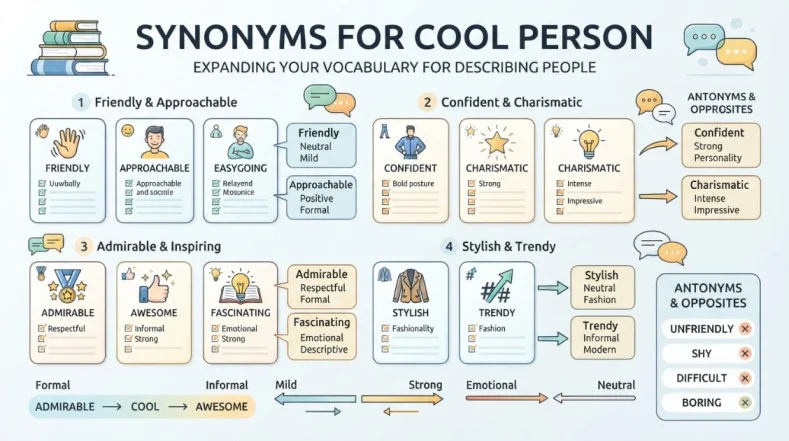
A cool person is generally someone who is likable, confident, relaxed, interesting, stylish, or admired by others. Depending on context, useful alternatives include admirable, charismatic, confident, friendly, laid back, impressive, stylish, fascinating, and easygoing.
Meaning, Tone and Context
1. Simple Definition
“Cool person” is an informal expression for someone who people find appealing, likable, confident, interesting, relaxed, fashionable, or enjoyable to be around.
The meaning changes according to context. Saying “She is a cool person” could describe her personality, attitude, appearance, social behavior, or overall impression.
2. Part of Speech
“Cool” is an adjective, while “person” is a noun.
Together, “cool person” forms a noun phrase used to describe someone in a positive or generally approving way.
3. Positive, Negative, or Neutral Tone
“Cool person” usually has a positive tone.
It can communicate approval, admiration, friendliness, or social acceptance. In some contexts, however, “cool” may specifically refer to style, confidence, emotional control, or a relaxed personality.
4. Formality Level
“Cool person” is primarily informal and conversational.
It works well in texts, conversations, social media posts, casual emails, and personal writing. In academic or professional writing, a more precise word such as admirable, professional, charismatic, confident, or approachable may communicate the intended quality more clearly.
5. Common Use Cases
You might use “cool person” when talking about:
- A friendly classmate
- An interesting coworker
- A confident friend
- A stylish person
- Someone who stays calm under pressure
- A person who is enjoyable to spend time with
- Someone admired by a group
- A person with an appealing personality
6. Important Word Forms and Related Expressions
The adjective “cool” can have several meanings.
“Cool” can describe temperature, appearance, personality, behavior, emotional control, or social appeal.
Related expressions include “coolness,” “coolly,” “cool headed,” “cool looking,” “cool attitude,” and “cool under pressure.”
The phrase “cool person,” however, normally focuses on positive social qualities rather than temperature.
When and How to Use “Cool Person”
“Cool person” is most natural when you are speaking casually or describing someone from a personal perspective.
The phrase is flexible, but it is also broad. If you know exactly what makes the person appealing, a more specific synonym can create a stronger sentence.
1. Casual Context
“Jordan is a really cool person, so everyone enjoys hanging out with him.”
Here, “cool” means likable and enjoyable to spend time with.
2. Personal Context
“My new neighbor seems like a cool person.”
The phrase communicates a friendly, positive first impression.
3. Professional Context
“Although she is our manager, she is a cool person who makes everyone feel comfortable.”
This is acceptable in casual workplace conversation, but “approachable” or “supportive” may be more appropriate in formal writing.
4. Social Media Context
“Met some cool people at the concert last night.”
Here, “cool” creates a relaxed, natural social media tone.
5. Creative Context
“He was the kind of cool person who never needed to prove himself.”
In creative writing, the phrase can describe confidence and self assurance.
6. Emotional Context
“She stayed calm and kind when everything went wrong. She is genuinely a cool person.”
Here, “cool” suggests emotional control as well as positive character.
7. Email Context
“Your colleague sounds like a cool person.”
This works in a friendly personal email, but a professional email may benefit from a more specific term such as friendly, approachable, or professional.
Another Word for “Cool Person”
There is no single perfect replacement because “cool person” can describe several different qualities.
- For professional writing, “approachable,” “admirable,” “charismatic,” or “professional” may work.
- For academic writing, “respected,” “admirable,” or “influential” may be more precise.
- For casual conversation, “awesome person,” “great person,” “fun person,” or “easygoing person” sounds natural.
- For emotional writing, “kindhearted,” “compassionate,” or “warm” may fit better.
- For creative writing, “charismatic,” “magnetic,” “fascinating,” or “captivating” can add personality.
- For resume or workplace use, “approachable,” “collaborative,” “dependable,” or “professional” is usually more precise.
- For social media captions, “awesome,” “amazing,” “stylish,” “fun,” or “legend” can sound natural depending on the audience.
- For a stronger meaning, consider “exceptional,” “remarkable,” “outstanding,” or “extraordinary.”
- For a softer meaning, “pleasant,” “friendly,” “nice,” or “easygoing” may be better.
When Not to Use “Cool Person”
“Cool person” can be too vague when you need to explain exactly why someone is appealing.
For example:
“She is a cool person.”
This tells the reader that you like her, but it does not explain whether she is friendly, confident, stylish, intelligent, generous, or relaxed.
A more precise sentence would be:
“She is an approachable manager who makes new employees feel comfortable.”
“Cool person” can also sound too casual in formal documents.
Instead of saying:
“He is a cool person and an excellent manager.”
A professional version could be:
“He is an approachable manager who communicates clearly and supports his team.”
The goal is not always to replace “cool.” The goal is to choose a word that communicates the exact quality you mean.
Words Commonly Confused With “Cool Person”
Cool Person vs. Nice Person
A nice person is generally kind, pleasant, or considerate. A cool person can be nice, but the word “cool” may also suggest confidence, style, or social appeal.
Cool Person vs. Friendly Person
A friendly person is warm and approachable. A cool person may be friendly, but could instead be admired for confidence, style, humor, or a relaxed attitude.
Cool Person vs. Confident Person
A confident person believes in their abilities or decisions. A cool person may appear confident, but confidence is only one possible meaning.
Cool Person vs. Popular Person
A popular person is widely liked or socially recognized. A cool person does not necessarily need to be popular.
Cool Person vs. Stylish Person
A stylish person has an appealing sense of fashion or design. A cool person may be stylish, but the phrase can refer to personality rather than appearance.
Cool Person vs. Interesting Person
An interesting person attracts attention through ideas, experiences, personality, or conversation. A cool person may be interesting, but the two expressions are not identical.
Best Synonym by Context for “Cool Person”
| Context | Best Synonym | Why It Works | Example |
|---|---|---|---|
| Formal writing | Admirable | Clearly communicates positive qualities | She is an admirable person who consistently helps others. |
| Academic writing | Respected | Describes someone viewed positively by others | He is a respected member of the academic community. |
| Professional or business use | Approachable | Describes someone easy to communicate with | Our director is approachable and open to questions. |
| Resume | Professional | Focuses on workplace behavior | She is a professional who communicates effectively. |
| Casual conversation | Easygoing | Suggests a relaxed and pleasant personality | Mike is easygoing and fun to be around. |
| Creative writing | Charismatic | Adds personality and social appeal | The charismatic stranger quickly attracted attention. |
| Emotional tone | Kindhearted | Highlights genuine kindness | She is a kindhearted person who cares about everyone. |
| Strong intensity | Exceptional | Gives a stronger sense of admiration | He is an exceptional person and a remarkable leader. |
| Soft or moderate tone | Pleasant | Offers a mild positive description | She is a pleasant person to work with. |
| Social media captions | Awesome | Sounds energetic and conversational | Had an awesome time with some amazing people. |
| US usage | Awesome | Common in casual American English | You are an awesome person. |
| UK usage | Brilliant | Common informal praise in British English | She is a brilliant person to work with. |
Which Synonym Should You Choose?
Start by asking what you actually mean by “cool.”
- If you mean someone is friendly, choose “friendly,” “warm,” or “approachable.”
- If you mean someone is relaxed, choose “easygoing,” “laid back,” or “relaxed.”
- If you mean someone is confident, choose “self assured,” “confident,” or “poised.”
- If you mean someone attracts people through personality, choose “charismatic,” “magnetic,” or “engaging.”
- If you mean someone deserves admiration, choose “admirable,” “remarkable,” or “exceptional.”
- If you mean someone has great style, choose “stylish,” “fashionable,” or “trendy.”
The most effective synonym is the one that preserves the specific meaning you intended.
Real Life Examples of “Cool Person” in Sentences
School
“Our new teacher is a cool person who makes difficult subjects easier to understand.”
A more precise alternative would be “approachable” if the focus is on the teacher’s friendly behavior.
Workplace
“Maria is a cool person, and she always listens to her coworkers.”
For formal workplace writing, “supportive” or “approachable” would communicate the idea more precisely.
Writing
“The author creates a cool character who remains calm when everyone else panics.”
Here, “composed” or “self assured” could add more specific meaning.
Conversation
“Your brother seems like a cool person.”
This is natural casual English.
Social Media
“Lucky to know so many cool people.”
The informal phrase fits the relaxed style of a social post.
Resume
“She is an approachable professional who builds strong relationships with clients.”
This is more suitable than “cool person” for a resume.
“Your new teammate sounds like a really nice person.”
In a friendly email, “nice” may sound more natural than “cool.”
Storytelling
“He walked into the room with the calm confidence of someone who never needed approval.”
This gives a more vivid description than simply calling him a cool person.
25 Synonyms for “Cool Person”
| Synonym | Simple Meaning | Best Used For | Example Sentence |
|---|---|---|---|
| Awesome | Extremely good or impressive | Casual conversation and social media | She is an awesome person who always brings positive energy. |
| Amazing | Very impressive or wonderful | Strong casual praise | He is an amazing person to have on your team. |
| Great | Very good and enjoyable | General conversation | You are a great person to work with. |
| Admirable | Worthy of respect or approval | Formal and professional writing | Her patience makes her an admirable person. |
| Approachable | Easy to talk to or contact | Workplace and professional settings | Our supervisor is approachable and welcoming. |
| Charismatic | Naturally attractive and engaging | Leadership and personality | The charismatic speaker quickly connected with the audience. |
| Confident | Secure in abilities or decisions | Personality descriptions | She is a confident person who handles pressure well. |
| Easygoing | Relaxed and not easily upset | Casual conversation | Ben is an easygoing person who rarely complains. |
| Friendly | Warm and pleasant toward others | Everyday descriptions | Our new neighbor is friendly and welcoming. |
| Likable | Easy for people to like | General personality descriptions | He has a likable personality that puts people at ease. |
| Pleasant | Nice and enjoyable to be around | Mild or professional praise | She is a pleasant person to work with. |
| Stylish | Having an appealing sense of style | Fashion and appearance | Marcus is a stylish person with a distinctive look. |
| Fascinating | Extremely interesting | Creative and descriptive writing | She is a fascinating person with unusual experiences. |
| Interesting | Able to attract attention or curiosity | General descriptions | He is an interesting person with plenty of stories to tell. |
| Engaging | Able to hold attention or interest | Professional and communication contexts | She is an engaging person who makes every discussion lively. |
| Fun | Enjoyable and entertaining | Casual conversation | Jake is a fun person to spend the weekend with. |
| Relaxed | Calm and comfortable | Personality descriptions | She is a relaxed person who handles changes easily. |
| Self assured | Confident without needing approval | Personality and professional writing | He is self assured and comfortable speaking to large groups. |
| Remarkable | Unusually impressive or notable | Formal praise | She is a remarkable person who has overcome significant challenges. |
| Exceptional | Far above ordinary | Strong praise and professional writing | He is an exceptional person and a talented leader. |
| Kindhearted | Naturally caring and kind | Emotional descriptions | She is a kindhearted person who notices when others need help. |
| Warm | Friendly and emotionally welcoming | Personal and emotional writing | He is a warm person who makes visitors feel at home. |
| Magnetic | Naturally able to attract attention | Creative descriptions | Her magnetic personality made everyone want to meet her. |
| Captivating | Extremely engaging or attractive | Creative writing | The captivating artist quickly became the center of attention. |
| Admirable | Deserving respect or approval | Formal and personal praise | His honesty makes him an admirable person. |
Synonym Groups and Usage Differences
Professional vs. Personal Synonyms
Professional descriptions should usually identify a specific quality.
“Approachable,” “dependable,” “collaborative,” “professional,” and “respectful” are more useful in workplace communication.
Personal conversations can be much more relaxed.
“Awesome,” “great,” “fun,” “cool,” and “easygoing” sound natural when talking about friends or acquaintances.
Formal vs. Conversational Synonyms
Formal writing benefits from precise vocabulary.
Use “admirable,” “respected,” “remarkable,” “exceptional,” or “approachable” when the situation requires a polished tone.
Conversational English allows expressions such as “awesome,” “great,” “fun,” and “cool.”
Academic Synonyms
Academic writing generally benefits from describing observable qualities rather than using broad praise.
Instead of calling a historical figure a “cool person,” consider “influential,” “respected,” “admirable,” or “notable,” depending on the evidence.
Professional and Business Synonyms
For emails, reviews, presentations, and workplace communication, “approachable,” “collaborative,” “professional,” “respectful,” and “reliable” are often more informative.
For a resume, avoid vague statements such as “I am a cool person.”
Instead, describe the qualities that matter professionally, such as communication, leadership, teamwork, adaptability, or reliability.
Creative or Literary Synonyms
Creative writing gives you more freedom.
“Magnetic,” “captivating,” “charismatic,” “fascinating,” and “self assured” can create a stronger character image.
The best choice depends on whether the character is attractive because of personality, confidence, mystery, style, intelligence, or emotional control.
Slang or Modern Synonyms
“Awesome,” “legend,” “badass,” and “icon” can appear in casual modern language.
However, these expressions are highly informal and can be inappropriate in academic, professional, or formal communication.
“Legend” can describe someone greatly admired, while “icon” often suggests exceptional cultural or social influence.
Strongest vs. Weaker Synonyms
A useful intensity scale is:
Mild: Pleasant, nice, friendly
Moderate: Great, likable, easygoing, approachable
Strong: Awesome, amazing, admirable, charismatic
Very strong: Remarkable, exceptional, extraordinary
Intensity should match the situation. Calling an ordinary pleasant interaction “extraordinary” can sound exaggerated.
Emotional vs. Neutral Synonyms
Emotional words include “kindhearted,” “warm,” “magnetic,” and “awesome.”
More neutral choices include “approachable,” “confident,” “professional,” “respected,” and “stylish.”
Choose emotional vocabulary when you want readers to feel your personal reaction. Choose neutral vocabulary when accuracy matters more than enthusiasm.
Antonyms of “Cool Person”
Because “cool person” is an informal phrase with several meanings, its opposites depend on which quality you have in mind.
| Antonym | Meaning | Example Sentence |
|---|---|---|
| Uncool | Not socially appealing or fashionable | His behavior came across as uncool. |
| Unfriendly | Not warm or welcoming | The unfriendly response made visitors uncomfortable. |
| Unpleasant | Not enjoyable to be around | His unpleasant attitude affected the conversation. |
| Boring | Not interesting or entertaining | The speaker seemed boring to the audience. |
| Dull | Lacking excitement or interest | The character felt dull compared with the others. |
| Awkward | Socially uncomfortable or lacking ease | His awkward response changed the mood. |
| Uptight | Tense or overly concerned with rules | He seemed uptight during the informal gathering. |
| Stuffy | Excessively formal or conventional | The atmosphere felt stuffy and restrictive. |
| Unfashionable | Not currently considered stylish | His outfit looked unfashionable to the group. |
| Conventional | Following ordinary or traditional patterns | Her personality was more conventional than adventurous. |
| Unapproachable | Difficult to talk to or contact | The manager appeared unapproachable. |
| Arrogant | Having an exaggerated sense of superiority | His arrogant behavior pushed people away. |
| Rude | Lacking respect or good manners | His rude comment ended the conversation. |
| Hostile | Unfriendly or openly antagonistic | The hostile response surprised everyone. |
| Inconsiderate | Failing to think about other people’s feelings | His inconsiderate behavior upset his friends. |
Comparison: “Cool Person” vs. Similar Words
“Cool Person” vs. “Nice Person”
The main difference is breadth. “Nice” usually focuses on kindness or pleasant behavior, while “cool” can include confidence, style, humor, or social appeal.
“Cool person” is more informal.
“Nice person” is more neutral and works in a wider range of situations.
Example:
“She is a cool person who always knows how to make people laugh.”
“She is a nice person who always helps her neighbors.”
“Cool Person” vs. “Friendly Person”
“Friendly” specifically emphasizes warmth and willingness to interact.
“Cool” can describe many other qualities.
“Friendly” is more precise when the main quality is social warmth.
Example:
“Carlos is a cool person with a great sense of style.”
“Carlos is a friendly person who welcomes every new employee.”
“Cool Person” vs. “Confident Person”
“Confident” focuses on self belief and composure.
“Cool” may suggest confidence, but does not necessarily mean the person is confident.
“Confident” is more precise and more suitable for professional writing.
Example:
“She is a cool person who never worries about fitting in.”
“She is a confident person who speaks clearly during presentations.”
“Cool Person” vs. “Charismatic Person”
Charismatic describes someone with a strong ability to attract or influence others through personality.
“Charismatic” is more specific and more formal.
Example:
“He is a cool person who enjoys meeting new people.”
“He is a charismatic leader who easily attracts an audience.”
“Cool Person” vs. “Stylish Person”
“Stylish” focuses primarily on appearance, fashion, design, or aesthetic taste.
“Cool” may include style but is not limited to it.
Example:
“She is a cool person with a relaxed attitude.”
“She is a stylish person known for her creative outfits.”
“Cool Person” vs. “Popular Person”
“Popular” describes social acceptance or recognition among many people.
A cool person may be admired without being widely popular.
Example:
“He is a cool person who prefers a small circle of friends.”
“He is a popular person who knows people throughout the school.”
Common Phrases and Expressions with “Cool Person”
1. A Really Cool Person
Meaning:
A strong but informal way to express positive feelings about someone’s personality.
Example sentence:
“She is a really cool person who makes everyone feel welcome.”
2. Such a Cool Person
Meaning:
An enthusiastic expression of admiration.
Example sentence:
“You are such a cool person for helping me prepare for the interview.”
3. One Cool Person
Meaning:
A casual way to emphasize that someone is impressive or admirable.
Example sentence:
“That is one cool person who never loses his sense of humor.”
4. A Super Cool Person
Meaning:
A highly informal expression meaning very likable or impressive.
Example sentence:
“Our guide was a super cool person who made the entire trip memorable.”
5. Cool People
Meaning:
A casual expression for people considered interesting, likable, stylish, or enjoyable.
Example sentence:
“I met some cool people at the conference.”
6. Cool With Someone
Meaning:
Being comfortable with, accepting of, or friendly toward someone.
Example sentence:
“I am cool with everyone on the new team.”
7. Stay Cool
Meaning:
Remain calm, especially during a stressful situation.
Example sentence:
“Try to stay cool when the interview gets difficult.”
8. Keep Your Cool
Meaning:
Remain calm and avoid reacting emotionally.
Example sentence:
“She managed to keep her cool during the disagreement.”
Common Mistakes to Avoid
1. Using “Cool Person” When a More Precise Word Is Better
“Cool” is broad. If you mean friendly, confident, stylish, or admirable, say exactly that.
2. Confusing “Cool” With “Popular”
Someone can be popular without being perceived as cool, and someone can be cool without being popular.
3. Using Casual Language in Formal Writing
Avoid “cool person” in formal reports, academic essays, and professional documents when a precise alternative is available.
4. Using an Overly Dramatic Synonym
Words such as “extraordinary” or “legendary” can exaggerate an ordinary compliment.
Choose a stronger term only when the situation supports it.
5. Repeating “Cool” Too Often
If every person in a story is described as cool, the writing loses descriptive power.
Replace repetition with specific qualities such as charming, confident, thoughtful, or charismatic.
6. Choosing the Wrong Emotional Tone
“Awesome” sounds enthusiastic, while “pleasant” sounds restrained.
Choose a synonym that matches the emotion you want the reader to understand.
7. Using Slang in Academic or Professional Writing
Expressions such as “badass,” “legend,” or “icon” may sound unnatural or inappropriate in formal contexts.
FAQs
What is the best synonym for “cool person”?
The best synonym depends on the intended meaning. “Awesome” works casually, while “admirable,” “approachable,” “charismatic,” or “exceptional” may fit more specific contexts.
What is a formal synonym for “cool person”?
“Admirable,” “respected,” “remarkable,” “exceptional,” and “approachable” are useful formal alternatives when they accurately describe the person’s qualities.
What is an informal synonym for “cool person”?
“Awesome person,” “great person,” “fun person,” “easygoing person,” and “amazing person” are natural informal alternatives in American English.
What is another word for “cool person” in professional writing?
“Approachable,” “professional,” “collaborative,” “respectful,” or “reliable” can work better because each describes a specific workplace quality.
What is the difference between “cool person” and “friendly person”?
“Friendly person” specifically describes warmth and social openness. “Cool person” is broader and may refer to personality, confidence, style, humor, or social appeal.
What is the opposite of “cool person”?
Depending on the intended meaning, possible opposites include uncool, unfriendly, unpleasant, boring, awkward, uptight, unapproachable, or inconsiderate.
Conclusion
“Cool person” is a flexible, positive, informal expression, but it can mean different things in different situations.
If you mean friendly, choose “friendly” or “warm.” you mean relaxed, choose “easygoing.” you mean confident, choose “self assured.” you mean socially engaging, consider “charismatic” or “magnetic.”
For professional and academic writing, precise vocabulary is usually stronger than broad praise. For casual conversations and social media, informal choices such as “awesome” or “great” may sound more natural.
The most useful vocabulary habit is simple: before choosing a synonym, identify the exact quality you want to describe. That small step makes your writing clearer, more natural, and more expressive.
Discover More Post:
- 25+ Synonyms for Secret | Meanings, Examples, and Best …
- 25 Synonyms for Saw | Meanings, Examples, and Best …
- 25+ Synonyms for Dream | Meanings, Examples, and Best …