We all use the word “stress” often. You might mention stress in a work email, describe a stressful semester in an essay, or use the word in a social media caption.
The problem is that “stress” can become repetitive. Depending on the situation, words such as pressure, strain, tension, anxiety, worry, and burden can communicate a more specific idea.
This guide explains the most useful synonyms for stress, including their meanings, tone, intensity, and best contexts. You will also learn how to choose the right word for academic writing, professional communication, everyday conversation, creative writing, and social media.
What Does “Stress” Mean?
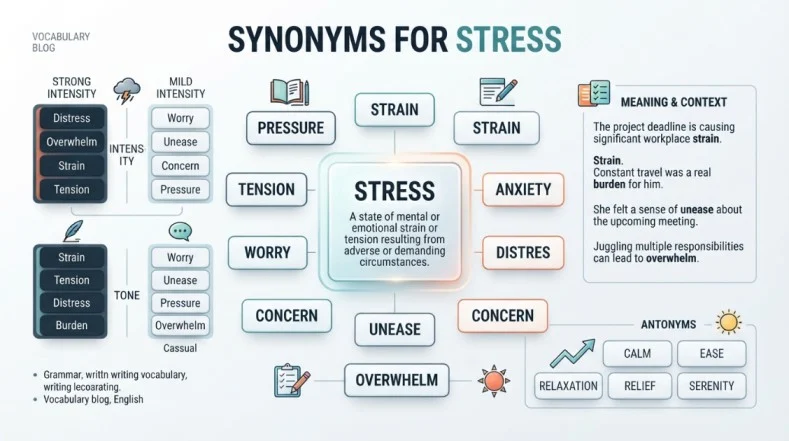
Stress means mental, emotional, or physical pressure caused by demanding situations or perceived challenges. Depending on context, useful synonyms include pressure, strain, tension, anxiety, worry, burden, distress, and unease.
Meaning, Tone and Context
1. Simple Definition
Stress is a state of mental, emotional, or physical pressure that can happen when a person feels unable to comfortably manage demands or challenges.
For example, a demanding workload can create stress, while uncertainty about an important decision can cause emotional stress.
2. Part of Speech
“Stress” is primarily a noun when it refers to pressure or strain.
Example:
“Too much stress can affect your concentration.”
It can also be a verb meaning to give special importance or emphasis to something.
Example:
“The professor stressed the importance of careful research.”
The noun sense and the verb sense should not be treated as identical when choosing synonyms.
3. Tone
The tone of “stress” is usually neutral, although the experience it describes is generally negative.
The word can describe a mild concern or a serious situation depending on the surrounding language.
4. Formality Level
“Stress” is a common and versatile word. It works in casual conversation, professional communication, academic writing, journalism, and personal writing.
More precise alternatives may be preferable when you want to describe a particular type of stress.
5. Common Use Cases
Stress commonly appears when discussing:
- Work demands
- School and exams
- Financial concerns
- Relationships
- Health and wellness
- Major life changes
- Deadlines
- Personal responsibilities
- Emotional difficulties
- Difficult decisions
6. Important Word Forms
Common related forms include:
Stress: the noun or verb.
Stressed: experiencing pressure or emphasizing something.
Stressful: causing pressure or difficulty.
Stressor: something that creates stress.
For example, a demanding deadline can be a stressor, while the resulting feeling may be stress.
When and How to Use “Stress”
“Stress” works best when you need a broad word for pressure or difficulty. Use a more specific synonym when you want readers to understand exactly what kind of pressure you mean.
Professional
“The new deadline has created considerable stress for the project team.”
Personal
“I have been dealing with a lot of stress lately.”
Academic
“Students may experience stress during major examinations.”
Emotional
“Her financial situation became a significant source of stress.”
Creative
“The constant noise added another layer of stress to an already difficult day.”
Social Media
“Trying to balance everything at once can bring a lot of stress.”
“I understand that the schedule change may create additional stress for the team.”
Another Word for “Stress”
The best single replacement depends on what you mean.
- Professional writing: pressure or strain
- Academic writing: pressure or psychological strain
- Casual conversation: worry or pressure
- Emotional writing: anxiety, distress, or anguish
- Creative writing: tension, turmoil, or strain
- Resume or workplace use: pressure, workload, or demanding conditions
- Social media captions: pressure, overwhelm, or worry
- Stronger meaning: distress, anguish, or severe strain
- Softer meaning: concern, unease, or pressure
If you simply need a broad replacement, pressure is often the closest everyday alternative.
When Not to Use “Stress”
“Stress” is useful, but it can sometimes be too broad.
If you specifically mean fear about an uncertain outcome, anxiety may be more precise.
Instead of:
“Her future caused stress.”
Try:
“She felt anxious about her future.”
If you mean physical or mental exhaustion caused by demands, strain may be clearer.
Instead of:
“The long hours caused stress.”
Try:
“The long hours placed considerable strain on him.”
If you mean a heavy responsibility, burden may communicate the idea better.
Instead of:
“The responsibility caused stress.”
Try:
“The responsibility became a heavy burden.”
Words Commonly Confused With “Stress”
Stress vs. Anxiety
Stress is often connected to a specific demand or challenge. Anxiety can involve persistent fear, apprehension, or worry, sometimes even when there is no immediate threat.
Stress vs. Pressure
Pressure usually emphasizes external demands or expectations. Stress often describes the internal response to those demands.
Stress vs. Strain
Strain suggests that something is being pushed beyond a comfortable or sustainable level. It can describe people, relationships, systems, or resources.
Stress vs. Tension
Tension often describes emotional discomfort, conflict, nervousness, or a feeling of tightness.
Stress vs. Worry
Worry focuses on repeated concern about a problem or possible outcome. Stress is broader and can include physical and emotional pressure.
Stress vs. Distress
Distress is generally stronger and more negative. It suggests significant emotional suffering or difficulty.
Best Synonym by Context for “Stress”
| Context | Best Synonym | Why It Works | Example |
|---|---|---|---|
| Formal writing | Pressure | Clear and widely accepted | The policy placed additional pressure on small businesses. |
| Academic writing | Strain | Precise for prolonged demands | Academic strain can affect concentration. |
| Professional or business use | Pressure | Natural in workplace communication | The team is working under considerable pressure. |
| Resume | Demands | Focuses on workload without sounding emotional | Successfully managed competing demands. |
| Casual conversation | Worry | Sounds natural and familiar | I have been dealing with a lot of worry lately. |
| Creative writing | Tension | Adds emotional atmosphere | Tension filled the room as the decision approached. |
| Emotional tone | Distress | Clearly communicates serious difficulty | The news caused considerable distress. |
| Strong intensity | Anguish | Communicates deep emotional suffering | She expressed anguish over the loss. |
| Soft or moderate tone | Unease | Suggests mild discomfort or concern | A feeling of unease remained after the meeting. |
| Social media captions | Overwhelm | Fits modern conversational language | Some days simply feel like too much overwhelm. |
| US usage | Stress | Common and broadly understood | Work stress can affect daily routines. |
| UK usage | Pressure | Often natural when discussing demands | The pressure of exams can be difficult. |
Which Synonym Should You Choose?
Start by identifying what kind of stress you are describing.
- If the problem comes from external demands, choose pressure.
- If prolonged demands are causing difficulty, choose strain.
- If you are describing nervous anticipation, choose anxiety.
- If you are describing repeated concern, choose worry.
- If you want to describe emotional discomfort or conflict, choose tension.
- If the situation involves serious emotional suffering, choose distress or anguish.
For professional writing, prefer precise and neutral words. For personal or creative writing, a more emotionally expressive synonym can make the sentence more vivid.
Real Life Examples of “Stress” in Sentences
School
“Final exams can create significant stress for students.”
Workplace
“Managing several deadlines at once increased the team’s stress.”
Writing
“Financial stress is a recurring theme in the novel.”
Conversation
“I need a quiet weekend because work has been causing too much stress.”
Social Media
“Sometimes taking a break is the best way to step away from everyday stress.”
Resume
“Managed competing priorities effectively under significant pressure.”
“I understand the urgency, but the revised deadline may place additional pressure on the team.”
Storytelling
“As the deadline approached, the stress in the office became impossible to ignore.”
25 Synonyms for “Stress”
| Synonym | Simple Meaning | Best Used For | Example Sentence |
|---|---|---|---|
| Pressure | Demands that feel difficult to manage | Work, school, responsibilities | The pressure of the deadline affected the entire team. |
| Strain | Difficulty caused by prolonged demands | Work, relationships, resources | Long hours placed strain on their relationship. |
| Tension | Emotional or nervous discomfort | Conflict, atmosphere, relationships | Tension filled the room after the announcement. |
| Anxiety | Fear or worry about what may happen | Emotional situations | She felt anxiety before the interview. |
| Worry | Repeated concern about a problem | Casual and personal situations | His financial worries kept him awake. |
| Distress | Serious emotional difficulty | Strong emotional situations | The accident caused considerable distress. |
| Burden | A responsibility that feels heavy | Duties and obligations | Caring for everything alone became a burden. |
| Concern | Uneasiness about a possible problem | Professional and personal situations | The delay raised concern among customers. |
| Unease | Mild discomfort or apprehension | Subtle emotional situations | She felt a sense of unease about the decision. |
| Overwhelm | A feeling of having too much to handle | Modern personal language | The number of tasks left him feeling overwhelmed. |
| Frustration | Irritation caused by difficulty or obstacles | Work and personal situations | Repeated delays caused considerable frustration. |
| Agitation | Restlessness or emotional disturbance | Stronger emotional descriptions | The uncertainty led to visible agitation. |
| Turmoil | A state of serious emotional or social disorder | Creative and emotional writing | The family went through months of emotional turmoil. |
| Anguish | Severe emotional pain | Serious personal situations | She experienced deep anguish after the loss. |
| Adversity | Difficult circumstances that require endurance | Formal and motivational writing | The organization continued working despite adversity. |
| Difficulty | A problem that requires effort to overcome | General situations | Financial difficulty created additional challenges. |
| Hardship | Severe or prolonged difficulty | Social and economic contexts | The family faced significant financial hardship. |
| Trouble | Problems or difficulties | Casual conversation | He has been having trouble at work lately. |
| Nervousness | Uneasy feelings caused by anticipation | Interviews, exams, events | Her nervousness disappeared once the presentation began. |
| Apprehension | Uneasy expectation about something ahead | Formal and emotional writing | He approached the meeting with apprehension. |
| Restlessness | Inability to relax or remain settled | Emotional and physical situations | She experienced restlessness while waiting for the results. |
| Discomfort | A feeling of uneasiness | Mild situations | The uncertainty created some discomfort. |
| Struggle | Difficulty in managing or overcoming something | Personal and social contexts | Balancing work and school was a daily struggle. |
| Weight | An emotional or figurative burden | Creative and personal writing | The weight of responsibility became difficult to carry. |
| Friction | Tension or disagreement between people or groups | Workplace and relationships | Miscommunication created friction between departments. |
Synonym Groups and Usage Differences
Professional vs. Personal Synonyms
Professional communication usually benefits from neutral words such as pressure, strain, demands, difficulty, and concern.
Personal writing can use more emotional words such as worry, anxiety, overwhelm, anguish, and turmoil.
For example:
Professional: “The additional workload has created pressure for the department.”
Personal: “I have been feeling overwhelmed by everything lately.”
Formal vs. Conversational Synonyms
Formal writing often favors strain, pressure, distress, concern, hardship, and adversity.
Conversational language naturally uses stress, worry, trouble, pressure, and nervousness.
In a research paper, “prolonged psychological strain” may sound more precise than “a lot of stress.”
In a text message, “I have so much stress right now” sounds completely natural.
Academic Synonyms
Academic writing benefits from precise vocabulary.
Useful choices include:
- Pressure
- Strain
- Anxiety
- Distress
- Difficulty
- Adversity
- Concern
The best choice depends on what your evidence actually describes. Avoid replacing “stress” with a more complicated word simply to sound academic.
Professional and Business Synonyms
In workplace writing, pressure is often useful because it focuses on demands without unnecessarily emphasizing personal emotion.
Strain works when prolonged demands are affecting people, relationships, or organizational resources.
Concern works when the focus is on a possible problem.
Example:
“The current workload is placing considerable pressure on the team.”
Creative or Literary Synonyms
Creative writing gives you more freedom to choose expressive vocabulary.
Tension can create atmosphere.
Turmoil can communicate emotional disorder.
Anguish can communicate deep suffering.
Weight can work as a metaphor for responsibility.
Example:
“The weight of the decision followed him long after the meeting ended.”
Slang or Modern Synonyms
There is no single slang replacement for stress that works in every situation.
Words such as overwhelm are common in modern conversational language, especially when people describe having too many responsibilities.
Very casual expressions may work in texts or social media, but they should generally be avoided in academic papers, resumes, and formal business documents.
Strongest vs. Weaker Synonyms
A rough intensity scale can help you choose vocabulary:
Unease → Concern → Worry → Pressure → Stress → Strain → Anxiety → Distress → Anguish
This is not a universal ranking. Context can change the intensity of each word.
For example, anxiety may be mild in one sentence and severe in another. Choose the word according to the actual situation rather than relying only on an intensity scale.
Emotional vs. Neutral Synonyms
More neutral choices include:
Pressure, difficulty, concern, demands, strain
More emotionally expressive choices include:
Anxiety, distress, anguish, turmoil, overwhelm
If your goal is objective professional writing, choose neutral vocabulary. If your goal is personal storytelling, emotional vocabulary may communicate the experience more effectively.
Antonyms of “Stress”
| Antonym | Meaning | Example Sentence |
|---|---|---|
| Calm | A state without agitation or pressure | She remained calm during the difficult meeting. |
| Relaxation | A state of rest and reduced tension | A short period of relaxation helped him recover. |
| Ease | Freedom from difficulty or pressure | The new system made the process easier. |
| Peace | A state of quiet and freedom from conflict | The quiet setting gave her a sense of peace. |
| Tranquility | Deep calm and quiet | The garden provided a feeling of tranquility. |
| Comfort | A state of physical or emotional relief | Talking with a friend brought comfort. |
| Relief | Freedom from a troubling condition | Finishing the project brought immediate relief. |
| Serenity | A peaceful and undisturbed state | The lake created an atmosphere of serenity. |
| Composure | Calm self control | He maintained his composure during the crisis. |
| Equanimity | Calmness when facing difficulty | She handled the criticism with equanimity. |
| Reassurance | Something that reduces fear or concern | The manager offered reassurance about the changes. |
| Rest | A period without demanding activity | She needed a full night of rest. |
| Leisure | Time free from work or obligations | He spent the weekend enjoying leisure activities. |
| Contentment | A feeling of satisfaction and peace | The slower lifestyle brought her greater contentment. |
| Stability | A condition of balance and consistency | Financial stability reduced his concerns. |
Comparison: Stress vs. Similar Words
Stress vs. Pressure
The main difference is that pressure usually emphasizes external demands, while stress can describe the internal response to those demands.
Pressure can sound more neutral and professional.
Example with stress:
“The workload caused considerable stress.”
Example with pressure:
“The workload placed considerable pressure on the team.”
Stress vs. Anxiety
Stress often has an identifiable source, such as deadlines or responsibilities. Anxiety focuses more strongly on fear, apprehension, or worry.
Anxiety can be more emotionally specific.
Example with stress:
“The upcoming exam caused stress.”
Example with anxiety:
“She felt anxiety about the exam results.”
Stress vs. Strain
Strain emphasizes the effect of prolonged demands or difficulty.
Strain can sound more formal and analytical than stress.
Example with stress:
“The project created stress for the employees.”
Example with strain:
“The project placed considerable strain on the employees.”
Stress vs. Tension
Tension often describes emotional discomfort, nervousness, conflict, or a charged atmosphere.
Tension is especially useful when describing relationships or situations involving conflict.
Example with stress:
“The negotiations caused stress.”
Example with tension:
“The negotiations created tension between the two sides.”
Stress vs. Worry
Worry focuses on repeated concern about something that might happen.
Stress is broader and can include pressure from workload, responsibilities, uncertainty, or difficult circumstances.
Example with stress:
“Work has caused a lot of stress.”
Example with worry:
“She spent the evening worrying about the deadline.”
Stress vs. Distress
Distress generally describes a more serious level of emotional difficulty.
It is more emotionally intense and formal than ordinary stress.
Example with stress:
“The situation caused significant stress.”
Example with distress:
“The situation caused considerable emotional distress.”
Common Phrases and Expressions with “Stress”
1. Under Stress
Meaning:
Experiencing significant pressure or difficulty.
Example sentence:
“Employees may make mistakes when they are working under stress.”
2. Stress Level
Meaning:
The amount of pressure or tension someone is experiencing.
Example sentence:
“My stress level usually increases when several deadlines overlap.”
3. Stress Management
Meaning:
Methods used to reduce or handle stress.
Example sentence:
“Regular breaks can be part of an effective stress management routine.”
4. Source of Stress
Meaning:
A person, situation, activity, or condition that creates pressure.
Example sentence:
“Unclear expectations became a major source of stress for the team.”
5. Stress Response
Meaning:
The mental or physical reaction to a demanding situation.
Example sentence:
“The body can produce a stress response during a frightening event.”
6. Relieve Stress
Meaning:
To reduce feelings of pressure or tension.
Example sentence:
“Taking a walk can help some people relieve stress.”
7. Work Stress
Meaning:
Pressure associated with employment or workplace responsibilities.
Example sentence:
“Work stress can make it difficult to disconnect after office hours.”
Common Mistakes to Avoid
1. Using “Stress” When a More Precise Word Is Better
“Stress” is broad. If you specifically mean fear, pressure, conflict, or emotional suffering, choose a word that communicates that meaning.
2. Confusing Stress With Anxiety
These words overlap, but they are not always interchangeable. Stress often relates to demands, while anxiety emphasizes apprehension or fear.
3. Using a Casual Synonym in Formal Writing
Words such as “trouble” may sound too conversational in an academic paper.
A more precise choice such as “strain,” “pressure,” or “difficulty” may fit better.
4. Using an Overly Dramatic Synonym
Do not describe an ordinary deadline as “anguish” unless the context genuinely involves severe emotional suffering.
Choose vocabulary that matches the actual intensity.
5. Repeating “Stress” Too Often
Repeating the same word can make an article or essay sound flat.
Use relevant alternatives such as pressure, strain, concern, tension, or worry when the meaning truly changes.
6. Choosing the Wrong Emotional Tone
“Concern” sounds softer than “distress.” “Anguish” sounds much stronger than “unease.”
Always consider the emotional weight of your replacement.
7. Using Slang in Academic or Professional Writing
Very casual expressions may be appropriate in a text message but can weaken an essay, report, resume, or formal email.
FAQs
What is the best synonym for stress?
The best synonym depends on context. Pressure is a strong general replacement, while strain, anxiety, tension, worry, or distress may be more precise.
What is a formal synonym for stress?
Strain, pressure, distress, adversity, and difficulty can work as formal alternatives. Choose based on the exact type of stress being described.
What is an informal synonym for stress?
In casual conversation, worry, pressure, trouble, and overwhelm can work naturally. “Stress” itself is also highly conversational.
What is another word for stress in professional writing?
Pressure is often a natural professional alternative. Strain can work when prolonged demands are affecting people, systems, or relationships.
What is the difference between stress and anxiety?
Stress commonly results from identifiable demands or challenges, while anxiety emphasizes apprehension or fear about possible problems or outcomes.
What is the opposite of stress?
Common opposites include calm, relaxation, ease, peace, tranquility, relief, serenity, and composure. The best choice depends on context.
Conclusion
“Stress” is a flexible word for mental, emotional, or physical pressure, but it is not always the most precise choice.
Use pressure for external demands, strain for prolonged difficulty, anxiety for apprehension, worry for repeated concern, tension for emotional discomfort, and distress for more serious emotional difficulty.
The best synonym for stress is the word that matches your exact meaning, tone, and audience.
Before publishing an important vocabulary article, academic assignment, or professional document, verify definitions and subtle distinctions with trusted dictionaries such as Cambridge, Oxford, Merriam Webster, Collins, or Britannica.
Discover More Post:
- 25+ Synonyms for Secret | Meanings, Examples, and Best …
- 25 Synonyms for Saw | Meanings, Examples, and Best …
- 25+ Synonyms for Dream | Meanings, Examples, and Best …