If you keep using the word individual in essays, emails, resumes, reports, conversations, or captions, your writing can start to sound repetitive. The good news is that individual has several useful alternatives, but the right choice depends on what you actually mean.
You might need a formal term such as person or participant, a professional word such as employee or candidate, or a more descriptive choice such as character or human being.
This guide explains the meaning of individual, shows 25 accurate alternatives, and helps you choose the right word for academic, professional, casual, emotional, and creative situations.
What Does “Individual” Mean?
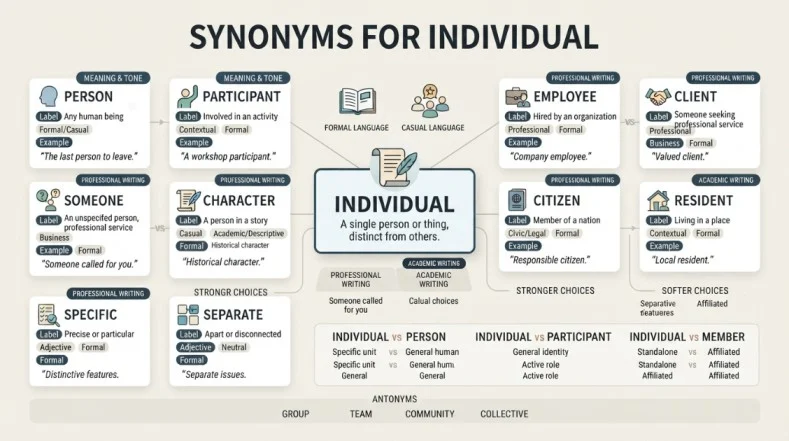
Individual usually means one person considered separately from a group. Depending on context, useful synonyms include person, human, individual person, participant, member, citizen, resident, and someone. For formal writing, person or participant often works well, while character can suit creative writing.
Meaning, Tone and Context
Simple Definition
Individual can refer to one person considered separately from other people. It emphasizes the person as a single unit rather than as part of a group.
For example:
“Each individual received a certificate.”
Here, individual means each separate person.
Individual can also describe something that is separate, distinct, or belonging to one particular person.
For example:
“Each student has an individual learning plan.”
In this sentence, individual describes something specific to each student.
Part of Speech
Individual is commonly used as both a noun and an adjective.
As a noun:
“Every individual deserves respect.”
As an adjective:
“Each individual case requires careful review.”
Tone
The word individual is generally neutral. It does not automatically communicate positive or negative emotion.
Its tone depends on the surrounding sentence.
For example:
“Each individual contributed to the project.”
This sounds neutral and professional.
“The individual refused to cooperate.”
This can sound somewhat distant because individual is being used instead of the more natural word person.
Formality Level
Individual is appropriate in formal, academic, professional, and everyday communication.
However, person is often more natural in ordinary conversation.
For example:
“Every individual has different experiences.”
This is correct but somewhat formal.
“Every person has different experiences.”
This sounds more conversational.
Common Use Cases
Individual commonly appears in:
- Academic writing
- Business communication
- Legal and administrative writing
- Psychology and social science
- Education
- Healthcare communication
- Resumes and professional profiles
- General conversation
- Creative writing
- Social media content
Important Word Forms
Individual: one person or something separate.
Individually: separately or one at a time.
Individuality: the qualities that make someone distinct.
Individualistic: emphasizing personal independence or personal interests.
Individualized: designed for the needs of one particular person.
When and How to Use “Individual”
Use individual when you want to emphasize that one person is being considered separately from a larger group.
It is especially useful when the distinction between one person and a group matters.
Professional
“Each individual employee is responsible for completing the required training.”
This works well in workplace policies and formal instructions.
Personal
“Every individual has a different way of handling difficult situations.”
Person would sound slightly more natural in casual conversation.
Academic
“The study examined how each individual responded to the new learning environment.”
The word fits academic writing because it emphasizes separate participants.
Emotional
“Every individual deserves the opportunity to be heard.”
This creates a respectful and inclusive tone.
Creative
“An unusual individual entered the quiet room.”
Here, individual gives the person a slightly mysterious or distinctive quality.
Social Media
“Every individual brings a different perspective to the conversation.”
This sounds polished without being overly formal.
Resume
“I work effectively with individual clients and diverse teams.”
This is appropriate when describing one on one professional work.
Another Word for “Individual”
The best replacement depends on the intended meaning.
Professional Writing
Person is usually the safest replacement.
“Each person received a copy of the report.”
Academic Writing
Participant works when referring to someone involved in a study, experiment, survey, or research project.
Casual Conversation
Person or someone sounds natural.
“I met someone at the conference.”
Emotional Writing
Human being can emphasize dignity, identity, or shared humanity.
“Every human being deserves compassion.”
Creative Writing
Character works when discussing someone in a story.
“The main character struggled with the decision.”
Resume or Workplace Use
Employee, candidate, client, or professional can be more precise than individual when the person’s role is known.
Social Media Captions
Person, someone, or individual can work depending on tone.
“Every person has a story worth hearing.”
Stronger Meaning
Distinct person or unique individual can emphasize difference or individuality.
Softer Meaning
Person is usually warmer and more natural than individual.
When Not to Use “Individual”
Individual is not always the clearest choice.
When Person Is More Natural
Instead of:
“An individual walked into the store.”
Use:
“A person walked into the store.”
Person sounds more natural unless the context requires a formal or detached tone.
When a Specific Role Is Better
Instead of:
“Each individual should contact the company.”
Use:
“Each customer should contact the company.”
The second sentence tells readers exactly who should take action.
When the Word Sounds Too Formal
In casual conversation, individual can sound unnecessarily official.
Instead of:
“An individual asked me for directions.”
Say:
“Someone asked me for directions.”
When More Precision Is Needed
Instead of:
“The individual participated in the project.”
Use:
“The participant contributed to the research project.”
Participant tells readers what role the person had.
When the Word Sounds Too Distant
In sensitive personal writing, person can sound warmer.
Instead of:
“Each individual affected by the event deserves support.”
You could write:
“Each person affected by the event deserves support.”
Words Commonly Confused With “Individual”
Individual vs. Person
Person is the general term for a human being. Individual often emphasizes one person separately from a group.
Individual vs. Human
Human identifies the person as a member of the human species. Individual emphasizes one distinct person.
Individual vs. Participant
Participant describes someone’s role in an activity, study, event, or program. It is more specific than individual.
Individual vs. Member
Member means someone belonging to a group, organization, team, or community. Individual emphasizes the person separately.
Individual vs. Character
Character usually refers to a person in a story, play, film, or fictional work. It can also describe a person’s qualities in some contexts.
Individual vs. Citizen
Citizen identifies a person’s legal or civic relationship with a country. Individual does not provide that information.
Best Synonym by Context for “Individual”
| Context | Best Synonym | Why It Works | Example |
|---|---|---|---|
| Formal writing | Person | Clear and broadly accepted | Each person must complete the form. |
| Academic writing | Participant | Identifies a research or study role | Each participant completed the survey. |
| Professional use | Employee | Identifies a workplace role | Each employee receives training. |
| Business use | Client | Identifies the person receiving a service | Each client receives personal support. |
| Resume | Professional | Highlights workplace identity | I support professionals across several industries. |
| Casual conversation | Person | Natural and familiar | I spoke with a person outside the office. |
| Creative writing | Character | Fits stories and fictional people | The character entered the room quietly. |
| Emotional writing | Human being | Emphasizes shared humanity | Every human being deserves respect. |
| Strong distinction | Distinct person | Highlights separateness | Each person has a distinct perspective. |
| Softer tone | Person | Sounds warmer and more natural | Every person deserves a fair opportunity. |
| Social media | Someone | Sounds conversational | Someone out there may need to hear this today. |
| Education | Student | Identifies the relevant role | Each student receives individual feedback. |
| Research | Subject | Can identify a research subject when appropriate | Each subject completed the assigned task. |
| Community | Resident | Identifies someone living in a place | Each resident received an information packet. |
| Legal or civic | Citizen | Provides a specific civic meaning | Every citizen has certain legal rights. |
| Group membership | Member | Shows belonging to a group | Each member can vote. |
For US English, person is generally the most versatile everyday alternative. Individual remains useful when the sentence needs to emphasize separation, distinct identity, or formal precision.
Which Synonym Should You Choose?
Start by asking what information you want the word to communicate.
If you simply mean one human being, choose person.
If the person has a defined role, choose a more specific term.
Use student for education, employee for workplace contexts, client for professional services, customer for buyers, and participant for studies or organized activities.
If the person belongs to a group, member may be more informative.
For creative writing, character can provide a clearer storytelling meaning.
For emotional writing, human being can emphasize dignity and shared humanity.
The best synonym is therefore not always the most sophisticated word. It is the word that communicates the intended meaning most precisely.
Real Life Examples of “Individual” in Sentences
School
“Each individual student received written feedback on the assignment.”
Workplace
“The company provides individual support to employees who need additional training.”
Writing
“Every individual has a different perspective on success.”
Conversation
“Each individual can make their own decision.”
In casual speech, “Each person can make their own decision” may sound more natural.
Social Media
“Never underestimate what one individual can accomplish with patience and persistence.”
Resume
“I provide individualized support to clients with different professional goals.”
“Please ensure that each individual receives the updated instructions.”
Storytelling
“The mysterious individual stood near the doorway and watched the crowd.”
In this creative context, individual can create distance or mystery.
25 Synonyms for “Individual”
The alternatives below cover both the noun sense of individual as one person and the adjective sense of individual as separate, distinct, or specific.
| Synonym | Simple Meaning | Best Used For | Example Sentence |
|---|---|---|---|
| Person | A human being | General communication | Every person deserves an opportunity to learn. |
| Human | A member of the human species | General or scientific contexts | Each human responds differently to change. |
| Human being | A person considered as a human | Emotional or philosophical writing | Every human being deserves dignity. |
| Someone | An unspecified person | Casual conversation | Someone left a message for you. |
| Somebody | An unspecified person | Informal conversation | Somebody needs to explain what happened. |
| One | A single person | Formal or general statements | One should consider the consequences carefully. |
| Participant | A person taking part in something | Research and events | Each participant completed the questionnaire. |
| Member | A person belonging to a group | Organizations and teams | Every member received a welcome packet. |
| Citizen | A legally recognized member of a country | Civic and legal contexts | Every citizen has civic responsibilities. |
| Resident | A person who lives in a particular place | Local and housing contexts | Each resident received the notice. |
| Inhabitant | A person living in a particular place | Formal geographical writing | Each inhabitant depended on the local water supply. |
| Client | A person receiving professional services | Business and professional communication | The client requested a revised proposal. |
| Customer | A person who buys goods or services | Retail and business | Each customer received a receipt. |
| Employee | A person who works for an organization | Workplace writing | Every employee completed the training. |
| Candidate | A person being considered for a position or opportunity | Hiring and elections | Each candidate submitted a resume. |
| Student | A person receiving education | School and academic contexts | Each student selected a research topic. |
| Subject | A person involved in a research study | Research writing | Each subject completed the assigned task. |
| Character | A person in a story or fictional work | Creative writing | The main character faced a difficult choice. |
| Self | A person’s own identity or personality | Psychological and reflective writing | She wanted to understand her true self. |
| Personage | A notable or distinctive person | Formal or literary writing | The historical personage attracted considerable attention. |
| Particular | A specific one rather than others | Formal descriptions | The policy applies to a particular group. |
| Separate | Existing apart from others | Formal and descriptive writing | Each department operates as a separate unit. |
| Distinct | Clearly different or identifiable | Academic and professional writing | Each region has a distinct cultural identity. |
| Specific | Clearly identified or limited to one thing | Professional and academic writing | The report addresses a specific concern. |
| Singular | One rather than several | Formal and grammatical contexts | The decision reflected a singular perspective. |
Not every synonym can replace individual in every sentence. Person is the broadest noun alternative, while words such as participant, client, employee, and candidate add information about the person’s role.
Synonym Groups and Usage Differences
Professional vs. Personal Synonyms
Professional writing often benefits from precise role based words.
Use employee, client, customer, candidate, participant, or professional when that role is relevant.
Personal writing usually sounds more natural with person, someone, somebody, or human being.
Formal vs. Conversational Synonyms
For reports, essays, and official documents, individual, person, participant, subject, and specific can work well.
For texts and everyday conversations, person, someone, and somebody are usually more natural.
Academic Synonyms
Academic writing should favor precision rather than unnecessary complexity.
Participant is appropriate for people taking part in research. Subject may be appropriate in specific research contexts. Person or individual works when the sentence is discussing people generally.
Professional and Business Synonyms
Business writing becomes clearer when the person’s role is identified.
For example:
“Each client will receive an update.”
This is more informative than:
“Each individual will receive an update.”
Use employee, customer, client, candidate, applicant, or professional when the context supports it.
Creative or Literary Synonyms
Creative writing allows more variation.
Character works for fictional people. Personage can create a formal or historical tone. Human being can emphasize emotional or philosophical themes.
Individual can also create a sense of distance or mystery.
Slang or Modern Synonyms
There are informal expressions for a person, but most slang is highly dependent on region, age group, and social setting.
Words such as someone and somebody are safer casual choices. Slang should generally be avoided in academic essays, formal business communication, and professional resumes unless the style specifically calls for it.
Strongest vs. Weaker Synonyms
Individual does not have a simple intensity scale because most alternatives change meaning rather than intensity.
A practical scale for specificity is:
Person: broad and neutral.
Individual: neutral but more detached or formal.
Participant: identifies involvement.
Member: identifies group belonging.
Employee: identifies employment.
Client: identifies a professional relationship.
Candidate: identifies consideration for a position or opportunity.
The most specific word is usually the strongest choice when the person’s role is known.
Emotional vs. Neutral Synonyms
- For a neutral tone, use person or individual.
- For a warmer emotional tone, use human being.
- For a conversational tone, use someone.
- For a creative tone, use character when discussing fiction.
The surrounding sentence matters as much as the synonym itself.
Antonyms of “Individual”
Individual does not have 15 strict opposites in every grammatical sense. The following are context based opposites that describe groups, collections, or combined entities rather than one separate person.
| Antonym | Meaning | Example Sentence |
|---|---|---|
| Group | Several people considered together | The group made a joint decision. |
| Collective | People considered as one unit | The collective agreed on the proposal. |
| Community | People connected by place or identity | The community supported the project. |
| Crowd | A large gathering of people | A crowd gathered outside the building. |
| Team | People working together toward a goal | The team completed the project. |
| Organization | A structured group of people | The organization released a statement. |
| Society | People living together within a social system | Society changes over time. |
| Population | All people within a defined area or group | The population increased during the decade. |
| Public | People considered collectively | The public received the announcement. |
| Mass | A large number considered together | The message reached a mass audience. |
| Aggregate | A collection viewed as a whole | The aggregate results revealed a broader trend. |
| Whole | Something considered as one complete unit | The whole group participated. |
| Pair | Two people considered together | The pair worked on the presentation. |
| Partnership | Two or more people or organizations working together | The partnership produced a new service. |
| Committee | A group formed for a specific purpose | The committee reviewed the proposal. |
Comparison: “Individual” vs. Similar Words
Individual vs. Person
The main difference is emphasis. Person simply identifies a human being, while individual often emphasizes one person as separate from a group.
Neither is inherently stronger, but individual is often more formal or detached.
Example:
“Each person received a ticket.”
“Each individual received a ticket.”
The first sounds more natural in everyday speech.
Individual vs. Human
Human identifies a member of the human species. Individual focuses on one separate person.
Human can sound broader or more philosophical.
Example:
“Every individual has unique experiences.”
“Humans have developed complex social systems.”
Individual vs. Participant
Participant is more specific because it identifies someone taking part in an activity, study, event, or program.
Participant is therefore more precise when involvement matters.
Example:
“Each individual received an email.”
“Each participant received an email.”
The second tells the reader why the people are being discussed.
Individual vs. Member
Member indicates belonging to a group. Individual does not necessarily imply group membership.
Example:
“Each individual made a decision.”
“Each member voted.”
The second sentence clearly connects the person to a group.
Individual vs. Character
Character usually refers to a person in fiction or storytelling.
Individual can refer to a real person or a fictional person, but character is much more natural when discussing narrative roles.
Example:
“The individual entered the room.”
“The character entered the room.”
The second sentence clearly places the person within a story.
Individual vs. Specific
Specific is generally an adjective meaning clearly identified or limited to one particular thing.
Individual can also function as an adjective, especially when emphasizing something belonging separately to one person.
Example:
“Each individual student received feedback.”
“Please address this specific concern.”
The words are related but do not normally substitute for each other.
Common Phrases and Expressions with “Individual”
1. Individual Differences
Meaning:
The ways in which people vary from one another.
Example sentence:
“Teachers should recognize individual differences among students.”
2. Individual Needs
Meaning:
The particular needs of one person.
Example sentence:
“The program was designed around individual needs.”
3. Individual Responsibility
Meaning:
Responsibility assigned to one person rather than a group.
Example sentence:
“Each employee has individual responsibility for completing the task.”
4. Individual Choice
Meaning:
A decision made by one person.
Example sentence:
“Career selection is ultimately an individual choice.”
5. Individual Rights
Meaning:
Rights belonging to each person separately.
Example sentence:
“The policy aims to protect individual rights.”
6. Individual Achievement
Meaning:
An accomplishment credited to one person.
Example sentence:
“The award recognizes individual achievement.”
7. Individual Attention
Meaning:
Personal attention given to one person.
Example sentence:
“Small classes allow students to receive individual attention.”
8. Individual Approach
Meaning:
A method adapted for a particular person.
Example sentence:
“The counselor developed an individual approach for each client.”
Common Mistakes to Avoid
1. Using Individual When Person Is Clearer
“An individual called me yesterday” is grammatically correct, but “A person called me yesterday” sounds more natural in many everyday situations.
2. Confusing Individual With Participant
Not every individual is a participant.
Use participant only when someone is actively taking part in an activity, study, event, or program.
3. Using a Casual Synonym in Formal Writing
Someone and somebody work well in conversation but may sound less precise in formal reports.
Choose person, individual, participant, or another context specific term when appropriate.
4. Using an Overly Dramatic Synonym
Human being can add emotional weight.
Do not use it merely to make ordinary writing sound more sophisticated.
5. Repeating Individual Too Often
Repeated use can make writing feel mechanical.
If the meaning remains accurate, alternate between person, participant, member, employee, client, or another precise term.
6. Choosing the Wrong Emotional Tone
Individual can sometimes sound detached.
If you are writing about a sensitive personal issue, person or human being may create a warmer tone.
7. Using Slang in Academic or Professional Writing
Informal expressions may sound unnatural in essays, reports, resumes, and formal emails.
Choose vocabulary that matches the audience and purpose.
FAQs
What is the best synonym for “individual”?
Person is usually the best general synonym because it is clear, natural, and suitable for most situations. More specific alternatives may be better when a person’s role matters.
What is a formal synonym for “individual”?
Person, participant, subject, member, or specific role based terms can work formally. Individual itself is also common in formal and academic writing.
What is an informal synonym for “individual”?
Someone, somebody, and person are natural informal alternatives. Someone is especially useful when the identity of the person is unknown or unimportant.
What is another word for “individual” in professional writing?
The best choice depends on the role. Employee, client, customer, candidate, participant, member, and professional can provide greater precision than individual.
What is the difference between “individual” and “person”?
Person simply means a human being. Individual often emphasizes one person separately from others, so it can sound more formal or detached.
What is the opposite of “individual”?
Common context based opposites include group, collective, team, crowd, community, organization, and society. The appropriate opposite depends on the sentence.
Conclusion
The word individual generally refers to one person considered separately from a group. It can also describe something that is separate, distinct, or specific to one person.
The best synonym depends on your purpose. Use person for general communication, participant for research, employee for workplace writing, client for professional services, member for group contexts, and character for creative writing.
When you want a warmer emotional tone, human being can work well. When you want casual language, someone or somebody may sound more natural.
The most useful vocabulary tip is simple: do not replace individual just to sound more advanced. Replace it when another word communicates the exact meaning, role, or tone more clearly.
Definitions and nuanced usage should be verified with trusted dictionaries such as Cambridge, Oxford, Merriam Webster, Collins, or Britannica before publication when authoritative source checking is required.
Discover More Post:
- 25+ Synonyms for Values | Meanings, Examples, and Best …
- 25 Synonyms for Saw | Meanings, Examples, and Best …
- 25+ Synonyms for Dream | Meanings, Examples, and Best …