Have you ever used the word “reflection” several times in an essay, caption, email, or personal statement and wanted a more precise alternative? The word can describe thoughtful consideration, an image in a mirror, or the return of light or sound.
The best synonym depends on which meaning you intend. A student may need “thought” or “consideration,” while a photographer may mean “image” or “mirror image.” In professional writing, “analysis,” “review,” or “assessment” may communicate the idea more precisely.
This guide explains synonyms for reflection by meaning, tone, formality, and situation, so you can choose a word that sounds natural and accurate.
What Does “Reflection” Mean?
Reflection usually means thoughtful consideration, an image produced by a surface, or the return of light or sound. In academic writing, use “analysis” or “consideration.” In casual language, “thought” works well. For visual meaning, “image” is often better.
Meaning, Tone and Context
Simple Definition
“Reflection” has several important meanings.
First, it can mean careful thought about an experience, idea, decision, or situation.
Example: “After some reflection, she decided to change her career path.”
Second, it can mean an image that appears when something is mirrored by a surface.
Example: “His reflection appeared in the window.”
Third, reflection can describe the return of light, sound, or another physical wave after reaching a surface.
Example: “The reflection of sunlight made the water sparkle.”
Finally, “reflection” can describe something that represents or reveals another quality.
Example: “The company’s success is a reflection of its dedicated employees.”
Part of Speech
“Reflection” is primarily a noun.
Its related forms include “reflect,” which is the verb, and “reflective,” which is an adjective describing something that involves careful thought or reflects something visually or physically.
“Reflectively” is the related adverb.
Tone
The tone of “reflection” is generally neutral, but it can become thoughtful, emotional, academic, professional, or descriptive depending on context.
- In personal writing, it can suggest self awareness. In academic writing, it can indicate careful consideration or analysis. In visual descriptions, it is usually factual.
Formality Level
“Reflection” works in both everyday and formal English.
Words such as “thought” and “consideration” are common in ordinary conversation. “Contemplation,” “assessment,” and “analysis” tend to sound more formal or specialized.
Common Uses
You may encounter “reflection” in:
- Personal essays
- Academic assignments
- Journals
- Professional reviews
- Performance evaluations
- Speeches
- Social media captions
- Photography
- Art criticism
- Descriptions of light and sound
- Career discussions
- Self improvement writing
When and How to Use “Reflection”
Use “reflection” when you want to communicate thoughtful consideration, a mirrored image, a physical return, or something that represents another quality.
Professional
“Her reflection on the project helped the team identify several areas for improvement.”
Here, “reflection” refers to thoughtful consideration.
Personal
“After a weekend of reflection, I realized that I needed to set clearer boundaries.”
The word creates a thoughtful and personal tone.
Academic
“The reflection section asks students to consider what they learned from the experiment.”
This is common in educational writing.
Emotional
“His reflection on the past brought back memories he had tried to forget.”
The word works naturally when discussing memories and feelings.
Creative
“The moon appeared as a silver reflection across the quiet lake.”
Here, “reflection” describes a visual image.
Social Media
“A little reflection can help us appreciate how far we have come.”
This use gives the caption a thoughtful tone.
“Thank you for sharing your reflection on the meeting.”
This sounds professional and respectful.
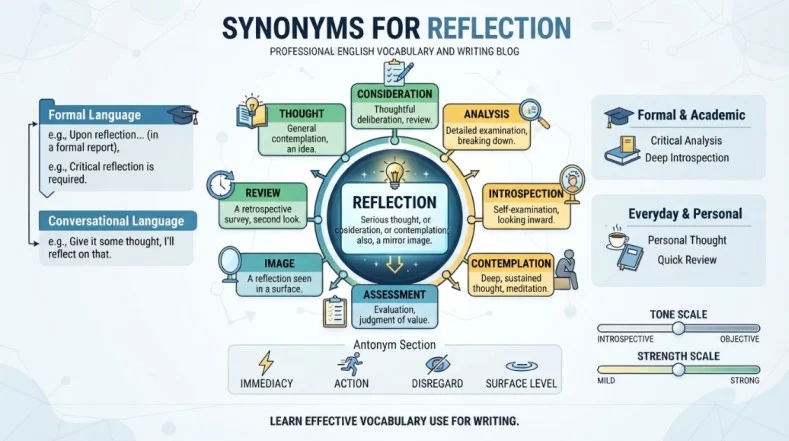
Another Word for “Reflection”
There is no single best replacement for every meaning of “reflection.” The right choice depends on what you are describing.
- For professional writing, “assessment,” “review,” or “analysis” may be more precise.
- For academic writing, “analysis,” “consideration,” or “evaluation” can work well.
- For casual conversation, “thought” is often the most natural choice.
- For emotional writing, “introspection” or “contemplation” can add depth.
- For creative writing, “image,” “mirror image,” or “echo” may be appropriate depending on the intended meaning.
- For resume or workplace use, “assessment,” “review,” or “analysis” can communicate professional evaluation more directly.
- For social media captions, “thought,” “introspection,” and “looking back” can sound natural.
- For a stronger meaning, consider “contemplation” or “introspection.”
- For a softer meaning, “thought” or “consideration” may be better.
When Not to Use “Reflection”
Do not use “reflection” simply because it sounds sophisticated. Choose a more precise word when the context clearly points to a particular meaning.
Instead of:
“Her reflection of the project was useful.”
Use:
“Her assessment of the project was useful.”
“Assessment” makes the evaluative meaning clearer.
If you mean a mirror image, “reflection” is usually appropriate. However, “image” may be clearer when the visual appearance matters more than the mirrored effect.
If you mean casual thinking, “thought” can sound more natural than “reflection.”
If you mean detailed intellectual examination, “analysis” may be more precise.
Words Commonly Confused With “Reflection”
Reflection vs. Thought
“Thought” is broader and more ordinary. “Reflection” usually suggests deliberate consideration.
Use “thought” for everyday ideas and “reflection” when the thinking involves looking back or considering something carefully.
Reflection vs. Introspection
“Introspection” specifically involves examining your own thoughts, feelings, or motives.
“Reflection” can be personal, but it can also refer to an external topic, object, or experience.
Reflection vs. Analysis
“Analysis” involves examining something systematically to understand its parts, meaning, or significance.
“Reflection” is often more personal and interpretive.
Reflection vs. Review
A “review” usually involves looking over something, often to evaluate it or summarize it.
“Reflection” more strongly suggests personal consideration or insight.
Reflection vs. Contemplation
“Contemplation” suggests sustained and serious thought.
“Reflection” is broader and can describe either a brief consideration or a deeper process.
Reflection vs. Image
“Image” refers to a visual representation.
“Reflection” specifically suggests an image produced by a surface, such as a mirror, window, or pool of water.
Best Synonym by Context for “Reflection”
| Context | Best Synonym | Why It Works | Example |
|---|---|---|---|
| Formal writing | Consideration | Sounds polished without being overly complex | The decision followed careful consideration. |
| Academic writing | Analysis | Emphasizes examination and interpretation | Her analysis of the results revealed a clear pattern. |
| Professional use | Assessment | Communicates structured evaluation | The manager completed an assessment of the process. |
| Resume | Evaluation | Shows the ability to examine results or performance | Conducted an evaluation of customer feedback. |
| Casual conversation | Thought | Natural and easy to understand | After some thought, I changed my mind. |
| Creative writing | Image | Works well for visual descriptions | A beautiful image appeared on the surface of the lake. |
| Emotional writing | Introspection | Highlights examination of personal feelings | The experience encouraged deep introspection. |
| Strong intensity | Contemplation | Suggests sustained and serious thought | Years of contemplation shaped his decision. |
| Mild or moderate tone | Thought | Keeps the expression simple | I gave it some thought before responding. |
| Social media | Looking back | Sounds natural and conversational | Looking back, I appreciate the journey even more. |
| Photography | Mirror image | Clearly describes the visual effect | The lake created a mirror image of the mountains. |
| Workplace review | Review | Fits a practical examination of work | The project review identified several improvements. |
| Personal growth | Self examination | Emphasizes personal evaluation | Self examination helped her understand the mistake. |
| Literature | Meditation | Can suggest deep, sustained thought | The poem becomes a meditation on loss. |
| Light or sound | Rebound | Describes physical return in appropriate contexts | The signal can rebound from the surface. |
Which Synonym Should You Choose?
Start by identifying what “reflection” means in your sentence.
- If you mean ordinary thinking, choose “thought.”
- If you mean careful consideration, choose “consideration.”
- If you mean systematic examination, choose “analysis.”
- If you mean professional judgment, choose “assessment” or “evaluation.”
- If you mean looking inward, choose “introspection.”
- If you mean prolonged serious thought, choose “contemplation.”
- If you mean a visual duplicate, choose “image” or “mirror image.”
- If you mean looking back at an experience, “review” or “looking back” may be more natural.
Also consider formality. A word such as “thought” fits casual communication, while “assessment” and “evaluation” are more common in professional settings.
Real Life Examples of “Reflection” in Sentences
School
“The assignment required a short reflection on what the student learned.”
Workplace
“Her reflection on the presentation helped the team improve its communication strategy.”
Writing
“The author uses reflection to connect the character’s past with her present choices.”
Conversation
“After some reflection, I think your suggestion makes sense.”
Social Media
“Today is a good day for reflection and gratitude.”
Resume
“Completed a detailed reflection and evaluation of project outcomes.”
“I appreciate your reflection on the challenges we faced during the project.”
Storytelling
“His reflection on childhood became the turning point of the story.”
25 Synonyms for “Reflection”
| Synonym | Simple Meaning | Best Used For | Example Sentence |
|---|---|---|---|
| Thought | An idea or process of thinking | Casual and general use | After some thought, Maya accepted the offer. |
| Consideration | Careful thought about something | Formal and professional writing | The proposal deserves careful consideration. |
| Contemplation | Deep and sustained thought | Serious or philosophical writing | Years of contemplation influenced his decision. |
| Introspection | Examination of your own thoughts and feelings | Emotional and personal writing | Introspection helped her understand her reaction. |
| Analysis | Detailed examination of something | Academic and professional writing | His analysis of the report identified several patterns. |
| Evaluation | Careful judgment about value or performance | Workplace and academic contexts | The evaluation showed that the program had improved. |
| Assessment | Judgment based on examination | Professional and educational contexts | The assessment highlighted several areas for improvement. |
| Review | Examination of something previously completed | Work, school, and general use | The project review revealed an important issue. |
| Examination | Careful investigation or consideration | Formal and academic writing | The examination of the evidence raised new questions. |
| Meditation | Deep and sustained consideration | Literary, philosophical, and personal writing | The novel is a meditation on memory and loss. |
| Deliberation | Careful consideration before making a decision | Formal decision making | The committee reached its decision after lengthy deliberation. |
| Intention | A purpose or meaning behind an action | Interpretive contexts | Her actions were a reflection of her good intentions. |
| Insight | A clear understanding gained through thought | Personal, academic, and professional writing | The experience gave him valuable insight into leadership. |
| Awareness | Conscious understanding of something | Personal development and professional writing | Greater awareness helped the team recognize the problem. |
| Self examination | Careful examination of yourself | Personal and emotional writing | Self examination helped him identify his priorities. |
| Retrospection | Looking back on past events | Formal and literary writing | Her retrospection revealed how much her values had changed. |
| Reconsideration | Thinking about something again | Decisions and formal communication | The new evidence led to a reconsideration of the plan. |
| Reviewal | The act of reviewing something | Limited formal use | The document required reviewal before publication. |
| Image | A visual representation | Mirrors, water, glass, and photography | The mountain image appeared clearly in the lake. |
| Mirror image | A reversed visual copy | Visual and descriptive contexts | The still pond created a mirror image of the trees. |
| Echo | Something that repeats or resembles another thing | Literary and figurative writing | Her speech was an echo of ideas discussed earlier. |
| Representation | Something that expresses or depicts another thing | Academic and professional contexts | The result is a representation of changing consumer habits. |
| Manifestation | A visible expression of something | Abstract or formal writing | The artwork became a manifestation of the artist’s memories. |
| Indication | Something that shows or suggests another quality | Formal and analytical contexts | The result was an indication of stronger customer engagement. |
| Expression | A visible or noticeable representation of an idea or feeling | Emotional, artistic, and general writing | Her smile was an expression of genuine relief. |
Note that these words do not all replace “reflection” in every sentence. Some apply specifically to thought, some to visual meaning, and others to figurative representation.
Synonym Groups and Usage Differences
Professional vs. Personal Synonyms
Professional writing often benefits from precise words such as “assessment,” “evaluation,” “review,” and “analysis.”
Personal writing can sound more natural with “thought,” “introspection,” “contemplation,” or “looking back.”
For example, a business report might discuss an “assessment of performance,” while a personal essay might describe “reflection on a difficult experience.”
Formal vs. Conversational Synonyms
Formal writing can use “consideration,” “deliberation,” “examination,” and “evaluation.”
Conversational English usually favors “thought,” “review,” or “looking back.”
The simpler word is often better when the audience does not need technical or academic language.
Academic Synonyms
“Analysis,” “examination,” “consideration,” and “evaluation” are useful in academic writing because they communicate specific intellectual activities.
“Reflection” itself is also common in reflective essays and learning assignments, particularly when students are asked to connect experiences with lessons or personal development.
Professional and Business Synonyms
In business communication, “assessment,” “evaluation,” “review,” and “analysis” can make the intended action clearer.
For example, “project assessment” usually sounds more specific than “project reflection” when discussing measurable performance.
Creative or Literary Synonyms
Creative writing gives you more freedom.
“Contemplation,” “meditation,” “introspection,” “echo,” and “image” can create different emotional or visual effects.
Choose based on whether you want the reader to notice thought, memory, emotion, symbolism, or visual imagery.
Slang or Modern Synonyms
There is no widely accepted slang replacement for “reflection” that works naturally across all contexts.
Casual expressions such as “looking back” can work in conversation and social captions, but they should not automatically replace “reflection” in formal writing.
Strongest vs. Weaker Synonyms
A useful intensity scale for the thought related meaning is:
Mild: thought
Moderate: consideration
Focused: reflection
Strong: contemplation
Deeply personal: introspection
Highly deliberate: deliberation
The scale is contextual rather than absolute. “Introspection,” for example, is not simply a stronger version of “reflection.” It has a more specific inward focus.
Emotional vs. Neutral Synonyms
- For a neutral tone, use “thought,” “review,” “analysis,” or “assessment.”
- For an emotional tone, use “introspection,” “contemplation,” or “meditation.”
- For a visual and neutral meaning, use “image” or “mirror image.”
Antonyms of “Reflection”
“Reflection” does not have one universal opposite because the word has several meanings. The following are contextual opposites, particularly for its thought related meaning.
| Antonym | Meaning | Example Sentence |
|---|---|---|
| Impulsiveness | Acting without careful thought | His impulsiveness caused him to accept the offer immediately. |
| Thoughtlessness | Lack of careful consideration | Thoughtlessness can create unnecessary problems. |
| Rashness | Acting too quickly or carelessly | Her rashness led to a decision she later regretted. |
| Inattention | Failure to notice or consider something | Inattention to detail caused the error. |
| Distraction | A state that prevents focused thought | Constant distraction made it difficult to concentrate. |
| Carelessness | Lack of sufficient attention | Carelessness resulted in several avoidable mistakes. |
| Neglect | Failure to give proper attention | Neglect of the issue allowed it to become more serious. |
| Forgetfulness | Failure to remember | His forgetfulness caused him to miss the appointment. |
| Ignorance | Lack of knowledge or awareness | Ignorance of the rules created confusion. |
| Superficiality | Lack of depth in thought or understanding | The superficiality of the discussion limited its value. |
| Spontaneity | Acting naturally without prior deliberation | Her spontaneity made the conversation lively. |
| Haste | Excessive speed in action or decision making | Haste can lead to poor decisions. |
| Reactivity | Responding quickly without extended consideration | Reactivity can make difficult conversations harder. |
| Avoidance | Deliberately refusing to address something | Avoidance of the problem did not make it disappear. |
| Absorption | Taking in energy rather than returning it | Dark materials can increase the absorption of light. |
Comparison: “Reflection” vs. Similar Words
Reflection vs. Thought
The main difference is depth and intention. “Thought” is broad and everyday, while “reflection” often suggests deliberate consideration.
“Reflection” can sound stronger and more thoughtful. “Thought” is more conversational.
Example with reflection: “Her reflection on the experience changed her perspective.”
Example with thought: “After some thought, she changed her mind.”
Reflection vs. Introspection
“Introspection” specifically focuses on examining your own inner thoughts, feelings, or motives.
It is more specialized than “reflection” and often sounds more formal.
Example with reflection: “His reflection on the event helped him learn from it.”
Example with introspection: “Introspection helped him understand why the event affected him.”
Reflection vs. Analysis
“Analysis” involves systematic examination, while “reflection” can be more personal and interpretive.
“Analysis” is generally more precise for academic or technical evaluation.
Example with reflection: “Her reflection focused on what she learned.”
Example with analysis: “Her analysis focused on the causes of the problem.”
Reflection vs. Consideration
“Consideration” emphasizes giving something careful attention before deciding or responding.
It is often more formal than ordinary “thought.”
Example with reflection: “The experience encouraged reflection.”
Example with consideration: “The proposal requires careful consideration.”
Reflection vs. Contemplation
“Contemplation” suggests sustained, serious thought.
It can therefore sound more formal, philosophical, or deliberate than “reflection.”
Example with reflection: “He spent the evening in reflection.”
Example with contemplation: “She spent months in contemplation before making the decision.”
Reflection vs. Image
“Image” describes a visual representation, while “reflection” specifically suggests an image returned or reproduced by a reflective surface.
Example with reflection: “Her reflection appeared in the mirror.”
Example with image: “The image in the photograph was slightly blurred.”
Common Phrases and Expressions with “Reflection”
1. A moment of reflection
Meaning:
A short period spent thinking carefully about something.
Example sentence:
“After the ceremony, everyone took a moment of reflection.”
2. Upon reflection
Meaning:
After thinking carefully about something.
Example sentence:
“Upon reflection, I realized that the decision was correct.”
3. Deep reflection
Meaning:
Serious and focused thought.
Example sentence:
“The experience led him into deep reflection about his goals.”
4. Self reflection
Meaning:
Careful examination of your own thoughts, behavior, or choices.
Example sentence:
“Regular self reflection can help you recognize patterns in your behavior.”
5. Reflection on the past
Meaning:
Thoughtful consideration of earlier experiences or events.
Example sentence:
“Her reflection on the past helped her appreciate her progress.”
6. A reflection of something
Meaning:
Something that represents or reveals another quality.
Example sentence:
“Strong customer service is a reflection of thoughtful leadership.”
7. In reflection
Meaning:
While thinking carefully about something.
Example sentence:
“In reflection, he understood why the experience had mattered so much.”
8. Reflection in the mirror
Meaning:
The visual image produced by a mirror.
Example sentence:
“She checked her reflection in the mirror before leaving.”
Common Mistakes to Avoid
1. Using “reflection” when a more precise synonym is better
“Reflection” can be broad. If you specifically mean systematic examination, “analysis” may be clearer.
2. Confusing reflection with introspection
Introspection specifically concerns your inner thoughts and feelings. Reflection can concern yourself, other people, events, ideas, or objects.
3. Using a casual synonym in formal writing
Words such as “thought” can be perfectly correct, but formal contexts may require more precise terms such as “consideration,” “assessment,” or “evaluation.”
4. Using an overly dramatic synonym
“Contemplation” may sound too serious when you simply mean that someone thought about something briefly.
Choose the intensity that matches the situation.
5. Repeating “reflection” too often
If an essay uses “reflection” repeatedly, alternate it with accurate words such as “consideration,” “analysis,” “thought,” or “introspection.”
Do not replace every occurrence automatically. Repetition is better than an inaccurate synonym.
6. Choosing the wrong emotional tone
“Introspection” can sound deeply personal, while “assessment” sounds objective and professional.
Match the synonym to the emotional purpose of your sentence.
7. Using overly casual language in academic or professional writing
Expressions such as “looking back” may work well in personal writing but can sound less formal in a research report or business document.
FAQs
What is the best synonym for “reflection”?
The best synonym depends on meaning. “Thought” works for casual use, “analysis” for academic contexts, “assessment” for business, and “introspection” for personal examination.
What is a formal synonym for “reflection”?
“Consideration,” “contemplation,” “analysis,” “evaluation,” and “assessment” can serve as formal alternatives, depending on the intended meaning and context.
What is an informal synonym for “reflection”?
“Thought” is usually the simplest informal alternative. “Looking back” can also work when discussing past experiences in casual conversation.
What is another word for “reflection” in professional writing?
“Assessment,” “evaluation,” “review,” and “analysis” are useful professional alternatives when you want to describe examination, judgment, or consideration.
What is the difference between “reflection” and “introspection”?
Reflection can involve thinking about experiences, ideas, or events. Introspection specifically means examining your own thoughts, feelings, or motives.
What is the opposite of “reflection”?
There is no single opposite for every meaning. For thoughtful consideration, contextual opposites include impulsiveness, thoughtlessness, haste, and superficiality.
Conclusion
“Reflection” can describe thoughtful consideration, self examination, a visual image, or the return of light or sound. Because it has several meanings, the best synonym depends heavily on context.
Use “thought” for everyday language, “consideration” for careful thinking, “analysis” for systematic examination, “assessment” for professional evaluation, and “introspection” for looking inward.
For creative writing, “image,” “echo,” or “meditation” can add a more descriptive or literary quality.
The most useful vocabulary habit is simple: do not choose a synonym merely because it sounds more sophisticated. Choose the word that communicates your exact meaning, appropriate tone, and intended level of formality.
Source verification note: Before publishing definitions as authoritative references, verify them using trusted dictionaries such as Cambridge, Oxford, Merriam Webster, Collins, or Britannica
Discover More Post:
- 25+ Synonyms for God | Meanings, Examples, and Best …
- 25+ Synonyms for Action | Meanings, Examples, and Best …
- 25+ Synonyms for Anxiety | Meanings, Examples, and Best …