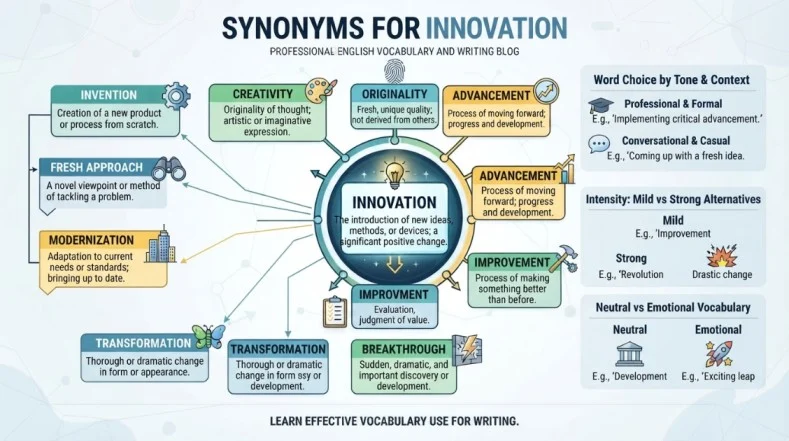
If you keep using the word “innovation” in your essays, emails, presentations, captions, or resume, your writing can start to sound repetitive. Choosing a more precise alternative can make your message clearer, more professional, and more engaging.
The right synonym depends on what you mean. A new product may involve an invention, a major scientific change may be a breakthrough, while a fresh approach may be better described as originality or creativity.
This guide explains synonyms for innovation by meaning, tone, formality, intensity, and context. You will also find practical examples to help you choose the right word instead of simply replacing one word with another.
What Does “Innovation” Mean?
Innovation means introducing a new idea, method, product, process, or improvement that creates useful change. Depending on context, strong alternatives include invention, creativity, originality, advancement, breakthrough, modernization, transformation, and ingenuity.
Meaning, Tone and Context
Simple Definition
Innovation refers to the introduction or practical use of something new or improved. It often involves solving a problem, improving an existing system, or creating a new way to accomplish something.
For example, a company that develops a faster payment system may describe the new system as an innovation.
Part of Speech
“Innovation” is primarily a noun.
Example:
“The company is known for innovation in renewable energy.”
The related adjective is innovative, while the related verb is innovate.
Tone
Innovation generally has a positive or neutral tone.
In business, education, technology, science, and professional communication, it often suggests progress, creativity, improvement, or useful change.
However, the word itself does not automatically mean that something is successful. An innovation can be new without being effective.
Formality Level
“Innovation” is a moderately formal word. It works naturally in:
- Business reports
- Academic writing
- Professional presentations
- Technology discussions
- Resumes
- Marketing
- News writing
- Everyday conversations
For casual conversation, simpler alternatives such as “new idea,” “new approach,” or “fresh idea” may sound more natural.
Common Use Cases
Innovation is commonly used when discussing:
- Technology
- Science
- Business
- Education
- Medicine
- Product development
- Engineering
- Marketing
- Workplace processes
- Creative problem solving
Important Word Forms
Innovation: the new idea, method, product, or improvement.
Innovate: to introduce or develop something new.
Innovative: describing something that uses a new or original approach.
Innovator: a person or organization that introduces new ideas or methods.
Innovatively: in a new or original way.
When and How to Use “Innovation”
Use “innovation” when you are talking about meaningful novelty, especially when a new idea, product, method, or process is introduced or applied.
1. Professional Context
“The company continues to invest in innovation to improve customer service.”
Here, innovation refers to new approaches that can improve business operations.
2. Academic Context
“Technological innovation has changed the way students access educational resources.”
The word works well because the sentence discusses broader developments and their effects.
3. Workplace Context
“Our team developed an innovation that reduced the time required to process customer requests.”
In this example, innovation refers to a practical improvement.
4. Personal Context
“I enjoy working on projects that give me opportunities to explore innovation.”
This usage is possible, although “new ideas” may sound more natural in casual conversation.
5. Creative Context
“The artist brought innovation to a traditional style of painting.”
Innovation emphasizes the artist’s fresh treatment of an established form.
6. Social Media Context
“Celebrating the ideas and innovation behind our newest project.”
This works well for professional social media because it communicates creativity and progress.
7. Resume Context
“Led innovation initiatives that improved workflow efficiency across three departments.”
Here, innovation sounds professional and communicates involvement in organizational improvement.
Another Word for “Innovation”
There is no single replacement that works in every sentence. The best synonym depends on whether you mean a new creation, an improvement, creative thinking, major progress, or a dramatic change.
| Context | Recommended Alternative |
|---|---|
| Professional writing | Advancement |
| Academic writing | Development |
| Casual conversation | New idea |
| Emotional writing | Inspiration |
| Creative writing | Originality |
| Resume or workplace | Improvement |
| Social media captions | Creativity |
| Strong meaning | Breakthrough |
| Softer meaning | Fresh approach |
Professional Writing
Advancement works well when innovation refers to progress in a field, system, or technology.
Academic Writing
Development can be appropriate when discussing a new method, technology, theory, or area of progress.
Casual Conversation
New idea is often more natural than innovation when speaking informally.
Emotional Writing
Inspiration can work when the emphasis is on the creative source behind something new rather than the resulting product or process.
Creative Writing
Originality is useful when you want to emphasize freshness and uniqueness.
Resume or Workplace Use
Improvement is often clearer when the innovation specifically made a process, product, or result better.
Social Media Captions
Creativity gives a warmer and more accessible tone when highlighting fresh thinking.
Stronger Meaning
Breakthrough suggests a significant achievement or discovery that changes what was previously possible.
Softer Meaning
Fresh approach works when the change is useful and new but not necessarily revolutionary.
When Not to Use “Innovation”
“Innovation” can sometimes sound too broad or impressive for a simple change.
For example:
“We introduced an innovation by changing the meeting schedule.”
If the change is simply moving a meeting from Monday to Tuesday, “innovation” sounds unnecessarily grand.
A clearer sentence would be:
“We introduced a new approach to scheduling team meetings.”
Similarly, avoid using innovation when you really mean creativity, invention, improvement, or modernization. These words can communicate more specific ideas.
Precision matters because a synonym should preserve the intended meaning rather than merely sound sophisticated.
Words Commonly Confused With “Innovation”
Innovation vs. Invention
An invention is something newly created. Innovation often involves introducing, applying, or improving an idea in a useful way.
A new device can be an invention. Using that device to solve a practical problem in a new market can involve innovation.
Innovation vs. Creativity
Creativity is the ability to generate original ideas. Innovation usually involves putting a new idea into practical use.
A person can be highly creative without producing a practical innovation.
Innovation vs. Improvement
Improvement means making something better. Innovation usually emphasizes novelty as well as useful change.
Replacing a slow process with a faster version may be an improvement. Developing an entirely new process may be considered innovation.
Innovation vs. Advancement
Advancement focuses on progress or development. Innovation emphasizes something new or newly applied.
A technology can advance gradually without every step being described as an innovation.
Innovation vs. Breakthrough
A breakthrough is usually a major development that produces a significant change or solves a difficult problem.
Innovation is broader. It can describe both modest and major changes.
Innovation vs. Modernization
Modernization means updating something to make it more current or suitable for modern conditions.
Innovation can create something genuinely new, while modernization may simply update an existing system.
Best Synonym by Context for “Innovation”
| Context | Best Synonym | Why It Works | Example |
|---|---|---|---|
| Formal writing | Advancement | Sounds precise and professional when discussing progress | The advancement transformed the industry. |
| Academic writing | Development | Fits research, technology, and evolving ideas | The development changed research methods. |
| Professional or business use | Improvement | Clearly communicates practical value | The improvement reduced processing time. |
| Resume | Initiative | Highlights proactive involvement in creating change | Led a major process improvement initiative. |
| Casual conversation | New idea | Simple and natural | She came up with a new idea for the project. |
| Creative writing | Originality | Highlights uniqueness and fresh thinking | The writer’s originality made the story memorable. |
| Emotional tone | Inspiration | Connects new ideas with creative motivation | Her work became a source of inspiration. |
| Strong intensity | Breakthrough | Suggests major and important progress | The discovery represented a scientific breakthrough. |
| Mild or moderate tone | Fresh approach | Communicates novelty without exaggeration | We need a fresh approach to the problem. |
| Social media captions | Creativity | Friendly and accessible | Celebrating creativity and fresh thinking today. |
| Technology | Advancement | Commonly describes progress in technology | Recent technological advancements are changing communication. |
| Product development | Invention | Useful when a genuinely new product has been created | The invention opened a new market. |
| Organizational change | Transformation | Emphasizes substantial change | The company underwent a digital transformation. |
| Updating systems | Modernization | Specifically communicates bringing something up to date | The modernization improved the public website. |
| New methods | Approach | Focuses on how something is done | The team introduced a new approach to training. |
Which Synonym Should You Choose?
Start by identifying what you actually mean by innovation.
- If you mean creating something that did not exist before, consider invention.
- If you mean generating fresh ideas, choose creativity or originality.
- If you mean making something better, use improvement.
- If you mean major progress, consider advancement.
- If you mean a significant achievement that changes the situation, breakthrough may be more precise.
- If you mean bringing an older system up to date, choose modernization.
- If you mean a major and wide ranging change, transformation may communicate the scale more clearly.
Also consider formality. “New idea” sounds conversational, while “advancement” and “development” fit professional and academic contexts more naturally.
Finally, consider emotional intensity. “Fresh approach” is relatively mild, while “breakthrough” carries much stronger significance.
Real Life Examples of “Innovation” in Sentences
School
“The science project encouraged students to think about innovation and practical problem solving.”
Workplace
“The company rewards employees who suggest innovation that improves everyday operations.”
Writing
“The article examines how innovation has influenced modern communication.”
Conversation
“I really admire the innovation behind this new app.”
Social Media
“Proud to share the creativity and innovation behind our latest project.”
Resume
“Supported innovation projects that improved internal communication and workflow.”
“Our team is exploring innovation opportunities that could make the customer experience simpler.”
Storytelling
“Years of experimentation eventually led to an innovation that changed the way the village stored water.”
25 Synonyms for “Innovation”
| Synonym | Simple Meaning | Best Used For | Example Sentence |
|---|---|---|---|
| Invention | Something newly created | New products, devices, methods | The invention changed how farmers monitored crops. |
| Creativity | Ability to produce fresh ideas | Arts, problem solving, marketing | Her creativity helped the team develop a memorable campaign. |
| Originality | Quality of being new and distinctive | Writing, design, art, ideas | The originality of his concept attracted attention. |
| Ingenuity | Cleverness in solving problems | Engineering, practical solutions | Her ingenuity helped the team repair the equipment with limited resources. |
| Novelty | Newness or unfamiliarity | New concepts, products, experiences | The novelty of the design attracted early customers. |
| Advancement | Progress toward a better or more developed state | Science, technology, business | The advancement improved the accuracy of the system. |
| Development | Growth or creation of something new | Research, technology, products | The development of the software took several months. |
| Improvement | A change that makes something better | Processes, services, performance | The improvement made the checkout process faster. |
| Breakthrough | Major progress or achievement | Science, technology, research | Researchers announced a breakthrough in battery performance. |
| Progress | Movement toward a better or more advanced state | General professional and academic use | The project has made significant progress this year. |
| Transformation | A substantial change in form or function | Organizations, technology, society | Digital transformation changed how the company served customers. |
| Modernization | Updating something for current needs | Systems, infrastructure, institutions | The modernization of the library improved access to digital resources. |
| Reform | A change intended to improve a system | Government, education, organizations | The reform introduced a more efficient approval process. |
| Revolution | A dramatic and far reaching change | Technology, culture, industry | Smartphones created a revolution in personal communication. |
| Evolution | Gradual development or change | Products, ideas, systems | The platform’s evolution reflects changing customer expectations. |
| Discovery | Finding something previously unknown | Science, research, exploration | The discovery opened a new area of research. |
| Creation | The act of making something new | Art, products, ideas | The creation of the platform required years of development. |
| Renewal | The process of making something fresh or active again | Organizations, traditions, communities | The renewal of the program attracted new participants. |
| Reinvention | Creating a new version or approach | Brands, careers, organizations | The company’s reinvention helped it reach a younger audience. |
| Pioneering | Introducing an approach before others | Technology, science, business | The company took a pioneering approach to sustainable packaging. |
| Enterprise | A purposeful and energetic project or undertaking | Business and ambitious projects | The new enterprise brought several creative ideas to market. |
| Initiative | A planned action intended to achieve a result | Workplace, organizations, projects | The team launched an initiative to improve customer support. |
| Ingenuity | Clever and inventive problem solving | Technical and practical contexts | The engineer’s ingenuity solved a difficult design problem. |
| Newness | The quality of being new | General descriptions of fresh concepts | The newness of the concept made it difficult to evaluate immediately. |
| Freshness | A quality suggesting something new or different | Creative and conversational writing | The freshness of the campaign made the brand feel more current. |
Editing note: “Ingenuity” appears twice in the source vocabulary because it is especially useful for innovation, but for a published version where every table entry must be unique, retain only one occurrence. The 25 unique choices are obtained by removing the duplicate occurrence.
Synonym Groups and Usage Differences
Professional vs. Personal Synonyms
Professional writing often benefits from precise terms such as advancement, development, improvement, initiative, modernization, and transformation.
Personal writing can use warmer expressions such as creativity, inspiration, fresh thinking, or new idea.
For example, a resume might say:
“Led process improvement initiatives.”
A personal reflection might say:
“I was inspired by the creativity behind the project.”
Formal vs. Conversational Synonyms
Formal writing generally favors advancement, development, innovation, transformation, modernization, and reform.
Conversational English usually sounds more natural with new idea, fresh approach, creativity, or new way.
Compare:
“The organization adopted a new approach to employee training.”
with:
“They found a new way to train employees.”
Both are correct, but the second is more conversational.
Academic Synonyms
Academic writing benefits from precise words that identify the type of change being discussed.
Useful choices include development, advancement, discovery, evolution, improvement, and breakthrough.
Avoid replacing innovation with a dramatic term such as revolution unless the evidence supports a very substantial change.
Professional and Business Synonyms
Business writing often needs language that communicates measurable value.
Improvement works when something became better.
Transformation works when the change was extensive.
Advancement works when discussing progress.
Initiative works when describing an organized effort.
Modernization works when updating an existing system.
Creative or Literary Synonyms
Creative writing gives you more freedom to emphasize mood and originality.
Words such as originality, creativity, inspiration, freshness, reinvention, and discovery can create different effects.
For example:
“The originality of her voice gave the familiar story a new energy.”
This feels more expressive than simply saying:
“Her innovation improved the story.”
Slang or Modern Synonyms
Innovation does not have many direct slang equivalents.
Expressions such as fresh idea, fresh thinking, new way, and game changer may appear in casual or marketing language.
“Game changer” is especially informal and promotional. It should be used carefully in academic writing and formal professional documents because it can sound exaggerated.
Strongest vs. Weaker Synonyms
A practical intensity scale can look like this:
Newness → Fresh approach → Improvement → Development → Advancement → Transformation → Breakthrough → Revolution
This is not a strict dictionary scale. The words emphasize different aspects of change.
“Fresh approach” suggests a modest change in method.
“Breakthrough” suggests important progress.
“Revolution” suggests extremely broad or dramatic change.
Emotional vs. Neutral Synonyms
More neutral choices include development, advancement, improvement, modernization, and progress.
More expressive choices include inspiration, creativity, originality, reinvention, and revolution.
Choose neutral language for reports and factual explanations. Use expressive language when the emotional or creative effect matters.
Antonyms of “Innovation”
Because innovation describes newness and useful change, its opposite can vary by context. The following words represent different forms of resistance to change, lack of progress, or preference for established methods.
| Antonym | Meaning | Example Sentence |
|---|---|---|
| Tradition | Established customs or practices | The organization continued to follow tradition. |
| Stagnation | Lack of development or progress | Years of stagnation limited the company’s growth. |
| Status quo | Existing state of affairs | The committee decided to maintain the status quo. |
| Convention | An established way of doing something | The industry relied heavily on convention. |
| Conformity | Following established standards or expectations | Excessive conformity can discourage fresh thinking. |
| Imitation | Copying an existing model | The product offered imitation rather than originality. |
| Rigidity | Inability or unwillingness to change | Organizational rigidity made adaptation difficult. |
| Resistance | Opposition to change | Resistance slowed the introduction of the new system. |
| Inactivity | Lack of action | Inactivity prevented the project from developing. |
| Regression | Movement toward an earlier or less developed state | The policy change resulted in regression rather than progress. |
| Decline | A reduction in quality, strength, or performance | The company experienced a decline in productivity. |
| Deterioration | Becoming worse over time | Lack of investment led to the deterioration of the infrastructure. |
| Preservation | Keeping something in its existing condition | Preservation was prioritized over modernization. |
| Routine | Regular and repeated behavior | The team became comfortable with routine. |
| Conventionality | Dependence on established ideas or methods | The design lacked originality because of its conventionality. |
Comparison: Innovation vs. Similar Words
Innovation vs. Invention
Main difference: Invention focuses on creating something new. Innovation can include applying, improving, or successfully introducing a new idea.
Stronger: Neither is automatically stronger. The context determines significance.
More formal: Both work well in formal writing.
Example: “The invention created a new device.”
“Innovation made the device practical for everyday users.”
Innovation vs. Creativity
Main difference: Creativity is the generation of original ideas, while innovation usually involves implementing or applying new ideas.
Stronger: Innovation often implies practical impact.
More formal: Innovation is generally more suitable for business and organizational discussions.
Example: “Her creativity produced several original concepts.”
“The company turned those concepts into practical innovations.”
Innovation vs. Improvement
Main difference: Improvement means making something better. Innovation adds an element of novelty or a new approach.
Stronger: Innovation generally suggests greater novelty.
More formal: Both are appropriate in professional writing.
Example: “The improvement reduced delivery times.”
“The innovation introduced a completely new delivery process.”
Innovation vs. Advancement
Main difference: Advancement emphasizes progress, while innovation emphasizes new ideas or methods.
Stronger: Advancement can describe gradual progress, while innovation can describe a new approach.
More formal: Both are formal enough for academic and professional use.
Example: “The advancement improved data processing.”
“The innovation introduced a new way to process the data.”
Innovation vs. Breakthrough
Main difference: Breakthrough suggests a significant achievement or major step forward.
Stronger: Breakthrough is usually more intense.
More formal: Both work in formal writing.
Example: “The team introduced an innovation in battery design.”
“The new material represented a breakthrough in battery technology.”
Innovation vs. Modernization
Main difference: Modernization means updating something to meet current standards or needs. Innovation can involve creating something entirely new.
Stronger: Innovation generally emphasizes novelty more strongly.
More formal: Both are appropriate for professional and academic contexts.
Example: “The modernization of the system improved security.”
“The company introduced an innovation that changed how the system operated.”
Common Phrases and Expressions with “Innovation”
1. Innovation in Technology
Meaning:
New ideas, methods, products, or improvements within technology.
Example sentence:
“Innovation in technology continues to influence how people work and communicate.”
2. Innovation in Business
Meaning:
New approaches that help organizations create value, solve problems, or improve operations.
Example sentence:
“Innovation in business often requires understanding changing customer needs.”
3. Drive Innovation
Meaning:
To actively encourage or cause new ideas and improvements.
Example sentence:
“Strong leadership can help drive innovation across an organization.”
4. Foster Innovation
Meaning:
To create conditions that encourage new ideas and experimentation.
Example sentence:
“The company created an environment designed to foster innovation.”
5. Encourage Innovation
Meaning:
To support people or teams in developing new ideas.
Example sentence:
“Managers should encourage innovation while maintaining clear project goals.”
6. Innovation Strategy
Meaning:
A planned approach for developing and applying new ideas.
Example sentence:
“The company updated its innovation strategy after reviewing customer feedback.”
7. Innovation in Education
Meaning:
New methods, technologies, or approaches used to improve learning.
Example sentence:
“Innovation in education can give students more flexible ways to learn.”
8. Innovation and Creativity
Meaning:
A phrase connecting the generation of original ideas with their practical development or application.
Example sentence:
“The workshop focused on innovation and creativity in product design.”
Common Mistakes to Avoid
1. Using Innovation When a More Precise Word Is Better
Do not call every small change an innovation.
Instead of:
“The company made an innovation to its meeting schedule.”
Try:
“The company made an improvement to its meeting schedule.”
2. Confusing Innovation With Invention
An invention is something created for the first time. Innovation can involve improving or applying an existing idea in a new way.
3. Using a Casual Synonym in Formal Writing
Words such as “cool idea” or “new trick” may sound inappropriate in academic or professional communication.
Use approach, development, advancement, or improvement instead when appropriate.
4. Using an Overly Dramatic Synonym
Calling a minor software update a “revolution” can make your writing sound exaggerated.
Choose improvement or update when the change is relatively small.
5. Repeating Innovation Too Often
If “innovation” appears several times in the same paragraph, replace some occurrences with precise alternatives such as advancement, development, creativity, improvement, or new approach.
6. Choosing the Wrong Emotional Tone
“Breakthrough” creates more excitement than “development.”
If you are writing a neutral report, avoid dramatic words unless they accurately describe the scale of the achievement.
7. Using Slang in Academic or Professional Writing
Expressions such as “game changer” may work in marketing or casual social media content, but they can sound overly promotional in academic writing.
FAQs
What is the best synonym for innovation?
The best synonym depends on meaning. Use invention for something newly created, improvement for better performance, and breakthrough for major progress.
What is a formal synonym for innovation?
Advancement, development, modernization, transformation, and improvement can serve as formal alternatives when they accurately describe the type of change.
What is an informal synonym for innovation?
In casual English, “new idea,” “fresh approach,” “new way,” and “creative idea” often sound more natural than the formal word innovation.
What is another word for innovation in professional writing?
Professional alternatives include advancement, improvement, development, initiative, modernization, and transformation, depending on the specific type and scale of change.
What is the difference between innovation and invention?
Invention focuses on creating something new, while innovation can involve applying, improving, or introducing an idea in a useful and practical way.
What is the opposite of innovation?
Common contextual opposites include stagnation, conformity, tradition, rigidity, resistance, conventionality, and status quo, depending on the sentence.
Conclusion
Innovation means introducing or applying a new idea, method, product, or improvement that creates useful change. However, the word you choose should reflect the exact meaning you want to communicate.
Use invention for something newly created, creativity for original thinking, improvement for making something better, advancement for progress, and breakthrough for major achievements.
For professional writing, precise vocabulary is usually more effective than simply choosing the most impressive sounding word. Think about the scale of the change, the level of formality, and whether you are emphasizing novelty, creativity, progress, or practical results.
When choosing synonyms for innovation, ask yourself one simple question: What exactly is new, and what changed because of it? That answer will usually lead you to the most accurate word.
Discover More Post:
- 25+ Synonyms for God | Meanings, Examples, and Best …
- 25+ Synonyms for Action | Meanings, Examples, and Best …
- 25+ Synonyms for Anxiety | Meanings, Examples, and Best …