The word “communicate” appears everywhere. You may use it in an email, resume, essay, workplace message, social media caption, or everyday conversation. Repeating the same word can make otherwise strong writing feel predictable.
Finding the right alternative is not simply about replacing one word with another. The best synonym depends on what you mean, who you are addressing, and how formal or emotional your message needs to sound. This guide explains synonyms for communicate with practical examples so you can choose words that fit the situation naturally.
What Does “Communicate” Mean?
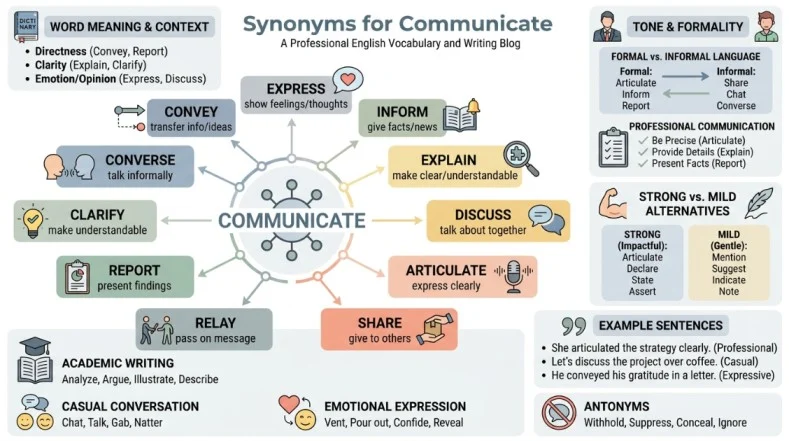
To communicate means to share information, thoughts, feelings, or ideas with another person or group. Depending on context, useful alternatives include convey, express, explain, discuss, inform, relay, articulate, and correspond.
Meaning, Tone and Context
Simple Definition
Communicate means to give or exchange information, ideas, thoughts, or feelings with another person or group.
Communication can happen through speech, writing, gestures, facial expressions, signs, images, or other methods.
Part of Speech
Communicate is primarily a verb.
Examples include:
“Please communicate the changes to the team.”
“She communicates clearly with her students.”
Tone
The word communicate is generally neutral. It does not automatically sound positive or negative.
Its tone depends on the surrounding sentence and situation.
Formality Level
Communicate works in both formal and casual English. It is especially common in professional, academic, business, and workplace writing.
In casual conversation, people may choose simpler words such as tell, talk, share, or explain.
Common Use Cases
You can use communicate when discussing:
- Sharing information
- Expressing feelings
- Explaining ideas
- Giving instructions
- Talking with others
- Workplace collaboration
- Academic discussion
- Written correspondence
- Nonverbal signals
- Public announcements
Important Word Forms
Communicate: verb
Communication: noun
Communicator: noun
Communicative: adjective
Communicated: past tense and past participle
Communicating: present participle
Example:
“Her communication skills helped the team work more effectively.”
When and How to Use “Communicate”
Use communicate when you want to emphasize the process of sharing information, thoughts, feelings, or meaning.
1. Professional
“Employees should communicate project updates clearly and promptly.”
2. Personal
“I find it easier to communicate my feelings when I have time to think.”
3. Academic
“Students must communicate their arguments clearly in the final essay.”
4. Emotional
“She struggled to communicate how deeply the situation had affected her.”
5. Creative
“The character communicates fear through silence rather than dialogue.”
6. Social Media
“Good creators communicate their ideas in ways that are easy to understand.”
7. Email
“Please communicate any scheduling changes before Friday.”
Another Word for “Communicate”
The best single replacement depends on the exact meaning.
- If you mean share information, use convey or inform.
- If you mean express an idea, use express or articulate.
- If you mean explain something, use clarify or explain.
- If you mean talk with someone, use converse or discuss.
Here are useful choices by situation:
| Situation | Strong Alternative |
|---|---|
| Professional writing | Convey |
| Academic writing | Articulate |
| Casual conversation | Talk |
| Emotional writing | Express |
| Creative writing | Portray |
| Resume or workplace use | Collaborate |
| Social media captions | Share |
| Stronger meaning | Articulate |
| Softer meaning | Share |
When Not to Use “Communicate”
Communicate can sometimes sound too broad when a more specific verb would tell the reader exactly what happened.
For example:
“We communicated the problem to the manager.”
This is correct, but “reported” may be more precise if you formally gave the manager information about a problem.
“We reported the problem to the manager.”
Similarly, “communicate” may be unnecessarily formal in casual conversation.
Instead of:
“I need to communicate something with you.”
A natural casual choice is:
“I need to talk to you about something.”
Use the more specific word when the action matters.
Words Commonly Confused With “Communicate”
Communicate vs. Convey
Communicate is broader. Convey focuses on successfully carrying an idea, feeling, or meaning to another person.
“Good leaders communicate with their teams.”
“Her expression conveyed disappointment.”
Communicate vs. Express
Express usually focuses on showing or stating thoughts, opinions, or emotions.
Communicate can involve a wider exchange of information.
“She communicated the instructions clearly.”
“She expressed her frustration.”
Communicate vs. Inform
Inform means giving someone information.
Communicate can involve both giving and receiving information.
“The manager informed employees about the change.”
“The manager communicated with employees throughout the transition.”
Communicate vs. Discuss
Discuss means talking about a particular subject with another person or group.
Communicate is broader and does not necessarily require a discussion.
“We discussed the proposal.”
“We communicated the project requirements.”
Communicate vs. Explain
Explain means making something understandable by providing details or clarification.
Communicate can simply mean sharing information.
“She explained the process.”
“She communicated the deadline.”
Communicate vs. Correspond
Correspond often refers to exchanging written messages, especially letters or emails.
“We corresponded by email for several months.”
“We communicated regularly about the project.”
Best Synonym by Context for “Communicate”
| Context | Best Synonym | Why It Works | Example |
|---|---|---|---|
| Formal writing | Convey | Sounds polished and precise | The report conveys the main findings clearly. |
| Academic writing | Articulate | Emphasizes clear expression of ideas | Students should articulate their arguments carefully. |
| Professional use | Inform | Clearly focuses on providing information | Please inform the team about the schedule change. |
| Business use | Liaise | Emphasizes coordination between people or groups | She will liaise with the client during the project. |
| Resume | Collaborate | Highlights productive interaction | Collaborated with designers to improve client communication. |
| Casual conversation | Talk | Natural and familiar | I need to talk with you later. |
| Creative writing | Portray | Shows how meaning or emotion is represented | The novel portrays grief through subtle details. |
| Emotional tone | Express | Works well for feelings and opinions | He expressed his concerns calmly. |
| Strong intensity | Articulate | Suggests precise and effective expression | She articulated a compelling argument. |
| Soft or moderate tone | Share | Sounds friendly and approachable | I wanted to share an idea with you. |
| Social media | Share | Fits everyday digital communication | She shared her thoughts in a short video. |
| Written exchange | Correspond | Refers naturally to ongoing written contact | The two researchers corresponded for years. |
| Instructions | Explain | Makes the information easier to understand | The trainer explained the new procedure. |
| Announcement | Announce | Clearly signals public or formal information | The company announced its new policy. |
| Problem or issue | Report | Indicates that information about a situation was given | Employees should report safety concerns promptly. |
| Information transfer | Relay | Emphasizes passing information to another person | Please relay the message to the supervisor. |
| Nonverbal meaning | Signal | Works for gestures, signs, and indications | Her expression signaled concern. |
| Conversation | Converse | Refers to verbal interaction | They conversed about the new proposal. |
| Group interaction | Engage | Highlights active involvement | The speaker engaged the audience effectively. |
| US and UK usage | Communicate | Common and natural in both varieties | Teams must communicate clearly across departments. |
Which Synonym Should You Choose?
Start by identifying what is actually being communicated.
- If you are sharing general information, choose inform, share, or convey.
- If you are explaining an idea, choose explain, clarify, or articulate.
- If you are discussing feelings, choose express, voice, or share.
- If you are talking about a business relationship, liaise, correspond, or collaborate may be more precise.
Next, consider formality.
Words such as talk and share are natural in casual settings. Words such as articulate, convey, and correspond are more suitable for formal or professional contexts.
Finally, consider emotional intensity.
Express can highlight emotion. Articulate suggests precision. Convey often focuses on meaning. Share can sound warmer and more personal.
Real Life Examples of “Communicate” in Sentences
School
“Students need to communicate their ideas clearly during group discussions.”
Workplace
“Managers should communicate expectations before assigning major projects.”
Writing
“The author communicates a strong message through simple language.”
Conversation
“Good friends communicate openly when something feels wrong.”
Social Media
“Visual content can communicate an idea faster than a long caption.”
Resume
“Communicated project updates to internal teams and external partners.”
“I am writing to communicate an important change to the meeting schedule.”
Storytelling
“The character communicates loneliness through silence and body language.”
25 Synonyms for “Communicate”
| Synonym | Simple Meaning | Best Used For | Example Sentence |
|---|---|---|---|
| Convey | To communicate meaning or information | Formal and professional writing | The chart conveys the main trend clearly. |
| Express | To show thoughts or feelings | Emotional and personal writing | She expressed her concerns respectfully. |
| Articulate | To express something clearly and effectively | Academic and professional contexts | He articulated his position with confidence. |
| Inform | To give someone information | Business and formal communication | Please inform the staff about the update. |
| Explain | To make something easier to understand | Instructions and teaching | The professor explained the concept clearly. |
| Discuss | To talk about a subject | Academic and professional settings | We discussed the proposed changes. |
| Tell | To give information through speech or writing | Everyday conversation | Please tell me what happened. |
| Share | To give information, thoughts, or feelings to others | Casual and personal contexts | She shared her concerns with her friend. |
| Relay | To pass information from one person to another | Workplace and practical communication | I will relay your message to the director. |
| Report | To provide information about an event or situation | Professional and official contexts | The employee reported the issue immediately. |
| Announce | To make information known publicly | News and public communication | The company announced its expansion plans. |
| State | To express something clearly and directly | Formal and academic writing | The report states the main objective. |
| Disclose | To reveal information | Legal, financial, and formal contexts | The company disclosed the relevant financial information. |
| Notify | To officially tell someone about something | Administrative and professional writing | We notified customers about the policy change. |
| Correspond | To exchange written communication | Emails and letters | The researchers corresponded throughout the study. |
| Converse | To talk with another person | Formal or literary descriptions of conversation | The guests conversed quietly after dinner. |
| Liaise | To communicate for coordination | Business and organizational settings | She liaises with several departments. |
| Collaborate | To work and communicate together | Workplace and project settings | The teams collaborated on the new campaign. |
| Engage | To communicate or interact actively | Professional, educational, and social contexts | The teacher engaged students in discussion. |
| Address | To communicate about a particular issue | Professional and formal contexts | The manager addressed employee concerns. |
| Clarify | To make meaning easier to understand | Workplace, academic, and personal communication | Could you clarify the final requirement? |
| Voice | To express an opinion or concern | Emotional and professional contexts | Several employees voiced their concerns. |
| Signal | To communicate through an indication or sign | Nonverbal communication | The warning light signaled a problem. |
| Portray | To communicate an idea through representation | Creative and literary writing | The film portrays the character as deeply conflicted. |
| Present | To communicate information to an audience | Academic and professional settings | She presented the findings to the committee. |
Synonym Groups and Usage Differences
Professional vs. Personal Synonyms
Professional communication often benefits from precise words such as convey, inform, articulate, report, clarify, notify, and liaise.
Personal communication is usually more natural with words such as talk, share, tell, express, and discuss.
Compare these examples:
“Please inform the department about the change.”
“I wanted to tell you about the change.”
Both communicate the same basic idea, but the second sounds more personal.
Formal vs. Conversational Synonyms
Formal writing often favors convey, articulate, disclose, correspond, notify, and state.
Conversational English commonly uses talk, tell, share, explain, and discuss.
Choose the word that matches your audience rather than automatically choosing the most sophisticated vocabulary.
Academic Synonyms
Academic writing benefits from precise verbs.
Articulate works well when discussing arguments.
Present works well for research findings.
Explain works well when describing concepts.
State works well for clearly presenting a position or conclusion.
For example:
“The researcher articulates a clear argument about language development.”
Professional and Business Synonyms
Business writing often requires clarity and accuracy.
Use inform when giving information, notify for official notice, report for an issue or event, relay for passing information, and liaise for coordination.
Use collaborate when the focus is on working together toward a shared goal.
Creative or Literary Synonyms
Creative writing can use words that communicate more than direct speech.
Portray can describe how a story represents a person or emotion.
Signal can describe a gesture or visual clue.
Express can highlight emotion.
Convey can describe an underlying message or mood.
For example:
“The quiet setting conveys a sense of isolation.”
Slang or Modern Synonyms
There is no single slang word that replaces communicate in every situation.
Casual expressions such as talk, chat, text, and reach out may work depending on context.
“Let’s chat about the project” sounds relaxed.
“Let’s communicate about the project” sounds unnecessarily formal in everyday speech.
Avoid casual expressions in academic essays and formal business documents unless the context specifically calls for them.
Strongest vs. Weaker Synonyms
There is no universal intensity ranking because each synonym emphasizes a different aspect of communication. Still, this practical scale can help:
Share: gentle and approachable
Tell: direct and ordinary
Inform: clear and factual
Convey: purposeful and polished
Express: personal or emotional
Articulate: highly precise and deliberate
Disclose: strong when revealing previously private information
The strongest choice depends on what you want the reader to notice.
Emotional vs. Neutral Synonyms
For neutral communication, use inform, state, report, notify, or communicate.
For emotional communication, use express, voice, share, or convey.
For example:
“The report communicated the results.”
“The speaker expressed her disappointment.”
The second sentence adds an emotional dimension that the first does not.
Antonyms of “Communicate”
Some antonyms depend on the intended meaning of communicate. The following words represent situations involving silence, withholding information, separation, or failure to exchange information.
| Antonym | Meaning | Example Sentence |
|---|---|---|
| Silence | To avoid speaking or providing information | He chose to silence his concerns. |
| Withhold | To keep information from others | The witness withheld important details. |
| Conceal | To deliberately hide information | She concealed the truth from the group. |
| Suppress | To prevent information or expression from being shared | The policy attempted to suppress criticism. |
| Hide | To keep something from being known | He hid the real reason for the decision. |
| Ignore | To deliberately give no response or attention | She ignored the message. |
| Avoid | To stay away from interaction or discussion | He avoided discussing the problem. |
| Isolate | To separate someone from communication or interaction | The situation isolated the employee from the team. |
| Disconnect | To end or prevent a connection | The outage disconnected the teams temporarily. |
| Seclude | To keep apart from other people | The retreat secluded him from outside communication. |
| Mute | To prevent or stop sound or speech | She muted the microphone during the meeting. |
| Obscure | To make information difficult to understand or recognize | The vague wording obscured the main point. |
| Mislead | To communicate in a way that creates a false impression | The advertisement misled customers about the product. |
| Misrepresent | To communicate information inaccurately | The article misrepresented the study results. |
| Disregard | To pay no attention to communication or information | The supervisor disregarded repeated warnings. |
Comparison: “Communicate” vs. Similar Words
Communicate vs. Convey
Communicate covers the broader act of exchanging information.
Convey emphasizes successfully carrying a message, meaning, feeling, or impression to someone.
Communicate is broader.
Convey is often more polished in formal writing.
Communicate: “The manager communicated the new policy.”
Convey: “The manager conveyed the importance of the new policy.”
Communicate vs. Express
Communicate can involve information, instructions, ideas, and feelings.
Express focuses more strongly on putting thoughts, opinions, or emotions into words or another form.
Express is often more emotional.
Communicate: “She communicated the instructions clearly.”
Express: “She expressed her frustration calmly.”
Communicate vs. Inform
Inform specifically means giving someone information.
Communicate can involve a two way exchange.
Inform is more specific when the main action is providing information.
Communicate: “The company communicated with its customers.”
Inform: “The company informed customers about the change.”
Communicate vs. Discuss
Discuss means talking about a specific topic.
Communicate does not necessarily require a conversation about a subject.
Discuss is more specific.
Communicate: “We communicated throughout the project.”
Discuss: “We discussed the budget during the meeting.”
Communicate vs. Explain
Explain focuses on making something understandable.
Communicate can involve simply passing information without providing detailed clarification.
Explain is better when confusion needs to be resolved.
Communicate: “She communicated the deadline.”
Explain: “She explained why the deadline had changed.”
Communicate vs. Talk
Talk is informal and usually refers to spoken conversation.
Communicate is broader because it can include writing, gestures, signs, and other forms of information exchange.
Talk is more conversational.
Communicate: “The organization communicates with customers through email.”
Talk: “I need to talk with you after lunch.”
Common Phrases and Expressions with “Communicate”
1. Communicate clearly
Meaning:
To express information in a way that is easy to understand.
Example sentence:
“Strong leaders communicate clearly during difficult situations.”
2. Communicate effectively
Meaning:
To share information successfully and achieve the intended understanding.
Example sentence:
“Employees need to communicate effectively across different departments.”
3. Communicate with someone
Meaning:
To exchange information with another person.
Example sentence:
“She communicates with clients every morning.”
4. Communicate an idea
Meaning:
To express or explain a thought or concept.
Example sentence:
“The presentation communicates the main idea effectively.”
5. Communicate expectations
Meaning:
To clearly tell people what is expected of them.
Example sentence:
“Managers should communicate expectations before a project begins.”
6. Communicate concerns
Meaning:
To tell someone about worries, problems, or objections.
Example sentence:
“Employees should feel comfortable communicating concerns to their supervisors.”
7. Communicate through writing
Meaning:
To share information by using written language.
Example sentence:
“Some students communicate their strongest ideas through writing.”
Common Mistakes to Avoid
1. Using “Communicate” When a More Precise Word Is Better
“Communicate the problem” is acceptable, but “report the problem” may be more precise in a workplace context.
2. Confusing “Communicate” With “Convey”
Convey focuses on carrying meaning, emotion, or information to someone.
Communicate is broader and can describe the overall exchange.
3. Using Casual Synonyms in Formal Writing
Words such as talk and chat can sound too casual in academic or formal professional writing.
Choose communicate, discuss, convey, articulate, or inform when appropriate.
4. Using an Overly Dramatic Synonym
Disclose suggests revealing information that may have been private or previously unknown.
Do not use disclose when you simply mean tell.
5. Repeating “Communicate” Too Often
Repeating the same verb can make professional writing feel flat.
Replace it with precise alternatives such as inform, explain, report, convey, or articulate when the meaning changes.
6. Choosing the Wrong Emotional Tone
Express can highlight feelings.
Inform is usually factual.
Share can sound warmer.
Choose according to the emotional effect you want.
7. Using Slang in Academic or Professional Writing
Words such as chat may work in a casual message but can weaken the tone of an academic essay or formal report.
FAQs
What is the best synonym for “communicate”?
The best synonym depends on context. Convey works well for formal writing, express for feelings, inform for information, and talk for casual conversation.
What is a formal synonym for “communicate”?
Convey, articulate, inform, disclose, correspond, and liaise can serve as formal alternatives, depending on the specific meaning and sentence.
What is an informal synonym for “communicate”?
Talk, tell, share, chat, and discuss are common informal alternatives. The best choice depends on whether you mean speaking, exchanging ideas, or giving information.
What is another word for “communicate” in professional writing?
Useful professional alternatives include convey, inform, articulate, report, relay, clarify, notify, liaise, and collaborate.
What is the difference between “communicate” and “express”?
Communicate broadly means sharing or exchanging information, ideas, or feelings. Express specifically emphasizes putting thoughts, opinions, or emotions into a form others can understand.
What is the opposite of “communicate”?
There is no single universal opposite. Depending on context, possible opposites include withhold, conceal, silence, ignore, avoid, disconnect, and suppress.
Conclusion
Communicate means to share or exchange information, ideas, thoughts, or feelings. It is a flexible word that works in personal conversations, academic writing, professional communication, emails, resumes, and creative work.
The best synonym depends on your purpose. Choose convey for polished communication, articulate for precise ideas, inform for factual information, express for feelings, explain for clarification, and talk for casual conversation.
The most useful vocabulary habit is to avoid replacing a word simply because you want variety. Instead, identify the exact meaning you want to express and select the synonym that communicates that meaning most accurately.
For dictionary verification before publishing, check definitions and usage with trusted sources such as Cambridge Dictionary, Oxford English Dictionary, Merriam Webster, Collins Dictionary, or Britannica.
Read More Related Articles:
- 25+ Synonyms for Resources | Meanings, Examples, and Best …
- 25+ Synonyms for Secret | Meanings, Examples, and Best …
- 25+ Synonyms for Action | Meanings, Examples, and Best …