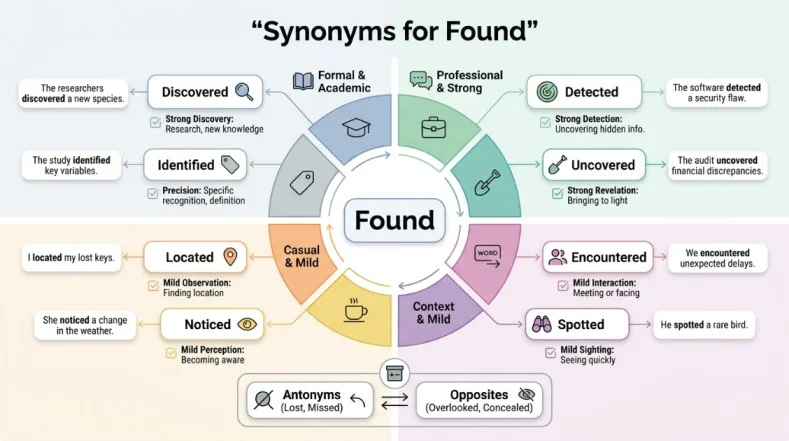
The word found appears everywhere. You might write that you found an important source, found a solution, found a job, found an old photo, or found something interesting online. Repeating the same word can make otherwise strong writing feel predictable.
The best alternative depends on what you mean. Words such as discovered, located, identified, encountered, uncovered, noticed, and detected can add accuracy and variety. This guide explains the differences so you can choose the right word for emails, essays, resumes, conversations, captions, and creative writing.
What Does “Found” Mean?
Found usually means discovered, located, noticed, or encountered something. Formal writing often favors identified or discovered, while casual speech uses came across or spotted. Academic, professional, emotional, and creative contexts may require more precise alternatives.
Meaning, Tone and Context
1. Simple Definition
Found is commonly the past tense and past participle of the verb find. It describes discovering, locating, noticing, or obtaining something.
For example:
I found my keys under the couch.
Here, found means located something that was previously missing.
It can also describe discovering information, ideas, problems, opportunities, or experiences.
The researchers found evidence supporting the theory.
In this sentence, found means discovered or determined through investigation.
2. Part of Speech
Found is primarily a verb form.
The forms of the verb find are:
Find: present form
Found: past tense and past participle
Finding: present participle and gerund
There is also a separate verb found, meaning to establish or create something.
The university was founded in 1890.
This second meaning has a different word family and should not be confused with found as the past tense of find.
3. Tone
The word found is generally neutral.
It does not automatically sound positive or negative. Its meaning depends on what was discovered.
She found a beautiful old photograph.
This sounds positive.
The inspection found several safety problems.
This sounds negative because of the information discovered.
4. Formality Level
Found works comfortably in casual, academic, professional, and formal writing.
Its main limitation is not formality. It is precision.
In some sentences, another word can explain exactly how something was discovered.
For example:
The team found an error.
A more precise version might be:
The team detected an error.
5. Common Use Cases
You can use found when talking about:
- Objects you locate
- Information you discover
- Problems you identify
- People you encounter
- Solutions you discover
- Opportunities you notice
- Places you visit or locate
- Evidence revealed through research
- Feelings or opinions you develop
- Unexpected experiences
When and How to Use “Found”
Use found when you want a simple and natural way to describe discovering, locating, noticing, or encountering something.
It is especially useful when the exact method of discovery does not matter.
Professional
We found several inconsistencies in the quarterly report.
Personal
I found my old college notebook in the closet.
Academic
The study found a significant relationship between the two variables.
Emotional
She found comfort in talking with an old friend.
Creative
At sunset, they found a quiet path through the forest.
Social Media
Found this amazing little bookstore while exploring downtown.
I found the document you requested and attached it here.
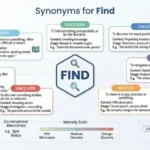
Another Word for “Found”
The best replacement depends on the intended meaning.
| Context | Recommended Word |
|---|---|
| Professional writing | Identified |
| Academic writing | Discovered |
| Casual conversation | Came across |
| Emotional writing | Discovered |
| Creative writing | Uncovered |
| Resume or workplace | Identified |
| Social media | Spotted |
| Stronger discovery | Uncovered |
| Softer observation | Noticed |
- If you simply mean that something was located, located is often the clearest alternative.
- If you mean that new information became known, discovered is usually stronger.
- If something appeared unexpectedly during an activity, encountered or came across may sound more natural.
When Not to Use “Found”
Although found is correct in many situations, it can sometimes be too general.
When a specific discovery matters
Instead of:
The scientist found an unusual pattern.
Use:
The scientist detected an unusual pattern.
Detected emphasizes careful observation or identification.
When you want to emphasize research
Instead of:
Researchers found new evidence.
Use:
Researchers discovered new evidence.
Discovered gives greater emphasis to the process of learning something previously unknown.
When something was revealed
Instead of:
The investigation found hidden records.
Use:
The investigation uncovered hidden records.
Uncovered suggests that something concealed became known.
When something was physically located
Instead of:
The technician found the damaged component.
Use:
The technician located the damaged component.
Located emphasizes physical position.
Words Commonly Confused With “Found”
Found vs. Discovered
Found is broader and can mean simply located or noticed. Discovered usually suggests learning something new or previously unknown.
I found my wallet.
Scientists discovered a new species.
Found vs. Located
Located specifically emphasizes determining where something is.
We located the missing file.
Found can mean the same thing but is more general.
Found vs. Identified
Identified means recognized or determined what something is.
The doctor identified the cause of the problem.
Finding something does not necessarily mean identifying it.
Found vs. Noticed
Noticed emphasizes becoming aware of something.
I noticed a small crack in the window.
You can notice something without actively searching for it.
Found vs. Encountered
Encountered emphasizes coming into contact with something or someone.
We encountered several challenges during the project.
It often works better than found when describing an experience or situation.
Found vs. Obtained
Obtained means acquired or received something.
She obtained permission from the manager.
Something you obtain is not necessarily something you discover.
Best Synonym by Context for “Found”
| Context | Best Synonym | Why It Works | Example |
|---|---|---|---|
| Formal writing | Identified | Sounds precise and professional | The review identified several weaknesses. |
| Academic writing | Discovered | Emphasizes new knowledge | Researchers discovered new evidence. |
| Business use | Identified | Fits reports and analysis | The audit identified several concerns. |
| Resume | Uncovered | Shows useful discovery | Uncovered opportunities to reduce costs. |
| Casual conversation | Came across | Natural in everyday speech | I came across an old picture. |
| Creative writing | Uncovered | Adds a sense of revelation | She uncovered a forgotten letter. |
| Emotional writing | Discovered | Can describe an inner realization | He discovered a new sense of confidence. |
| Strong discovery | Uncovered | Suggests something hidden was revealed | Investigators uncovered the truth. |
| Moderate tone | Noticed | Sounds observational and restrained | She noticed a change in his expression. |
| Social media | Spotted | Short and conversational | Spotted this beautiful mural downtown. |
| Physical location | Located | Clearly indicates position | The team located the missing equipment. |
| Research | Revealed | Emphasizes what evidence shows | The survey revealed a major trend. |
| Investigation | Detected | Suggests careful examination | The system detected an unusual pattern. |
| Unexpected experience | Encountered | Focuses on experience | We encountered several obstacles. |
| New information | Learned | Focuses on gaining knowledge | I learned that the store had moved. |
| Hidden information | Unearthed | Suggests difficult discovery | The archive unearthed valuable records. |
| Something overlooked | Discovered | Highlights later awareness | She discovered an error in the final draft. |
| Positive opportunity | Identified | Useful for business contexts | We identified a promising opportunity. |
| Problem detection | Detected | Strong for technical contexts | Engineers detected a fault. |
| Personal realization | Realized | Describes understanding | He realized that he needed more time. |
Which Synonym Should You Choose?
Start by asking what found actually means in your sentence.
- If you physically located something, choose located.
- If you learned something previously unknown, choose discovered.
- If you recognized what something was, choose identified.
- If you simply became aware of something, choose noticed.
- If something was hidden and became known, choose uncovered or unearthed.
- If you experienced something unexpectedly, choose encountered or came across.
For professional writing, prioritize precision. A specific verb usually communicates more information than the broad word found.
Real Life Examples of “Found” in Sentences
School
I found three reliable sources for my history essay.
A more academic alternative is:
I identified three reliable sources for my history essay.
Workplace
The manager found several errors in the report.
A more professional version is:
The manager identified several errors in the report.
Writing
The editor found a few unclear sentences.
A precise alternative is:
The editor noticed a few unclear sentences.
Conversation
I found your message while checking my inbox.
A natural alternative is:
I came across your message while checking my inbox.
Social Media
Found this beautiful coffee shop while walking around the city.
The conversational word spotted can also work well in a caption.
Resume
I found opportunities to improve customer retention.
A stronger professional version is:
I identified opportunities to improve customer retention.
I found the file you mentioned in your previous message.
A concise professional alternative is:
I located the file you mentioned in your previous message.
Storytelling
She found an old letter tucked inside the wooden box.
A more literary version is:
She uncovered an old letter tucked inside the wooden box.
25 Synonyms for “Found”
The following words cover different meanings of found, so they should not be treated as interchangeable in every sentence.
| Synonym | Simple Meaning | Best Used For | Example Sentence |
|---|---|---|---|
| Discovered | Learned or revealed something new | Research and new information | The researchers discovered an unexpected pattern. |
| Located | Determined where something is | Physical objects and places | The rescue team located the missing hiker. |
| Identified | Recognized what something is | Professional and analytical writing | The analyst identified the main source of the problem. |
| Noticed | Became aware of something | Everyday observation | She noticed a small change in the schedule. |
| Detected | Found through careful observation | Technical and scientific contexts | The sensor detected a sudden increase in pressure. |
| Uncovered | Revealed something hidden | Investigations and discoveries | The journalist uncovered previously unknown details. |
| Revealed | Made something known or visible | Evidence and information | The report revealed a significant trend. |
| Encountered | Came into contact with | Experiences and situations | We encountered several challenges during testing. |
| Spotted | Saw or recognized something | Casual conversation | I spotted your car outside the restaurant. |
| Observed | Saw and paid attention to | Academic and formal contexts | Researchers observed a change in behavior. |
| Unearthed | Discovered something buried or hidden | History and investigation | Archaeologists unearthed ancient artifacts. |
| Learned | Gained knowledge | Information and personal experience | She learned the truth after reviewing the records. |
| Realized | Became aware of a fact | Thoughts and personal understanding | He realized that the deadline had changed. |
| Encountered | Experienced or met unexpectedly | People, problems, and situations | The team encountered unexpected delays. |
| Came across | Discovered unexpectedly | Casual speech and writing | I came across an interesting article yesterday. |
| Ran across | Found unexpectedly | Informal conversation | I ran across an old friend at the store. |
| Detected | Recognized something through examination | Technical contexts | The software detected an unusual login attempt. |
| Recognized | Identified something familiar | People, objects, and ideas | She recognized the author from a previous event. |
| Disclosed | Made information known | Formal and legal contexts | The company disclosed the relevant financial information. |
| Revealed | Brought information into view | Reports and storytelling | The investigation revealed several inconsistencies. |
| Exposed | Brought something hidden to light | Problems and wrongdoing | The investigation exposed serious weaknesses. |
| Discovered | Came to know something | General discovery | He discovered a useful shortcut. |
| Identified | Determined or named something | Business and academic use | The team identified a better approach. |
| Observed | Saw or recorded something | Research and formal writing | The researchers observed a consistent pattern. |
| Sighted | Saw something, often at a distance | People, animals, and objects | The crew sighted land before sunrise. |
Some entries overlap because found has several meanings. For example, located works well for a missing object, while discovered is better for new knowledge.
Synonym Groups and Usage Differences
Professional vs. Personal Synonyms
Professional writing benefits from precise words such as identified, detected, located, revealed, and uncovered.
Personal communication can comfortably use found, noticed, spotted, came across, and ran across.
Compare:
I found an issue with the report.
I identified an issue with the report.
The second version sounds more analytical and workplace appropriate.
Formal vs. Conversational Synonyms
For reports, essays, presentations, and formal emails, consider identified, discovered, detected, revealed, observed, and located.
For texts and casual conversations, found, spotted, came across, and ran across sound natural.
Avoid replacing every instance of found with a more formal word. Natural writing needs variety without sounding forced.
Academic Synonyms
Academic writing often benefits from discovered, identified, detected, observed, revealed, and determined.
For example:
The researchers found a relationship between sleep and concentration.
A more precise academic version is:
The researchers identified a relationship between sleep and concentration.
The right choice depends on whether the researchers observed, calculated, detected, or discovered the relationship.
Professional and Business Synonyms
Workplace communication frequently favors identified, detected, located, uncovered, revealed, and determined.
These verbs can make reports, presentations, evaluations, and resumes more specific.
We found ways to reduce expenses.
A stronger workplace version is:
We identified ways to reduce expenses.
Creative or Literary Synonyms
Creative writing can use uncovered, unearthed, encountered, discovered, revealed, and sighted when the context supports them.
These words can create a stronger sense of discovery.
She found a letter in the attic.
She uncovered a faded letter beneath a stack of old books.
The second sentence creates more imagery without changing the basic event.
Slang or Modern Synonyms
There are few true slang synonyms for found, but informal expressions such as came across and ran across are common in American English.
They work well in conversations, texts, and casual social posts.
They are usually less suitable for formal academic or professional writing.
Strongest vs. Weaker Synonyms
A useful intensity scale is:
Noticed: mild awareness
Spotted: clear visual recognition
Located: successful physical discovery
Identified: clear recognition or determination
Discovered: meaningful new knowledge
Uncovered: discovery of something hidden
Unearthed: strong suggestion of difficult or concealed discovery
Exposed: strong emphasis on bringing hidden information into public view
Intensity depends heavily on context. Exposed can sound dramatic when the subject is an ordinary object or harmless fact.
Emotional vs. Neutral Synonyms
Neutral choices include found, located, identified, noticed, detected, and observed.
More emotionally suggestive choices include discovered, uncovered, unearthed, and exposed.
For emotional writing, discovered can also describe an important realization.
She discovered a renewed sense of purpose.
Antonyms of “Found”
Because found has multiple meanings, its opposite depends on context. The following words describe situations involving failure to locate, failure to recognize, disappearance, or concealment.
| Antonym | Meaning | Example Sentence |
|---|---|---|
| Lost | Unable to locate | I lost my keys this morning. |
| Missed | Failed to notice or encounter | She missed the warning sign. |
| Overlooked | Failed to notice | The reviewer overlooked an important detail. |
| Ignored | Chose not to notice or consider | The manager ignored the warning. |
| Misplaced | Put somewhere and cannot locate | I misplaced the receipt. |
| Concealed | Kept hidden | The documents were concealed from investigators. |
| Hid | Put out of sight | He hid the package in the closet. |
| Missed | Failed to locate or recognize | The search team missed the second trail. |
| Disregarded | Failed to consider | The committee disregarded the evidence. |
| Forgotten | No longer remembered | She had forgotten the address. |
| Rejected | Declined to accept | The company rejected the proposed solution. |
| Denied | Refused to acknowledge or accept | He denied the allegations. |
| Concealed | Prevented from being discovered | The records were deliberately concealed. |
| Overlooked | Failed to give attention to | We overlooked a small formatting error. |
| Discarded | Threw something away | They discarded the damaged equipment. |
Some of these are contextual opposites rather than dictionary opposites. The correct antonym depends on whether found means located, discovered, recognized, or established.
Comparison: Found vs. Similar Words
Found vs. Discovered
Main difference: Found is broad, while discovered usually emphasizes gaining new knowledge.
Stronger: Discovered often suggests a more meaningful discovery.
More formal: Both can be formal, but discovered often sounds more precise in research contexts.
Examples:
I found an old photograph.
Scientists discovered a previously unknown species.
Found vs. Located
Main difference: Located specifically describes determining where something is.
Stronger: Neither is inherently stronger.
More formal: Located can sound more precise in professional or technical contexts.
Examples:
I found my keys.
The technician located the damaged cable.
Found vs. Identified
Main difference: Identified means recognized or determined what something is.
Stronger: Identified is more specific when recognition is important.
More formal: Identified often fits professional and academic writing well.
Examples:
We found a problem.
We identified the source of the problem.
Found vs. Noticed
Main difference: Noticed emphasizes awareness, while found can describe active searching or discovery.
Stronger: Neither is universally stronger.
More formal: Observed may be preferable in highly formal research writing.
Examples:
I found an error.
I noticed an error.
Found vs. Encountered
Main difference: Encountered emphasizes experiencing or meeting something.
Stronger: Encountered can sound more significant when describing challenges.
More formal: Encountered is often suitable for professional writing.
Examples:
We found several problems.
We encountered several problems during testing.
Found vs. Uncovered
Main difference: Uncovered suggests that something hidden or previously unknown was revealed.
Stronger: Uncovered is generally more vivid and forceful.
More formal: Both can be formal, although uncovered can carry a more investigative tone.
Examples:
The team found new information.
The investigation uncovered new information.
Common Phrases and Expressions with “Found”
1. Found a Solution
Meaning:
Discovered or developed an effective answer to a problem.
Example sentence:
The team found a solution before the deadline.
2. Found the Answer
Meaning:
Discovered the correct answer to a question or problem.
Example sentence:
After reviewing the data, she found the answer.
3. Found Out
Meaning:
Learned information or discovered a fact.
Example sentence:
I found out that the meeting had been moved.
4. Found Evidence
Meaning:
Discovered information that supports or challenges a claim.
Example sentence:
Investigators found evidence linking the two events.
5. Found a Way
Meaning:
Discovered or created a method for accomplishing something.
Example sentence:
We found a way to complete the project on time.
6. Found Common Ground
Meaning:
Discovered shared interests, opinions, or positions.
Example sentence:
The two groups found common ground during the discussion.
7. Found Yourself
Meaning:
Became aware of being in a particular situation or state.
Example sentence:
She found herself thinking about the opportunity again.
8. Found Relief
Meaning:
Experienced a reduction in worry, discomfort, or emotional difficulty.
Example sentence:
He found relief after finally discussing the problem.
Common Mistakes to Avoid
1. Using “Found” When a More Precise Word Is Better
The audit found several errors.
This is correct, but identified may communicate the professional action more clearly.
2. Confusing “Found” With “Founded”
These words have different meanings.
Found can mean discovered or located.
Founded means established or created.
She found an old company record.
She founded a technology company.
3. Using a Casual Synonym in Formal Writing
Expressions such as came across and ran across are natural in conversation.
For a formal report, discovered or identified may be more appropriate.
4. Using an Overly Dramatic Synonym
Do not use exposed or unearthed for every ordinary discovery.
I uncovered my socks in the drawer.
This sounds unnecessarily dramatic.
I found my socks in the drawer.
The simple version is better.
5. Repeating “Found” Too Often
Repeated use can make an essay or report feel monotonous.
Instead of:
The study found this. The researchers found that. The team found another pattern.
Consider:
The study identified this trend. The researchers discovered another relationship. The team detected an additional pattern.
6. Choosing the Wrong Emotional Tone
Detected sounds technical.
Uncovered sounds investigative.
Discovered can sound positive or meaningful.
Choose according to the emotional effect you want.
7. Using Slang in Academic or Professional Writing
Ran across is natural in casual American English but can sound too informal in a research paper.
Use encountered, discovered, or identified when the context calls for greater formality.
FAQs
What is the best synonym for “found”?
The best synonym depends on meaning. Use located for physical objects, discovered for new knowledge, and identified for recognizing a problem or cause.
What is a formal synonym for “found”?
Identified, discovered, detected, located, and observed are useful formal alternatives. The best choice depends on exactly what was found.
What is an informal synonym for “found”?
Came across, ran across, and spotted can work in informal American English. They are especially natural in conversations, texts, and casual posts.
What is another word for “found” in professional writing?
Identified is often an excellent professional alternative because it suggests deliberate analysis, recognition, or determination.
What is the difference between “found” and “discovered”?
Found can simply mean located or noticed something. Discovered usually emphasizes learning something new or previously unknown.
What is the opposite of “found”?
Depending on meaning, useful opposites include lost, misplaced, overlooked, missed, concealed, hidden, and ignored.
Conclusion
The word found is useful because it works across everyday conversation, academic writing, workplace communication, and creative language. However, its broad meaning means that a more precise synonym can sometimes make your sentence stronger.
Use located for physical position, discovered for new knowledge, identified for analysis, noticed for awareness, detected for careful examination, and uncovered for hidden information.
The best synonym for found is always the one that communicates your exact meaning without changing the tone. A simple vocabulary habit can help: before replacing found, ask yourself whether you mean located, discovered, noticed, identified, encountered, or revealed. That small distinction can make your writing clearer and more professional.
Read More Related Articles:
- 25+ Synonyms for Resources | Meanings, Examples, and Best …
- 25+ Synonyms for Secret | Meanings, Examples, and Best …
- 25+ Synonyms for Action | Meanings, Examples, and Best …