The word “resources” appears everywhere. Students use it in essays, professionals use it in reports, writers use it to describe useful materials, and businesses use it when discussing money, people, tools, or available support. Repeating the same word can make otherwise strong communication feel flat.
Learning synonyms for resources helps you choose a word that matches your exact meaning. Depending on the situation, you may need a precise term such as materials, assets, supplies, funds, references, personnel, or support. The right choice makes writing clearer, more professional, and easier to understand.
What Does “Resources” Mean?
Resources are useful supplies, materials, people, money, information, tools, or assets available to accomplish a purpose. Depending on context, alternatives include materials, assets, supplies, funds, references, personnel, support, and provisions.
Meaning, Tone and Context
Simple Definition
“Resources” refers to things that can be used to achieve a goal, solve a problem, complete a task, or meet a need.
The meaning changes according to context. A classroom resource may be a textbook or website, while a business resource may be money, equipment, technology, or employees.
Part of Speech
“Resources” is a plural noun.
The singular form is “resource.”
Example:
“The library provides valuable resources for students.”
“Time is an important resource.”
Tone
“Resources” is generally neutral and practical. It does not normally express a positive or negative feeling by itself.
- The surrounding sentence can give it a particular tone. In business writing, it can sound strategic. In academic writing, it can refer to research materials. In environmental writing, it can describe natural assets.
Formality Level
“Resources” works in both formal and everyday English.
It is especially common in academic writing, business communication, government documents, education, technology, project management, and professional reports.
Common Use Cases
The word can describe many categories, including:
- • Financial resources, such as money and funding
- • Human resources, such as employees and personnel
- • Educational resources, such as books and learning materials
- • Digital resources, such as websites, software, and databases
- • Natural resources, such as water, forests, and minerals
- • Business resources, such as equipment, technology, and facilities
- • Community resources, such as local services and support programs
Important Word Forms
Resource is the singular noun.
Resources is the plural noun.
Resourceful is an adjective describing someone who can find effective ways to solve problems or use what is available.
Resourcefully is an adverb describing an action performed in an inventive or practical way.
When and How to Use “Resources”
Use “resources” when you are referring to several useful things collectively or when the exact category is broader than one specific item.
1. Academic Context
“Students can use online resources to find reliable information for their research.”
2. Professional Context
“Our team needs additional resources to complete the project on time.”
3. Business Context
“The company is investing more resources in customer service.”
4. Personal Context
“She used the resources available at her local library to learn graphic design.”
5. Environmental Context
“Communities must protect natural resources for future generations.”
6. Email Context
“I have attached several resources that may help you prepare for the presentation.”
7. Social Media Context
“This post includes useful resources for anyone learning how to improve their writing.”
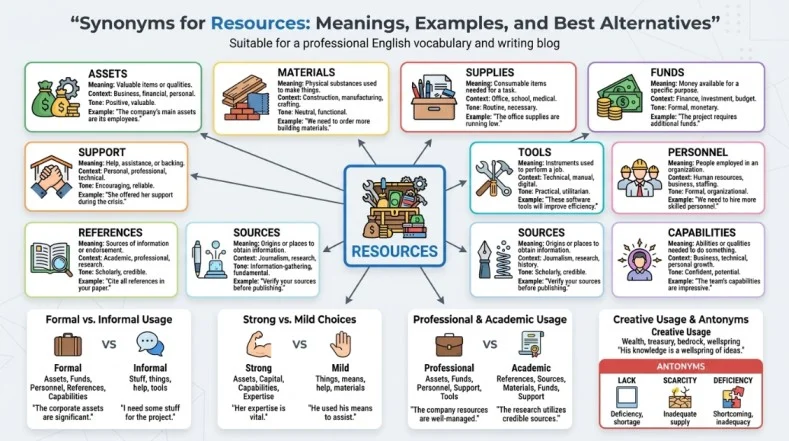
Another Word for “Resources”
The best single replacement depends on what “resources” actually means.
- For professional writing, “assets” often works when referring to valuable business resources.
- For academic writing, “materials” or “references” can be more precise.
- For casual conversation, “supplies” or “tools” may sound more natural when discussing physical items.
- For emotional writing, “support” may work when resources refer to people or assistance.
- For creative writing, “means” can describe what someone has available to accomplish something.
- For resumes and workplace writing, “assets,” “tools,” “capabilities,” or “personnel” may be more specific.
- For social media captions, “tools,” “materials,” “guides,” or “references” can make the message clearer.
- For a stronger meaning, “assets” or “capital” may emphasize value.
- For a softer or broader meaning, “support” or “materials” may sound more approachable.
When Not to Use “Resources”
“Resources” can become too vague when the reader needs to know exactly what is available.
For example:
“Employees need more resources.”
This sentence does not explain whether employees need training, equipment, money, software, staff, or information.
A more precise version is:
“Employees need additional training materials and software.”
The word can also sound overly formal in casual conversation.
Instead of saying:
“I need additional resources to make dinner.”
You would usually say:
“I need a few more ingredients.”
The more specific word gives the reader useful information immediately.
Words Commonly Confused With “Resources”
Resources vs. Assets
Resources are things available for use. Assets are valuable things owned or controlled by an individual or organization.
A company may have many resources, but only some of them may be classified as financial or accounting assets.
Resources vs. Materials
Materials usually refer to physical or informational items used to create, learn, or complete something.
Resources have a broader meaning and can include materials, money, people, equipment, and information.
Resources vs. Supplies
Supplies usually refer to items that are consumed or regularly used.
Resources can include supplies, but the word covers a much wider range of things.
Resources vs. Tools
Tools are specific instruments or methods used to perform a task.
A software program can be a tool, while a broader collection of software, funding, personnel, and information can be described as resources.
Resources vs. Support
Support refers to help, assistance, or encouragement.
Resources may provide support, but they do not necessarily involve direct assistance from another person.
Resources vs. Capital
Capital generally refers to money, financial assets, or other wealth used to produce value.
Resources include capital, but they can also include people, materials, information, and equipment.
Best Synonym by Context for “Resources”
| Context | Best Synonym | Why It Works | Example |
|---|---|---|---|
| Formal writing | Assets | Highlights useful or valuable holdings | The organization must manage its assets carefully. |
| Academic writing | Materials | Clearly identifies learning or research content | Students received additional research materials. |
| Professional use | Assets | Sounds strategic and business focused | The company should use its digital assets effectively. |
| Resume | Capabilities | Highlights available skills and strengths | I helped expand the team’s technical capabilities. |
| Casual conversation | Supplies | Natural for physical items | We need more supplies for the project. |
| Creative writing | Means | Suggests available ways to achieve something | She had few means to escape the difficult situation. |
| Emotional tone | Support | Emphasizes help and assistance | The family found support during a difficult period. |
| Strong intensity | Assets | Emphasizes value and usefulness | Experienced employees are valuable assets to the organization. |
| Soft or moderate tone | Materials | Sounds neutral and approachable | I shared some helpful materials with the group. |
| Social media | Tools | Works well for practical recommendations | Here are five useful tools for new writers. |
| Financial context | Funds | Specifically identifies available money | The program received additional funds. |
| Human resources | Personnel | Clearly identifies people working for an organization | Additional personnel were assigned to the project. |
| Environmental context | Reserves | Suggests stored or available natural supplies | The region has significant water reserves. |
| Technology context | Infrastructure | Describes systems that support operations | The company upgraded its digital infrastructure. |
| Research context | References | Identifies sources of information | The article includes several useful references. |
Which Synonym Should You Choose?
Start by identifying what “resources” means in your sentence.
- If you mean money, choose “funds,” “capital,” or “financing.”
- If you mean physical items, choose “supplies,” “materials,” or “equipment.”
- If you mean information, choose “references,” “sources,” “materials,” or “information.”
- If you mean employees, choose “personnel,” “staff,” “workforce,” or “team members.”
- If you mean valuable business holdings, choose “assets.”
- If you mean help from people or organizations, choose “support” or “assistance.”
- If you mean technology or systems, consider “tools,” “infrastructure,” or “technology.”
Also consider formality. “Supplies” sounds natural in everyday conversation, while “assets” often fits business communication better.
Real Life Examples of “Resources” in Sentences
School
“The teacher provided students with additional resources for the history project.”
Workplace
“The department needs more resources to handle the growing workload.”
Writing
“Writers can use language resources to improve vocabulary and sentence variety.”
Conversation
“I found some great resources for learning photography online.”
Social Media
“We created a list of free resources for new entrepreneurs.”
Resume
“Managed project resources while coordinating schedules, materials, and team responsibilities.”
“I am sharing a few resources that may help you prepare for the meeting.”
Storytelling
“With limited resources, the travelers had to find creative ways to continue their journey.”
25 Synonyms for “Resources”
| Synonym | Simple Meaning | Best Used For | Example Sentence |
|---|---|---|---|
| Assets | Valuable things available or owned | Business and finance | Skilled employees can become valuable assets to a company. |
| Materials | Items used for learning, creating, or working | Academic and practical contexts | The teacher shared useful materials with the class. |
| Supplies | Items needed for a particular activity | Everyday and workplace use | We ordered additional supplies for the office. |
| Funds | Money available for a purpose | Financial contexts | The nonprofit received funds for its community program. |
| Capital | Money or wealth used to create value | Business and finance | The startup needs more capital to expand. |
| Support | Help or assistance | Personal, professional, and social contexts | The program provides support to new students. |
| Assistance | Help provided to someone | Formal and professional writing | Customers can request assistance from the service team. |
| Aid | Help given to address a need | Humanitarian and formal contexts | The organization provided aid to affected families. |
| Tools | Things used to accomplish a task | Technology and practical work | These tools can help writers edit their work. |
| Equipment | Physical items needed for an activity | Technical and professional contexts | The laboratory purchased new equipment. |
| Personnel | People employed by an organization | Business and formal contexts | Additional personnel were assigned to the project. |
| Staff | Employees working for an organization | Workplace communication | The hospital added more staff during the busy season. |
| Workforce | The people available to perform work | Business and economic contexts | The region has a highly skilled workforce. |
| Team | A group working toward a shared goal | Professional and casual contexts | Our team has the skills needed to complete the project. |
| Workforce capacity | Available ability to perform work | Organizational planning | The manager evaluated workforce capacity before accepting new projects. |
| Infrastructure | Systems and facilities supporting an activity | Technology and public services | The city needs stronger digital infrastructure. |
| References | Sources used for information | Academic and research writing | The report includes several reliable references. |
| Sources | Places or materials from which information comes | Research and journalism | Researchers compared information from multiple sources. |
| Information | Facts or knowledge available for use | Academic and professional contexts | The team needs more information before making a decision. |
| Provisions | Supplies or arrangements made for a need | Formal writing | The emergency plan includes provisions for temporary shelter. |
| Reserves | Stored supplies or money kept for future use | Finance and natural resources | The company maintains cash reserves for unexpected costs. |
| Means | Available ways or methods for achieving something | Formal and literary contexts | The organization has the means to support the initiative. |
| Capabilities | Abilities or capacity available | Professional and technical contexts | The new system improves the company’s analytical capabilities. |
| Capacity | The amount that can be handled or provided | Business and organizational contexts | The facility expanded its production capacity. |
| Provisions and supplies | Available items prepared for use | Emergency and practical contexts | The team checked its provisions and supplies before departure. |
Note that not every synonym above can replace “resources” in every sentence. Context determines the most accurate choice. “Funds” works for money, while “references” works for information sources. “Personnel” works for people, while “equipment” refers to physical items.
Synonym Groups and Usage Differences
Professional vs. Personal Synonyms
Professional writing often benefits from precise words such as assets, personnel, capabilities, infrastructure, funds, and capacity.
Personal writing can use simpler terms such as support, supplies, tools, materials, and assistance.
For example, a business report might say:
“The organization allocated additional funds to the project.”
A personal message might say:
“I found some helpful materials for you.”
Formal vs. Conversational Synonyms
Formal writing often uses terms such as provisions, assets, capital, personnel, infrastructure, and assistance.
Conversational English usually favors words such as supplies, tools, help, staff, materials, and support.
Choose the word that sounds natural for the audience rather than replacing every instance of “resources” with a more complicated word.
Academic Synonyms
Academic writing often requires precision.
“Materials” is useful for books, documents, and learning content.
“References” and “sources” work well when discussing information used to support an argument.
“Data” can be appropriate when the resources specifically consist of collected measurements or research information.
Professional and Business Synonyms
Business communication frequently uses assets, capital, funds, personnel, workforce, capabilities, capacity, and infrastructure.
These words help identify the exact type of resource being discussed.
For example, “business assets” emphasizes value, while “financial resources” emphasizes money available to an organization.
Creative or Literary Synonyms
Creative writing may use “means,” “provisions,” “support,” or “assets” depending on the scene and intended tone.
“Means” can sound particularly natural in literary contexts when describing what someone has available to accomplish something.
Example:
“He had little means but refused to surrender.”
Slang or Modern Synonyms
There are few true slang synonyms for “resources” that work across contexts.
Words such as “stuff” may sometimes replace “resources” in very casual speech, but “stuff” is vague and should not be used in academic or professional writing.
“Tools” is a modern and natural choice when discussing apps, software, websites, or practical methods.
Strongest vs. Weaker Synonyms
A useful intensity scale depends on the meaning:
Mild: materials
Moderate: supplies
More specific: tools
Value focused: assets
Financially focused: capital
Highly strategic: capabilities
The strongest word is not necessarily the best word. Precision matters more than intensity.
Emotional vs. Neutral Synonyms
“Resources” is neutral.
“Materials,” “supplies,” “funds,” and “equipment” are also generally neutral.
“Support,” “aid,” and “assistance” can feel more human because they emphasize help.
“Assets” can sound strategic because it emphasizes value.
Antonyms of “Resources”
“Resources” does not have one universal opposite because its meaning changes across contexts. The following terms can function as contextual opposites when discussing availability, abundance, or useful assets.
| Antonym | Meaning | Example Sentence |
|---|---|---|
| Scarcity | A lack of something needed | Water scarcity affects many communities. |
| Shortage | An insufficient amount | The hospital faced a shortage of supplies. |
| Deficit | An amount that is less than required | The project has a budget deficit. |
| Lack | Absence or insufficient availability | A lack of funding delayed the program. |
| Depletion | Reduction caused by continued use | Resource depletion can damage ecosystems. |
| Exhaustion | Complete or near complete use | The exhaustion of fuel reserves caused problems. |
| Poverty | Severe lack of wealth or resources | Poverty can limit access to education. |
| Need | A condition requiring something | The community has a serious need for clean water. |
| Constraint | Something that limits available options | Budget constraints affected the project plan. |
| Limitation | A condition that restricts ability or availability | Limited staffing created a major limitation. |
| Insufficiency | A condition of not having enough | The insufficiency of funds prevented expansion. |
| Deprivation | Lack of something necessary or valuable | Food deprivation can have serious consequences. |
| Waste | Poor or unnecessary use of available resources | Waste can reduce the value of available materials. |
| Loss | The removal or disappearance of something useful | The loss of equipment disrupted operations. |
| Unavailability | A condition in which something cannot be obtained or used | The unavailability of staff delayed the meeting. |
Comparison: “Resources” vs. Similar Words
“Resources” vs. “Assets”
The main difference is scope.
“Resources” can include almost anything useful for reaching a goal. “Assets” usually emphasizes things that have value and are owned or controlled.
“Assets” is often more business focused.
Example:
“The company needs more resources for the project.”
“The company needs to protect its digital assets.”
“Resources” vs. “Materials”
“Materials” usually refers to things used for learning, creating, building, or working.
“Resources” is broader.
Example:
“The teacher provided several resources for the course.”
“The teacher provided several reading materials.”
“Materials” is more precise when you specifically mean documents or learning content.
“Resources” vs. “Supplies”
“Supplies” usually refers to physical items needed for an activity.
“Resources” can refer to physical items, money, people, information, and more.
Example:
“The organization needs additional resources.”
“The organization needs additional medical supplies.”
“Supplies” is more specific and concrete.
“Resources” vs. “Tools”
“Tools” are instruments, systems, methods, or applications used to accomplish a task.
“Resources” has a wider meaning.
Example:
“These resources can help students improve their writing.”
“These editing tools can help students improve their writing.”
“Tools” is stronger when referring to specific applications or methods.
“Resources” vs. “Support”
“Support” means help, assistance, or encouragement.
Resources may provide support, but resources are not always people or assistance.
Example:
“The project needs more resources.”
“The employees need more support.”
“Support” is better when the main idea is help rather than supplies or assets.
“Resources” vs. “Funds”
“Funds” specifically means money available for a purpose.
“Resources” may include money, but it covers much more.
Example:
“The organization needs more resources.”
“The organization needs more funds.”
“Funds” is more precise when the issue is financial.
Common Phrases and Expressions with “Resources”
1. Natural Resources
Meaning:
Materials and elements found in nature that people can use, such as water, forests, minerals, and energy sources.
Example sentence:
“Communities must manage natural resources responsibly.”
2. Human Resources
Meaning:
The people who work for or are available to an organization.
Example sentence:
“The company is investing in human resources and employee development.”
3. Financial Resources
Meaning:
Money or financial assets available for a particular purpose.
Example sentence:
“The program needs additional financial resources to expand.”
4. Educational Resources
Meaning:
Materials, tools, services, or information used to support learning.
Example sentence:
“The school provides educational resources for students and teachers.”
5. Online Resources
Meaning:
Websites, digital documents, databases, videos, and other information available online.
Example sentence:
“Students can find many useful online resources for research.”
6. Community Resources
Meaning:
Local services, organizations, facilities, or forms of assistance available to people.
Example sentence:
“The counselor helped families connect with community resources.”
7. Limited Resources
Meaning:
A situation in which there is not enough money, time, staff, equipment, or other useful support.
Example sentence:
“The team completed the project despite limited resources.”
8. Additional Resources
Meaning:
Extra materials, money, people, tools, or support provided beyond what is already available.
Example sentence:
“Please contact us if you need additional resources.”
Common Mistakes to Avoid
1. Using “Resources” When a Precise Word Is Better
Saying “We need more resources” can be unclear.
If you mean money, say “We need more funds.” If you mean employees, say “We need additional staff.”
2. Confusing “Resources” With “Assets”
Not every resource is necessarily an asset in an accounting or ownership sense.
Use “assets” when value or ownership is important.
3. Using a Casual Synonym in Formal Writing
Words such as “stuff” may work in casual conversation but usually weaken academic and professional writing.
Choose “materials,” “resources,” “equipment,” or another precise term instead.
4. Using an Overly Dramatic Synonym
Do not use “capital” when you simply mean school supplies.
Likewise, do not use “assets” when “materials” is the natural choice.
5. Repeating “Resources” Too Often
Repetition can make a paragraph feel mechanical.
Replace some instances with precise alternatives when the meaning changes.
6. Choosing the Wrong Emotional Tone
“Assets” can sound business focused, while “support” can sound more human.
Choose according to the feeling and purpose of the sentence.
7. Using Slang in Academic or Professional Writing
Words such as “stuff” are too vague for most essays, reports, resumes, and formal emails.
Specific vocabulary creates clearer communication.
FAQs
What is the best synonym for “resources”?
The best synonym depends on context. “Materials” works for learning content, “assets” for valuable holdings, “funds” for money, and “supplies” for physical items.
What is a formal synonym for “resources”?
“Assets,” “provisions,” “capital,” “personnel,” and “infrastructure” can work as formal alternatives when they accurately describe the specific type of resource.
What is an informal synonym for “resources”?
“Supplies,” “tools,” and “help” can sound more conversational, depending on meaning. “Stuff” is possible in casual speech but is usually too vague.
What is another word for “resources” in professional writing?
Professional alternatives include assets, capabilities, personnel, funds, infrastructure, capacity, and materials. Choose the term that identifies the resource type precisely.
What is the difference between “resources” and “materials”?
“Resources” has a broader meaning and can include people, money, tools, information, and supplies. “Materials” usually refers to items used for learning, creating, or working.
What is the opposite of “resources”?
There is no single universal opposite. Contextual opposites include scarcity, shortage, deficit, lack, depletion, constraint, limitation, and insufficiency.
Conclusion
“Resources” is a flexible word for useful things available to accomplish a goal. Its meaning can include money, people, information, materials, equipment, support, technology, or natural supplies.
The best synonyms for resources depend on context. Use “assets” for valuable holdings, “funds” for money, “materials” for learning content, “supplies” for physical items, “personnel” for people, and “support” for assistance.
The most useful vocabulary habit is simple: do not replace a word just to sound sophisticated. First identify what the word actually means in your sentence, then choose the most precise altern.
Discover More Post:
- 25+ Synonyms for Determine | Meanings, Examples, and Best …
- 25+ Synonyms for Affect | Meanings, Examples, and Best …
- 25+ Synonyms for We | Meanings, Examples, and Best …