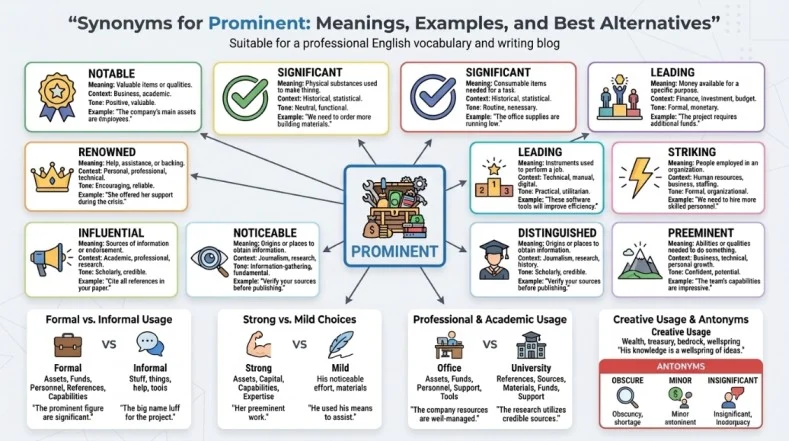
Repeating the word “prominent” can make an essay, resume, email, caption, or professional message sound predictable. Choosing a more precise alternative can make your writing clearer, more natural, and better suited to the situation.
This guide to synonyms for prominent explains the word from several angles, including importance, visibility, reputation, physical position, and influence. You will find practical examples and useful alternatives for academic writing, workplace communication, creative writing, everyday conversation, and social media.
What Does “Prominent” Mean?
Prominent describes someone or something that is important, well known, easily noticed, or physically noticeable. Depending on context, useful alternatives include notable for formal writing, leading for business, famous for reputation, conspicuous for visibility, and outstanding for strong praise.
Meaning, Tone and Context
Simple Definition
Prominent generally means important, noticeable, famous, influential, or easy to see.
The exact meaning depends on the sentence. A prominent scientist may be highly respected, while a prominent feature may simply be easy to notice.
Part of Speech
Prominent is an adjective.
Examples include:
“Her prominent role in the project helped the team succeed.”
“The building has a prominent entrance.”
Tone
Prominent is usually neutral to positive.
It can describe importance, reputation, visibility, influence, or physical appearance. The tone changes slightly depending on the noun it modifies.
Formality Level
Prominent is moderately formal and works well in professional, academic, journalistic, and everyday writing.
It is especially useful when you want to sound precise without using an overly complicated word.
Common Use Cases
Prominent commonly describes:
- Important people
- Influential organizations
- Famous places
- Major features
- Noticeable characteristics
- Important positions
- Physical features that project outward
- Widely recognized ideas or issues
Related Word Forms
The main related form is prominence, a noun meaning importance, visibility, or distinction.
Example:
“The company gained prominence after launching its new product.”
When and How to Use “Prominent”
Use prominent when you want to communicate that someone or something deserves attention because of importance, reputation, visibility, influence, or physical position.
Professional
“The company has a prominent position in the renewable energy market.”
Academic
“The study examines a prominent theory in modern psychology.”
Personal
“She played a prominent role in organizing the family celebration.”
Emotional
“His prominent contribution to the community earned widespread appreciation.”
Creative
“A prominent mountain peak appeared above the morning fog.”
Social Media
“The mural has become a prominent feature of the neighborhood.”
“Please place the most prominent findings near the beginning of the report.”
Another Word for “Prominent”
The best single replacement depends on what you mean.
- If prominent means important, use significant or important.
- If it means well known, use renowned, famous, or celebrated.
- If it means easy to notice, use conspicuous, noticeable, or striking.
- If it means highly respected, use distinguished, eminent, or acclaimed.
- If it means physically projecting, use protruding, projecting, or jutting.
Best Choices by Situation
- Professional writing: significant, leading, influential
- Academic writing: notable, significant, distinguished
- Casual conversation: famous, well known, noticeable
- Emotional writing: remarkable, outstanding, celebrated
- Creative writing: striking, pronounced, salient
- Resume or workplace use: leading, distinguished, influential
- Social media captions: striking, famous, noticeable
- Stronger meaning: preeminent, foremost, outstanding
- Softer meaning: noticeable, visible, recognized
When Not to Use “Prominent”
Prominent is not always the most precise choice.
If you mean someone is famous, famous is clearer than prominent.
“The prominent actor attended the event” is acceptable, but “The famous actor attended the event” communicates reputation more directly.
- If you mean something is easy to see, conspicuous or noticeable may be more accurate.
- If you mean something is extremely important, preeminent or foremost can communicate greater importance.
- If you are describing a physical feature, choose protruding, projecting, or jutting when the physical meaning is central.
Words Commonly Confused With “Prominent”
Prominent vs. Important
Important focuses on value, significance, or necessity.
Prominent can mean important, but it can also mean noticeable or famous.
Prominent vs. Famous
Famous means widely known.
Prominent can suggest reputation, but it can also describe something that is simply noticeable or important.
Prominent vs. Significant
Significant emphasizes importance or meaningful effect.
Prominent can emphasize visibility or recognition instead.
Prominent vs. Conspicuous
Conspicuous means very easy to notice.
Prominent can mean noticeable, but it does not always imply that something strongly attracts attention.
Prominent vs. Influential
Influential means having the power to affect people, decisions, or events.
Prominent can describe someone who is important or well known without necessarily having influence.
Prominent vs. Outstanding
Outstanding suggests exceptional quality or achievement.
Prominent mainly indicates importance, recognition, visibility, or physical projection.
Best Synonym by Context for “Prominent”
| Context | Best Synonym | Why It Works | Example |
|---|---|---|---|
| Formal writing | Notable | Clear and polished | She made a notable contribution to the field. |
| Academic writing | Significant | Emphasizes importance | The research identified a significant pattern. |
| Professional use | Leading | Shows a strong position | The firm is a leading provider of financial services. |
| Resume | Distinguished | Highlights achievement and reputation | She built a distinguished career in public service. |
| Business | Influential | Emphasizes impact | He is an influential voice in the industry. |
| Casual conversation | Famous | Sounds natural and familiar | That restaurant is famous for its desserts. |
| Creative writing | Striking | Creates a vivid impression | The painting has a striking central image. |
| Emotional tone | Remarkable | Adds admiration | Her remarkable achievement inspired the entire team. |
| Strong intensity | Preeminent | Shows exceptional importance | He is a preeminent expert in the field. |
| Softer tone | Noticeable | Focuses on visibility | There was a noticeable change in her attitude. |
| Social media caption | Striking | Short and expressive | The city skyline looked striking at sunset. |
| Public reputation | Renowned | Emphasizes respect and recognition | She is a renowned author. |
| Leadership | Foremost | Suggests the highest position | He is one of the foremost experts on the subject. |
| Physical appearance | Protruding | Describes something extending outward | The rock had a protruding edge. |
| Physical position | Projecting | Describes outward extension | A projecting balcony overlooked the street. |
Which Synonym Should You Choose?
Start by identifying what prominent means in your sentence.
- If you mean important, choose significant, important, or major.
- If you mean famous, choose famous, renowned, celebrated, or well known.
- If you mean influential, choose influential, leading, or distinguished.
- If you mean easy to notice, choose noticeable, conspicuous, striking, or visible.
- If you mean exceptionally important, choose preeminent or foremost.
- If you mean a physical feature that extends outward, choose protruding, projecting, or jutting.
The best synonym is not always the most sophisticated word. Choose the word that communicates your exact meaning with the least confusion.
Real Life Examples of “Prominent” in Sentences
School
“The professor discussed several prominent theories during the lecture.”
Workplace
“She holds a prominent position within the organization.”
Writing
“The article explores a prominent issue in modern education.”
Conversation
“He became a prominent figure in the local community.”
Social Media
“The bridge is a prominent feature in the city skyline.”
Resume
“Received recognition for a prominent role in a major client project.”
“The report highlights three prominent concerns that require immediate attention.”
Storytelling
“A prominent tower rose above the old town and guided travelers toward the center.”
25 Synonyms for “Prominent”
| Synonym | Simple Meaning | Best Used For | Example Sentence |
|---|---|---|---|
| Notable | Worth noticing or remembering | Formal and academic writing | She made a notable contribution to the project. |
| Significant | Important or meaningful | Academic and professional writing | The discovery had a significant effect on the industry. |
| Important | Having considerable value | General communication | Education plays an important role in society. |
| Conspicuous | Very easy to notice | Visibility and appearance | The bright sign was conspicuous from across the street. |
| Noticeable | Easy to see or recognize | Everyday communication | There was a noticeable improvement in his writing. |
| Distinguished | Respected for achievement or quality | Professional and academic contexts | She has a distinguished career in medicine. |
| Eminent | Highly respected and recognized | Formal writing | The conference attracted several eminent scholars. |
| Renowned | Widely known and respected | People, institutions, and places | The city is renowned for its architecture. |
| Famous | Widely known | Casual and general writing | The restaurant is famous for its homemade pasta. |
| Celebrated | Widely admired or praised | People, achievements, and creative work | The celebrated author spoke at the event. |
| Acclaimed | Highly praised | Writers, artists, products, and achievements | The acclaimed director released a new film. |
| Influential | Able to affect opinions or actions | Leadership and business | She is an influential voice in education. |
| Leading | At or near the front of a field | Business and professional writing | The company is a leading provider of technology services. |
| Foremost | Most important or respected | Formal writing | He is a foremost authority on environmental policy. |
| Preeminent | More important or distinguished than others | Highly formal contexts | She is a preeminent researcher in the field. |
| Outstanding | Exceptionally good or impressive | Achievement and praise | His outstanding performance earned recognition. |
| Remarkable | Unusually impressive or noticeable | Positive and emotional writing | Her remarkable progress encouraged the entire class. |
| Striking | Very noticeable or impressive | Creative and descriptive writing | The building has a striking glass entrance. |
| Salient | Most noticeable or important | Academic and analytical writing | The report identifies the salient issues affecting growth. |
| Pronounced | Strongly noticeable or clearly marked | Formal description | The region experienced a pronounced increase in demand. |
| Major | Very important or large in scope | General and professional writing | The company announced a major expansion. |
| Key | Extremely important to a result | Business and everyday writing | Communication is a key part of effective leadership. |
| High profile | Receiving considerable public attention | People, events, and organizations | The company hired a high profile consultant. |
| Visible | Easy to see or recognize | Physical and figurative contexts | Her work is highly visible across the organization. |
| Protruding | Extending outward from a surface | Physical descriptions | A protruding branch blocked part of the walkway. |
Synonym Groups and Usage Differences
Professional vs. Personal Synonyms
Professional writing often benefits from words such as significant, leading, influential, distinguished, and notable.
Personal communication can use simpler choices such as famous, noticeable, important, or remarkable.
For example, “She is a leading researcher” sounds professional, while “She is a famous researcher” sounds more conversational.
Formal vs. Conversational Synonyms
Formal choices include eminent, preeminent, foremost, distinguished, salient, and significant.
Conversational choices include famous, important, noticeable, and well known.
Use the simpler word when clarity matters more than formality.
Academic Synonyms
Academic writing often benefits from significant, notable, salient, distinguished, and prominent itself.
These words allow writers to describe important findings, theories, researchers, issues, and trends without sounding overly emotional.
Professional and Business Synonyms
For business communication, leading, influential, significant, notable, key, and distinguished are especially useful.
A phrase such as “a leading company” communicates market position more directly than simply saying “a prominent company.”
Creative or Literary Synonyms
Creative writing can benefit from striking, remarkable, pronounced, and salient.
For physical descriptions, protruding and projecting can create a clearer visual image.
Example:
“The striking tower dominated the quiet skyline.”
Slang or Modern Synonyms
There is no single slang replacement for prominent that works in every situation.
Words such as famous and high profile can sound more conversational, especially when discussing celebrities, influencers, brands, or public events.
Avoid overly casual expressions in academic papers, formal reports, and professional applications.
Strongest vs. Weaker Synonyms
A useful intensity scale is:
Noticeable → Notable → Significant → Important → Distinguished → Influential → Leading → Foremost → Preeminent
This scale is not absolute because context changes the strength of each word.
Use preeminent only when the subject genuinely holds an exceptionally high position or level of recognition.
Emotional vs. Neutral Synonyms
Neutral choices include visible, noticeable, significant, salient, and major.
More positive or admiring choices include remarkable, outstanding, acclaimed, celebrated, renowned, and distinguished.
Choose neutral vocabulary when you want an objective tone.
Antonyms of “Prominent”
Because prominent has several meanings, its antonyms depend on context.
| Antonym | Meaning | Example Sentence |
|---|---|---|
| Obscure | Not widely known or understood | The writer remained obscure for many years. |
| Inconspicuous | Not easily noticed | The entrance was intentionally inconspicuous. |
| Unnoticed | Not observed or recognized | His contribution went unnoticed. |
| Unremarkable | Not unusual or impressive | The building looked unremarkable from the outside. |
| Ordinary | Not special or exceptional | It appeared to be an ordinary neighborhood. |
| Minor | Less important | The report mentioned only a minor concern. |
| Insignificant | Having little importance | The difference was insignificant. |
| Secondary | Less important than something else | The issue was considered secondary to public safety. |
| Subordinate | Lower in position or importance | The department played a subordinate role in the project. |
| Hidden | Kept out of sight | The entrance was hidden behind the trees. |
| Concealed | Deliberately kept from view | The documents were concealed in a secure location. |
| Unknown | Not known or recognized | The artist was unknown at the time. |
| Overlooked | Not given proper attention | Several useful details were overlooked. |
| Unimportant | Lacking importance | The manager considered the issue unimportant. |
| Peripheral | Outside the main focus | The discussion moved toward peripheral concerns. |
Comparison: “Prominent” vs. Similar Words
Prominent vs. Important
Main difference: Important focuses on value or significance, while prominent can also describe visibility, reputation, or physical position.
Stronger: Important can be stronger when the sentence specifically concerns necessity or value.
More formal: Both are suitable for formal writing.
Examples:
“Education is important for personal development.”
“She played a prominent role in the education program.”
Prominent vs. Famous
Main difference: Famous means widely known, while prominent has broader meanings.
Stronger: Famous is stronger when public recognition is the specific point.
More formal: Prominent is generally more formal.
Examples:
“She is a famous singer.”
“She holds a prominent position in the music industry.”
Prominent vs. Significant
Main difference: Significant emphasizes importance or meaningful effect.
Stronger: Significant is stronger when discussing impact.
More formal: Both work well in formal writing.
Examples:
“The study found a significant change.”
“The researcher became a prominent figure in the field.”
Prominent vs. Conspicuous
Main difference: Conspicuous focuses on something being highly noticeable.
Stronger: Conspicuous is stronger when visibility is the central idea.
More formal: Prominent is often more versatile in formal writing.
Examples:
“The building has a prominent location.”
“The bright advertisement was conspicuous.”
Prominent vs. Influential
Main difference: Influential means capable of affecting people, decisions, or events.
Stronger: Influential is stronger when actual impact matters.
More formal: Both are appropriate for professional contexts.
Examples:
“She is a prominent journalist.”
“She is an influential journalist whose opinions shape public discussion.”
Prominent vs. Outstanding
Main difference: Outstanding means exceptionally good or impressive, while prominent mainly means important, noticeable, or well known.
Stronger: Outstanding is stronger for praise.
More formal: Both can work in professional writing.
Examples:
“He is a prominent researcher.”
“He is an outstanding researcher.”
Common Phrases and Expressions with “Prominent”
1. Prominent Role
Meaning:
An important or noticeable part in an activity, organization, or event.
Example sentence:
“She played a prominent role in the campaign.”
2. Prominent Figure
Meaning:
A person who is important, influential, or well known.
Example sentence:
“The author became a prominent figure in contemporary literature.”
3. Prominent Position
Meaning:
An important role or a highly visible location.
Example sentence:
“She accepted a prominent position within the organization.”
4. Prominent Feature
Meaning:
A characteristic that is especially noticeable or important.
Example sentence:
“The large windows are a prominent feature of the building.”
5. Prominent Place
Meaning:
An important or highly visible location.
Example sentence:
“The painting occupies a prominent place in the gallery.”
6. Prominent Member
Meaning:
A recognized or influential member of a group.
Example sentence:
“He became a prominent member of the local business community.”
7. Prominent Issue
Meaning:
An issue receiving considerable attention or importance.
Example sentence:
“Climate policy remains a prominent issue in public discussions.”
8. Prominent Position in Society
Meaning:
A respected or influential social position.
Example sentence:
“She earned a prominent position in the national education community.”
Common Mistakes to Avoid
1. Using “Prominent” When a More Precise Word Is Better
Do not use prominent when you specifically mean famous, influential, or physically projecting.
Choose the word that matches the exact meaning.
2. Confusing “Prominent” With “Important”
The words overlap, but they are not identical.
Something can be prominent because it is visible without being especially important.
3. Using a Casual Synonym in Formal Writing
Words such as famous may sound less precise in academic or professional contexts.
Consider notable, distinguished, or renowned when the context calls for a polished tone.
4. Using an Overly Dramatic Synonym
Preeminent and foremost can sound excessive if the subject is simply well known.
Match the strength of the synonym to the facts.
5. Repeating “Prominent” Too Often
Repeated use can make your writing feel flat.
Alternate carefully with notable, significant, leading, influential, or noticeable when the meanings genuinely match.
6. Choosing the Wrong Emotional Tone
Renowned and celebrated usually carry positive associations.
Conspicuous can sometimes suggest unwanted attention. Consider the emotional effect before replacing prominent.
7. Using Slang in Academic or Professional Writing
Casual expressions may sound unnatural in research papers, resumes, reports, and formal emails.
Choose clear, established vocabulary instead.
FAQs
What is the best synonym for prominent?
The best synonym depends on context. Use notable for formal writing, significant for importance, renowned for reputation, conspicuous for visibility, and leading for professional contexts.
What is a formal synonym for prominent?
Notable, distinguished, eminent, significant, foremost, and preeminent are strong formal alternatives, depending on whether you mean importance, recognition, or influence.
What is an informal synonym for prominent?
Famous, important, noticeable, and well known can work in casual conversation, although the best choice depends on the exact meaning.
What is another word for prominent in professional writing?
Leading, significant, influential, distinguished, notable, and key are useful professional alternatives when they accurately express the intended meaning.
What is the difference between prominent and significant?
Prominent can mean important, well known, noticeable, or physically projecting. Significant mainly emphasizes importance, meaning, or measurable effect.
What is the opposite of prominent?
Common contextual antonyms include obscure, inconspicuous, unnoticed, minor, insignificant, hidden, unknown, and unimportant.
Conclusion
Prominent is a versatile adjective that can describe importance, recognition, influence, visibility, or physical projection. The best synonym depends on the exact meaning you want to communicate.
- For formal writing, try notable or distinguished. For professional communication, leading or influential often works well. For reputation, use renowned or famous. For visibility, choose conspicuous or noticeable. For exceptional importance, consider foremost or preeminent.
A useful vocabulary habit is to identify the meaning first and choose the synonym second. This simple approach makes your writing more precise, natural, and effective.
Discover More Post:
- 25+ Synonyms for Determine | Meanings, Examples, and Best …
- 25+ Synonyms for Affect | Meanings, Examples, and Best …
- 25+ Synonyms for We | Meanings, Examples, and Best …