The word “suffering” appears everywhere, from personal stories and emotional captions to essays, emails, workplace discussions, and professional writing. Repeating the same word can make otherwise meaningful writing feel flat or predictable.
Choosing the right alternative depends on what kind of suffering you mean. Words such as pain, distress, hardship, anguish, misery, and adversity can express different levels of physical, emotional, or life related difficulty. This guide explains those differences so you can choose language that sounds natural, precise, and appropriate for your audience.
What Does “Suffering” Mean?
Suffering means experiencing physical pain, emotional distress, hardship, or significant difficulty. Depending on context, strong alternatives include anguish and misery, while formal choices include distress, adversity, and affliction.
Meaning, Tone and Context
Simple Definition
Suffering refers to the experience of pain, distress, hardship, or difficulty. It can describe physical discomfort, emotional pain, psychological distress, or challenging circumstances.
For example:
“Her suffering continued for several months.”
Here, suffering refers to a difficult experience that causes pain or distress.
Part of Speech
“Suffering” is commonly used as a noun and as the present participle of the verb “suffer.”
As a noun:
“His suffering was difficult to watch.”
As a verb form:
“She is suffering from severe pain.”
Tone
The word “suffering” generally has a negative and serious tone. It emphasizes difficulty, pain, or distress rather than a simple inconvenience.
The emotional intensity can vary. “Discomfort” sounds milder than “suffering,” while “agony” or “anguish” can sound considerably stronger.
Formality Level
“Suffering” works in casual conversation, academic writing, professional communication, journalism, literature, and emotional writing.
Its meaning is broad, so a more specific synonym can often make your sentence clearer.
Common Use Cases
You may use “suffering” when discussing:
- Physical pain
- Emotional distress
- Mental or psychological difficulty
- Poverty or hardship
- Loss and grief
- Difficult life circumstances
- Social problems
- Serious illness
- Humanitarian issues
- Personal struggles
Related Word Forms
The main related forms include:
“Suffer” is the verb.
“Suffering” is the noun or present participle.
“Suffered” is the past tense and past participle.
“Sufferer” refers to a person experiencing pain, illness, or difficulty.
When and How to Use “Suffering”
“Suffering” is useful when you want to communicate meaningful pain or hardship without necessarily specifying the exact type.
It is especially effective when the experience involves prolonged difficulty or serious emotional or physical distress.
1. Personal Context
“After losing her longtime friend, she experienced deep suffering.”
2. Medical Context
“The treatment helped reduce the patient’s suffering.”
3. Academic Context
“The study examines the social causes of human suffering.”
4. Professional Context
“The organization works to reduce suffering among vulnerable communities.”
5. Emotional Context
“His silence revealed the suffering he had been hiding.”
6. Social Media Context
“Behind every smile, there may be a story of suffering that others never see.”
7. Creative Writing Context
“The character carried years of suffering but refused to surrender hope.”
Another Word for “Suffering”
The best single replacement depends on the type and intensity of difficulty.
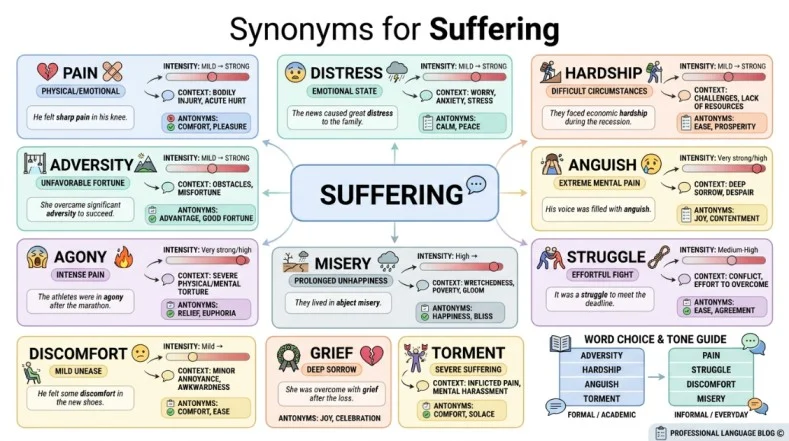
For general use, “pain” is one of the most natural alternatives. For emotional suffering, “anguish” or “distress” may be more precise.
Professional Writing
Use “distress,” “hardship,” “adversity,” or “affliction” when the situation requires a more precise or formal tone.
Academic Writing
“Distress,” “adversity,” “hardship,” and “affliction” can work well when discussing specific causes or effects.
Casual Conversation
“Pain,” “difficulty,” “struggle,” and “trouble” usually sound natural in everyday speech.
Emotional Writing
“Anguish,” “heartache,” “misery,” and “despair” can communicate deeper emotional experiences.
Creative Writing
“Agony,” “torment,” “anguish,” and “misery” can create stronger emotional imagery.
Resume or Workplace Use
In professional writing, “hardship,” “adversity,” “challenge,” or “distress” is often more appropriate than highly emotional terms.
Social Media Captions
“Pain,” “struggle,” “heartache,” and “hardship” can sound natural depending on the message.
Stronger Meaning
Choose “agony,” “torment,” or “anguish” when the suffering is exceptionally intense.
Softer Meaning
Choose “discomfort,” “difficulty,” “challenge,” or “strain” when the situation is serious but not extreme.
When Not to Use “Suffering”
“Suffering” can be too broad when you know exactly what someone is experiencing.
For example:
“She was suffering at work.”
This sentence does not explain whether she was stressed, overworked, unhappy, or physically uncomfortable.
A more precise sentence would be:
“She was experiencing severe workplace stress.”
“Suffering” can also sound overly dramatic for minor problems.
Instead of:
“I am suffering because my internet is slow.”
Use:
“I am frustrated because my internet is slow.”
The better choice depends on accuracy, intensity, and context.
Words Commonly Confused With “Suffering”
Pain
Pain usually refers to physical or emotional discomfort. It can be temporary or ongoing.
“Suffering” is broader and can include pain, hardship, distress, and difficult life circumstances.
Distress
Distress usually refers to significant emotional or psychological difficulty.
It is often more precise than suffering when describing someone’s mental or emotional state.
Hardship
Hardship describes difficult living conditions or challenging circumstances.
It focuses more on external difficulties than on the internal experience of pain.
Struggle
A struggle describes difficulty in dealing with a problem or achieving something.
It does not always imply severe pain or distress.
Agony
Agony describes extremely intense physical or emotional pain.
It is stronger and more dramatic than the general word suffering.
Misery
Misery refers to profound unhappiness, discomfort, or emotional suffering.
It usually emphasizes an unhappy emotional state.
Best Synonym by Context for “Suffering”
| Context | Best Synonym | Why It Works | Example |
|---|---|---|---|
| Formal writing | Distress | Clear and professional | The policy aims to reduce public distress. |
| Academic writing | Adversity | Useful for difficult circumstances | The research explores resilience during adversity. |
| Professional or business use | Hardship | Describes difficult circumstances clearly | The program supports employees facing financial hardship. |
| Resume | Challenge | Positive and professional | She overcame significant professional challenges. |
| Casual conversation | Pain | Simple and natural | He is still dealing with pain after the injury. |
| Creative writing | Torment | Creates strong emotional imagery | Years of torment shaped the character. |
| Emotional writing | Anguish | Clearly expresses deep emotional pain | She felt profound anguish after the loss. |
| Strong intensity | Agony | Communicates extreme pain | He cried out in agony. |
| Soft or moderate tone | Discomfort | Sounds less severe | The medication caused mild discomfort. |
| Social media captions | Struggle | Relatable and conversational | Every struggle can teach you something valuable. |
| Medical context | Pain | Specific and widely understood | The treatment reduced her pain. |
| Mental health context | Distress | Focuses on emotional difficulty | The crisis caused considerable emotional distress. |
| Financial context | Hardship | Clearly describes economic difficulty | Many families experienced financial hardship. |
| Literary context | Misery | Adds emotional depth | The character lived in misery for years. |
| Historical context | Affliction | Formal and descriptive | The community endured a serious affliction. |
Which Synonym Should You Choose?
Start by identifying what kind of suffering you are describing.
If you mean physical discomfort, “pain” is usually the clearest choice. If you mean emotional difficulty, “distress,” “anguish,” or “heartache” may be better.
Consider intensity next.
For moderate difficulty, choose “discomfort,” “difficulty,” or “strain.” For severe experiences, “agony,” “torment,” or “anguish” may be more appropriate.
Think about formality as well.
Academic and professional writing generally benefits from precise terms such as “distress,” “adversity,” and “hardship.” Casual writing can use simpler words such as “pain” and “struggle.”
Finally, consider the emotional effect.
Neutral language informs the reader. Emotional language creates a stronger reaction. The best synonym is the one that accurately communicates your intended meaning without exaggerating it.
Real Life Examples of “Suffering” in Sentences
School
“The essay examines how war can create suffering for civilians.”
Workplace
“The company introduced new policies to reduce employee stress and suffering.”
Writing
“Using the word suffering repeatedly can make an emotional passage feel less precise.”
Conversation
“I understand what you are going through, and I hope your suffering becomes easier to manage.”
Social Media
“Sometimes people hide their suffering behind a confident smile.”
Resume
“Overcoming professional adversity strengthened her leadership skills.”
“We recognize the hardship caused by the recent disruption and appreciate your patience.”
Storytelling
“Years of torment had changed him, but he still believed that life could improve.”
25 Synonyms for “Suffering”
| Synonym | Simple Meaning | Best Used For | Example Sentence |
|---|---|---|---|
| Pain | Physical or emotional discomfort | General situations | The medicine helped reduce her pain. |
| Distress | Serious emotional difficulty | Formal and emotional writing | The event caused considerable distress. |
| Hardship | Difficult life circumstances | Financial and social situations | The family faced financial hardship. |
| Adversity | Difficult circumstances or challenges | Academic and professional writing | She remained strong during adversity. |
| Anguish | Deep emotional pain | Emotional and literary writing | He felt anguish after the loss. |
| Agony | Extremely intense pain | Severe physical or emotional experiences | She cried out in agony. |
| Misery | Deep unhappiness or suffering | Emotional writing | He lived in misery after the tragedy. |
| Torment | Severe and prolonged suffering | Literary and emotional contexts | The memory continued to torment him. |
| Affliction | A condition that causes suffering | Formal writing | The disease became a serious affliction. |
| Struggle | Difficulty dealing with a problem | Casual and professional contexts | Her struggle inspired others. |
| Difficulty | A problem or challenging situation | General and moderate contexts | He faced difficulty adjusting to the change. |
| Discomfort | Mild physical or emotional unease | Medical and everyday use | The treatment caused slight discomfort. |
| Hardship | Severe difficulty or deprivation | Social and financial writing | The community endured years of hardship. |
| Heartache | Emotional pain caused by loss | Personal and emotional writing | The separation brought deep heartache. |
| Grief | Deep sadness after loss | Bereavement and emotional contexts | She needed time to process her grief. |
| Despair | Loss of hope | Strong emotional situations | He struggled with despair after repeated failures. |
| Woe | Serious trouble or sorrow | Literary and expressive writing | The poem describes years of woe. |
| Trouble | Problems or difficulties | Casual conversation | They went through a period of trouble. |
| Strain | Pressure that causes difficulty | Work, relationships, and health | Financial strain affected the household. |
| Tribulation | Severe trial or difficulty | Formal and literary writing | The community survived years of tribulation. |
| Hurt | Physical or emotional pain | Casual conversation | Her words caused unexpected hurt. |
| Sorrow | Deep sadness | Emotional and literary writing | He expressed his sorrow through music. |
| Trauma | Deep psychological injury from a distressing event | Psychological and serious contexts | The experience left lasting trauma. |
| Wretchedness | Extreme unhappiness or poor conditions | Literary and expressive writing | The novel portrays the wretchedness of war. |
| Pangs | Sudden sharp feelings of pain or emotion | Literary and emotional contexts | He felt pangs of regret after leaving. |
Synonym Groups and Usage Differences
Professional vs. Personal Synonyms
Professional writing usually benefits from precise and restrained language.
Words such as “distress,” “hardship,” “adversity,” and “strain” can describe difficult circumstances without sounding excessively emotional.
Personal writing can be more expressive.
Words such as “heartache,” “anguish,” “grief,” and “misery” allow the writer to communicate emotional depth.
Formal vs. Conversational Synonyms
Formal contexts favor words such as “adversity,” “affliction,” “distress,” and “tribulation.”
Conversational English usually sounds more natural with “pain,” “hurt,” “trouble,” “difficulty,” and “struggle.”
For example:
Formal: “The intervention reduced emotional distress.”
Conversational: “The treatment helped with her pain.”
Academic Synonyms
Academic writing should favor precise language rather than dramatic wording.
“Distress,” “adversity,” “hardship,” “trauma,” and “affliction” can be useful when their meanings match the subject.
For example:
“The study investigates the relationship between economic hardship and educational outcomes.”
Professional and Business Synonyms
Workplace writing should usually sound factual and measured.
“Challenge,” “hardship,” “strain,” “distress,” and “difficulty” are often better choices than “agony” or “torment.”
For example:
“The organization created a support program for employees experiencing financial hardship.”
Creative or Literary Synonyms
Creative writing gives you more freedom to use emotionally powerful vocabulary.
“Torment,” “anguish,” “agony,” “misery,” “woe,” and “sorrow” can create stronger imagery.
However, intensity should match the scene. Using “agony” for a minor inconvenience can make the writing feel exaggerated.
Slang or Modern Synonyms
There is no single slang replacement that works for every meaning of suffering.
Casual words such as “hurt,” “rough time,” “struggle,” and “going through it” can work in informal conversations and social media.
They are generally unsuitable for academic research, formal reports, and professional documents when precise language is expected.
Strongest vs. Weaker Synonyms
A useful intensity scale is:
Mild: discomfort
Moderate: difficulty, strain, struggle
Serious: hardship, distress, adversity
Strong: pain, sorrow, grief, misery
Very strong: anguish, torment
Extreme: agony
The exact intensity can change depending on the sentence and context.
Emotional vs. Neutral Synonyms
Neutral terms include “difficulty,” “hardship,” “distress,” and “challenge.”
More emotional terms include “anguish,” “heartache,” “misery,” “grief,” and “despair.”
Choose neutral vocabulary when accuracy matters more than emotional impact. Choose expressive vocabulary when the emotional experience is central to the message.
Antonyms of “Suffering”
| Antonym | Meaning | Example Sentence |
|---|---|---|
| Comfort | A state of physical or emotional ease | The supportive environment provided comfort. |
| Relief | Reduction of pain or difficulty | The medication brought immediate relief. |
| Pleasure | A feeling of enjoyment | The trip gave her great pleasure. |
| Happiness | A positive emotional state | The reunion brought genuine happiness. |
| Joy | Strong feelings of happiness | The celebration filled the family with joy. |
| Contentment | A peaceful feeling of satisfaction | He found contentment in a simple lifestyle. |
| Ease | Freedom from difficulty or discomfort | The new system made the process easier. |
| Wellbeing | A healthy and positive state | Exercise can support overall wellbeing. |
| Prosperity | A state of financial or social success | The region experienced years of prosperity. |
| Peace | Freedom from conflict or disturbance | The community finally enjoyed peace. |
| Satisfaction | A feeling that something is fulfilling | She felt satisfaction after completing the project. |
| Enjoyment | Pleasure gained from an activity | Reading became a source of enjoyment. |
| Recovery | Return to a healthier condition | His recovery progressed steadily. |
| Healing | The process of becoming healthy or emotionally restored | Time supported her healing. |
| Flourishing | Growing or developing successfully | The community is now flourishing. |
Comparison: “Suffering” vs. Similar Words
Suffering vs. Pain
The main difference is scope. Pain usually describes a specific physical or emotional sensation, while suffering can describe a broader experience of difficulty.
“Pain” is often more precise.
“Suffering” is broader and can be more serious depending on context.
Example:
“She experienced severe pain after the injury.”
“The illness caused years of suffering.”
Suffering vs. Distress
Distress usually emphasizes emotional or psychological difficulty.
Suffering can include emotional, physical, social, and situational difficulties.
“Distress” often sounds more precise and formal.
Example:
“The incident caused emotional distress.”
“The disease caused prolonged suffering.”
Suffering vs. Hardship
Hardship focuses on difficult circumstances, especially financial or social conditions.
Suffering focuses more directly on the experience of pain or distress.
“Hardship” is often more suitable for economic or social discussions.
Example:
“The family experienced financial hardship.”
“The experience caused significant suffering.”
Suffering vs. Struggle
A struggle is a difficult effort or problem.
Suffering emphasizes pain or distress.
A struggle does not always involve suffering.
Example:
“She struggled to complete the assignment.”
“She experienced emotional suffering after the loss.”
Suffering vs. Agony
Agony is much stronger than ordinary suffering.
It describes extreme physical or emotional pain.
Example:
“He experienced suffering during the illness.”
“He screamed in agony when the injury occurred.”
Suffering vs. Misery
Misery focuses strongly on unhappiness and emotional distress.
Suffering has a broader meaning and can include physical pain and difficult circumstances.
Example:
“She was suffering after the accident.”
“He spent months in emotional misery.”
Common Phrases and Expressions with “Suffering”
1. Human Suffering
Meaning:
Pain, hardship, or distress experienced by people.
Example sentence:
“The documentary explores human suffering during times of conflict.”
2. Emotional Suffering
Meaning:
Psychological or emotional pain.
Example sentence:
“Talking with someone you trust can help reduce emotional suffering.”
3. Physical Suffering
Meaning:
Pain or discomfort experienced by the body.
Example sentence:
“The treatment was designed to reduce physical suffering.”
4. Needless Suffering
Meaning:
Pain or difficulty that could potentially be prevented.
Example sentence:
“Early intervention may prevent needless suffering.”
5. Prolonged Suffering
Meaning:
Suffering that continues for a long period.
Example sentence:
“The condition resulted in prolonged suffering.”
6. End Suffering
Meaning:
To stop or reduce a person’s pain or distress.
Example sentence:
“The organization works to end unnecessary suffering.”
7. Cause Suffering
Meaning:
To create pain, distress, or hardship.
Example sentence:
“Conflict can cause suffering for entire communities.”
8. Reduce Suffering
Meaning:
To make pain or distress less severe.
Example sentence:
“Better access to care can reduce suffering.”
Common Mistakes to Avoid
1. Using “Suffering” When a More Precise Word Is Better
“Suffering” is broad.
If you specifically mean physical pain, “pain” may communicate your idea more clearly.
2. Confusing Suffering With Struggle
A struggle describes difficulty with a task, situation, or goal.
It does not automatically mean someone is experiencing serious pain.
3. Using a Casual Synonym in Formal Writing
Words such as “hurt” or “rough time” may sound too conversational in academic or professional writing.
Use precise alternatives such as “distress,” “hardship,” or “adversity” when appropriate.
4. Using an Overly Dramatic Synonym
“Agony” and “torment” are powerful words.
Do not use them for ordinary inconvenience or mild frustration.
5. Repeating “Suffering” Too Often
Repeated use can make an emotional passage feel predictable.
Replace some instances with accurate alternatives such as “pain,” “distress,” “hardship,” or “anguish.”
6. Choosing the Wrong Emotional Tone
“Hardship” and “anguish” do not communicate exactly the same feeling.
Choose the synonym that matches whether the problem is practical, physical, emotional, or psychological.
7. Using Slang in Academic or Professional Writing
Informal expressions may work in conversations and captions but can weaken formal writing.
Choose vocabulary that matches the expectations of your audience.
FAQs
What is the best synonym for “suffering”?
The best synonym depends on context. “Pain” works generally, while “distress,” “hardship,” “anguish,” and “agony” provide more specific meanings.
What is a formal synonym for “suffering”?
“Distress,” “adversity,” “hardship,” and “affliction” are useful formal alternatives when they accurately describe the situation.
What is an informal synonym for “suffering”?
“Pain,” “hurt,” “trouble,” and “struggle” can work naturally in casual conversations, depending on the specific meaning.
What is another word for “suffering” in professional writing?
“Hardship,” “distress,” “difficulty,” “adversity,” or “strain” can work well in professional writing when the context supports the meaning.
What is the difference between “suffering” and “pain”?
Pain usually describes a specific physical or emotional sensation. Suffering is broader and can include pain, distress, hardship, or prolonged difficulty.
What is the opposite of “suffering”?
Common opposites include comfort, relief, happiness, joy, peace, ease, contentment, satisfaction, and wellbeing.
Conclusion
Understanding the right synonyms for suffering helps you communicate pain, hardship, and emotional difficulty with greater precision. “Pain” works well for general physical or emotional discomfort, while “distress” suits formal contexts and “hardship” fits difficult life circumstances.
For stronger emotional writing, consider “anguish,” “misery,” “torment,” or “agony.” For softer situations, “discomfort,” “difficulty,” or “strain” may be more accurate.
The best synonym is not always the strongest word. Choose the word that matches your meaning, audience, formality, and emotional intensity. A simple vocabulary habit can make your writing more precise: identify the exact kind of suffering first, then select the word that describes it most naturally.
Discover More Post: