The word tough appears everywhere, from conversations about difficult exams to captions about strong people and emails describing challenging projects. While it is useful, repeating the same word can make your writing feel limited or less precise.
Learning the right synonyms for tough helps you match your vocabulary to the situation. A demanding assignment, a durable material, a resilient person, and a severe condition all need slightly different words. This guide explains those differences with practical examples for students, professionals, writers, job seekers, and everyday speakers.
What Does “Tough” Mean?
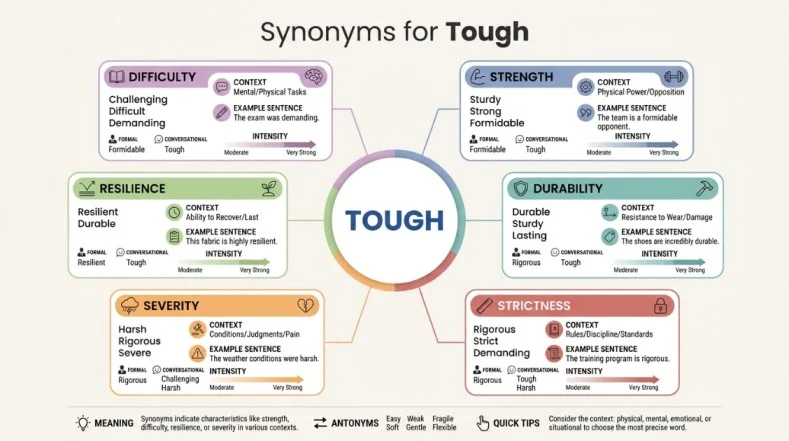
Tough can mean difficult to handle, physically strong, emotionally resilient, durable, or strict. The best synonym depends on context, such as challenging for academic use, demanding for work, resilient for people, durable for materials, and harsh for severe conditions.
Meaning, Tone and Context
Simple Definition of Tough
Tough is an adjective that commonly describes something difficult, strong, durable, demanding, or able to withstand pressure.
For example, you might call an exam tough because it is difficult, a person tough because they are resilient, or a material tough because it does not break easily.
Part of Speech
Tough is primarily an adjective.
Examples include:
- A tough decision.
- A tough athlete.
- A tough material.
- A tough situation.
- A tough manager.
It can also appear in informal expressions and related word forms.
Tone of Tough
The tone is usually neutral, but it can become positive or negative depending on the context.
Calling someone tough can suggest strength, courage, persistence, or emotional resilience. Calling a situation tough usually emphasizes difficulty.
Formality Level
Tough is common in everyday American English and works in many informal, professional, and general contexts.
For academic or professional writing, a more precise alternative can sometimes sound stronger. For example, challenging, demanding, rigorous, or formidable may communicate a specific meaning more clearly.
Common Uses of Tough
Tough is often used for:
- Difficult tasks.
- Challenging decisions.
- Strong or resilient people.
- Durable materials.
- Difficult circumstances.
- Strict rules or treatment.
- Severe conditions.
- Physically demanding activities.
- Emotional experiences.
- Competitive situations.
When and How to Use “Tough”
Use tough when you want a flexible word that communicates difficulty, strength, durability, or resilience without sounding excessively formal.
1. Academic Context
“The final chemistry exam was tough, but the extra practice helped me prepare.”
Here, tough means difficult.
2. Professional Context
“Our team faced a tough deadline, so we reorganized the project schedule.”
Here, tough describes a demanding situation.
3. Personal Context
“She stayed tough during a difficult period and continued moving forward.”
Here, tough suggests emotional strength and resilience.
4. Physical Context
“This hiking trail is tough, especially during the final climb.”
Here, tough means physically demanding.
5. Material Context
“This fabric is tough enough to withstand frequent use.”
Here, tough means durable.
6. Social Media Context
“Some days are tough, but every setback can teach you something valuable.”
Here, tough expresses emotional difficulty.
7. Workplace Email Context
“We are dealing with a tough situation, but the team is working on a practical solution.”
Here, tough communicates difficulty without sounding overly dramatic.
Another Word for “Tough”
The best single replacement depends on what tough means in your sentence.
For difficulty, challenging is usually one of the safest choices. Physical durability, durable or sturdy works better. For emotional strength, resilient is more precise.
Professional Writing
Use challenging, demanding, rigorous, or formidable.
Example:
“The company faced a challenging market environment.”
Academic Writing
Use challenging, demanding, rigorous, or arduous, depending on the meaning.
Example:
“The research involved a rigorous evaluation process.”
Casual Conversation
Use hard, rough, or tough.
Example:
“That workout was really hard.”
Emotional Writing
Use resilient, strong, steadfast, or tenacious.
Example:
“She remained resilient despite repeated setbacks.”
Creative Writing
Use gritty, rugged, formidable, harsh, or unyielding, depending on the scene.
Example:
“The rugged landscape tested every traveler.”
Resume or Workplace Use
Use resilient, tenacious, adaptable, or determined when describing professional qualities.
Example:
“Demonstrated a resilient approach to complex business challenges.”
Social Media Captions
Use strong, resilient, gritty, or simply hard for a casual tone.
Example:
“Strong through the tough days and grateful for the good ones.”
Stronger Meaning
Use formidable, arduous, severe, grueling, or daunting, depending on what you are describing.
Softer Meaning
Use challenging, demanding, or difficult when you want a less dramatic description.
When Not to Use “Tough”
Although tough is versatile, it can sometimes be too broad.
If you are describing a difficult academic task, challenging or rigorous may be more precise.
Instead of:
“The research was tough.”
Try:
“The research process was rigorous.”
If you are describing a material, durable may be clearer.
Instead of:
“This material is tough.”
Try:
“This material is highly durable.”
If you are describing emotional strength, resilient can communicate the idea more accurately.
Instead of:
“She is tough.”
Try:
“She is remarkably resilient.”
If you are describing strict rules, stringent or strict may be a better choice.
Instead of:
“The new requirements are tough.”
Try:
“The new requirements are stringent.”
Words Commonly Confused With “Tough”
Tough vs. Difficult
Difficult mainly means hard to do, understand, solve, or manage.
Tough can mean difficult, but it can also describe strength, durability, severity, or resilience.
Example:
“The assignment was difficult.”
“The athlete is tough.”
Tough vs. Hard
Hard is one of the closest everyday alternatives to tough when describing difficulty.
However, hard has many additional meanings, including physical firmness and intensity.
Example:
“The exam was hard.”
“The table is hard.”
Tough vs. Strong
Strong mainly describes physical power, intensity, or ability.
Tough often suggests the ability to withstand difficulty, damage, pressure, or pain.
Example:
“She is strong enough to lift the equipment.”
“She is tough enough to handle difficult situations.”
Tough vs. Durable
Durable specifically describes something that can withstand use, pressure, or damage over time.
It is more precise than tough for products and materials.
Example:
“This backpack is durable and designed for frequent travel.”
Tough vs. Harsh
Harsh describes something severe, unpleasant, or difficult to tolerate.
It often carries a negative emotional tone.
Example:
“The harsh weather caused travel delays.”
Tough vs. Challenging
Challenging means requiring effort, skill, or determination.
It is usually more neutral and polished than tough, making it useful in professional and academic writing.
Example:
“The project was challenging but rewarding.”
Best Synonym by Context for “Tough”
| Context | Best Synonym | Why It Works | Example |
|---|---|---|---|
| Formal writing | Difficult | Clear and widely appropriate | The decision was difficult. |
| Academic writing | Challenging | Sounds precise and natural | The course was challenging. |
| Professional use | Demanding | Highlights effort and pressure | The role is demanding. |
| Resume | Resilient | Highlights personal strength | A resilient professional can adapt quickly. |
| Casual conversation | Hard | Natural everyday choice | That test was hard. |
| Creative writing | Formidable | Adds dramatic strength | A formidable opponent stood before him. |
| Emotional tone | Resilient | Emphasizes recovery and strength | She remained resilient after the setback. |
| Strong intensity | Arduous | Suggests sustained difficulty | The journey was arduous. |
| Moderate intensity | Challenging | Balanced and neutral | The assignment was challenging. |
| Social media | Strong | Short and expressive | Stay strong through tough times. |
| Material description | Durable | Precisely describes lasting strength | The boots are durable. |
| Physical activity | Strenuous | Emphasizes physical effort | The workout was strenuous. |
| Strict rules | Stringent | Clearly communicates strict requirements | The company introduced stringent standards. |
| Severe conditions | Harsh | Describes unpleasant severity | The region experienced harsh conditions. |
| Difficult decision | Difficult | Natural and direct | It was a difficult choice. |
| Competitive situation | Formidable | Suggests serious strength or opposition | They faced a formidable competitor. |
Which Synonym Should You Choose?
Start by identifying what tough means in your sentence.
- If it means difficult, choose difficult, challenging, or hard.
- If it means physically demanding, choose strenuous, arduous, or demanding.
- If it describes a person, consider resilient, strong, tenacious, or gritty.
- If it describes materials, choose durable, sturdy, robust, or rugged.
- If it describes strict requirements, choose stringent, strict, or rigorous.
- If it describes severe conditions, choose harsh or severe.
The best synonym is not always the strongest word. Choose the word that expresses the exact meaning you intend.
Real Life Examples of “Tough” in Sentences
School
“The students knew the final exam would be tough, so they started studying early.”
Workplace
“Managing several projects at once can be tough without a clear system.”
Writing
“The author describes a tough period in her life with honesty and detail.”
Conversation
“That was a tough decision, but I think you made the right choice.”
Social Media
“Keep going even when the road gets tough.”
Resume
“Demonstrated resilience while managing tough business challenges.”
“We understand that this is a tough situation, and we are working toward a solution.”
Storytelling
“After years of hardship, the tough old sailor still refused to give up.”
25 Synonyms for “Tough”
The following words are useful alternatives in specific contexts. They are not interchangeable in every sentence because tough has several different meanings.
| Synonym | Simple Meaning | Best Used For | Example Sentence |
|---|---|---|---|
| Difficult | Hard to do or handle | General difficulty | The assignment was difficult. |
| Challenging | Requires effort or skill | Academic and professional situations | The project was challenging but rewarding. |
| Hard | Difficult or requiring effort | Casual conversation | That workout was hard. |
| Demanding | Requires considerable effort | Work, study, and responsibilities | The position is demanding. |
| Arduous | Very difficult and requiring sustained effort | Formal and literary writing | The hikers completed an arduous journey. |
| Strenuous | Requiring significant physical effort | Exercise and physical tasks | The climb was strenuous. |
| Taxing | Draining energy or attention | Mental and emotional situations | The long meeting was mentally taxing. |
| Formidable | Very difficult to overcome or deal with | Competition and serious challenges | They faced a formidable opponent. |
| Daunting | Intimidating because of difficulty | New tasks and major challenges | Starting a new career can feel daunting. |
| Rigorous | Extremely thorough or demanding | Academic and professional settings | The program has rigorous requirements. |
| Stringent | Very strict or demanding | Rules and standards | The laboratory follows stringent safety rules. |
| Severe | Very serious or intense | Conditions and problems | The area experienced severe weather. |
| Harsh | Severe, unpleasant, or difficult to tolerate | Weather, treatment, and conditions | The harsh climate affected farming. |
| Durable | Able to last despite use or damage | Products and materials | These shoes are durable. |
| Sturdy | Strong and well built | Furniture, structures, and objects | The table has a sturdy frame. |
| Robust | Strong, reliable, and able to withstand pressure | Systems and products | The company needs a robust security system. |
| Rugged | Strong enough for rough conditions | Equipment, landscapes, and people | The rugged vehicle handled the terrain well. |
| Resilient | Able to recover from difficulty | People, organizations, and communities | The resilient team recovered quickly. |
| Hardy | Strong enough to survive difficult conditions | People, plants, and animals | These plants are hardy enough for cold weather. |
| Strong | Powerful or mentally determined | People and physical strength | She remained strong during the crisis. |
| Tenacious | Persistent and unwilling to give up | People and professional qualities | The tenacious reporter continued investigating. |
| Gritty | Showing courage and determination | People and creative descriptions | The gritty competitor refused to quit. |
| Unyielding | Not giving way or changing | Attitudes, resistance, and conditions | The unyielding pressure continued for months. |
| Uncompromising | Refusing to weaken a position or standard | Principles and attitudes | His uncompromising standards improved the work. |
| Grueling | Extremely tiring and demanding | Physical or prolonged experiences | The athletes completed a grueling training session. |
Synonym Groups and Usage Differences
Professional vs. Personal Synonyms
Professional writing benefits from precise words such as challenging, demanding, rigorous, and formidable.
When describing personal qualities, resilient, tenacious, strong, and gritty are usually more effective.
For example:
Professional:
“The team managed a demanding product launch.”
Personal:
“She remained resilient throughout the transition.”
Formal vs. Conversational Synonyms
For casual conversation, hard, tough, and rough sound natural.
For reports, essays, and formal communication, difficult, challenging, demanding, rigorous, or arduous may provide greater precision.
Casual:
“That exam was tough.”
Formal:
“The examination presented several challenging problems.”
Academic Synonyms
Academic writing usually benefits from words that describe the specific type of difficulty.
- Use challenging for tasks that require skill.
- Use rigorous for demanding standards or methods.
- Use arduous for sustained effort.
- Use difficult when a straightforward description is enough.
Professional and Business Synonyms
In business communication, challenging, demanding, formidable, rigorous, and stringent are particularly useful.
For example:
“The organization operates in a challenging market.”
“The new regulations impose stringent requirements.”
“The company faced a formidable competitor.”
These choices sound more precise than repeatedly using tough.
Creative or Literary Synonyms
Creative writing gives you more freedom to choose words based on atmosphere.
Rugged can create a physical image.
Harsh can create a sense of severity.
Formidable can make a character or obstacle feel powerful.
Gritty can suggest determination and realism.
Slang or Modern Synonyms
There are informal expressions that can communicate strength or difficulty, but they are highly dependent on audience and context.
Words such as hardcore can work in casual speech, entertainment, sports, or online communities.
Avoid such expressions in academic papers, formal reports, resumes, and important professional communication unless the context specifically calls for them.
Strongest vs. Weaker Synonyms
A useful intensity scale looks like this:
Moderate: difficult, challenging
More demanding: demanding, taxing, strenuous
Very difficult: arduous, grueling, daunting
Very serious or severe: formidable, severe, harsh
The exact strength depends on the noun being described. A grueling workout is extremely tiring, while a formidable opponent is difficult to defeat.
Emotional vs. Neutral Synonyms
Neutral choices: difficult, challenging, demanding
Positive strength: strong, resilient, hardy, tenacious
More emotional: gritty, daunting, harsh, grueling
Choose neutral vocabulary when accuracy matters more than emotional impact.
Antonyms of “Tough”
Because tough has several meanings, its opposite can change depending on context.
| Antonym | Meaning | Example Sentence |
|---|---|---|
| Easy | Not difficult | The assignment was easy. |
| Simple | Easy to understand or do | The instructions were simple. |
| Effortless | Requiring little effort | She made the task look effortless. |
| Gentle | Mild and not harsh | The treatment was gentle. |
| Soft | Not hard physically | The material feels soft. |
| Mild | Not severe or intense | The weather remained mild. |
| Flexible | Able to bend or adapt | The schedule is flexible. |
| Lenient | Not strict | The teacher was lenient about late work. |
| Fragile | Easily damaged or broken | The glass is fragile. |
| Delicate | Easily damaged or requiring care | The flowers are delicate. |
| Weak | Lacking strength | The structure was weak. |
| Tender | Soft or easily affected | The meat was tender. |
| Smooth | Even and without roughness | The surface is smooth. |
| Comfortable | Easy to tolerate or experience | The chair is comfortable. |
| Manageable | Easy enough to control or handle | The workload became manageable. |
Comparison: Tough vs. Similar Words
Tough vs. Difficult
Main difference: Difficult focuses on difficulty. Tough has a wider range of meanings, including strength and durability.
Stronger: Tough can sound stronger when describing a difficult experience.
More formal: Difficult is generally more neutral and formal.
Examples:
“Tough: The team faced a tough season.”
“Difficult: The team faced a difficult season.”
Tough vs. Hard
Main difference: Hard is a very common everyday word for difficulty. Tough can also describe resilience and durability.
Stronger: Tough may sound more emotionally forceful.
More formal: Neither is especially formal, although difficult is more suitable for formal writing.
Examples:
“Tough: It was a tough decision.”
“Hard: It was a hard decision.”
Tough vs. Challenging
Main difference: Challenging emphasizes the effort, skill, or thought required.
Stronger: Tough can sound slightly more emotionally intense.
More formal: Challenging is generally more polished for professional and academic writing.
Examples:
“Tough: The assignment was tough.”
“Challenging: The assignment was challenging.”
Tough vs. Strong
Main difference: Strong describes power or strength. Tough emphasizes the ability to withstand difficulty, damage, or pressure.
Stronger: Tough is often stronger when describing resilience.
More formal: Strong is neutral and broadly acceptable.
Examples:
“Tough: She is tough under pressure.”
“Strong: She is physically strong.”
Tough vs. Durable
Main difference: Durable specifically means able to last despite use or damage.
Stronger: Tough is broader, while durable is more precise for materials.
More formal: Durable is more technical and precise.
Examples:
“Tough: This fabric is tough.”
“Durable: This fabric is durable and long lasting.”
Tough vs. Harsh
Main difference: Tough can describe difficulty or strength, while harsh emphasizes severity or unpleasantness.
Stronger: Harsh usually carries a more negative emotional tone.
More formal: Both can appear in formal writing, depending on context.
Examples:
“Tough: They faced a tough winter.”
“Harsh: They faced harsh winter conditions.”
Common Phrases and Expressions with “Tough”
1. Tough Decision
Meaning:
A choice that is difficult because the available options have significant consequences.
Example sentence:
“Choosing between the two job offers was a tough decision.”
2. Tough Time
Meaning:
A difficult period in someone’s life.
Example sentence:
“She supported her friend through a tough time.”
3. Tough Break
Meaning:
An unfortunate situation or disappointing event.
Example sentence:
“Missing the opportunity because of bad weather was a tough break.”
4. Tough Call
Meaning:
A difficult decision that requires careful judgment.
Example sentence:
“It was a tough call, but the manager chose to delay the launch.”
5. Tough Luck
Meaning:
An informal expression used when someone experiences bad fortune.
Example sentence:
“He missed the final shot and joked that it was tough luck.”
6. Tough Customer
Meaning:
A person who is difficult to satisfy, persuade, or negotiate with.
Example sentence:
“The buyer was a tough customer, but the salesperson remained professional.”
7. Tough Love
Meaning:
A firm approach intended to help someone improve, even when it may feel unpleasant.
Example sentence:
“His coach used tough love to encourage greater discipline.”
8. Tough Enough
Meaning:
Strong or capable enough to handle a difficult situation.
Example sentence:
“She proved that she was tough enough to lead the team.”
Common Mistakes to Avoid
1. Using Tough When a More Precise Synonym Is Better
Tough is flexible, but precision improves writing.
Instead of saying:
“The material is tough.”
Use:
“The material is durable.”
2. Confusing Tough With Strong
A person can be physically strong without being emotionally tough.
Use strong for power and tough for resilience or the ability to withstand difficulty.
3. Using a Casual Synonym in Formal Writing
Words such as hard may sound natural in conversation but can sometimes feel less polished in formal writing.
Consider difficult, challenging, or demanding instead.
4. Using an Overly Dramatic Synonym
Do not call an ordinary assignment arduous or grueling unless it genuinely requires exceptional effort.
Strong vocabulary should match the situation.
5. Repeating Tough Too Often
Repeated use can make writing feel basic.
Replace some instances with precise alternatives such as challenging, resilient, durable, or demanding.
6. Choosing the Wrong Emotional Tone
Harsh has a more negative tone than challenging.
If you want to describe difficulty without sounding negative, challenging is often the better choice.
7. Using Slang in Academic or Professional Writing
Informal expressions can make an essay, resume, or business document sound less polished.
Choose vocabulary that matches the expectations of your audience.
FAQs
What is the best synonym for tough?
The best synonym depends on meaning. Challenging works well for difficulty, resilient for people, and durable for materials.
What is a formal synonym for tough?
Formal alternatives include difficult, challenging, demanding, rigorous, arduous, and formidable, depending on context.
What is an informal synonym for tough?
Common informal alternatives include hard, rough, and sometimes strong, depending on what you are describing.
What is another word for tough in professional writing?
Challenging, demanding, rigorous, and formidable are useful professional choices when they accurately express the intended meaning.
What is the difference between tough and difficult?
Difficult mainly means hard to do or handle. Tough can also mean durable, resilient, strong, strict, or severe.
What is the opposite of tough?
The opposite depends on context. For difficulty, use easy or manageable. For physical strength, use fragile or weak.
Conclusion
The word tough is useful because it can describe difficulty, strength, resilience, durability, strictness, or severity. However, its broad meaning makes context especially important when choosing a replacement.
For difficult tasks, try challenging or demanding. Strong people, resilient or tenacious may be better. For materials, durable or sturdy provides greater precision. Severe conditions, harsh or severe can communicate the intended meaning more clearly.
The best synonyms for tough are not simply the strongest words available. They are the words that express your exact meaning while matching your audience and tone. A practical vocabulary habit is to ask yourself what kind of toughness you mean before replacing the word.
Discover More Post:
- 25+ Synonyms for Determine | Meanings, Examples, and Best …
- 25+ Synonyms for Affect | Meanings, Examples, and Best …
- 25+ Synonyms for We | Meanings, Examples, and Best …