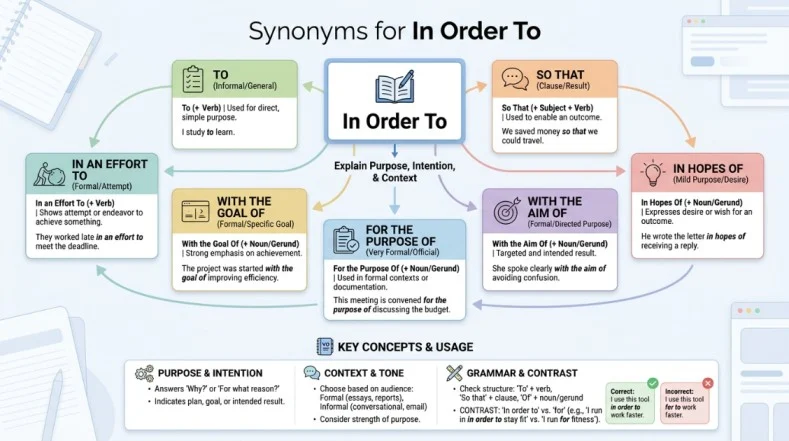
Writers often repeat “in order to” when explaining purpose in essays, emails, resumes, reports, and everyday sentences. Although the phrase is grammatically correct, using the same expression repeatedly can make your writing feel unnecessarily wordy.
Learning the best synonyms for in order to helps you choose shorter, clearer, or more formal alternatives. In many situations, simple “to” is the strongest choice, while “so that,” “with the goal of,” or “for the purpose of” may work better when you need a specific tone or sentence structure.
What Does “In Order To” Mean?
“In order to” expresses purpose or intention. The best alternative is usually “to,” while “so that” suits clauses, “with the goal of” works professionally, and “for the purpose of” provides a formal or academic tone.
Meaning, Tone and Context
Simple Definition
“In order to” means for the purpose of doing something. It explains why someone performs an action or what result they hope to achieve.
For example:
She studied every evening in order to improve her grades.
The phrase connects an action with its intended purpose.
Part of Speech
“In order to” is a purpose expression made from the preposition “in,” the noun “order,” and the infinitive marker “to.”
It is normally followed by the base form of a verb.
Example:
He saved money in order to buy a new laptop.
Tone
The phrase has a neutral and slightly formal tone. It is appropriate in academic writing, professional communication, essays, reports, and everyday conversation.
However, it can sometimes sound more formal or wordy than necessary.
Formality Level
“In order to” is acceptable across formal and informal situations, but the shorter “to” is usually more natural.
Compare:
She attended the meeting in order to learn about the project.
She attended the meeting to learn about the project.
The second sentence is shorter without changing the meaning.
Common Use Cases
You can use “in order to” when explaining:
- A goal
- A purpose
- An intended result
- A reason for an action
- A professional objective
- An academic purpose
- A personal intention
Related Forms
The expression does not have conventional adjective, noun, or verb forms.
Related purpose expressions include “so that,” “for the purpose of,” “with the goal of,” “with the intention of,” and “to.”
When and How to Use “In Order To”
Use “in order to” when you want to clearly connect an action with its intended purpose.
It is grammatically correct, but it is often interchangeable with the simpler “to.”
Professional
The company updated its security system in order to protect customer information.
Academic
Researchers collected additional data in order to improve the reliability of the study.
Personal
I woke up early in order to prepare breakfast for my family.
I am contacting you in order to confirm the meeting time.
Resume
Coordinated team projects in order to improve workflow efficiency.
Creative
She walked quietly through the forest in order to avoid disturbing the birds.
Casual
I called you in order to tell you about the change.
In casual conversation, “I called you to tell you about the change” usually sounds more natural.
Another Word for “In Order To”
The best single replacement for “in order to” is usually “to.”
It preserves the meaning while making the sentence shorter and more direct.
Professional Writing
Use “to” for clear and efficient business writing.
We changed the process to reduce delays.
Academic Writing
Use “to” when a simple purpose statement is enough.
The study was designed to examine consumer behavior.
Casual Conversation
“To” is the most natural choice.
I went outside to get some fresh air.
Emotional Writing
Use “in hopes of” when the sentence emphasizes hope.
She reached out in hopes of repairing the friendship.
Creative Writing
Use “with the intention of” or “in an effort to” when you want a more deliberate or literary feeling.
He returned to the village with the intention of uncovering the truth.
Resume or Workplace Use
“To” is usually best because resumes benefit from concise language.
Managed client accounts to improve retention.
Social Media Captions
Use “to,” “so,” or “that way” depending on the sentence.
Taking a quiet morning walk to clear my mind.
Stronger Meaning
Use “with the goal of,” “with the aim of,” or “with the intention of” when you want to emphasize deliberate purpose.
Softer Meaning
Use “in hopes of” when the desired result is uncertain.
She applied for the program in hopes of gaining valuable experience.
When Not to Use “In Order To”
“In order to” is not wrong, but it can be unnecessary when “to” communicates the same idea.
Compare:
We met in order to discuss the proposal.
We met to discuss the proposal.
The second version is more concise.
Avoid using “in order to” repeatedly throughout an essay or report. Repetition can make otherwise clear writing feel mechanical.
It can also be inappropriate when the grammar requires a different structure.
For example:
We changed the schedule so that everyone could attend.
Here, “so that” works naturally because the purpose is followed by a complete clause.
Words Commonly Confused With “In Order To”
“To”
“To” is the simplest alternative when the purpose is followed by a base verb.
She exercised to stay healthy.
“So That”
“So that” normally introduces a complete clause with its own subject and verb.
She exercised so that she could stay healthy.
“For”
“For” can express purpose when followed by a noun or gerund.
This tool is for editing photographs.
She went to the store for some groceries.
It is not normally a direct replacement before a base verb.
“Because”
“Because” explains a reason, while “in order to” explains a purpose.
He stayed home because he was sick.
He stayed home in order to rest.
“For the Purpose Of”
“For the purpose of” expresses purpose in a formal way and is usually followed by a noun or gerund.
The information was collected for the purpose of evaluating the program.
“With the Goal Of”
“With the goal of” emphasizes an objective or desired result.
The team redesigned the website with the goal of improving accessibility.
Best Synonym by Context for “In Order To”
| Context | Best Synonym | Why It Works | Example |
|---|---|---|---|
| Formal writing | For the purpose of | Clearly emphasizes purpose | The records were reviewed for the purpose of identifying errors. |
| Academic writing | To | Concise and precise | Researchers gathered data to test the hypothesis. |
| Professional use | To | Direct and efficient | We updated the policy to improve compliance. |
| Resume | To | Saves space and sounds action oriented | Trained employees to improve customer service. |
| Casual conversation | To | Natural and simple | I went outside to get some air. |
| Creative writing | With the intention of | Highlights deliberate purpose | He returned with the intention of finding answers. |
| Emotional writing | In hopes of | Expresses uncertainty and hope | She called in hopes of hearing good news. |
| Strong purpose | With the goal of | Makes the objective prominent | The campaign launched with the goal of increasing awareness. |
| Soft purpose | In hopes of | Sounds less forceful | He reached out in hopes of resolving the issue. |
| Social media | To | Short and natural | Working hard to build something meaningful. |
| Business report | With the aim of | Sounds structured and purposeful | The company changed its strategy with the aim of reducing costs. |
| Formal policy | For the purpose of | Suitable for official language | The data may be used for the purpose of quality review. |
| Everyday writing | To | Avoids unnecessary wording | I stopped by to say hello. |
| US English | To | Most common concise choice | She called to confirm the appointment. |
| UK English | To | Also natural and widely used | He went there to speak with the manager. |
Which Synonym Should You Choose?
Choosing an alternative depends mainly on sentence structure and tone.
- Choose “to” when you want the clearest and shortest expression of purpose.
- Choose “so that” when the purpose needs a complete clause with a subject and verb.
- Choose “with the goal of” when the objective deserves emphasis.
- Choose “for the purpose of” when writing in a formal or official style.
- Choose “in hopes of” when the desired result is uncertain.
- Choose “with the intention of” when you want to emphasize deliberate intent.
- Choose “in an effort to” when someone is actively trying to achieve a result.
Before replacing the phrase, check the grammar that follows it. Not every purpose expression fits the same sentence structure.
Real Life Examples of “In Order To” in Sentences
School
Maya reviewed her notes in order to prepare for the final exam.
A shorter alternative is:
Maya reviewed her notes to prepare for the final exam.
Workplace
The manager reorganized the schedule in order to improve productivity.
A more concise version is:
The manager reorganized the schedule to improve productivity.
Writing
The author used specific examples in order to make the explanation clearer.
Conversation
I called in order to ask about your weekend plans.
In casual speech, “I called to ask about your weekend plans” sounds more natural.
Social Media
Taking a short break in order to recharge before the next project.
A more natural caption would be:
Taking a short break to recharge before the next project.
Resume
Developed training materials in order to support new employees.
A stronger resume version is:
Developed training materials to support new employees.
I am writing in order to request additional information.
A cleaner version is:
I am writing to request additional information.
Storytelling
He crossed the river in order to reach the abandoned cabin before sunset.
Creative writing may benefit from “with the intention of” when the character’s purpose needs emphasis.
25 Synonyms for “In Order To”
Some entries below are direct alternatives, while others are purpose expressions that require a different grammatical structure. This distinction matters for accurate writing.
| Synonym | Simple Meaning | Best Used For | Example Sentence |
|---|---|---|---|
| To | For the purpose of doing something | Everyday, academic, and professional writing | She studied to pass the exam. |
| So that | For a particular intended result | Clauses and explanatory writing | He left early so that he could avoid traffic. |
| So as to | For the purpose of doing something | Formal writing | The team met early so as to review the agenda. |
| For the purpose of | For a specific purpose | Formal and official writing | The survey was created for the purpose of collecting feedback. |
| With the aim of | With a particular objective | Business and academic writing | The company invested in training with the aim of improving service. |
| With the goal of | With a desired result in mind | Professional communication | The team redesigned the process with the goal of reducing delays. |
| With a view to | With the intention of achieving something | Formal writing | The organization changed its policy with a view to improving access. |
| For | Intended for a particular use | Nouns and gerunds | This room is for studying. |
| To ensure | To make a result certain or more likely | Professional and formal writing | We checked the figures to ensure accuracy. |
| To allow | To make something possible | Explanatory and professional writing | The update was released to allow users to access new features. |
| To enable | To make an action possible | Technical and professional writing | The new system was designed to enable faster payments. |
| So | For that purpose or result | Conversational writing | I moved closer so I could hear the speaker. |
| In an effort to | While actively trying to achieve something | Professional and news style writing | The company changed its policy in an effort to reduce waste. |
| With the intention of | Deliberately planning to achieve something | Formal and creative writing | She returned with the intention of finding the missing letter. |
| Aiming to | Trying to achieve a goal | Professional and modern writing | The program is aiming to improve reading skills. |
| Seeking to | Trying to achieve or accomplish something | Formal and professional writing | The organization is seeking to expand its services. |
| Designed to | Created for a particular purpose | Product and professional writing | The tool is designed to simplify financial reporting. |
| Intended to | Planned or meant to achieve something | Formal and explanatory writing | The changes are intended to improve safety. |
| In pursuit of | Actively seeking a goal | Formal and literary writing | She moved to the city in pursuit of greater opportunities. |
| With the intention of | Deliberately planning an action | Formal and creative writing | He spoke privately with the intention of resolving the dispute. |
| In hopes of | Hoping to achieve something | Personal and emotional writing | They traveled abroad in hopes of finding new opportunities. |
| For the sake of | For the benefit or preservation of something | Emotional and general writing | She stayed calm for the sake of her children. |
| That way | So that a particular result can happen | Casual conversation | Save the receipt that way you can return the item if necessary. |
| As a means of | As a method for achieving something | Formal and academic writing | Exercise can serve as a means of reducing stress. |
| In an attempt to | While trying to achieve something | Formal, professional, and analytical writing | The company changed the process in an attempt to reduce errors. |
Synonym Groups and Usage Differences
Professional vs. Personal Synonyms
Professional writing usually benefits from direct expressions such as “to,” “with the goal of,” “with the aim of,” and “in an effort to.”
Personal writing can use “in hopes of,” “for the sake of,” or “with the intention of” when the writer wants to communicate emotion or personal motivation.
Formal vs. Conversational Synonyms
For formal reports, “for the purpose of,” “with a view to,” and “with the aim of” can work well.
For conversations, texts, and casual emails, “to” is usually the most natural choice.
Academic Synonyms
Academic writing values precision more than complicated vocabulary.
“To,” “so that,” “with the aim of,” and “for the purpose of” can all work depending on sentence structure.
Do not replace “in order to” with a longer phrase simply to make an essay sound more academic. Clear writing is usually stronger.
Professional and Business Synonyms
Business writing often benefits from concise expressions.
Use “to” for routine purposes, “with the goal of” for objectives, “in an effort to” for active initiatives, and “to ensure” when emphasizing a desired standard or result.
Creative or Literary Synonyms
Creative writing gives you more room to emphasize intention and emotion.
“With the intention of,” “in pursuit of,” and “in hopes of” can add depth when the character’s motivation matters.
Slang or Modern Synonyms
There is no true slang synonym for “in order to.”
Casual expressions such as “so” or “that way” may replace the idea in conversation, but they should not automatically be used in academic or professional writing.
Strongest vs. Weaker Synonyms
Purpose expressions do not have a strict strength scale because their meanings differ slightly.
A useful practical scale is:
Simple: to
Clear purpose: so that
Emphasized goal: with the goal of
Deliberate intention: with the intention of
Active attempt: in an effort to
Strong formal purpose: for the purpose of
The strongest choice depends on what you want to emphasize, not simply on word length.
Emotional vs. Neutral Synonyms
“To” is highly neutral.
“With the goal of” emphasizes ambition.
“In an effort to” emphasizes active effort.
“In hopes of” introduces hope or uncertainty.
“For the sake of” can introduce emotional importance or sacrifice.
Antonyms of “In Order To”
“In order to” does not have true lexical antonyms because it expresses purpose rather than a single concept with a direct opposite.
However, the following expressions can create a contrasting meaning by removing, rejecting, or changing the idea of purpose.
| Antonym or Contrasting Expression | Meaning | Example Sentence |
|---|---|---|
| Without | Not doing something as part of a purpose | He left without saying goodbye. |
| Without intending to | An action happened without deliberate purpose | She interrupted without intending to be rude. |
| Unintentionally | Happening without deliberate purpose | He unintentionally deleted the file. |
| Accidentally | Happening by mistake | She accidentally sent the wrong document. |
| By chance | Happening without a planned purpose | They met by chance at the airport. |
| Randomly | Without a specific plan or purpose | The numbers were selected randomly. |
| Aimlessly | Without a clear goal | He wandered aimlessly through the streets. |
| Without a goal | Lacking a specific objective | The project continued without a clear goal. |
| Without a purpose | Not directed toward a particular objective | The activity seemed to continue without a purpose. |
| Instead of | Choosing one action or option rather than another | She walked instead of taking the bus. |
| Regardless of | Without allowing a particular factor to determine the action | He continued regardless of the criticism. |
| Despite | Acting even though an opposing condition exists | They continued despite the difficulties. |
| Against the intention | Contrary to what was intended | The change worked against the original intention. |
| Contrary to plan | Different from the intended plan | The event developed contrary to plan. |
| Without planning | Acting without preparation or deliberate design | They made the decision without planning ahead. |
Comparison: “In Order To” vs. Similar Words
“In Order To” vs. “To”
The main difference is length.
Both can express purpose before a base verb. “To” is usually more concise and natural.
Neither is stronger in meaning. “In order to” can sound slightly more deliberate or formal.
Example:
She studied in order to improve her writing.
She studied to improve her writing.
“In Order To” vs. “So That”
“In order to” is normally followed by a base verb.
“So that” is normally followed by a complete clause.
“So that” is useful when the purpose requires a different subject.
Example:
He saved money in order to travel.
He saved money so that his family could travel with him.
“So that” is not necessarily more formal. It simply provides a different grammatical structure.
“In Order To” vs. “For”
“In order to” can be followed by a base verb.
“For” is often followed by a noun or gerund when expressing purpose.
Example:
She went to the library in order to study.
The library has a quiet room for studying.
“For” is not a universal replacement.
“In Order To” vs. “Because”
“In order to” expresses purpose.
“Because” explains a reason or cause.
Example:
She left early in order to avoid traffic.
She left early because she felt tired.
The first explains what she wanted to accomplish. The second explains why she left.
“In Order To” vs. “With the Goal Of”
“With the goal of” places stronger emphasis on an objective.
It is longer and generally more suitable when discussing projects, strategies, plans, or organizational objectives.
Example:
The company changed the system in order to improve efficiency.
The company changed the system with the goal of improving efficiency.
The second gives the goal more emphasis.
- “In Order To” vs. “In Hopes Of”
- “In hopes of” introduces an uncertain desired result.
- “In order to” does not necessarily express uncertainty.
Example:
She studied in order to pass the exam.
She studied in hopes of earning a scholarship.
The second sentence emphasizes hope rather than a straightforward purpose.
Common Phrases and Expressions with “In Order To”
1. In order to achieve
Meaning:
Used to introduce a goal someone wants to accomplish.
Example sentence:
In order to achieve better results, the team reviewed its strategy.
2. In order to improve
Meaning:
Used when an action is intended to make something better.
Example sentence:
The company updated its training program in order to improve employee performance.
3. In order to avoid
Meaning:
Used to explain an action intended to prevent something.
Example sentence:
She left early in order to avoid heavy traffic.
4. In order to ensure
Meaning:
Used when an action is intended to make a result more certain.
Example sentence:
We checked the documents twice in order to ensure accuracy.
5. In order to help
Meaning:
Used to explain that an action is performed for someone’s benefit.
Example sentence:
The teacher created a guide in order to help students understand the assignment.
6. In order to prevent
Meaning:
Used to explain an action intended to stop an unwanted event.
Example sentence:
The team added extra security in order to prevent unauthorized access.
7. In order to maintain
Meaning:
Used when an action is intended to preserve an existing condition.
Example sentence:
The staff follows a regular schedule in order to maintain consistent quality.
8. In order to support
Meaning:
Used when an action is intended to provide assistance or strengthen something.
Example sentence:
The organization raised funds in order to support local education programs.
Common Mistakes to Avoid
1. Using “In Order To” When “To” Is Better
This is the most common issue.
We met in order to discuss the problem.
Usually, this is cleaner:
We met to discuss the problem.
2. Confusing Purpose With Reason
“In order to” explains an intended purpose, while “because” normally explains a reason.
Do not automatically replace one with the other.
3. Using “For” Before a Base Verb
This structure is usually incorrect:
She went there for improve her skills.
Use:
She went there to improve her skills.
Or:
She went there for professional development.
4. Using an Overly Formal Expression
“For the purpose of” may sound excessive in a simple sentence.
Instead of:
I called for the purpose of asking a question.
Use:
I called to ask a question.
5. Repeating “In Order To” Too Often
Repeating the phrase several times in an essay can make your writing sound mechanical.
Mix concise alternatives when they accurately fit the grammar.
6. Choosing a Synonym With the Wrong Emotional Tone
“In hopes of” suggests uncertainty or hope.
“With the goal of” suggests a defined objective.
Choose based on meaning rather than simply replacing words.
7. Using Casual Expressions in Formal Writing
“That way” and conversational “so” may work in speech but can sound too casual in formal reports or academic writing.
FAQs
What is the best synonym for “in order to”?
The best synonym is usually “to.” It expresses the same purpose clearly and concisely, making it ideal for everyday, academic, professional, and resume writing.
What is a formal synonym for “in order to”?
“For the purpose of,” “with the aim of,” and “with the intention of” are formal alternatives. Choose based on sentence structure and the emphasis you need.
What is an informal synonym for “in order to”?
“To” is the most natural informal alternative. In conversation, expressions such as “so” or “that way” can also communicate purpose depending on context.
What is another word for “in order to” in professional writing?
“To” is generally the strongest professional choice because it is concise. “With the goal of” and “in an effort to” work when emphasizing objectives or active efforts.
What is the difference between “in order to” and “so that”?
“In order to” is normally followed by a base verb, while “so that” introduces a clause. “So that” is useful when the purpose includes a separate subject.
What is the opposite of “in order to”?
There is no exact lexical opposite. Contrasting expressions include “without,” “accidentally,” “unintentionally,” and “without a purpose,” depending on the intended meaning.
Conclusion
“In order to” expresses purpose or intention, but it is often longer than necessary. In most sentences, “to” is the best synonym because it is clear, natural, and concise.
For formal writing, consider “for the purpose of” or “with the aim of.” Professional goals, “with the goal of” works well. For emotional uncertainty, “in hopes of” can be more expressive.
The key to choosing the best synonyms for in order to is not finding the longest or most sophisticated phrase. Choose the expression that fits your grammar, purpose, audience, and tone.
A simple vocabulary tip: whenever you write “in order to,” try replacing it with “to.” If the meaning stays exactly the same, the shorter version is often the stronger choice.
Read More Related Articles:
- 25+ Synonyms for Secret | Meanings, Examples, and Best …
- 25+ Synonyms for God | Meanings, Examples, and Best …
- 25+ Synonyms for Action | Meanings, Examples, and Best …