The word person appears everywhere. You might use it repeatedly in an essay, email, resume, social media caption, workplace message, or everyday conversation. Sometimes, however, a more specific word can make your sentence clearer and more natural.
Learning synonyms for person is not simply about replacing one word with another. The right choice depends on what you mean, how formal you want to sound, and whether you are describing someone’s role, character, identity, behavior, or relationship.
This guide explains the most useful alternatives with practical examples. You will learn which words fit academic writing, professional communication, casual speech, creative writing, and emotionally meaningful situations.
What Does “Person” Mean?
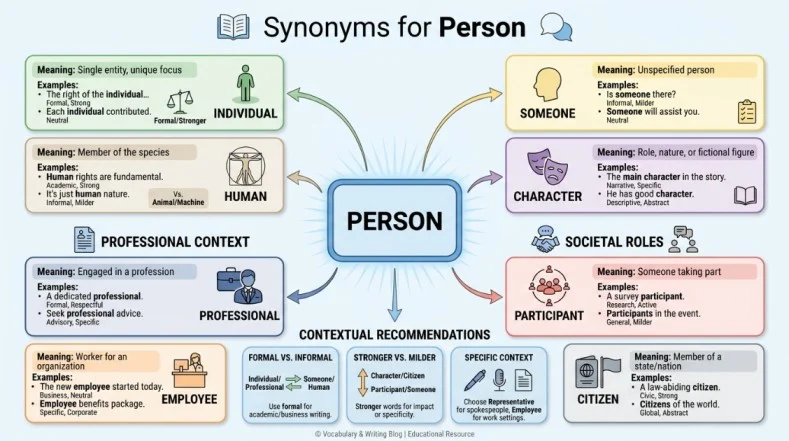
A person is an individual human being. Useful synonyms include individual for formal writing, human for general discussion, someone for casual use, individual or professional for workplace contexts, and character for creative writing.
Meaning, Tone and Context
Simple Definition
Person means an individual human being. It is one of the most general words in English for referring to a human individual.
For example:
Every person deserves to be treated with respect.
Part of Speech
Person is primarily a noun.
Its plural form is people. The plural persons also exists, but it is more common in formal, legal, or official language.
Tone
The word person is generally neutral. It does not automatically communicate praise, criticism, emotion, status, or personality.
That neutrality makes it extremely versatile.
Formality Level
Person works in almost every level of communication, including casual conversations, academic writing, business communication, emails, and professional documents.
More specific alternatives can sound more polished when the context requires precision.
Common Use Cases
You can use person when talking about:
- An individual human being
- Someone whose identity is not specified
- A participant in an event
- A customer or client
- Someone’s character or personality
- A worker or professional
- A person in a story or situation
- A human being in general
Related Word Forms
The most important related forms include:
Person: an individual human being.
People: the standard plural form.
Personal: relating to an individual.
Personally: from an individual’s own perspective or experience.
Personality: the distinctive qualities and behavioral patterns of an individual.
When and How to Use “Person”
Use person when you need a broad, neutral term for an individual human being.
It is especially useful when the person’s profession, role, personality, or identity is not important to your sentence.
1. Professional
The person responsible for the project will contact you tomorrow.
2. Personal
She is a kind person who always helps her neighbors.
3. Academic
Each person develops language skills at a different pace.
4. Emotional
He is the person I trust most during difficult times.
5. Creative
A mysterious person appeared at the edge of the village.
6. Social Media
Sometimes one person can completely change your day.
7. Email
Please direct this request to the appropriate person.
Another Word for “Person”
The best single replacement for person is usually individual when you want a formal and precise alternative.
However, context matters.
| Situation | Recommended Word |
|---|---|
| Professional writing | Individual |
| Academic writing | Individual |
| Casual conversation | Someone |
| Emotional writing | Someone |
| Creative writing | Character |
| Resume or workplace use | Professional |
| Social media captions | Someone |
| Stronger meaning | Human being |
| Softer, conversational meaning | Someone |
Professional Writing
Use individual when you want a neutral, professional tone.
Each individual is responsible for completing the required training.
Academic Writing
Individual often sounds more precise than person in analytical writing.
Each individual responds differently to environmental changes.
Casual Conversation
Someone is natural when you are referring to an unspecified person.
Someone left their phone on the table.
Emotional Writing
Someone can sound warmer and more personal.
Sometimes someone enters your life and changes everything.
Creative Writing
Use character when referring to a person within a story, novel, play, or fictional situation.
The main character struggles to understand his past.
Resume or Workplace Use
Use a role specific noun when possible.
Instead of:
I am a person who manages teams effectively.
Write:
I am an experienced manager who leads teams effectively.
Social Media Captions
Someone or human can create a more conversational or reflective tone.
Be the person who makes someone else feel seen.
Stronger Meaning
Human being can emphasize humanity, individuality, or shared human experience.
Every human being deserves dignity.
Softer Meaning
Someone usually sounds more natural and conversational.
Someone is waiting outside.
When Not to Use “Person”
Although person is correct in many situations, it can sometimes be too broad.
When a Role Matters
Instead of:
The person spoke to the customer.
Use:
The representative spoke to the customer.
When a Profession Matters
Instead of:
She is a person who works with patients.
Use:
She is a nurse who works with patients.
When Writing About Fiction
Instead of:
The person in the novel changes throughout the story.
Use:
The character in the novel changes throughout the story.
When a Formal Alternative Improves Precision
Instead of:
Every person in the study completed the survey.
You could write:
Every individual in the study completed the survey.
The second version emphasizes each participant as a separate unit.
When Repetition Becomes Noticeable
If person appears repeatedly in the same paragraph, consider a more precise term rather than replacing every occurrence mechanically.
Words Commonly Confused With “Person”
Person vs. People
Person refers to one individual. People normally refers to more than one individual.
One person attended the meeting.
Fifty people attended the meeting.
Person vs. Individual
Individual often emphasizes one separate member of a group. It can sound more formal than person.
Person vs. Human
Human emphasizes humanity or the human species. It can function as both a noun and an adjective.
Person vs. Character
Character usually refers to someone in a story, play, movie, or fictional setting. It can also describe someone’s moral qualities.
Person vs. Someone
Someone means an unspecified or unknown person and is common in everyday communication.
Person vs. Professional
Professional identifies someone through their occupation, expertise, or workplace role. It is not a universal synonym for person.
Best Synonym by Context for “Person”
| Context | Best Synonym | Why It Works | Example |
|---|---|---|---|
| Formal writing | Individual | Precise and professional | Each individual received a copy. |
| Academic writing | Individual | Fits analytical language | Each individual showed a different response. |
| Business use | Representative | Identifies a business role | A company representative called today. |
| Resume | Professional | Highlights workplace identity | She is a skilled professional. |
| Casual conversation | Someone | Natural and conversational | Someone is waiting outside. |
| Creative writing | Character | Fits fictional people | The character faces a difficult choice. |
| Emotional writing | Someone | Feels personal and natural | Someone believed in me. |
| Strong emphasis | Human being | Highlights humanity | Every human being deserves respect. |
| Soft, conversational tone | Someone | Sounds relaxed | Someone helped me today. |
| Social media | Someone | Fits informal captions | Be someone others can trust. |
| Legal or official use | Person | Standard and direct | No person may enter without authorization. |
| Group discussion | Participant | Identifies involvement | Each participant shared an opinion. |
Which Synonym Should You Choose?
Start with the meaning you want to communicate.
If you simply mean one human being, person is usually the safest choice. You want greater formality, individual is often better.
If you are talking about an unknown or unspecified human, someone sounds natural. You are discussing a story, use character.
For workplace writing, identify the person’s role whenever possible. Words such as employee, manager, representative, customer, or professional can provide much more useful information than the general word person.
For emotional or reflective writing, someone or human being may communicate more warmth or humanity.
Real Life Examples of “Person” in Sentences
School
Each person in the class contributed one idea to the project.
Workplace
The right person will review your application.
Writing
The writer introduces a person who challenges traditional expectations.
Conversation
I met a person from Chicago at the conference.
Social Media
One kind person can make a difficult day easier.
Resume
Instead of:
I am a person with strong communication skills.
Use:
I am a professional with strong communication and leadership skills.
Please contact the appropriate person if you need additional assistance.
Storytelling
The old person at the doorway seemed to know more than he revealed.
25 Synonyms for “Person”
Some words below are close alternatives only in particular contexts. English synonyms are rarely interchangeable in every sentence.
| Synonym | Simple Meaning | Best Used For | Example Sentence |
|---|---|---|---|
| Individual | One particular human | Formal and academic writing | Each individual has different goals. |
| Human | A human being | General or philosophical discussion | Every human makes mistakes. |
| Someone | An unspecified person | Casual conversation | Someone called while you were away. |
| Somebody | An unspecified person | Informal conversation | Somebody left a jacket here. |
| Character | A person in a story | Fiction and literature | The character learns from his mistake. |
| Human being | A member of humanity | Emotional or philosophical writing | Every human being deserves respect. |
| Soul | A person viewed emotionally | Literary or poetic writing | A kind soul offered us shelter. |
| Individuality | A person considered as distinct | Identity discussions | The program celebrates individuality. |
| Citizen | A person belonging to a country or community | Civic and legal contexts | Every citizen has responsibilities. |
| Resident | A person living in a place | Housing and local contexts | Each resident received a notice. |
| Participant | A person taking part | Events and studies | Every participant completed the survey. |
| Member | A person belonging to a group | Organizations and communities | Each member can vote. |
| Employee | A person who works for an organization | Workplace writing | Every employee receives training. |
| Professional | A person with professional expertise | Career and business contexts | She is a respected professional. |
| Representative | A person acting for another group | Business and customer service | A representative will contact you. |
| Customer | A person buying a product or service | Commerce | The customer requested a refund. |
| Client | A person receiving professional services | Business and services | The client approved the proposal. |
| Consumer | A person who uses or purchases goods | Business and marketing | The consumer expects clear information. |
| Colleague | A person you work with | Workplace communication | My colleague helped with the presentation. |
| Stranger | A person you do not know | Personal and narrative contexts | A stranger offered directions. |
| Adult | A fully grown person | Age related contexts | Every adult must register separately. |
| Teenager | A person aged between 13 and 19 | Age specific contexts | The teenager joined the program. |
| Leader | A person who guides others | Management and leadership | The leader encouraged the team. |
| Expert | A person with specialized knowledge | Academic and professional contexts | An expert reviewed the findings. |
| Candidate | A person seeking a position or opportunity | Elections and hiring | Each candidate submitted a resume. |
Synonym Groups and Usage Differences
Professional vs. Personal Synonyms
Professional writing benefits from role specific words.
Use employee, manager, professional, client, customer, representative, or colleague when the person’s role matters.
Personal communication usually favors person, someone, somebody, or friend depending on the situation.
Formal vs. Conversational Synonyms
Individual is more formal than someone or somebody.
For an academic report:
Each individual completed the assessment.
For casual conversation:
Someone left their bag here.
Both are natural, but their tone differs.
Academic Synonyms
Academic writing often benefits from individual, participant, subject, or researcher, depending on the exact meaning.
Do not use participant unless the person actually takes part in a study, activity, or event.
Professional and Business Synonyms
Business communication should identify the person’s role when relevant.
Use employee, client, customer, manager, representative, professional, or colleague rather than repeatedly using person.
Creative or Literary Synonyms
Creative writing gives you more flexibility.
Character, soul, stranger, and human being can create different impressions depending on the scene.
For example:
A stranger stood beneath the streetlight.
This creates more atmosphere than:
A person stood beneath the streetlight.
Slang or Modern Synonyms
There is no single slang replacement for person that works universally.
Words such as guy, folks, or dude can be appropriate in informal American English, but they have specific gender, number, age, or tone implications.
Avoid them in formal reports, academic essays, resumes, and professional documents unless the context specifically calls for conversational language.
Strongest vs. Weaker Synonyms
There is no strict intensity scale because these words describe different aspects of a human being.
General: person
- More formal: individual
- More human focused: human being
- More role specific: professional, employee, participant
- More literary: soul
- More narrative: character, stranger
Emotional vs. Neutral Synonyms
Person, individual, and participant are generally neutral.
Human being can emphasize shared humanity.
Soul can sound affectionate, compassionate, or poetic.
Stranger adds social distance because it identifies someone the speaker does not know.
Antonyms of “Person”
Strictly speaking, person does not have a direct antonym because it names a human individual rather than describing a quality that has an opposite.
The following terms can function as contextual contrasts, depending on the sentence.
| Antonym | Meaning | Example Sentence |
|---|---|---|
| Animal | A nonhuman living organism | The shelter cares for every animal. |
| Object | A nonliving thing | The object was left on the table. |
| Thing | A general nonhuman entity | The thing moved across the floor. |
| Machine | A mechanical system | The machine operates automatically. |
| Robot | A programmed machine | The robot completed the task. |
| Device | A piece of equipment | The device records temperature. |
| Plant | A living organism that is not an animal | The plant needs more sunlight. |
| Inanimate object | Something without life | The sculpture is an inanimate object. |
| Artifact | A human made object | The museum displayed an ancient artifact. |
| Property | Something owned | The building is company property. |
| Product | Something made for sale | The product arrived yesterday. |
| Material | Physical substance | The material can withstand heat. |
| Tool | An object used to perform a task | The tool needs repair. |
| Structure | A constructed physical form | The structure survived the storm. |
| Entity | A distinct thing or being | The database stores each entity separately. |
Important: These are contextual contrasts, not perfect dictionary antonyms of person.
Comparison: Person vs. Similar Words
Person vs. Individual
Main difference: Both refer to one human, but individual often emphasizes separateness or identity.
Stronger: Neither is inherently stronger.
More formal: Individual.
Examples:
Each person deserves an opportunity.
Each individual completed a separate form.
Person vs. Human
Main difference: Human emphasizes humanity or the human species, while person focuses on an individual.
Stronger: Human can sound more philosophical or biological.
More formal: Both can be formal depending on context.
Examples:
She is a thoughtful person.
Human behavior is complex.
Person vs. Someone
Main difference: Someone refers to an unspecified person.
Stronger: Neither is stronger.
More formal: Person.
Examples:
The person at the desk can help you.
Someone at the desk can help you.
Person vs. Character
Main difference: Character usually refers to someone in fiction or a narrative.
Stronger: Character is more context specific.
More formal: Neither universally.
Examples:
I met a person at the station.
The main character arrives at the station.
Person vs. Professional
Main difference: Professional identifies someone through work, expertise, or professional conduct.
Stronger: Professional is more specific.
More formal: Professional can sound more workplace oriented.
Examples:
She is a helpful person.
She is a skilled professional.
Person vs. Participant
Main difference: A participant is specifically someone taking part in an activity, study, event, or process.
Stronger: Participant is more precise.
More formal: Participant is common in formal and academic contexts.
Examples:
Each person received a badge.
Each participant received a badge.
Common Phrases and Expressions with “Person”
1. A People Person
Meaning: Someone who enjoys interacting with and understanding other people.
Example sentence:
Maria is a real people person who makes everyone feel welcome.
2. Person of Interest
Meaning: Someone who attracts attention because of their connection to an investigation or situation.
Example sentence:
Police identified a person of interest during the investigation.
3. In Person
Meaning: Physically present rather than communicating remotely.
Example sentence:
We decided to discuss the issue in person.
4. Person to Person
Meaning: Directly between two people.
Example sentence:
The manager prefers person to person communication for sensitive matters.
5. Person in Charge
Meaning: The person responsible for something.
Example sentence:
Please speak with the person in charge.
6. First Person
Meaning: A perspective using pronouns such as I, me, and we.
Example sentence:
The essay is written in the first person.
7. Third Person
Meaning: A perspective that refers to people using names or pronouns such as he, she, or they.
Example sentence:
The story is told in the third person.
8. A Person of Character
Meaning: Someone regarded as having strong moral qualities.
Example sentence:
She is a person of character who keeps her promises.
Common Mistakes to Avoid
1. Replacing “Person” With Any Similar Word
Not every related word is interchangeable.
A participant takes part in something. A customer buys something. An employee works for an organization.
2. Confusing “Person” With “People”
Use person for one individual and people for the normal plural.
One person arrived.
Several people arrived.
3. Using Casual Language in Formal Writing
Words such as guy or dude may sound too casual in an academic paper, business report, or resume.
Choose person, individual, or a precise role instead.
4. Using an Overly Dramatic Synonym
Replacing every occurrence of person with soul can make ordinary writing sound unnecessarily poetic.
Choose literary words only when the tone supports them.
5. Repeating “Person” Too Often
Repeated use can make writing feel basic or monotonous.
Instead of replacing every occurrence, identify the person’s actual role when that information is relevant.
6. Choosing the Wrong Emotional Tone
Stranger, soul, human being, and individual create different impressions.
Choose based on what you want readers to understand, not simply because the word appears on a synonym list.
7. Using Slang in Academic or Professional Writing
Informal words can weaken an otherwise polished piece of writing.
Use conversational vocabulary for conversations and appropriately formal vocabulary for professional or academic contexts.
FAQs
What is the best synonym for person?
Individual is often the best formal synonym for person. In casual conversation, someone is more natural, while role specific words provide greater precision.
What is a formal synonym for person?
Individual is a common formal synonym for person. Depending on context, participant, professional, representative, or citizen may be more precise.
What is an informal synonym for person?
Someone and somebody are natural informal alternatives. In very casual American English, words such as guy may also work in suitable contexts.
What is another word for person in professional writing?
Use individual for general professional references, or choose a role specific term such as employee, client, customer, manager, or representative.
What is the difference between person and individual?
Both can describe one human being. Individual often sounds more formal and emphasizes a particular member of a group or a distinct person.
What is the opposite of person?
Person has no exact direct antonym. Depending on context, a contrast might be animal, object, machine, robot, or another nonhuman entity.
Conclusion
The word person is a flexible, neutral term for an individual human being. It works in casual conversations, academic writing, professional communication, emails, essays, resumes, and everyday speech.
The best alternative depends on your purpose. Choose individual for formal writing, someone for casual language, character for fiction, professional for workplace contexts, and human being when emphasizing humanity.
The most useful vocabulary habit is to choose synonyms according to meaning and context, not simply to avoid repetition. A precise word almost always makes your writing clearer and more effective.
Read More Related Articles:
- 25+ Synonyms for Secret | Meanings, Examples, and Best …
- 25+ Synonyms for God | Meanings, Examples, and Best …
- 25+ Synonyms for Action | Meanings, Examples, and Best …