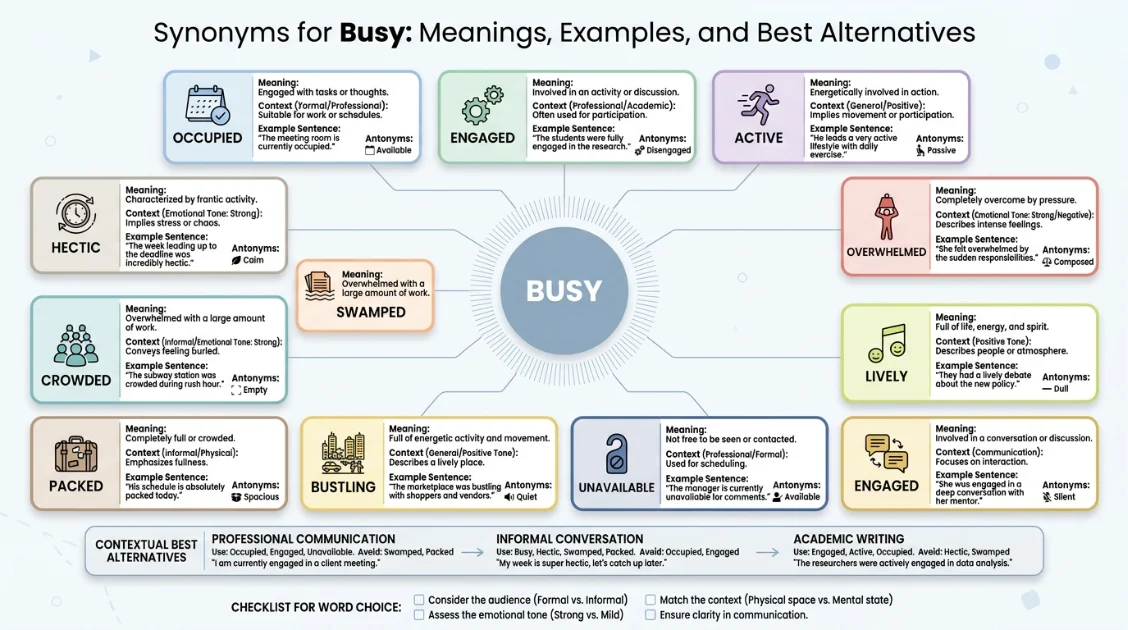
The word “busy” appears everywhere. You may use it in emails, work messages, essays, conversations, social media captions, or a resume, but repeating the same word can make your vocabulary feel limited.
Learning synonyms for busy helps you describe the exact situation. You might be occupied with work, engaged in a project, overwhelmed by responsibilities, or surrounded by activity. The right alternative makes your writing clearer and your message more precise.
What Does “Busy” Mean?
Busy means actively occupied, involved, or unavailable because of work, activities, people, or responsibilities. Depending on context, useful alternatives include occupied for formal writing, engaged for professional communication, hectic for intense situations, and bustling for places.
Meaning, Tone and Context
Simple Definition
“Busy” describes someone or something that has a lot of activity, work, tasks, people, or movement.
For a person, it usually means they have something to do or are not currently available. For a place, it can describe a high level of activity or many people.
Part of Speech
“Busy” is primarily an adjective.
Examples include:
• I am busy this afternoon.
• The restaurant is busy tonight.
• She has a busy schedule.
The related noun is “busyness,” although “a busy schedule” or “a demanding workload” often sounds more natural.
Tone
The tone of “busy” is generally neutral.
However, the emotional meaning can change with context. “Busy” can suggest productivity, pressure, excitement, inconvenience, or overcrowding.
Formality Level
“Busy” is common in everyday English and works in most situations.
For professional or academic writing, a more precise word can sometimes communicate the intended meaning better.
Common Use Cases
You can use “busy” to describe:
• A person with many responsibilities
• A workplace with many tasks
• A schedule filled with appointments
• A crowded location
• A period with intense activity
• A phone line that cannot accept another call
• A person who is unavailable
When and How to Use “Busy”
“Busy” is useful when you want a simple, natural way to say that someone or something has a lot of activity or demands.
Professional
“Our team is busy preparing the quarterly presentation.”
Personal
“I have been busy with family responsibilities this week.”
Academic
“Students become especially busy during final exam season.”
Emotional
“She felt busy all day but still worried that she had not accomplished enough.”
Creative
“The busy streets came alive as the city prepared for the festival.”
Social Media
“Busy day, but I finally finished everything on my list.”
“I am busy with meetings today, but I can respond tomorrow morning.”
Another Word for “Busy”
The best single replacement depends on what you mean.
If you mean having many tasks, occupied is a strong general alternative. If you mean involved in something, engaged may be better.
For intense pressure, use hectic. For a crowded place, bustling or crowded is more precise.
Professional Writing
Use occupied, engaged, active, or involved.
Example: “I am currently engaged in several client projects.”
Academic Writing
Use occupied, active, engaged, or involved, depending on the sentence.
Example: “The researchers were actively involved in the study.”
Casual Conversation
Use tied up, swamped, packed, or simply occupied.
Example: “I am tied up this afternoon.”
Emotional Writing
Use overwhelmed, stressed, or swamped when the word needs to communicate pressure.
Example: “She felt overwhelmed by everything on her schedule.”
Creative Writing
Use bustling, lively, teeming, or active when describing a place or atmosphere.
Example: “The bustling market filled the street with music and conversation.”
Resume or Workplace Use
Use managed, handled, coordinated, juggled, or oversaw when describing productive responsibilities.
Example: “Managed multiple client accounts while meeting weekly deadlines.”
Social Media Captions
Use packed, hectic, nonstop, or full for an informal and natural tone.
Example: “A packed day, but every minute was worth it.”
Stronger Meaning
Use swamped, overwhelmed, hectic, or overloaded when activity creates pressure.
Softer Meaning
Use occupied, engaged, active, or involved when you want a neutral tone.
When Not to Use “Busy”
“Busy” is not always the most precise choice.
If you are describing a crowded restaurant, “busy” works, but “crowded” tells readers specifically that there are many people.
Instead of saying, “The street was busy,” you could write, “The street was bustling with shoppers.” This creates a clearer image.
In professional writing, “I am busy” can sometimes sound vague. “I am currently in meetings” gives the reader useful information.
In emotional situations, “busy” may also be too mild. If someone is struggling under excessive responsibilities, “overwhelmed” communicates the emotional pressure more effectively.
Words Commonly Confused With “Busy”
Busy vs. Occupied
“Busy” usually emphasizes activity or having many things to do. “Occupied” often emphasizes that someone is currently engaged or unavailable.
“I am busy today” sounds broad.
“I am occupied with a client meeting” sounds more specific.
Busy vs. Crowded
“Busy” can describe activity in a place. “Crowded” specifically emphasizes that many people or objects are occupying a space.
“The café is busy” means there is considerable activity.
“The café is crowded” emphasizes the number of people.
Busy vs. Hectic
“Hectic” suggests intense, rushed, or difficult activity.
“Busy” is neutral.
“My week is busy” simply means I have many things to do.
“My week is hectic” suggests that the schedule is demanding and possibly stressful.
Busy vs. Active
“Active” emphasizes movement, participation, or ongoing activity.
“Busy” often emphasizes a high amount of work or activity.
“She is active in the community” means she participates regularly.
“She is busy with community projects” emphasizes her workload.
Busy vs. Engaged
“Engaged” means involved or occupied with something.
It is often more professional than “busy.”
“She is busy with the project” is natural.
“She is engaged in the project” sounds more formal and emphasizes involvement.
Busy vs. Overwhelmed
“Overwhelmed” is much stronger than “busy.”
Someone who is busy may simply have many tasks. Someone who is overwhelmed may feel unable to manage the amount of work or pressure.
Best Synonym by Context for “Busy”
| Context | Best Synonym | Why It Works | Example |
|---|---|---|---|
| Formal writing | Occupied | Neutral and precise | The manager was occupied with several urgent matters. |
| Academic writing | Engaged | Shows active involvement | The students were engaged in laboratory research. |
| Professional use | Involved | Highlights participation | She is involved in several company initiatives. |
| Resume | Managed | Shows productive responsibility | Managed multiple projects simultaneously. |
| Casual conversation | Tied up | Natural and conversational | I am tied up this afternoon. |
| Creative writing | Bustling | Creates a vivid sense of activity | The bustling market filled the square. |
| Emotional tone | Overwhelmed | Communicates pressure | He felt overwhelmed by his workload. |
| Strong intensity | Swamped | Suggests an excessive workload | I am swamped with assignments today. |
| Soft or moderate tone | Occupied | Avoids sounding stressed | She is occupied with another task. |
| Social media | Packed | Short and expressive | My weekend is packed with plans. |
| Crowded place | Crowded | Focuses on many people | The stadium was crowded before the game. |
| Active place | Lively | Suggests energy and movement | The neighborhood is lively at night. |
| Fast paced situation | Hectic | Communicates pressure and speed | It was a hectic morning at the office. |
| Professional involvement | Engaged | Sounds polished and focused | Our team remains engaged in the project. |
| Heavy workload | Overloaded | Emphasizes excessive demands | The department is overloaded with requests. |
| Literary description | Teeming | Creates strong imagery | The harbor was teeming with boats. |
| Workplace activity | Active | Neutral and business friendly | The sales department is especially active this month. |
| Formal communication | Unavailable | Clearly explains lack of access | I am unavailable until Thursday. |
| Daily schedule | Full | Natural and moderate | My schedule is full this week. |
| Energetic environment | Vibrant | Adds positive energy | The downtown district has a vibrant atmosphere. |
Which Synonym Should You Choose?
Start by identifying what “busy” actually means in your sentence.
- If you simply have things to do, choose occupied. If you are participating in something, choose engaged or involved.
- If your workload feels difficult to control, choose swamped, overloaded, or overwhelmed.
- If you are describing a place, think about the specific image you want. Use crowded for many people, bustling for energetic activity, and lively for an enjoyable atmosphere.
For professional communication, avoid dramatic words unless they accurately describe the situation. “Occupied” or “engaged” can sound more polished than “swamped.”
Real Life Examples of “Busy” in Sentences
School
“Students often have busy schedules during the final weeks of the semester.”
Workplace
“Our office is busy preparing for the annual conference.”
Writing
“The writer had a busy morning filled with research and editing.”
Conversation
“Sorry I missed your call. I was busy all afternoon.”
Social Media
“Busy weekend, beautiful memories.”
Resume
“Managed a busy customer service desk while maintaining accurate records.”
“I am busy with meetings today, but I will review the document tomorrow.”
Storytelling
“The busy streets gradually became quiet as the evening ended.”
25 Synonyms for “Busy”
| Synonym | Simple Meaning | Best Used For | Example Sentence |
|---|---|---|---|
| Occupied | Having something to do | General and formal situations | I am occupied with an important project. |
| Engaged | Actively involved | Professional and academic contexts | She is engaged in research this semester. |
| Involved | Taking part in something | Work and personal activities | He is involved in several community projects. |
| Active | Doing or participating frequently | People, groups, places, and organizations | The organization remains active throughout the year. |
| Hectic | Very busy and rushed | Stressful schedules | Monday was hectic from start to finish. |
| Swamped | Extremely busy | Heavy workloads | I am swamped with emails today. |
| Overwhelmed | Unable to comfortably manage demands | Emotional or stressful situations | She felt overwhelmed by her growing workload. |
| Overloaded | Given more work than can easily be handled | Work and systems | The support team is overloaded with requests. |
| Crowded | Filled with many people or things | Places and spaces | The train was crowded during rush hour. |
| Bustling | Full of energetic activity | Streets, markets, cities, and businesses | The bustling downtown area attracts visitors every weekend. |
| Lively | Full of energy and activity | Social and physical settings | The restaurant has a lively atmosphere. |
| Teeming | Filled with large numbers of people or things | Descriptive and creative writing | The harbor was teeming with boats. |
| Packed | Filled or completely scheduled | Schedules, places, and events | My calendar is packed this week. |
| Full | Containing many activities or commitments | Schedules and calendars | I have a full schedule tomorrow. |
| Tied up | Temporarily unavailable because of something | Casual and workplace conversation | I am tied up in a meeting right now. |
| Unavailable | Not free to respond or participate | Professional communication | The director is unavailable this afternoon. |
| Active | Characterized by considerable activity | Business and general description | It has been an active week for the sales team. |
| Vibrant | Energetic and lively | Places and creative descriptions | The city has a vibrant downtown district. |
| Industrious | Hardworking and productive | Formal descriptions of people | She is an industrious employee who consistently meets deadlines. |
| Diligent | Careful and persistent in work | Academic and professional writing | He is diligent about completing every assignment. |
| Assiduous | Very persistent and hardworking | Formal writing | Her assiduous efforts improved the quality of the project. |
| Laboring | Working hard or continuously | Formal and literary contexts | The workers were laboring through the afternoon. |
| Preoccupied | Deeply focused on something else | Mental attention and distraction | He was preoccupied with an upcoming presentation. |
| In demand | Wanted by many people | Services, professionals, and products | Skilled technicians are currently in demand. |
| Occupied | Engaged with a task or responsibility | Formal and neutral contexts | The consultant was occupied with another client. |
Note: Some words above are contextual alternatives rather than perfect replacements in every sentence. For example, “crowded” describes a space, while “industrious” describes a person’s work habits.
Synonym Groups and Usage Differences
Professional vs. Personal Synonyms
Professional communication usually benefits from precise and neutral words such as occupied, engaged, involved, and unavailable.
Personal conversations allow more expressive options such as tied up, packed, and swamped.
Compare:
“I am unavailable until 3 p.m.”
“I am tied up until 3 p.m.”
Both communicate limited availability, but the second sounds more conversational.
Formal vs. Conversational Synonyms
For reports, formal emails, essays, and presentations, choose occupied, engaged, involved, diligent, or industrious when appropriate.
For texts and casual conversation, tied up, packed, and swamped sound more natural.
Academic Synonyms
Academic writing often benefits from precision rather than dramatic language.
Use engaged, involved, active, occupied, or diligent, depending on the intended meaning.
For example:
“The students were engaged in independent research.”
This is more informative than simply saying:
“The students were busy.”
Professional and Business Synonyms
Workplace writing should explain what makes someone busy whenever possible.
Instead of “I am busy,” consider:
- “I am in meetings this morning.”
- “I am currently handling several client requests.”
- “I am engaged in another project.”
- “I am unavailable until tomorrow.”
These versions provide more useful information.
Creative or Literary Synonyms
Creative writing benefits from words that create a stronger picture.
Bustling, teeming, lively, and vibrant can describe an energetic environment.
For example:
“The bustling market spilled into the narrow streets.”
This creates a stronger image than:
“The busy market filled the streets.”
Slang or Modern Synonyms
Casual expressions such as swamped, tied up, and packed are common in modern American conversation.
They are appropriate for texts, informal emails, and casual speech.
Avoid them in formal academic or professional writing when a more precise alternative is available.
Strongest vs. Weaker Synonyms
A useful intensity scale is:
Occupied → Engaged → Active → Hectic → Swamped → Overloaded → Overwhelmed
The first few words can remain neutral.
The final words suggest that the amount of work or activity has become difficult to manage.
Emotional vs. Neutral Synonyms
Neutral choices include occupied, engaged, active, and involved.
Words such as swamped, overloaded, and overwhelmed add emotional or stressful meaning.
Choose the emotional version only when the situation genuinely involves pressure.
Antonyms of “Busy”
| Antonym | Meaning | Example Sentence |
|---|---|---|
| Idle | Not working or active | The machines remained idle overnight. |
| Free | Available with no current commitment | I am free this evening. |
| Available | Ready to respond or participate | The manager is available after lunch. |
| Unoccupied | Not currently engaged in an activity | The room was unoccupied for several hours. |
| Inactive | Not participating or operating | The account has been inactive for months. |
| Quiet | Having little activity or noise | The office was quiet after everyone left. |
| Calm | Peaceful and without intense activity | The morning was calm and relaxed. |
| Empty | Containing no people or things | The parking lot was empty. |
| Vacant | Not occupied | Several offices remained vacant. |
| Leisurely | Done without hurry | They enjoyed a leisurely afternoon. |
| Relaxed | Free from pressure or tension | We had a relaxed evening at home. |
| Still | Without movement or activity | The streets were still before sunrise. |
| Dormant | Temporarily inactive | The project remained dormant for several months. |
| Resting | Taking a break from activity | The team was resting after the event. |
| Unhurried | Not rushed | She took an unhurried walk through the park. |
Comparison: “Busy” vs. Similar Words
Busy vs. Occupied
The main difference is emphasis. “Busy” focuses on having activity or tasks, while “occupied” focuses on being engaged or unavailable.
“Occupied” is slightly more formal.
“I am busy this afternoon.”
“I am occupied with a client meeting.”
Busy vs. Hectic
“Hectic” is stronger because it suggests rushed or intense activity.
“Hectic” can also carry a stressful feeling.
“My schedule is busy this week.”
“My schedule is hectic this week.”
Busy vs. Crowded
“Crowded” is specifically about space containing many people or objects.
“Busy” is broader and can describe activity.
“The restaurant is busy.”
“The restaurant is crowded.”
Busy vs. Active
“Active” focuses on participation, movement, or ongoing activity.
It is often more neutral than “busy.”
“She is busy with several projects.”
“She is active in several professional organizations.”
Busy vs. Engaged
“Engaged” emphasizes involvement and attention.
It often sounds more polished in professional and academic writing.
“He is busy with the research.”
“He is engaged in the research.”
Busy vs. Overwhelmed
“Overwhelmed” is much stronger.
It means that demands may feel excessive or difficult to manage.
“She is busy with work.”
“She is overwhelmed by her workload.”
Common Phrases and Expressions with “Busy”
1. Busy schedule
Meaning:
A schedule containing many appointments, tasks, or commitments.
Example sentence:
“I have a busy schedule this week.”
2. Busy day
Meaning:
A day filled with many activities or responsibilities.
Example sentence:
“It was a busy day at the office.”
3. Busy week
Meaning:
A week containing many tasks or events.
Example sentence:
“We have a busy week ahead of us.”
4. Busy season
Meaning:
A period when work or activity becomes unusually high.
Example sentence:
“The holiday season is our busiest time of year.”
5. Busy with something
Meaning:
Being occupied with a particular activity.
Example sentence:
“She is busy with a new marketing project.”
6. Keep busy
Meaning:
To stay occupied with activities or tasks.
Example sentence:
“I read and exercise to keep busy during the weekend.”
7. Busy street
Meaning:
A street with considerable traffic, movement, or activity.
Example sentence:
“They opened a café on a busy street downtown.”
8. Busy signal
Meaning:
A telephone signal indicating that a line is currently unavailable.
Example sentence:
“I called twice but kept getting a busy signal.”
Common Mistakes to Avoid
1. Using “Busy” When a More Precise Word Is Better
“The restaurant was busy” is understandable, but “crowded” may be better if the main issue is the number of customers.
2. Confusing “Busy” With “Hectic”
A busy schedule does not always feel stressful.
Use “hectic” when you want to communicate speed, pressure, or disorder.
3. Using Casual Synonyms in Formal Writing
Words such as “swamped” and “tied up” work well in conversation but may sound too informal in academic or highly formal writing.
4. Using an Overly Dramatic Synonym
Do not describe an ordinary workload as “overwhelming” unless it genuinely feels difficult to manage.
5. Repeating “Busy” Too Often
Repeating the same adjective can make writing feel flat.
Replace it with a more precise word when the context supports it.
6. Choosing the Wrong Emotional Tone
“Occupied” is neutral, while “overwhelmed” suggests pressure.
Choose based on the feeling you want readers to understand.
7. Using Slang in Academic or Professional Writing
Informal expressions can weaken otherwise polished writing.
Choose words such as “engaged,” “occupied,” or “involved” when the situation calls for a professional tone.
FAQs
1. What is the best synonym for busy?
The best synonym depends on context. “Occupied” is a strong general choice, while “engaged,” “hectic,” “swamped,” and “bustling” suit specific situations.
2. What is a formal synonym for busy?
“Occupied” and “engaged” are useful formal alternatives. “Involved” also works well when describing participation in professional or academic activities.
3. What is an informal synonym for busy?
“Tied up,” “swamped,” and “packed” are common informal alternatives. They work especially well in casual conversations, texts, and informal emails.
4. What is another word for busy in professional writing?
Use “occupied,” “engaged,” “involved,” or “unavailable.” For resumes, action verbs such as “managed” and “coordinated” can communicate productive work more effectively.
5. What is the difference between busy and hectic?
“Busy” means having many activities or responsibilities. “Hectic” is stronger and suggests that the activity is rushed, intense, or stressful.
6. What is the opposite of busy?
Common opposites include “free,” “available,” “idle,” “inactive,” “unoccupied,” “quiet,” and “unhurried.” The best choice depends on the intended meaning.
Conclusion
The word “busy” is useful because it works in everyday conversation, professional communication, academic writing, and descriptions of places. However, choosing more precise synonyms for busy can make your vocabulary clearer and more expressive.
Use occupied for a neutral alternative, engaged for involvement, hectic for intense activity, swamped for a heavy workload, and bustling for an energetic place.
The best synonym is not always the most sophisticated word. Choose the word that accurately matches the meaning, tone, and situation. A simple vocabulary habit is to ask yourself what “busy” actually means in your sentence, then replace it with the most precise word.
Read More Related Articles:
- 25+ Synonyms for Secret | Meanings, Examples, and Best …
- 25+ Synonyms for God | Meanings, Examples, and Best …
- 25+ Synonyms for Action | Meanings, Examples, and Best …