The word water appears everywhere. You may use it in an essay, describe a glass in an email, write a travel caption about the ocean, or explain a science topic at school. Repeating the same word can make otherwise strong writing feel plain.
Learning synonyms for water helps you choose language that matches your exact meaning. Sometimes you need a scientific term such as H2O. In other situations, freshwater, seawater, liquid, moisture, or a literary expression may communicate the idea more precisely.
The key is accuracy. Not every word related to water can replace water in every sentence. This guide explains the differences so you can improve vocabulary without sacrificing natural English or clarity.
What Does “Water” Mean?
Water is a clear liquid essential to life, commonly represented chemically as H2O. Depending on context, useful alternatives include liquid or H2O in scientific writing, freshwater in environmental contexts, drinking water professionally, and aqua or moisture in specialized or creative contexts.
Meaning, Tone and Context
Simple Definition
Water is a liquid made of hydrogen and oxygen. It is essential for humans, animals, plants, ecosystems, agriculture, and many industrial processes.
The word can describe a substance, a quantity of liquid, a body of water, or an action involving water.
Part of Speech
Water can function as both a noun and a verb.
As a noun, it refers to the substance itself.
Example: “Please drink more water.”
As a verb, it can mean to give water to something or to become filled with tears.
Example: “She watered the plants before leaving.”
Tone
Water is neutral in tone. It works naturally in casual conversation, academic writing, business communication, journalism, technical writing, and creative work.
Its meaning becomes more specific when you replace it with a contextual term.
Formality Level
Water is neither especially formal nor informal. It is a standard everyday word that is appropriate in almost any situation.
More specialized alternatives can make writing more precise rather than simply more formal.
Common Use Cases
Water commonly appears in discussions about:
- Drinking and hydration
- Health and nutrition
- Oceans, lakes, and rivers
- Weather and climate
- Agriculture
- Environmental science
- Chemistry
- Plumbing
- Travel and recreation
- Household activities
- Business and industry
- Creative descriptions
Important Word Forms and Related Terms
Water can become watered when used as a verb.
Related words include watery, waterless, aquatic, hydration, hydration related, and moisture.
These words are related to water, but they are not interchangeable synonyms in every sentence.
When and How to Use “Water”
Water is the best choice when you mean the substance generally and no additional detail is needed.
1. Casual Conversation
“Could you bring me a glass of water?”
2. Academic Writing
“Plants require water, sunlight, and nutrients to grow.”
3. Professional Communication
“The facility uses a large amount of water during daily operations.”
4. Personal Writing
“I drank some water after my morning walk.”
5. Social Media
“Nothing beats a quiet morning beside the water.”
6. Email
“Please make sure there is enough water available for the event.”
7. Creative Writing
“Moonlight shimmered across the still water.”
Another Word for “Water”
The best single replacement depends heavily on what you mean.
There is no universal substitute that works naturally in every sentence. For general writing, liquid can sometimes work, while H2O suits scientific contexts and aqua works in certain specialized or creative contexts.
Here are practical choices by situation:
| Situation | Useful Alternative |
|---|---|
| Professional writing | Drinking water |
| Academic writing | H2O |
| Casual conversation | Drink |
| Emotional writing | Tears, when water means tears |
| Creative writing | Liquid, stream, or tide, depending on meaning |
| Resume or workplace use | Potable water, drinking water, or water supply |
| Social media captions | Aqua, waves, sea, or ocean, depending on the subject |
| Stronger or more precise meaning | Floodwater, seawater, or brine |
| Softer descriptive meaning | Moisture |
The important point is precision. Moisture describes small amounts of liquid present in or on something, while water is the broader term.
When Not to Use “Water”
Water is often the right word, but a more precise term can improve your sentence when the source, condition, location, or purpose matters.
For example:
“Water covered the road.”
This sentence is understandable but vague.
“Floodwater covered the road.”
The second sentence immediately tells the reader what kind of water is involved.
Another example is:
“The experiment used water.”
In a chemistry context, “The experiment used distilled water” provides much more useful information.
Avoid replacing water with an unusual word simply to sound sophisticated. Precision is more valuable than complexity.
Words Commonly Confused With “Water”
Water vs. Moisture
Water is the general substance. Moisture usually refers to a small amount of water present in something.
Example: “The soil needs water.”
Example: “The soil contains enough moisture.”
Water vs. Liquid
Water is one specific liquid. Liquid is a broader category that includes water, oil, milk, and many other substances.
Example: “The bottle contains water.”
Example: “The container holds an unknown liquid.”
Water vs. Hydration
Water is a substance. Hydration refers to the process or state of supplying or retaining enough fluid.
Example: “Drink water regularly.”
Example: “Good hydration is important during exercise.”
Water vs. Aqua
Aqua is a Latin derived term associated with water. In modern English, it often appears in names, product descriptions, color terminology, and specialized expressions.
Example: “The resort features an aqua themed design.”
Water vs. H2O
H2O is the chemical formula for water. It is especially appropriate in chemistry and scientific contexts.
Example: “Water is H2O.”
Example: “The sample contained H2O molecules.”
Best Synonym by Context for “Water”
| Context | Best Synonym | Why It Works | Example |
|---|---|---|---|
| Formal writing | Potable water | Clearly identifies water safe for drinking | “The project will improve access to potable water.” |
| Academic writing | H2O | Precise scientific representation | “H2O consists of hydrogen and oxygen.” |
| Professional use | Water supply | Describes availability or infrastructure | “The building has a reliable water supply.” |
| Workplace use | Drinking water | Clearly identifies water intended for consumption | “Employees have access to drinking water.” |
| Resume | Water management | Useful for relevant environmental or technical work | “Assisted with water management projects.” |
| Casual conversation | Drink | Natural when referring to something consumed | “Can I get a drink?” |
| Creative writing | Stream | Useful when describing flowing water in a natural setting | “A clear stream wound through the forest.” |
| Emotional writing | Tears | Appropriate when water refers to tears | “Tears filled her eyes.” |
| Strong intensity | Floodwater | Indicates a large and potentially destructive amount | “Floodwater entered several homes.” |
| Soft or moderate description | Moisture | Useful for a small amount of water | “Morning moisture covered the leaves.” |
| Social media | Waves | Works well for ocean or beach imagery | “Listening to the waves all afternoon.” |
| Environmental writing | Freshwater | Specifies water with low salt content | “Freshwater ecosystems support diverse species.” |
| Marine writing | Seawater | Specifies ocean water | “The researchers analyzed seawater samples.” |
| Agriculture | Irrigation water | Identifies water used for crops | “The farm conserves irrigation water.” |
| Weather writing | Rainwater | Identifies water produced by rainfall | “The system collects rainwater.” |
Which Synonym Should You Choose?
Start by asking what kind of water you actually mean.
If you mean the substance generally, use water. It is clear, natural, and almost always appropriate.
If you need scientific precision, use H2O. If the subject is environmental science, freshwater, seawater, groundwater, or rainwater may be more accurate.
For professional writing, identify the purpose when possible. Potable water, drinking water, water supply, and irrigation water provide more information than the general word water.
For creative writing, choose a word that describes what the reader can see or feel. Stream, wave, tide, droplet, or rain can create a clearer image.
Finally, consider tone. A scientific report needs precision, while a poem may benefit from imagery.
Real Life Examples of “Water” in Sentences
School
“Students learned how the water cycle moves water through the atmosphere, land, and oceans.”
Workplace
“The company is reviewing its water consumption to reduce operating costs.”
Writing
“Clean water is essential for healthy communities.”
Conversation
“I need some water after that workout.”
Social Media
“Clear water, warm sunshine, and a perfect afternoon.”
Resume
“Supported projects focused on water conservation and resource management.”
“Please confirm whether bottled drinking water will be available for attendees.”
Storytelling
“After hours in the heat, the sound of running water felt like a welcome promise of relief.”
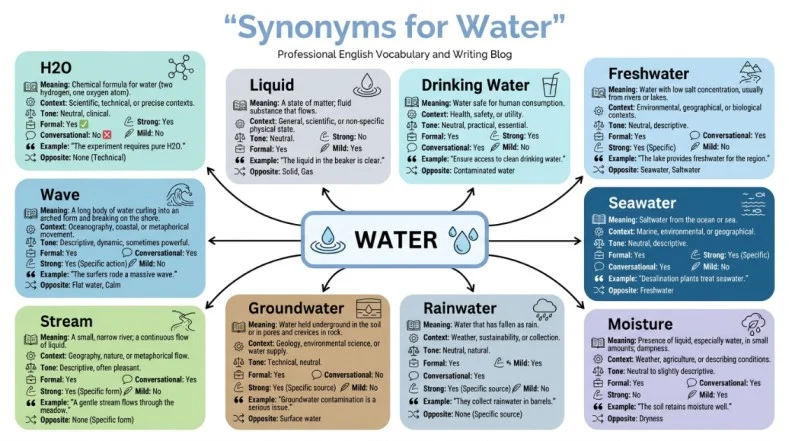
25 Synonyms for “Water”
Some entries below are direct substitutes only in particular contexts. Others are closely related alternatives that specify a particular form, source, use, or appearance of water. This distinction matters because English does not have 25 universal one word replacements for water.
| Synonym | Simple Meaning | Best Used For | Example Sentence |
|---|---|---|---|
| H2O | Chemical representation of water | Chemistry and science | “The sample contained H2O.” |
| Aqua | Water, often used in specialized language | Names, design, and specialized contexts | “The product has an aqua inspired appearance.” |
| Liquid | A substance in fluid form | General or technical descriptions | “The bottle contained a clear liquid.” |
| Fluid | A substance capable of flowing | Technical and scientific writing | “The body requires adequate fluid intake.” |
| Drink | Something consumed for hydration | Casual conversation | “I need a cold drink.” |
| Drinking water | Water intended for consumption | Health and professional communication | “The facility provides safe drinking water.” |
| Potable water | Water considered safe to drink | Technical and formal writing | “The village needs reliable potable water.” |
| Freshwater | Water with relatively low salt content | Environmental and geographic writing | “Freshwater habitats support many species.” |
| Seawater | Salt water from the sea | Marine science | “The researchers collected seawater samples.” |
| Saltwater | Water containing significant salt | Marine and general descriptions | “Saltwater covered the lower rocks.” |
| Groundwater | Water stored below the ground | Environmental science | “The town depends on groundwater.” |
| Rainwater | Water collected from rainfall | Weather, conservation, and gardening | “They collect rainwater for the garden.” |
| Springwater | Water that comes from a natural spring | Nature and drinking contexts | “The hikers filled their bottles with springwater.” |
| Floodwater | Water produced by flooding | Weather and emergency contexts | “Floodwater blocked the road.” |
| Runoff | Water flowing over land | Environmental and agricultural writing | “Heavy rain increased surface runoff.” |
| Irrigation water | Water supplied to crops | Agriculture | “Farmers are conserving irrigation water.” |
| Wastewater | Water affected by household or industrial use | Infrastructure and environmental writing | “The plant treats wastewater before discharge.” |
| Moisture | A small amount of water present in something | Soil, air, food, and materials | “The soil retained enough moisture.” |
| Droplet | A small drop of liquid | Descriptive and scientific writing | “A droplet rested on the leaf.” |
| Dew | Small drops formed on cool surfaces | Nature and creative writing | “Morning dew covered the grass.” |
| Condensation | Water formed when vapor cools | Science and weather | “Condensation formed on the cold glass.” |
| Brine | Highly salty water | Food processing and science | “The vegetables were preserved in brine.” |
| Tide | Regular rise and fall of ocean water | Coastal and literary contexts | “The tide reached the rocks by sunset.” |
| Wave | A moving ridge of water | Ocean descriptions and creative writing | “A large wave reached the shore.” |
| Stream | A small flowing body of water | Geography and creative writing | “A narrow stream crossed the trail.” |
Synonym Groups and Usage Differences
Professional vs. Personal Synonyms
Personal writing usually needs simple language. Water, drink, and drinking water are natural choices.
Professional writing often benefits from greater specificity. Potable water, water supply, water management, wastewater, and irrigation water can communicate the exact subject.
For example:
Personal: “I drank some water.”
Professional: “The facility requires a reliable supply of potable water.”
Formal vs. Conversational Synonyms
Water itself works in both formal and conversational English.
Words such as potable water and fluid are more specialized. Drink is more conversational when referring to something consumed.
In an academic report, “The participants consumed sufficient water” is more appropriate than using an overly casual expression.
Academic Synonyms
Scientific and academic writing benefits from precision.
Useful terms include H2O, freshwater, seawater, groundwater, condensation, runoff, and moisture.
Choose the word according to the scientific concept rather than simply searching for a more sophisticated alternative.
Professional and Business Synonyms
Business communication often requires terminology connected to a specific purpose.
Useful terms include water supply, drinking water, potable water, water management, wastewater, and irrigation water.
For example, a sustainability report might discuss “water consumption” rather than simply repeating “water” throughout the document.
Creative or Literary Synonyms
Creative writing benefits from concrete imagery.
Instead of repeatedly writing “water,” a writer might use stream, wave, tide, droplet, dew, rainwater, or seawater, depending on what the scene actually contains.
These words do more than avoid repetition. They help readers visualize the setting.
Slang or Modern Synonyms
There is no widely accepted slang word that universally replaces water in standard American English.
Words such as H2O may appear casually in fitness, sports, advertising, and social media contexts, but they are better treated as informal shorthand or scientific notation rather than true slang.
Avoid forcing trendy language into formal or academic writing.
Strongest vs. Weaker Synonyms
Water does not have a simple intensity scale because different alternatives describe different types or conditions rather than different strengths.
A useful descriptive scale is:
Moisture: small amount of water
Droplet: very small amount in drop form
Water: general substance
Stream: flowing body of water
Wave: moving water
Floodwater: water associated with flooding and potentially destructive conditions
The strongest choice depends on the situation, not on the word itself.
Emotional vs. Neutral Synonyms
Water is neutral.
Tears can add emotional meaning when water refers to crying.
Floodwater can suggest danger or disruption.
Dew can create a peaceful or delicate image.
Waves can create an energetic or scenic feeling.
Choose the word that conveys the intended image rather than simply choosing the most unusual synonym.
Antonyms of “Water”
Water does not have 15 exact dictionary antonyms. In fact, it has no single universal opposite in English.
For vocabulary building, the following terms represent contextual contrasts with water, especially in discussions about dryness, absence of water, or reduced moisture. They should not all be treated as strict lexical antonyms.
| Antonym | Meaning | Example Sentence |
|---|---|---|
| Dryness | Lack of moisture | “Dryness damaged the plants.” |
| Aridity | Extreme lack of moisture | “Aridity makes agriculture difficult.” |
| Drought | Extended period with little precipitation | “The drought reduced reservoir levels.” |
| Dehydration | Loss or lack of sufficient water | “Dehydration can become dangerous in extreme heat.” |
| Desiccation | Severe drying | “Desiccation affected the exposed soil.” |
| Waterlessness | Complete or near complete absence of water | “Waterlessness makes survival difficult.” |
| Dry land | Land lacking standing water | “The animals moved toward dry land.” |
| Dry soil | Soil with little moisture | “The dry soil needed irrigation.” |
| Dryness of air | Low atmospheric moisture | “The dryness of the air irritated his skin.” |
| Depletion | Reduction of an available supply | “Groundwater depletion is a serious concern.” |
| Scarcity | Insufficient availability | “Water scarcity affects many communities.” |
| Absence | State of not being present | “The absence of water stopped the experiment.” |
| Evaporation | Process that removes liquid water into vapor | “Evaporation increased during the hot afternoon.” |
| Dehumidification | Removal of moisture from air | “Dehumidification reduced moisture indoors.” |
| Desiccant | Substance used to remove moisture | “The package contained a desiccant.” |
These are best understood as contextual opposites, not as 15 perfect dictionary antonyms.
Comparison: Water vs. Similar Words
Water vs. Moisture
Main difference: Water is the general substance, while moisture usually means a small amount of water present in something.
Stronger: Water is broader. Moisture suggests a smaller quantity.
More formal: Neither is inherently more formal.
Example: “The plant needs water.”
Example: “The soil contains enough moisture.”
Water vs. Liquid
Main difference: Water is one specific liquid. Liquid refers to a broader physical state.
Stronger: Neither is inherently stronger.
More formal: Liquid can sound more technical in certain contexts.
Example: “She spilled water.”
Example: “The container held an unidentified liquid.”
Water vs. Fluid
Main difference: Fluid is a broader technical term for substances that flow.
Stronger: Neither.
More formal: Fluid is often more technical.
Example: “Drink enough water.”
Example: “The patient received intravenous fluid.”
Water vs. H2O
Main difference: Water is the common English word, while H2O is its chemical formula.
Stronger: Neither.
More formal: H2O is more scientific.
Example: “Water freezes at low temperatures.”
Example: “H2O contains hydrogen and oxygen.”
Water vs. Aqua
Main difference: Aqua is a Latin derived term associated with water and appears in particular names, descriptions, and specialized contexts.
Stronger: Neither.
More formal: Aqua can sound more stylized or specialized.
Example: “The pool contains water.”
Example: “The design uses an aqua color palette.”
Water vs. Hydration
Main difference: Water is a substance, while hydration describes the state or process of providing or retaining adequate fluid.
Stronger: Neither.
More formal: Hydration is more specialized.
Example: “Drink water throughout the day.”
Example: “Proper hydration supports physical performance.”
Common Phrases and Expressions with “Water”
1. Drink plenty of water
Meaning:
To consume an adequate amount of water.
Example sentence:
“Remember to drink plenty of water during the summer.”
2. Underwater
Meaning:
Located beneath the surface of water.
Example sentence:
“The researchers photographed the underwater habitat.”
3. Water bottle
Meaning:
A container designed to hold water.
Example sentence:
“She carried a reusable water bottle to class.”
4. Water supply
Meaning:
The available amount or system that provides water.
Example sentence:
“The city is working to protect its water supply.”
5. Water quality
Meaning:
The condition and suitability of water for a particular use.
Example sentence:
“Local officials regularly test water quality.”
6. Water cycle
Meaning:
The continuous movement of water through the environment.
Example sentence:
“Students studied the water cycle in science class.”
7. Water conservation
Meaning:
The practice of reducing unnecessary water use and protecting water resources.
Example sentence:
“Water conservation can lower household consumption.”
8. Water treatment
Meaning:
Processes used to improve water quality or make it suitable for a particular purpose.
Example sentence:
“The facility uses advanced water treatment technology.”
Common Mistakes to Avoid
1. Using Water When a More Precise Term Is Better
“Water damaged the basement” is understandable, but “floodwater damaged the basement” gives readers more information.
2. Treating Every Related Word as a Perfect Synonym
Moisture, fluid, liquid, and hydration are related to water but do not mean exactly the same thing.
3. Using a Casual Alternative in Formal Writing
“Drink” can sound too conversational when the intended meaning is potable water in a technical report.
4. Choosing an Overly Dramatic Word
Do not use “floodwater” simply to make ordinary water sound more powerful. The word should describe an actual flooding situation.
5. Repeating Water Too Often
Repetition is not automatically wrong. Replace water only when the alternative adds meaning or improves style.
6. Choosing the Wrong Emotional Tone
“Dew” may create a delicate natural image, while “floodwater” can suggest danger. Choose according to the intended mood.
7. Using Slang or Shorthand in Academic Writing
H2O can be appropriate in scientific writing, but it should not replace the normal word water everywhere. Use each term where it serves a clear purpose.
FAQs
1. What is the best synonym for water?
The best synonym depends on context. Use liquid for a broad substitute, H2O for science, freshwater for environmental writing, and drinking water for consumption.
2. What is a formal synonym for water?
Potable water is a useful formal and technical alternative when you specifically mean water that is safe for drinking. Water supply is useful for infrastructure discussions.
3. What is an informal synonym for water?
Drink can work informally when you mean something to consume. H2O is also common as casual shorthand, especially in fitness or social media contexts.
4. What is another word for water in professional writing?
Professional alternatives include potable water, drinking water, water supply, wastewater, water management, and irrigation water, depending on the specific meaning.
5. What is the difference between water and moisture?
Water is the general substance, while moisture usually describes a small amount of water present in soil, air, food, plants, or another material.
6. What is the opposite of water?
Water has no single universal antonym. Contextual opposites include dryness, drought, aridity, dehydration, desiccation, and water scarcity.
Conclusion
Water is a simple, essential word, but its alternatives can communicate much more precise meanings. The best choice depends on what you are describing, including its source, purpose, quantity, movement, or condition.
For scientific writing, H2O can provide precision. For environmental topics, freshwater, groundwater, seawater, and runoff are useful. Professional communication, potable water, drinking water, water supply, and water management can be more informative.
In creative writing, words such as stream, wave, tide, dew, and droplet can create stronger imagery when they accurately describe the scene.
The most useful vocabulary habit is simple: do not replace water just to avoid repetition. Replace it when the new word gives your reader a clearer, more specific, or more vivid understanding.
Read More Related Articles:
- 25+ Synonyms for Secret | Meanings, Examples, and Best …
- 25+ Synonyms for God | Meanings, Examples, and Best …
- 25+ Synonyms for Action | Meanings, Examples, and Best …