Using the word “same” repeatedly can make a sentence, email, essay, caption, or workplace message sound flat. A simple change to “identical,” “similar,” “equivalent,” or “unchanged” can make your meaning much more precise.
The best synonym depends on what you mean. This guide to synonyms for same explains the differences between common alternatives, from everyday conversation to academic writing, professional communication, resumes, creative writing, and social media.
What Does “Same” Mean?
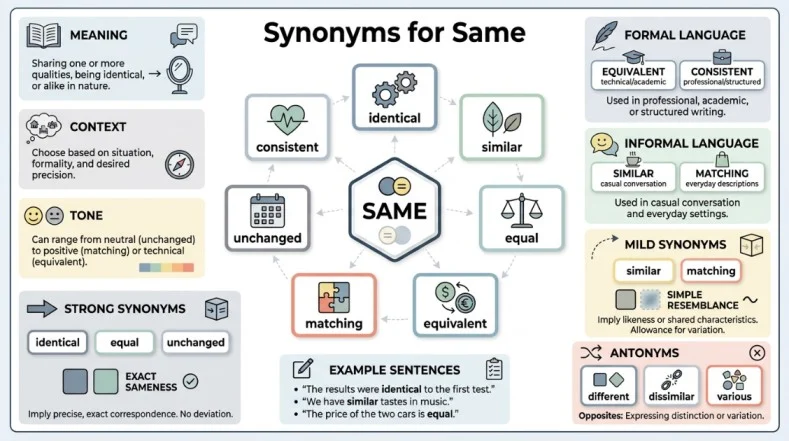
“Same” means identical in identity, characteristics, amount, or condition, or referring to something already mentioned. Useful alternatives include identical for exact matches, similar for resemblance, equivalent for equal value, and unchanged for something that remains constant.
Meaning, Tone and Context
Simple Definition
“Same” generally describes something that is identical to another thing or remains unchanged. It can also refer back to something previously mentioned.
For example:
“We chose the same restaurant.”
Here, “same” tells us that two people chose one identical restaurant.
Part of Speech
“Same” is most commonly used as a determiner, adjective, pronoun, or adverb.
Examples include:
“We have the same teacher.”
“She ordered the same.”
“The two answers are the same.”
“I feel the same.”
Tone
“Same” is usually neutral. It does not automatically express a positive or negative opinion.
The surrounding words determine the emotional effect.
“We had the same wonderful experience.”
“They made the same mistake again.”
Formality Level
“Same” is common in everyday English and is completely acceptable in professional and academic writing when it expresses the intended meaning.
However, more specific alternatives can make formal writing more precise.
For example:
“The results were the same.”
can become:
“The results were identical.”
if the results truly matched exactly.
Common Use Cases
You can use “same” when discussing:
- Identical objects
- Similar experiences
- Repeated actions
- Unchanged conditions
- Equal amounts
- Shared opinions
- Repeated mistakes
- Matching choices
- Previously mentioned information
- Consistent situations
Related Word Forms
“Same” does not have a conventional noun, verb, and adjective family in the way many vocabulary words do.
Related words include “sameness,” which refers to the quality of being the same, and “similarly,” which can describe resemblance but is not a direct grammatical form of “same.”
When and How to Use “Same”
“Same” works best when the meaning is clear from context. It is especially useful when two things share an identity, quality, condition, amount, or characteristic.
1. Professional
“Both departments use the same reporting system.”
2. Personal
“We had the same idea about where to go.”
3. Academic
“The two studies reached the same conclusion.”
4. Emotional
“I still have the same feelings about the situation.”
5. Creative
“The street looked the same after all those years.”
6. Social Media
“Same outfit, same coffee, same weekend mood.”
7. Email
“Please send the updated file to the same address.”
Another Word for “Same”
The best single replacement depends on the exact meaning.
- If you mean exactly alike, “identical” is often the strongest choice.
- If you mean nearly alike, “similar” is better.
- If you mean equal in value or function, “equivalent” is usually more precise.
- If you mean unchanged, choose “unchanged” or “constant.”
Professional Writing
Use “identical,” “equivalent,” “consistent,” or “unchanged” when they accurately express the intended relationship.
Academic Writing
Use “identical,” “equivalent,” “corresponding,” “consistent,” or “similar” depending on the evidence.
Casual Conversation
“Same,” “alike,” “similar,” and “matching” are natural choices.
Emotional Writing
“Unchanged,” “constant,” “consistent,” or “unchanged” can express continuity more clearly.
Creative Writing
“Identical,” “alike,” “matching,” “twin,” or “selfsame” can add descriptive variety.
Resume or Workplace Use
“Consistent,” “equivalent,” “matching,” and “corresponding” can be useful when describing processes, skills, standards, or responsibilities.
Social Media Captions
“Same,” “matching,” “alike,” and “similar” usually sound natural and conversational.
Stronger Meaning
Use “identical” when you want to emphasize exact sameness.
Softer Meaning
Use “similar” when the two things resemble each other without being exactly alike.
When Not to Use “Same”
“Same” is not always the most precise choice.
When Exact Identity Matters
Instead of:
“The two documents are the same.”
Use:
“The two documents are identical.”
This makes exact agreement clearer.
When You Mean Resemblance
Instead of:
“The two designs are the same.”
Use:
“The two designs are similar.”
“Similar” allows for differences.
When You Mean Equal Value
Instead of:
“These options are the same.”
Use:
“These options are equivalent.”
This is more precise when the options have equal value or function.
When You Mean No Change
Instead of:
“Her position is the same.”
Use:
“Her position remains unchanged.”
This emphasizes continuity rather than identity.
When You Need More Specific Meaning
“Same” can be too general when you need to explain whether two things are identical, equal, similar, matching, or consistent.
Words Commonly Confused With “Same”
Same vs. Similar
“Same” usually indicates identity or very close equivalence. “Similar” means that two things resemble each other but remain different.
“The two shirts are the same.”
means they are identical or effectively identical.
“The two shirts are similar.”
means they resemble each other.
Same vs. Identical
“Identical” is stronger and more precise than “same” when two things match in every relevant respect.
“The copies are identical.”
Same vs. Equal
“Equal” usually refers to amount, value, size, status, or mathematical quantity.
“The two payments are equal.”
Same vs. Equivalent
“Equivalent” means equal in value, function, meaning, or effect, even if two things are not physically identical.
“The two methods are equivalent.”
Same vs. Matching
“Matching” usually means that two things coordinate or correspond with each other.
“They wore matching shirts.”
The shirts do not necessarily have to be identical.
Same vs. Unchanged
“Unchanged” means something has remained as it was.
“The schedule remains unchanged.”
This is about continuity rather than comparison.
Best Synonym by Context for “Same”
| Context | Best Synonym | Why It Works | Example |
|---|---|---|---|
| Formal writing | Identical | Clearly expresses exact sameness | The two records contain identical information. |
| Academic writing | Equivalent | Useful for equal meaning or value | The two methods produced equivalent results. |
| Professional use | Consistent | Highlights reliable similarity | The team follows a consistent process. |
| Resume | Corresponding | Shows a clear relationship | Managed corresponding responsibilities across departments. |
| Casual conversation | Alike | Sounds natural and simple | The two brothers look alike. |
| Creative writing | Selfsame | Adds literary emphasis | She returned to the selfsame place years later. |
| Emotional tone | Unchanged | Highlights continuity | His feelings remained unchanged. |
| Strong intensity | Identical | Gives the clearest exact match | The two designs are identical. |
| Soft or moderate tone | Similar | Allows noticeable differences | The colors are similar. |
| Social media | Matching | Works well for coordinated styles | We chose matching outfits. |
| Business comparison | Equivalent | Emphasizes equal function or value | Both plans offer equivalent benefits. |
| Scientific context | Corresponding | Shows related positions or elements | The corresponding measurements were recorded. |
| Descriptive writing | Alike | Emphasizes resemblance | The houses looked remarkably alike. |
| Technical writing | Consistent | Communicates uniform behavior | The system produced consistent results. |
| Historical writing | Unchanged | Describes continuity over time | The basic structure remained unchanged. |
Which Synonym Should You Choose?
Choosing another word for “same” starts with identifying exactly what you mean.
Choose “identical” when:
Two things are exactly alike.
“The two copies are identical.”
Choose “similar” when:
Two things resemble each other but are not exactly alike.
“The designs are similar.”
Choose “equal” when:
You are comparing quantity, size, value, status, or mathematical amount.
“The two portions are equal.”
Choose “equivalent” when:
Two things have equal value, function, meaning, or effect.
“The certificates are equivalent.”
Choose “matching” when:
Two things coordinate or correspond visually or functionally.
“She wore matching shoes and a jacket.”
Choose “consistent” when:
Something remains uniform or agrees with an established pattern.
“The results were consistent across all tests.”
Choose “unchanged” when:
You want to emphasize that something has not changed.
“The policy remains unchanged.”
Real Life Examples of “Same” in Sentences
School
“The students used the same textbook for the course.”
A more precise alternative could be “identical” if you want to emphasize that the textbooks were exact copies.
Workplace
“Both offices follow the same procedure.”
“Consistent” may work better when emphasizing uniform workplace practices.
Writing
“The author used the same phrase several times.”
If the phrases match exactly, “identical phrase” may provide stronger precision.
Conversation
“I had the same reaction when I heard the news.”
This is natural and conversational.
Social Media
“Same coffee, same playlist, perfect morning.”
The informal use creates a relaxed social tone.
Resume
“Handled the same customer service responsibilities as senior team members.”
For a resume, “corresponding responsibilities” or a more specific description may sound more professional.
“Please use the same contact information for future correspondence.”
Storytelling
“Years later, the town looked almost the same.”
Here, “unchanged” could emphasize that the town had experienced little visible change.
25 Synonyms for “Same”
| Synonym | Simple Meaning | Best Used For | Example Sentence |
|---|---|---|---|
| Identical | Exactly alike | Exact matches | The two documents are identical. |
| Similar | Alike in some ways | Partial resemblance | The two plans are similar in structure. |
| Equal | The same in amount or value | Quantity and value | Both teams received equal funding. |
| Equivalent | Equal in value, meaning, or function | Formal comparisons | These qualifications are considered equivalent. |
| Alike | Similar or resembling each other | Everyday descriptions | The twins look remarkably alike. |
| Matching | Coordinated or corresponding | Clothing and objects | They selected matching colors. |
| Corresponding | Related or matching another thing | Formal and technical writing | The corresponding figures appear in the report. |
| Consistent | Remaining uniform or compatible | Professional and academic writing | The findings are consistent with earlier research. |
| Unchanged | Remaining as before | Conditions and situations | The original schedule remains unchanged. |
| Uniform | Consistent throughout | Systems, groups, and standards | The company follows a uniform procedure. |
| Duplicate | An exact copy | Documents and objects | Please keep a duplicate record. |
| Twin | Closely or exactly resembling another | Descriptive writing | The two buildings are architectural twins. |
| Selfsame | Exactly the same | Literary or formal writing | He returned to the selfsame village. |
| Coequal | Equal in rank or status | Formal contexts | The partners held coequal authority. |
| Coincident | Occurring or existing together | Events and circumstances | The two dates were coincident. |
| Concurrent | Happening at the same time | Events and actions | The meetings were concurrent. |
| Simultaneous | Happening at the same moment | Events and actions | The announcements were simultaneous. |
| Repeated | Occurring again | Actions and events | The repeated pattern was easy to recognize. |
| Constant | Remaining steady | Conditions and qualities | Her support was constant throughout the project. |
| Stable | Remaining steady or unchanged | Conditions and systems | The market remained relatively stable. |
| Invariable | Not changing | Formal descriptions | The rule is invariable across cases. |
| Interchangeable | Able to replace each other | Products, roles, or components | The two parts are interchangeable. |
| Indistinguishable | Impossible or difficult to tell apart | Exact resemblance | The two recordings were nearly indistinguishable. |
| Duplicate copy | A second identical version | Records and files | The office stored a duplicate copy. |
| Peer | Equal in status or position | People and professional contexts | She was respected as a peer by her colleagues. |
Synonym Groups and Usage Differences
Professional vs. Personal Synonyms
In professional writing, precision usually matters more than simple repetition.
“Equivalent,” “corresponding,” “consistent,” and “uniform” can communicate relationships more specifically.
In personal communication, “same,” “alike,” “similar,” and “matching” are often more natural.
Formal vs. Conversational Synonyms
For reports and academic writing, “identical,” “equivalent,” “corresponding,” and “consistent” can provide greater precision.
For texts, casual emails, and everyday speech, “same,” “similar,” “alike,” and “matching” usually sound more natural.
Academic Synonyms
Academic writing benefits from choosing a word that explains the exact relationship.
Use “identical” for exact matches, “similar” for resemblance, “equivalent” for equal value or function, and “consistent” when findings agree with another source or pattern.
Professional and Business Synonyms
Business communication often requires clarity.
“Equivalent” works for products, qualifications, and services. “Consistent” works for processes and performance. “Corresponding” works when comparing related items.
Creative or Literary Synonyms
Creative writing can use words such as “selfsame,” “alike,” “twin,” “unchanged,” and “indistinguishable.”
These choices can create a stronger descriptive effect than repeating “same.”
Slang or Modern Synonyms
There is no single modern slang replacement for “same” that works in every situation.
In casual internet language, “same” itself is often used as a short expression of agreement or shared experience.
“I need coffee before I can function.”
“Same.”
This usage is informal and should generally be avoided in academic or highly formal professional writing.
Strongest vs. Weaker Synonyms
A useful intensity scale is:
Similar → Alike → Matching → Equivalent → Indistinguishable → Identical
This is not a strict universal ranking because each word expresses a slightly different relationship.
“Similar” allows the greatest difference. “Identical” makes the strongest claim of exact sameness.
Emotional vs. Neutral Synonyms
Neutral words include “same,” “similar,” “equal,” and “equivalent.”
Words such as “unchanged,” “constant,” and “selfsame” can create a stronger sense of continuity or emotional emphasis.
Antonyms of “Same”
| Antonym | Meaning | Example Sentence |
|---|---|---|
| Different | Not the same | We chose different options. |
| Distinct | Clearly separate or different | The two categories are distinct. |
| Separate | Existing apart | The files are stored in separate folders. |
| Unlike | Not similar | Her approach is unlike mine. |
| Dissimilar | Not alike | The two materials are dissimilar. |
| Varied | Showing differences | The survey included varied responses. |
| Diverse | Containing many different types | The group has diverse perspectives. |
| Contrasting | Clearly different | The two designs have contrasting styles. |
| Opposite | Completely different in direction or quality | Their opinions were almost opposite. |
| Alternative | Another available choice | We selected an alternative solution. |
| Another | A different one | Please choose another option. |
| Changed | No longer the same | The schedule has changed. |
| Unequal | Not equal in amount or value | The two payments were unequal. |
| Unique | Different from others | Each piece has a unique design. |
| Individual | Separate from others | Every student received an individual assignment. |
Comparison: “Same” vs. Similar Words
“Same” vs. “Identical”
Main difference: “Same” is broad, while “identical” strongly indicates exact sameness.
Stronger word: Identical.
More formal word: Identical.
“The two answers are the same.”
“The two answers are identical.”
“Same” vs. “Similar”
Main difference: “Similar” allows differences, while “same” usually suggests identity or a very close match.
Stronger word: Same for identity, similar for resemblance.
More formal word: Similar can sound more precise in analytical writing.
“The two houses are the same.”
“The two houses are similar.”
“Same” vs. “Equal”
Main difference: “Equal” usually describes amount, value, size, or status.
Stronger word: Neither is universally stronger.
More formal word: Equal is often preferable in mathematical or quantitative contexts.
“The two portions are the same size.”
“The two portions are equal in size.”
“Same” vs. “Equivalent”
Main difference: “Equivalent” means equal in value, purpose, function, or meaning, even when things are not identical.
Stronger word: Equivalent is more precise for functional comparisons.
More formal word: Equivalent.
“These two products are the same.”
“These two products are equivalent in function.”
“Same” vs. “Matching”
Main difference: “Matching” suggests coordination or correspondence.
Stronger word: Neither is universally stronger.
More formal word: Corresponding is often more suitable for formal writing.
“They wore the same color.”
“They wore matching colors.”
“Same” vs. “Unchanged”
Main difference: “Same” can compare two things. “Unchanged” specifically describes something that has remained as it was.
Stronger word: Unchanged when continuity is the focus.
More formal word: Unchanged.
“The price is the same.”
“The price remains unchanged.”
Common Phrases and Expressions with “Same”
1. The Same As
Meaning:
Used to say that two things are identical or equivalent in the relevant context.
Example sentence:
“This model is the same as the one we purchased last year.”
2. At the Same Time
Meaning:
Used when two events happen simultaneously or when contrasting ideas are presented together.
Example sentence:
“She was excited and nervous at the same time.”
3. One and the Same
Meaning:
Used to emphasize that two descriptions or references identify one person or thing.
Example sentence:
“The author and the speaker were one and the same person.”
4. All the Same
Meaning:
Means despite that, nevertheless, or regardless.
Example sentence:
“The trip was exhausting, but we enjoyed it all the same.”
5. Same Here
Meaning:
An informal way to say that you share another person’s feeling, opinion, or situation.
Example sentence:
“I am ready for the weekend.”
“Same here.”
6. Same Thing
Meaning:
Refers to the identical object, idea, action, or situation.
Example sentence:
“We are discussing the same thing.”
7. Same Old
Meaning:
Refers to something familiar, repeated, or unchanged, sometimes with mild annoyance.
Example sentence:
“It was the same old routine every Monday.”
8. At the Same Level
Meaning:
Describes equal position, quality, status, or performance.
Example sentence:
“Both candidates performed at the same level.”
Common Mistakes to Avoid
1. Using “Same” When “Identical” Is More Precise
If two items are exact copies, “identical” makes the relationship clearer.
2. Confusing “Same” With “Similar”
“Similar” does not mean exactly the same. It describes resemblance with some differences.
3. Using Casual “Same” in Formal Writing
Expressions such as “same here” work in conversation but can sound too casual in academic or formal business writing.
4. Using “Identical” for Things That Only Resemble Each Other
Calling two things “identical” makes a strong claim. Use “similar” when meaningful differences exist.
5. Repeating “Same” Too Often
Repeated use can make writing sound basic or imprecise.
Instead of:
“The same method produced the same result under the same conditions.”
consider whether “identical,” “consistent,” or “unchanged” can provide more exact meaning.
6. Choosing a Synonym With the Wrong Emotional Tone
“Selfsame” can sound literary. “Equivalent” sounds analytical. “Same” sounds neutral and conversational.
Choose according to the audience and purpose.
7. Using Slang in Academic or Professional Writing
“Same” as an internet expression of agreement is casual.
Use a clearer phrase such as “I agree” or “I had a similar experience” when writing formally.
FAQs
What is the best synonym for “same”?
“Identical” is the best synonym when two things are exactly alike. “Similar,” “equivalent,” “matching,” and “unchanged” are better for different meanings.
What is a formal synonym for “same”?
“Identical,” “equivalent,” “corresponding,” “consistent,” and “uniform” can work as formal alternatives when their specific meanings fit the sentence.
What is an informal synonym for “same”?
“Alike,” “matching,” and “same” itself are natural in casual conversation. “Same here” is especially informal when expressing agreement.
What is another word for “same” in professional writing?
Use “equivalent” for equal function or value, “consistent” for uniform results, “corresponding” for related items, and “identical” for exact matches.
What is the difference between “same” and “similar”?
“Same” generally indicates identity or close equivalence, while “similar” means two things resemble each other but have some differences.
What is the opposite of “same”?
Common opposites include “different,” “distinct,” “separate,” “unlike,” “dissimilar,” and “varied.” The best choice depends on the context.
Conclusion
The word “same” is simple, useful, and highly versatile, but it does not always provide the most precise meaning. The best alternatives include “identical” for exact matches, “similar” for resemblance, “equivalent” for equal value or function, “matching” for coordination, and “unchanged” for continuity.
When choosing among synonyms for same, focus first on the relationship you want to describe. Ask whether you mean exact identity, resemblance, equal value, coordination, consistency, or a lack of change.
A practical vocabulary tip is to replace “same” only when the alternative adds meaning. Strong writing is not about using complicated words. It is about choosing the word that expresses your exact idea.
Read More Related Articles:
- 25+ Synonyms for Resources | Meanings, Examples, and Best …
- 25+ Synonyms for Secret | Meanings, Examples, and Best …
- 25+ Synonyms for Action | Meanings, Examples, and Best …