The word “kids” appears everywhere, from family conversations and school assignments to social media captions, emails, blogs, and everyday speech. It sounds natural, friendly, and familiar, but repeating it too often can make your writing feel less precise.
Finding the right alternative depends on what you mean. Children may sound neutral, youngsters can feel conversational, minors are more formal, and offspring is appropriate when discussing family relationships. This guide explains synonyms for kids by meaning, tone, formality, age, and situation so you can choose words that actually fit your sentence.
What Does “Kids” Mean?
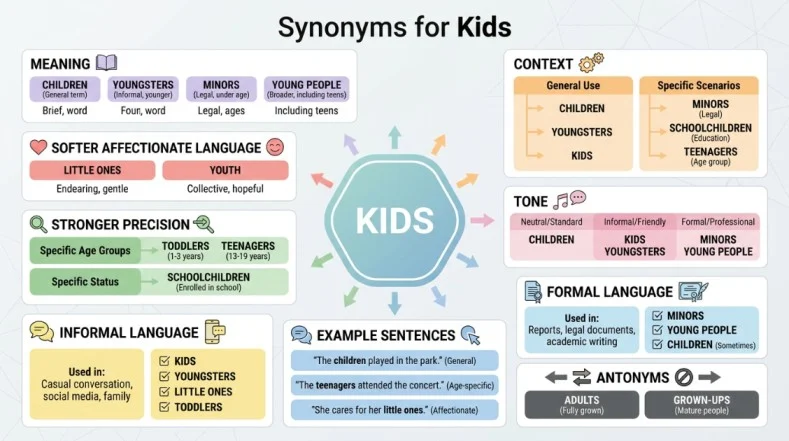
“Kids” is an informal noun meaning children or young people. The best alternatives include children for neutral writing, youngsters for casual contexts, minors for formal contexts, and little ones for warm or affectionate language.
Meaning, Tone and Context
1. Simple Definition
The word “kids” commonly means children or young people. In everyday American English, it is one of the most natural ways to refer to children.
The word can describe children generally, usually from infancy through the teenage years. Its exact age range depends on context.
2. Part of Speech
“Kids” is a plural noun.
The singular form is “kid.”
Example:
“The kids are playing outside.”
“The kid finished her homework.”
“Kid” can also be used as a verb meaning to joke or tease, but that meaning is different from the noun discussed in this article.
3. Tone
“Kids” usually has a friendly, casual, and neutral tone.
It is not normally negative. However, it can sound too informal for some legal, academic, medical, or highly professional contexts.
4. Formality Level
“Kids” is informal but widely accepted in everyday American English.
“Children” is generally more neutral and versatile. “Minors” is more formal and is often used in legal or official contexts.
5. Common Use Cases
You can use “kids” in:
- Casual conversation
- Family discussions
- Social media captions
- Friendly emails
- Parenting content
- Informal blogs
- Everyday storytelling
- Conversations about school or activities
6. Related Word Forms
Singular noun: kid
Plural noun: kids
Neutral alternative: children
Formal contextual alternative: minors
Related adjective: childish
Related noun: childhood
The word “childish” does not mean “related to children” in every situation. It often describes immature behavior, so context matters.
When and How to Use “Kids”
“Kids” works best when the tone is relaxed, friendly, and conversational.
It is especially common in American English and sounds natural in everyday speech.
Example 1: Casual
“The kids are playing soccer in the backyard.”
Example 2: Personal
“My kids love reading before bedtime.”
Example 3: Academic
“The kids in the class completed the science project.”
For a formal academic paper, “children” would usually be a better choice.
Example 4: Professional
“Our program provides free meals for local kids.”
This can work in public facing communication, although “children” may sound more formal in an official report.
Example 5: Social Media
“Watching these kids enjoy their first school trip was unforgettable.”
Example 6: Email
“The kids had a wonderful time at the event.”
Example 7: Creative
“The kids gathered around the old storyteller, waiting for the next part of the tale.”
Another Word for “Kids”
The best single replacement for “kids” is usually children because it preserves the meaning while sounding more neutral.
However, the best choice changes according to context.
| Context | Recommended Alternative |
|---|---|
| Professional writing | Children |
| Academic writing | Children |
| Casual conversation | Youngsters |
| Emotional writing | Little ones |
| Creative writing | Youngsters |
| Resume or workplace use | Children |
| Social media captions | Little ones or youngsters |
| Stronger formal meaning | Minors |
| Softer affectionate meaning | Little ones |
Professional Writing
Use children when writing reports, workplace documents, public information, or professional communication.
Example:
“The organization supports children from low income families.”
Academic Writing
Use children when discussing development, education, psychology, or childhood in formal writing.
Example:
“The study examines how children develop reading skills.”
Casual Conversation
Use youngsters or simply “kids.”
Example:
“The youngsters were excited about the trip.”
Emotional Writing
Use little ones when you want warmth or affection.
Example:
“The little ones were asleep before the movie ended.”
Creative Writing
Use youngsters, little ones, or a more descriptive phrase depending on the scene.
Example:
“The youngsters raced toward the river as the sun began to set.”
Resume or Workplace Use
Use children rather than “kids” when describing professional experience.
Better:
“Provided educational support to children ages six through twelve.”
Social Media Captions
“Kids” is perfectly natural for many captions.
Example:
“Happy moments with these amazing kids.”
Stronger Meaning
For a formal or legal context, minors can be more precise.
Example:
“The facility has separate rules for minors.”
Softer Meaning
For affectionate writing, little ones adds warmth.
Example:
“The little ones enjoyed every moment of the celebration.”
When Not to Use “Kids”
“Kids” is not wrong in most everyday situations, but another word may be more precise.
Formal or Legal Documents
Use “minors” when the legal status of people under the age of adulthood matters.
Less precise:
“The law protects kids.”
More precise:
“The law provides specific protections for minors.”
Academic Research
“Children” usually sounds more appropriate than “kids.”
Less formal:
“This study examines how kids learn language.”
Better:
“This study examines how children learn language.”
Professional Reports
A professional report may benefit from the neutral word “children.”
Less formal:
“The program served 300 kids.”
More formal:
“The program served 300 children.”
When Age Matters
“Kids” does not identify a precise age group.
If age is important, use terms such as infants, toddlers, children, adolescents, teenagers, or minors when appropriate.
When Family Relationship Matters
Use “offspring” when discussing biological children in a family or scientific context.
Example:
“Each parent contributed genetic material to their offspring.”
“Offspring” does not always sound natural as a replacement for “kids” in everyday conversation.
Words Commonly Confused With “Kids”
- Kids vs. Children
- “Kids” is informal, while “children” is more neutral and suitable for formal writing.
- Kids vs. Toddlers
A toddler is a young child, usually around the stage of learning to walk and developing early language skills. Not every child is a toddler.
Kids vs. Teenagers
Teenagers are specifically people in their teenage years. “Kids” can include teenagers, but it has a broader meaning.
Kids vs. Minors
“Minors” refers to people who have not reached the legal age of adulthood. It is more formal and often legal in tone.
Kids vs. Youngsters
“Youngsters” is a friendly term for young people. It can sound slightly more literary or old fashioned than “kids.”
Kids vs. Infants
An infant is a very young baby. “Kids” is much broader and can refer to children well beyond infancy.
Best Synonym by Context for “Kids”
| Context | Best Synonym | Why It Works | Example |
|---|---|---|---|
| Formal writing | Children | Neutral and widely accepted | The program benefits children in the community. |
| Academic writing | Children | Precise and standard | Children learn through interaction. |
| Professional or business use | Children | Clear and professional | Our services support children and families. |
| Resume | Children | Appropriate for professional experience | Taught reading skills to children. |
| Casual conversation | Youngsters | Friendly and natural | The youngsters had a great time. |
| Creative writing | Youngsters | Adds descriptive variety | The youngsters hurried down the path. |
| Emotional tone | Little ones | Warm and affectionate | The little ones were excited. |
| Formal intensity | Minors | Official and precise | The policy applies to minors. |
| Soft tone | Little ones | Gentle and affectionate | The little ones fell asleep quickly. |
| Social media captions | Kids | Natural and familiar | These kids made our day. |
| Family context | Children | Clear relationship reference | Her children live nearby. |
| Biological context | Offspring | Specific family or scientific meaning | The animals protect their offspring. |
| Education | Schoolchildren | Specifies children attending school | Schoolchildren participated in the event. |
| Legal context | Minors | Focuses on legal age | Minors require additional protections. |
| Youth programs | Young people | Broad and respectful | The center serves young people. |
| US everyday English | Kids | Extremely natural in conversation | The kids are outside. |
| UK formal usage | Children | Neutral and broadly understood | The children returned to school. |
Which Synonym Should You Choose?
Choosing the best synonym is less about replacing a word and more about preserving the intended meaning.
Use children when you want the safest neutral choice. It works in conversation, education, professional writing, and formal communication.
- Use youngsters when you want a friendly alternative that emphasizes youth.
- Use minors when legal age or official status matters.
- Use little ones when you want affection or warmth.
- Use young people when discussing a broader group that may include older teenagers or young adults.
- Use schoolchildren when the fact that they attend school is important.
- Use offspring only when the family or biological relationship is central to the sentence.
The best synonym should match both the meaning and the tone of the sentence.
Real Life Examples of “Kids” in Sentences
School
“The kids worked together to complete their science project.”
A formal school report could use “children” instead.
Workplace
“Our organization creates educational programs for kids.”
For a formal report, “children” is generally more appropriate.
Writing
“The children gathered around the teacher.”
This version sounds neutral and polished.
Conversation
“Are the kids coming with us tonight?”
This is a natural everyday use.
Social Media
“These kids know how to have fun.”
The casual word fits the relaxed tone.
Resume
“Supervised activities for children ages five through ten.”
“Children” is preferable in a professional resume.
“Please let us know if your children will attend the event.”
This sounds polite and appropriate for a formal email.
Storytelling
“The youngsters wandered through the garden, searching for the hidden gate.”
“Youngsters” gives the sentence a more descriptive feel.
25 Synonyms and Contextual Alternatives for “Kids”
The following words are not all interchangeable in every sentence. Some are exact or near equivalents, while others are useful context based alternatives.
| Synonym | Simple Meaning | Best Used For | Example Sentence |
|---|---|---|---|
| Children | Young human beings | Neutral and formal writing | The children enjoyed the activity. |
| Youngsters | Young people or children | Friendly writing | The youngsters gathered near the stage. |
| Minors | People below the legal age of adulthood | Legal and official contexts | Minors must follow the facility rules. |
| Young people | People who are relatively young | General social discussions | Young people often adapt quickly to new technology. |
| Little ones | Young children | Affectionate writing | The little ones were tired after the trip. |
| Youth | Young people considered as a group | Formal or social discussions | The program provides opportunities for local youth. |
| Schoolchildren | Children who attend school | Education | Schoolchildren visited the museum. |
| Pupils | Students, especially school age students | Education, especially formal usage | The pupils completed their assignments. |
| Adolescents | Young people in the developmental period between childhood and adulthood | Academic and medical writing | Adolescents may experience major social changes. |
| Teenagers | People aged thirteen through nineteen | Age specific contexts | The teenagers organized a community event. |
| Juveniles | Young people, especially in formal or legal contexts | Legal and official writing | The facility has separate rules for juveniles. |
| Infants | Very young babies | Medical and developmental contexts | The clinic provides care for infants. |
| Toddlers | Very young children learning early movement and language skills | Parenting and development | The toddlers played with colorful blocks. |
| Babies | Very young children, especially infants | Everyday and family contexts | The babies were sleeping peacefully. |
| Newborns | Babies in the earliest period after birth | Medical and parenting contexts | The hospital provides special care for newborns. |
| Offspring | A person’s or animal’s children | Family and biological contexts | The parents cared for their offspring. |
| Dependents | People who rely on another person for support | Financial and administrative contexts | The form asks applicants to list their dependents. |
| Descendants | People who come from a particular family line | Family history | Her descendants preserved the family tradition. |
| Progeny | Children or descendants | Formal or literary contexts | The king hoped his progeny would continue the tradition. |
| Heirs | People entitled to inherit property or a position | Legal and family contexts | His children were named as heirs. |
| Sons and daughters | Male and female children | Specific family references | Their sons and daughters attended the ceremony. |
| Boys and girls | Male and female children | Age and gender specific contexts | The coach welcomed boys and girls of all skill levels. |
| School age children | Children within typical school ages | Education and research | The program serves school age children. |
| Young members | Younger people within a group | Organizations and communities | Young members participated in the workshop. |
| Youngsters | Young people or children | Casual and descriptive writing | The youngsters ran across the field. |
Synonym Groups and Usage Differences
Professional vs. Personal Synonyms
In professional communication, children, minors, young people, and schoolchildren are generally more precise than “kids.”
Personal conversations can comfortably use “kids,” “little ones,” “boys and girls,” or “youngsters.”
The right word depends on whether you are communicating information or expressing familiarity and emotion.
Formal vs. Conversational Synonyms
For formal reports, choose children, minors, adolescents, or juveniles when the specific meaning fits.
For conversation, “kids,” “youngsters,” and “little ones” sound more natural.
Academic Synonyms
Academic writing often benefits from precise terms such as children, adolescents, minors, infants, and schoolchildren.
The best term depends on the age group being studied. Avoid choosing a formal sounding word if it changes the population being described.
Professional and Business Synonyms
In workplace emails, reports, presentations, and resumes, children is usually the safest choice.
Use minors when legal age is relevant. Use young people when the group includes older teenagers or young adults.
Creative or Literary Synonyms
Creative writing can use youngsters, little ones, youth, or progeny, depending on the mood and setting.
“Little ones” creates warmth, while “youngsters” can create a more conversational storytelling voice.
Slang or Modern Synonyms
“Kids” itself is a casual modern term and is widely used in American English.
Words such as “brats” can refer to children but usually carry a negative meaning. They should not be treated as neutral synonyms.
Strongest vs. Weaker Synonyms
There is no true intensity scale for most synonyms of “kids” because the alternatives mainly differ in age, formality, and emotional tone.
A useful practical scale is:
Neutral: children
Casual: kids
Friendly: youngsters
Affectionate: little ones
Formal: minors
Age specific: adolescents, teenagers, toddlers, infants
Biological or family focused: offspring
The strongest choice is the one that expresses the exact idea without changing the meaning.
Emotional vs. Neutral Synonyms
Children is usually neutral.
Kids is casual and familiar.
Little ones is warm and affectionate.
Youngsters is friendly.
Minors is formal and factual.
Progeny can sound formal or literary.
Antonyms of “Kids”
“Kids” does not have 15 distinct, exact antonyms. Its closest true conceptual opposite is adults, meaning people who have reached adulthood.
To avoid inventing inaccurate antonyms, the table below distinguishes genuine opposites from context based contrasts.
| Term | Meaning | Example Sentence |
|---|---|---|
| Adults | People who have reached adulthood | Adults must register separately. |
| Grownups | Informal term for adults | The grownups waited outside. |
| Mature adults | Adults viewed in terms of maturity | Mature adults can make independent decisions. |
| Adult population | Adults considered as a group | The survey focused on the adult population. |
| Adult participants | Adult people taking part in an activity | Adult participants completed the training. |
| Adult learners | Adults engaged in education | Adult learners attended evening classes. |
| Adult workers | Adults employed in a workplace | Adult workers received additional training. |
| Adult residents | Adult people living in a particular place | Adult residents received voting information. |
| Adult members | Adult people belonging to a group | Adult members attended the annual meeting. |
| Parents | Adults who have children | The parents attended the school meeting. |
| Guardians | Adults legally responsible for another person | Guardians signed the required forms. |
| Seniors | Older adults | Seniors received discounted admission. |
| Older adults | Adults in an older age group | Older adults participated in the program. |
| Grown people | Informal expression for adults | Grown people are responsible for their choices. |
| Adult persons | Formal reference to adults | The policy applies to adult persons. |
These are best understood as contextual contrasts, not 15 dictionary antonyms. “Adults” and “grownups” are the clearest opposites when “kids” means children.
Comparison: “Kids” vs. Similar Words
Kids vs. Children
The main difference is formality. “Kids” is informal, while “children” is neutral and more appropriate for formal writing.
“Children” is more versatile. “Kids” sounds more conversational.
Example:
“The kids are playing outside.”
“The children are playing outside.”
Kids vs. Youngsters
Both can refer to young people, but “youngsters” sounds slightly more descriptive or literary.
Neither is inherently more formal in every situation.
Example:
“The kids enjoyed the game.”
“The youngsters enjoyed the game.”
Kids vs. Minors
“Minors” specifically emphasizes legal age. “Kids” does not carry the same legal meaning.
“Minors” is much more formal.
Example:
“The kids entered the room.”
“Minors must have adult supervision.”
Kids vs. Youth
“Youth” can refer to young people collectively and often appears in social, educational, or public policy contexts.
“Youth” is more formal than “kids.”
Example:
“The kids joined the program.”
“The program supports local youth.”
Kids vs. Teenagers
“Teenagers” identifies people from ages thirteen through nineteen.
“Kids” is broader and can include younger children.
Example:
“The kids attended the event.”
“The teenagers stayed for the evening program.”
Kids vs. Toddlers
“Toddlers” describes a much narrower age group.
A toddler is a young child, but most children are not toddlers.
Example:
“The kids enjoyed the playground.”
“The toddlers played with building blocks.”
Common Phrases and Expressions with “Kids”
1. Kids at Heart
Meaning:
Adults who maintain a playful, youthful attitude.
Example sentence:
“Even though they are grandparents, they are still kids at heart.”
2. Kids These Days
Meaning:
A casual phrase used when discussing the behavior or habits of younger generations.
Example sentence:
“Kids these days have grown up with technology everywhere.”
3. Good for Kids
Meaning:
Suitable, useful, or beneficial for children.
Example sentence:
“This outdoor activity is good for kids.”
4. Kids Will Be Kids
Meaning:
A casual expression suggesting that children naturally behave in playful or unpredictable ways.
Example sentence:
“They made a huge mess while playing, but kids will be kids.”
5. The Kids Are Alright
Meaning:
A reassuring expression suggesting that a younger generation is doing well.
Example sentence:
“After meeting the students, I realized the kids are alright.”
6. Kids’ Stuff
Meaning:
Something considered easy or simple, often in casual language.
Example sentence:
“Once you understand the basics, the rest is kids’ stuff.”
7. Working With Kids
Meaning:
Having a job or activity involving children.
Example sentence:
“She enjoys working with kids at the community center.”
Common Mistakes to Avoid
1. Using “Kids” When a Precise Age Group Matters
Do not use “kids” when you specifically mean infants, toddlers, adolescents, or teenagers.
Choose the term that accurately describes the age group.
2. Confusing “Kids” With “Minors”
“Minors” has a legal meaning that “kids” does not.
Use “minors” when legal age is relevant.
3. Using “Kids” in Highly Formal Writing
“Kids” is not necessarily incorrect, but “children” often sounds more polished in academic papers, official reports, and formal documents.
4. Using “Progeny” as an Everyday Replacement
“Progeny” can refer to children or descendants, but it sounds formal or literary.
It would sound unnatural in many casual conversations.
5. Repeating “Kids” Too Often
Even a natural word can become repetitive.
Use “children,” “youngsters,” or another accurate term when the context supports it.
6. Choosing a Synonym With the Wrong Emotional Tone
“Little ones” sounds affectionate. “Minors” sounds official. “Juveniles” can sound legal or institutional.
Choose according to the emotional effect you want.
7. Using Slang in Academic or Professional Writing
Casual expressions may be suitable for conversation but less appropriate for research papers or formal reports.
FAQs
What is the best synonym for kids?
The best synonym for kids is usually “children” because it is neutral, clear, widely accepted, and suitable for both everyday and formal communication.
What is a formal synonym for kids?
“Children” is the best general formal alternative, while “minors” works when legal age or official status is important.
What is an informal synonym for kids?
“Kids” is already informal. “Youngsters” is another friendly option, while “little ones” adds an affectionate tone.
What is another word for kids in professional writing?
Use “children” in most professional writing. Choose “minors,” “adolescents,” or “young people” when those terms more precisely describe the group.
What is the difference between kids and children?
“Kids” is informal and conversational. “Children” is neutral and more suitable for academic, professional, official, and formal communication.
What is the opposite of kids?
The clearest opposite of “kids” is “adults” when kids means children. “Grownups” is a more informal alternative to adults.
Conclusion
The word “kids” is a natural and widely used informal term for children, especially in American English. However, the best alternative depends on your audience, purpose, and intended tone.
Use children for neutral and professional writing, youngsters for friendly language, minors for legal contexts, and little ones for affectionate writing. Terms such as teenagers, toddlers, and adolescents are better when a specific age group matters.
When choosing synonyms for kids, focus on precision rather than simply replacing one word with another. A good synonym should preserve the meaning while making your sentence sound natural for its specific situation.
Read More Related Articles:
- 25+ Synonyms for Resources | Meanings, Examples, and Best …
- 25+ Synonyms for Secret | Meanings, Examples, and Best …
- 25+ Synonyms for Action | Meanings, Examples, and Best …