Have you ever written “I acknowledge” several times in an email, essay, report, or workplace message and felt that every sentence sounded the same? Choosing a more precise alternative can make your writing clearer and more natural.
The word acknowledge can mean recognizing something, admitting a fact, confirming receipt, showing appreciation, or recognizing another person. The right synonym depends heavily on what you are trying to communicate.
This guide explains the most useful synonyms for acknowledge, including formal, academic, professional, emotional, conversational, and creative choices. It also shows which alternatives fit resumes, emails, essays, conversations, and social media.
What Does “Acknowledge” Mean?
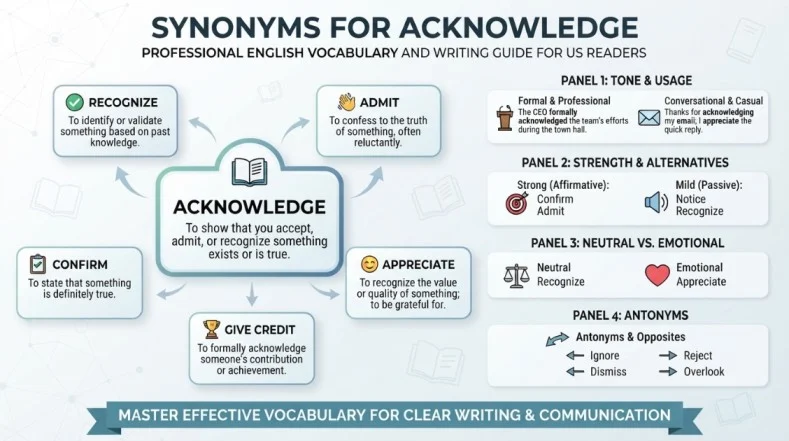
Acknowledge means to recognize, admit, confirm, or show awareness of something or someone. Formal choices include recognize and concede, while casual choices include note and mention. Professional writing often uses confirm, recognize, address, or credit.
Meaning, Tone and Context
Simple Definition
Acknowledge is a verb meaning to recognize something as true, important, present, received, or worthy of attention.
For example:
I acknowledge your concerns about the project.
Here, acknowledge means that the speaker recognizes and accepts that the concerns exist.
The word can also mean confirming that something was received:
Please acknowledge receipt of this email.
In another context, it can express appreciation:
She acknowledged the team’s contribution to the project.
Part of Speech
Acknowledge is primarily a verb.
Common related forms include:
Acknowledge: to recognize, admit, confirm, or show awareness.
Acknowledgment: recognition, admission, confirmation, or an expression of appreciation.
Acknowledged: recognized or accepted as true or important.
Acknowledging: recognizing or admitting something.
Tone
Acknowledge is generally neutral and professional. Its tone changes according to the context.
- It can sound respectful when recognizing someone’s contribution.
- It can sound formal when confirming receipt or admitting a fact.
- It can also sound serious when accepting responsibility or recognizing an uncomfortable truth.
Formality Level
Acknowledge is moderately formal and works well in professional communication, academic writing, business documents, essays, and everyday conversation.
In casual conversation, simpler alternatives such as notice, admit, mention, or recognize may sound more natural.
Common Use Cases
Acknowledge is commonly used when you want to:
- Recognize a fact
- Admit something is true
- Confirm receipt of information
- Recognize someone’s contribution
- Show appreciation
- Recognize someone’s presence
- Address a concern or problem
- Give credit to a person or source
When and How to Use “Acknowledge”
The best use of acknowledge depends on what you are recognizing.
Professional
We acknowledge the concerns raised by our customers and will review the issue promptly.
Here, acknowledge formally recognizes an issue without necessarily agreeing with every claim.
Personal
I acknowledge that I could have handled the situation better.
Here, the word expresses admission and personal responsibility.
Academic
The study acknowledges several limitations in its research design.
This use is common when writers openly recognize weaknesses or restrictions.
Emotional
He finally acknowledged how deeply the experience had affected him.
This use emphasizes recognition of an emotional reality.
Social Media
We want to acknowledge everyone who supported our launch.
Here, acknowledge publicly recognizes support or contribution.
I acknowledge receipt of your application and will review it shortly.
In this context, acknowledge means confirm that something was received.
Resume
Recognized for improving customer satisfaction through responsive service.
For a resume, recognized is usually more natural than acknowledge because it emphasizes an achievement or external appreciation.
Another Word for “Acknowledge”
There is no single replacement that works in every sentence. The best synonym depends on the intended meaning.
- For professional writing, use recognize, confirm, address, or acknowledge itself.
- For academic writing, use recognize, concede, identify, or note.
- For casual conversation, use notice, admit, mention, or recognize.
- For emotional writing, use admit, accept, recognize, or own.
- For creative writing, use recognize, notice, greet, salute, or pay tribute to, depending on the situation.
- For resume or workplace use, use recognize, credit, commend, or appreciate when describing achievements or contributions.
- For social media captions, use recognize, thank, celebrate, or give credit to.
- For a stronger meaning, consider admit, concede, or own when the context involves accepting an uncomfortable truth or responsibility.
- For a softer meaning, consider note, mention, or recognize.
When Not to Use “Acknowledge”
Acknowledge can sometimes sound unnecessarily formal.
Instead of:
I acknowledge that your idea is interesting.
A natural conversational alternative is:
I recognize that your idea is interesting.
Or:
I see why your idea could work.
Acknowledge can also be too general when you need to explain exactly what happened.
Instead of:
The company acknowledged the problem.
Consider:
The company confirmed the problem.
If the company actually admitted responsibility, you could write:
The company admitted responsibility for the problem.
The more precise verb tells readers what the company actually did.
Words Commonly Confused With “Acknowledge”
Acknowledge vs. Admit
Acknowledge means recognizing something as true, present, or important. Admit usually suggests accepting that something is true, especially when it may be uncomfortable or unfavorable.
Acknowledge vs. Recognize
Recognize is one of the closest alternatives to acknowledge. It often means identifying, understanding, or appreciating something.
Acknowledge vs. Accept
Accept suggests agreeing to receive, tolerate, approve, or come to terms with something. Acknowledge only requires recognition.
Acknowledge vs. Confirm
Confirm means establish that something is correct, true, or received. Acknowledge can mean this, but it has several broader meanings.
Acknowledge vs. Appreciate
Appreciate often communicates gratitude or understanding of value. Acknowledge can recognize a contribution without necessarily expressing gratitude.
Acknowledge vs. Concede
Concede usually means admitting that something is true, especially after disagreement. It is stronger and more argumentative than acknowledge.
Best Synonym by Context for “Acknowledge”
| Context | Best Synonym | Why It Works | Example |
|---|---|---|---|
| Formal writing | Recognize | Clear and professional | The report recognizes several important concerns. |
| Academic writing | Concede | Useful for accepting a limitation or opposing point | The authors concede that the sample was limited. |
| Professional or business use | Confirm | Clearly communicates receipt or verification | Please confirm receipt of the documents. |
| Resume | Recognized | Emphasizes external appreciation or achievement | Recognized for outstanding customer service. |
| Casual conversation | Notice | Sounds natural and conversational | I noticed that you changed the design. |
| Creative writing | Recognize | Preserves emotional and descriptive flexibility | She recognized the familiar voice immediately. |
| Emotional tone | Admit | Communicates personal acceptance of an uncomfortable truth | He admitted that he was afraid. |
| Strong intensity | Concede | Suggests accepting a point despite resistance | She conceded that her colleague had a valid argument. |
| Soft or moderate tone | Note | Makes recognition sound restrained and factual | The report notes several areas for improvement. |
| Social media captions | Thank | Directly expresses appreciation | We want to thank everyone who supported us. |
| Recognizing a contribution | Credit | Clearly gives someone responsibility or praise | The manager credited the team for the success. |
| Confirming receipt | Confirm | Direct and unambiguous | Please confirm that you received my message. |
Which Synonym Should You Choose?
Start by identifying what acknowledge means in your sentence.
- If you mean recognize something, choose recognize or note.
- If you mean admit something is true, choose admit or concede.
- If you mean confirm receipt, choose confirm.
- If you mean express gratitude, choose thank or appreciate.
- If you mean give someone credit, choose credit or recognize.
- If you mean recognize an issue, choose address or recognize.
For professional writing, prioritize precision over variety. A different synonym is not automatically better if it changes the meaning.
For emotional writing, choose a word that reflects the level of honesty or vulnerability you want to express.
Real Life Examples of “Acknowledge” in Sentences
School
The student acknowledged the limitations of the argument before presenting a stronger alternative.
Workplace
The manager acknowledged the team’s effort during the quarterly meeting.
Writing
The author acknowledges that the topic has several competing interpretations.
Conversation
I acknowledge your point, but I still see the situation differently.
Social Media
We want to acknowledge everyone who helped make this event possible.
Resume
Recognized for developing an efficient process that improved customer response times.
Please acknowledge receipt of the attached proposal.
Storytelling
She paused for a moment, then acknowledged the truth she had been avoiding.
25 Synonyms for “Acknowledge”
| Synonym | Simple Meaning | Best Used For | Example Sentence |
|---|---|---|---|
| Recognize | Show awareness or acceptance | General and professional writing | The company recognized the concerns raised by customers. |
| Admit | Accept that something is true | Personal or difficult truths | He admitted that he had made a mistake. |
| Concede | Accept a point after disagreement | Debates and academic arguments | The researcher conceded that more evidence was needed. |
| Confirm | Establish that something is true or received | Emails and business communication | Please confirm receipt of the contract. |
| Note | Mention or recognize something | Reports and formal writing | The report notes several significant changes. |
| Mention | Refer to something briefly | Conversation and general writing | She mentioned the issue during the meeting. |
| Notice | Become aware of something | Casual conversation | Did you notice the new sign outside? |
| Accept | Recognize or come to terms with something | Personal and emotional contexts | She accepted that the decision could not be changed. |
| Appreciate | Recognize value or effort | Gratitude and professional praise | We appreciate your dedication to the project. |
| Thank | Express gratitude toward someone | Personal and social communication | We thank everyone who contributed to the event. |
| Credit | Give recognition for a contribution | Business, academic, and professional contexts | The director credited the staff for the successful launch. |
| Identify | Recognize or establish what something is | Academic and analytical writing | The study identified several important risks. |
| Address | Recognize and deal with an issue | Professional and business writing | The company addressed the concerns in its latest statement. |
| Affirm | State or confirm something positively | Formal and academic writing | The findings affirm the importance of early planning. |
| Validate | Confirm that something is legitimate or meaningful | Emotional and professional contexts | The response validated the customer’s concerns. |
| Own | Accept responsibility for something | Casual and personal communication | She owned her mistake and apologized. |
| Greet | Show recognition of someone’s arrival or presence | Social situations | He greeted his neighbors as they entered the room. |
| Salute | Honor or recognize someone or something | Formal, ceremonial, and creative contexts | The ceremony saluted the volunteers for their service. |
| Welcome | Recognize someone’s arrival positively | Events and social situations | The host welcomed the new members warmly. |
| Cite | Give formal recognition to a source | Academic and professional writing | The article cites several earlier studies. |
| Commend | Publicly praise or recognize good work | Professional and formal contexts | The supervisor commended her for excellent leadership. |
| Honor | Show respect or recognition | Ceremonial and emotional writing | The organization honored its longtime volunteers. |
| Pay tribute to | Publicly express respect or admiration | Emotional and commemorative writing | The event paid tribute to the community’s founders. |
| Give credit to | Explicitly recognize someone’s contribution | Workplace and academic contexts | The manager gave credit to the design team. |
| Take note of | Deliberately recognize or consider something | Formal and analytical writing | Readers should take note of the revised requirements. |
Synonym Groups and Usage Differences
Professional vs. Personal Synonyms
Professional writing often benefits from precise verbs such as confirm, recognize, address, credit, and note.
For example:
The department confirmed receipt of the request.
Personal writing may use admit, appreciate, thank, notice, accept, or own.
For example:
I admit that I could have communicated more clearly.
The difference is not simply formality. The intended meaning also determines the best choice.
Formal vs. Conversational Synonyms
Formal contexts often favor recognize, concede, confirm, affirm, cite, and acknowledge.
Conversational contexts usually sound more natural with notice, mention, admit, thank, or own.
Compare:
The author acknowledges several limitations.
With:
The author admits there are a few limitations.
Both can work, but the second sounds more direct and conversational.
Academic Synonyms
Academic writing often needs careful distinctions.
- Use recognize when identifying an important fact.
- Use concede when accepting a limitation or opposing argument.
- Use note when making a restrained observation.
- Use cite when formally giving credit to a source.
- Use identify when pointing out a specific feature, issue, or result.
Professional and Business Synonyms
For emails, reports, presentations, and workplace communication, choose words that remove ambiguity.
- Use confirm when you mean receipt or verification.
- Use recognize when you mean awareness or appreciation.
- Use address when you mean recognize an issue and take action.
- Use credit when assigning responsibility for a success.
- Use commend when formally praising someone’s work.
Creative or Literary Synonyms
Creative writing often needs more emotional precision.
Recognize can suggest sudden awareness.
Notice can emphasize a small observation.
Admit can reveal vulnerability.
Honor and pay tribute to can create a respectful or commemorative tone.
Greet can describe recognition of a person’s arrival or presence.
Slang or Modern Synonyms
Acknowledge does not have a single slang replacement that works reliably across contexts.
Casual expressions such as “give credit to” or “own it” may work in informal speech, but they should be avoided when writing academic papers, formal reports, or professional documents.
Strongest vs. Weaker Synonyms
A useful intensity scale is:
Mild: note, mention, notice
Moderate: recognize, confirm, accept
Stronger: admit, own, concede
Strong recognition or praise: commend, honor, pay tribute to
The strongest choice depends on the meaning, not merely the emotional intensity.
Emotional vs. Neutral Synonyms
Neutral choices include recognize, note, confirm, identify, and acknowledge.
More emotional choices include admit, appreciate, thank, honor, and pay tribute to.
Choose neutral language when accuracy is the priority. Choose emotional language when the relationship, feeling, responsibility, or significance matters.
Antonyms of “Acknowledge”
There is no single opposite of acknowledge for every sense because the word has several meanings. The following alternatives represent different forms of nonrecognition, denial, rejection, or disregard.
| Antonym | Meaning | Example Sentence |
|---|---|---|
| Deny | Say something is not true | He denied the accusation. |
| Ignore | Deliberately pay no attention | She ignored the warning. |
| Disregard | Treat something as unimportant | The team disregarded the recommendation. |
| Reject | Refuse to accept something | The committee rejected the proposal. |
| Refuse | Decline to accept or recognize | He refused to accept responsibility. |
| Overlook | Fail to notice something | The reviewer overlooked an important detail. |
| Neglect | Fail to give proper attention | The report neglected several key concerns. |
| Dismiss | Treat something as unimportant or invalid | The manager dismissed the complaint. |
| Conceal | Keep something from being known | They concealed the relevant information. |
| Suppress | Prevent something from being expressed or revealed | The organization suppressed the findings. |
| Contradict | State that something is incorrect | The witness contradicted the earlier statement. |
| Dispute | Challenge whether something is true | The defendant disputed the claim. |
| Refute | Prove or argue that something is false | The researchers refuted the earlier conclusion. |
| Disavow | Publicly reject responsibility or connection | The organization disavowed the statement. |
| Forget | Fail to remember or consider something | I forgot to mention the final detail. |
Comparison: Acknowledge vs. Similar Words
Acknowledge vs. Recognize
The main difference is that recognize is often broader and can mean identifying or understanding something, while acknowledge emphasizes openly recognizing it.
Recognize can be stronger when identification is involved. Neither is automatically more formal.
Example:
She recognized the person from the photograph.
She acknowledged the person’s contribution.
Acknowledge vs. Admit
Admit usually implies accepting that something is true, especially something difficult or unfavorable.
Admit is often stronger emotionally than acknowledge.
Example:
He acknowledged the problem.
He admitted that he caused the problem.
Acknowledge vs. Accept
Accept means receiving, agreeing to, approving, or coming to terms with something.
Acknowledge only requires recognition.
Example:
She acknowledged the criticism.
She accepted the criticism and changed her approach.
Acknowledge vs. Confirm
Confirm is narrower and more precise when you need to verify information or receipt.
Confirm is usually the better choice for administrative emails.
Example:
I acknowledge your email.
I confirm receipt of your email.
Acknowledge vs. Appreciate
Appreciate communicates recognition of value or gratitude.
Acknowledge can recognize something without expressing thanks.
Example:
We acknowledge your contribution.
We appreciate your contribution.
Acknowledge vs. Concede
Concede usually involves accepting another person’s point after resistance, disagreement, or debate.
It often has a stronger argumentative meaning.
Example:
The author acknowledges the opposing view.
The author concedes that the opposing view has some merit.
Common Phrases and Expressions with “Acknowledge”
1. Acknowledge receipt
Meaning:
To confirm that something, such as an email, document, or payment, has been received.
Example sentence:
Please acknowledge receipt of the attached documents.
2. Acknowledge the problem
Meaning:
To recognize that a problem exists.
Example sentence:
The organization acknowledged the problem and began investigating it.
3. Acknowledge responsibility
Meaning:
To accept that you are responsible for something.
Example sentence:
She acknowledged responsibility for the mistake.
4. Acknowledge a contribution
Meaning:
To recognize someone’s help, effort, or role in an achievement.
Example sentence:
The director acknowledged the team’s contribution during the presentation.
5. Acknowledge a mistake
Meaning:
To openly recognize that an error occurred.
Example sentence:
He acknowledged his mistake and offered to correct it.
6. Acknowledge someone’s efforts
Meaning:
To recognize the work or effort someone has made.
Example sentence:
The supervisor acknowledged everyone’s efforts during the busy season.
7. Acknowledge a limitation
Meaning:
To recognize a weakness, restriction, or boundary.
Example sentence:
The researchers acknowledged the limitations of the study.
8. Acknowledge the importance
Meaning:
To recognize that something has significant value or influence.
Example sentence:
The report acknowledges the importance of clear communication.
Common Mistakes to Avoid
1. Using Acknowledge When a More Precise Synonym Is Better
“I acknowledge your email” is understandable, but “I confirm receipt of your email” is clearer when the intended meaning is simply that the message arrived.
2. Confusing Acknowledge With Accept
Recognizing something does not necessarily mean agreeing with it.
You can acknowledge a criticism without accepting that the criticism is correct.
3. Using a Casual Synonym in Formal Writing
Words such as own can sound too conversational in academic or highly formal writing.
Choose recognize, concede, confirm, or acknowledge when the context requires a more formal tone.
4. Using an Overly Dramatic Synonym
Words such as honor or pay tribute to may be too emotional for a routine business message.
A simple recognition may only require acknowledge, note, or recognize.
5. Repeating Acknowledge Too Often
Repeated use can make a document sound mechanical.
Replace it with a precise alternative when the meaning remains accurate.
6. Choosing the Wrong Emotional Tone
Admit can imply personal responsibility or an uncomfortable truth.
If you only mean that someone noticed an issue, recognize or note may be more appropriate.
7. Using Slang in Academic or Professional Writing
Expressions such as own it may work in casual conversation but can sound inappropriate in formal reports, essays, applications, and workplace documents.
FAQs
What is the best synonym for acknowledge?
Recognize is the most versatile alternative, but confirm, admit, appreciate, note, or credit may be better when the sentence has a more specific meaning.
What is a formal synonym for acknowledge?
Recognize is a strong formal alternative. Concede, affirm, confirm, cite, and note can also work depending on the intended meaning.
What is an informal synonym for acknowledge?
Notice, mention, admit, or own can work in casual conversation. The best choice depends on whether you mean awareness, admission, or responsibility.
What is another word for acknowledge in professional writing?
Recognize, confirm, address, credit, and commend are useful professional alternatives. Choose the word that precisely describes the action being taken.
What is the difference between acknowledge and recognize?
Acknowledge emphasizes openly recognizing something, while recognize can also mean identifying, understanding, or appreciating something.
What is the opposite of acknowledge?
Common opposites include deny, ignore, disregard, reject, dismiss, dispute, and overlook. The correct opposite depends on the particular meaning of acknowledge.
Conclusion
Acknowledge can mean recognizing a fact, admitting something is true, confirming receipt, recognizing a contribution, or showing appreciation.
The best synonym depends on the exact meaning. Use recognize for broad recognition, confirm for receipt or verification, admit for personal truth, concede for disagreement, appreciate for gratitude, and credit for contributions.
Good vocabulary is not about replacing every repeated word with a different word. It is about selecting the word that communicates your intended meaning, tone, and level of formality most accurately.
Before publishing important academic or professional content, verify definitions and nuanced usage with trusted dictionaries such as Cambridge, Oxford, Merriam Webster, Collins, or Britannica.
Discover More Post:
- 25+ Synonyms for God | Meanings, Examples, and Best …
- 25+ Synonyms for Action | Meanings, Examples, and Best …
- 25+ Synonyms for Anxiety | Meanings, Examples, and Best …