The word “most” appears everywhere. You may use it in an essay, email, conversation, caption, resume, report, or everyday sentence without thinking twice.
The problem is that “most” can express quantity, degree, frequency, preference, or the highest level of something. Choosing a more precise alternative can make your writing clearer and more natural.
This guide explains synonyms for most by meaning and context. You will learn which alternatives work best in academic writing, professional communication, casual conversation, creative writing, and social media.
What Does “Most” Mean?
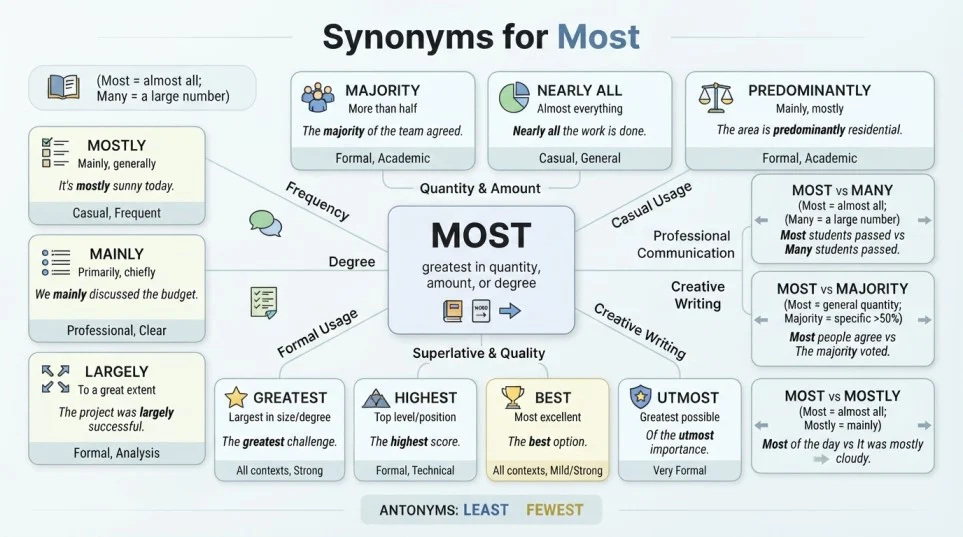
“Most” usually means the greatest amount, number, degree, or frequency. Depending on context, useful alternatives include majority, greatest, mainly, chiefly, largely, predominantly, nearly all, almost all, utmost, and best.
Meaning, Tone and Context
Simple Definition
“Most” generally refers to the greatest amount or number of something, or the highest degree of a quality.
For example:
“Most students completed the assignment.”
Here, “most” means a majority of the students.
It can also describe the highest degree:
“This is the most useful guide in the collection.”
In this sentence, “most” creates a superlative form and means the highest degree of usefulness.
Part of Speech
“Most” can function as several parts of speech depending on the sentence.
As a determiner:
“Most people enjoy music.”
As a pronoun:
“Most were satisfied with the decision.”
As an adverb:
“She was most helpful.”
As part of a superlative:
“He is the most experienced candidate.”
Tone
“Most” is usually neutral. It does not automatically create a positive or negative emotional tone.
The surrounding words determine the overall feeling.
For example:
“Most customers were satisfied.”
“Most customers were disappointed.”
The word itself remains neutral.
Formality Level
“Most” works comfortably in casual, academic, professional, and formal writing.
Because it is so common, however, repeating it frequently can make writing feel less precise.
Instead of writing:
“Most employees said most meetings were useful.”
You might write:
“The majority of employees said regular meetings were useful.”
Common Use Cases
“Most” commonly appears when discussing:
- A majority of people or things
- The greatest amount
- The highest degree
- Frequency
- Preference
- Superlative comparisons
- General observations
- Statistics
- Academic findings
- Everyday opinions
Related Forms
“Most” is related to the words “more” and “many” or “much,” depending on its grammatical function.
The opposite idea may be expressed by words such as “least,” “fewest,” or “minority,” depending on the meaning.
When and How to Use “Most”
Use “most” when you want to communicate that something represents a majority, the highest degree, or a very large proportion.
Professional
“Most employees completed the training before the deadline.”
Academic
“Most participants reported improved confidence after the program.”
Personal
“I spend most of my weekends with my family.”
Creative
“Most of the evening disappeared into quiet conversation.”
“Most” is particularly useful when you want to make a broad statement without sounding overly dramatic.
Another Word for “Most”
There is no single replacement that works in every sentence.
For quantity, “majority,” “nearly all,” “almost all,” and “bulk” can work well.
For frequency, “mostly,” “mainly,” “chiefly,” and “largely” are useful.
For the highest degree, “greatest,” “highest,” “utmost,” and “best” may be appropriate.
Professional Writing
Use “majority,” “largely,” “predominantly,” or “primarily.”
Example:
“Most customers preferred the updated design.”
More precise:
“The majority of customers preferred the updated design.”
Academic Writing
Use “majority,” “predominantly,” “largely,” or “the greater part,” depending on the evidence.
Casual Conversation
“Mostly,” “almost all,” “nearly all,” and “the majority” can sound natural.
Emotional Writing
“Nearly all,” “almost everything,” or “above all” may create more emotional emphasis.
Creative Writing
“Greater part,” “bulk,” “chiefly,” “predominantly,” or “the greatest” can add stylistic variety.
Resume or Workplace Use
“Predominantly,” “primarily,” “majority,” and “greatest” can be useful when they accurately describe measurable experience.
Social Media Captions
“Mostly,” “almost all,” “nearly all,” and “above all” are generally more conversational.
Stronger Meaning
Use “nearly all,” “almost all,” “overwhelming majority,” or “greatest” when the context supports a stronger claim.
Softer Meaning
Use “many,” “largely,” “generally,” or “often” when you do not want to imply an overwhelming majority.
When Not to Use “Most”
“Most” can become vague when the reader needs an exact or more carefully qualified meaning.
For example:
“Most customers liked the product.”
If you have reliable data, a stronger sentence could be:
“Seventy eight percent of customers liked the product.”
Do not use “most” when you actually mean “almost all.”
“Most employees attended” and “nearly all employees attended” communicate different proportions.
Also avoid replacing every occurrence of “most” with a fancy synonym. The original word is often the clearest choice.
Words Commonly Confused With “Most”
Most vs. More
“More” compares two amounts or degrees, while “most” generally expresses the highest degree among three or more or refers to a majority.
“Maria is more experienced than John.”
“Maria is the most experienced person on the team.”
Most vs. Many
“Many” means a large number, but it does not necessarily indicate a majority.
“Many students attended.”
“Most students attended.”
The second statement makes a stronger claim.
Most vs. Mostly
“Most” often functions as a determiner or superlative, while “mostly” usually functions as an adverb meaning mainly or for the greater part.
“Most employees agreed.”
“The discussion was mostly positive.”
Most vs. Majority
“Majority” specifically refers to more than half of a group.
“Most voters supported the proposal.”
“The majority of voters supported the proposal.”
The second version sounds more statistical and formal.
Most vs. Mainly
“Mainly” means primarily or chiefly. It usually describes what something consists of or what receives the greatest emphasis.
“The audience was mostly students.”
“The event was mainly designed for students.”
Most vs. Greatest
“Most” can create a superlative, while “greatest” is often a more explicit adjective expressing the highest level, amount, importance, or achievement.
“She had the most influence.”
“She had the greatest influence.”
Best Synonym by Context for Most
Which Synonym Should You Choose?
Start by identifying what “most” means in your sentence.
If you mean more than half of a group, choose “majority.”
If you mean almost everyone or everything, consider “nearly all” or “almost all.”
If you mean mainly or primarily, use “mostly,” “mainly,” “chiefly,” or “predominantly.”
If you mean the highest degree, consider “greatest,” “highest,” “utmost,” or “best.”
For professional and academic writing, precision matters more than vocabulary complexity. A simple word that expresses the exact meaning is usually better than an impressive word used incorrectly.
Real Life Examples of “Most” in Sentences
School
“Most students submitted their assignments on time.”
Workplace
“Most employees preferred the new scheduling system.”
Writing
“Most readers understand the basic argument.”
Conversation
“I spend most of my free time reading.”
Social Media
“Most of my favorite memories were made here.”
Resume
“Most of my professional experience involves customer support.”
“Most of the requested changes have been completed.”
Storytelling
“Most of the town had already gone to sleep when the storm arrived.”
18 Synonyms for “Most”
The following alternatives cover different meanings of “most.” Some describe quantity, while others describe degree, frequency, or emphasis. They should not be treated as interchangeable in every sentence.
Synonym Groups and Usage Differences
Professional vs. Personal Synonyms
Professional writing often benefits from precise words such as “majority,” “largely,” “primarily,” and “predominantly.”
Personal writing can use simpler alternatives such as “mostly,” “almost all,” and “nearly all.”
For example:
Professional:
“The majority of customers responded positively.”
Personal:
“Most of my friends loved the movie.”
Formal vs. Conversational Synonyms
“Majority,” “predominantly,” “chiefly,” and “preponderance” sound more formal.
“Mostly,” “mainly,” “almost all,” and “nearly all” are more accessible in everyday communication.
Choose based on the audience rather than trying to make every sentence sound sophisticated.
Academic Synonyms
Academic writing often benefits from “majority,” “predominantly,” “largely,” “primarily,” and “preponderance.”
These words can help distinguish a measured observation from a casual generalization.
However, always use the word that matches the evidence.
Professional and Business Synonyms
For emails, presentations, reports, and workplace communication, “majority,” “largely,” “primarily,” and “predominantly” are useful.
For example:
“The majority of respondents preferred the first proposal.”
“The project was largely completed before the review.”
Creative or Literary Synonyms
Creative writing gives you more freedom.
“Greater part,” “chiefly,” “bulk,” “greatest,” and “utmost” can add variety when they accurately communicate the intended meaning.
Still, clarity should come before decorative vocabulary.
Slang or Modern Synonyms
There is no necessary slang replacement for “most.”
Words such as “mostly” and “almost all” are already conversational and natural.
Avoid forcing trendy expressions into professional or academic writing when a standard word communicates the idea better.
Strongest vs. Weaker Synonyms
A useful scale for quantity is:
“Many” suggests a large number without saying that more than half are included.
“Most” suggests a majority.
“Nearly all” suggests a very large majority.
“Almost all” communicates a similarly strong proportion.
“Overwhelming majority” creates the strongest formal emphasis among these options.
For degree, “greatest” and “highest” communicate a superlative level.
“Utmost” can express the greatest possible degree, especially in serious or formal contexts.
Emotional vs. Neutral Synonyms
“Most” is generally neutral.
“Majority” is also relatively neutral and factual.
“Nearly all” can add emphasis.
“Overwhelming majority” strongly emphasizes the size of a group.
“Utmost” adds seriousness or importance.
“Best” introduces an evaluative judgment rather than a purely factual observation.
Antonyms of “Most”
Because “most” has several meanings, its opposite changes with context. The following words and phrases cover its major quantity, degree, frequency, and preference meanings.
Comparison: “Most” vs. Similar Words
“Most” vs. “Many”
The main difference is strength.
“Many” indicates a large number but does not necessarily mean more than half.
“Most” generally indicates a majority.
“Many people attended the event.”
“Most people attended the event.”
The second statement makes a stronger claim.
“Most” vs. “Majority”
“Majority” is more explicitly connected with more than half of a group.
“Most voters supported the candidate.”
“The majority of voters supported the candidate.”
“Majority” often sounds more formal and statistical.
“Most” vs. “Mostly”
“Most” and “mostly” are closely related but have different grammatical functions.
“Most customers were satisfied.”
“The feedback was mostly positive.”
“Mostly” is especially useful when you mean mainly or for the greater part.
“Most” vs. “Mainly”
“Mainly” means primarily.
“The article discusses most common mistakes.”
“The article mainly discusses writing mistakes.”
The first sentence uses “most” to identify a large or highest group. The second uses “mainly” to describe the primary focus.
“Most” vs. “Greatest”
“Greatest” usually expresses the highest degree, amount, importance, or achievement.
“She received the most votes.”
“She made the greatest contribution.”
“Most” is broader, while “greatest” is strongly associated with superlative comparison.
“Most” vs. “Nearly All”
“Most” indicates a majority but can represent a relatively modest majority.
“Nearly all” indicates a much larger proportion.
“Most employees completed the training.”
“Nearly all employees completed the training.”
Use “nearly all” only when the evidence supports that stronger claim.
Common Phrases and Expressions with “Most”
1. Most of the time
Meaning:
Usually or on the majority of occasions.
Example sentence:
“I work from home most of the time.”
2. For the most part
Meaning:
Generally or in most respects.
Example sentence:
“For the most part, the project went smoothly.”
3. At most
Meaning:
No more than a stated amount.
Example sentence:
“The meeting will take at most one hour.”
4. At the most
Meaning:
Used to emphasize the maximum possible amount.
Example sentence:
“You will need at the most two additional days.”
5. Most likely
Meaning:
Probably or with the highest likelihood.
Example sentence:
“She will most likely arrive before noon.”
6. Most importantly
Meaning:
Used to introduce the point considered most important.
Example sentence:
“Most importantly, the final decision should be based on reliable evidence.”
7. Make the most of
Meaning:
Use something as effectively or beneficially as possible.
Example sentence:
“Try to make the most of your time at college.”
8. For the most part
Meaning:
In general, with only some exceptions.
Example sentence:
“The feedback was positive for the most part.”
Common Mistakes to Avoid
1. Using “most” when you mean “many”
“Many” does not necessarily mean more than half.
If you know that more than half of a group agrees, “most” or “the majority” is more accurate.
2. Confusing “most” with “mostly”
Do not treat these forms as interchangeable.
“Most employees arrived early.”
“The office was mostly empty.”
3. Using “majority” without a group
“Majority” normally refers to a defined group or population.
Instead of saying “The majority was positive,” identify what group you mean when clarity requires it.
4. Using an overly dramatic synonym
“Overwhelming majority” should not replace “most” unless the proportion is genuinely overwhelming.
Precision is more important than intensity.
5. Repeating “most” too often
Repeated use can make an article or essay sound monotonous.
Where appropriate, vary the wording with “mainly,” “largely,” “predominantly,” “nearly all,” or “majority.”
6. Choosing the wrong emotional tone
“Best” expresses evaluation.
“Majority” is more factual.
“Utmost” creates a serious tone.
Choose the alternative according to the message you actually want to communicate.
7. Using very formal words unnecessarily
Words such as “preponderance” are not natural replacements in every sentence.
Simple language is often more effective.
FAQs
What is the best synonym for “most”?
The best synonym depends on meaning. “Majority” works for groups, “mostly” for general frequency, and “greatest” for the highest degree.
What is a formal synonym for “most”?
“Majority,” “predominantly,” “primarily,” “largely,” and “chiefly” can work as formal alternatives, depending on the sentence.
What is an informal synonym for “most”?
“Mostly,” “almost all,” and “nearly all” are natural conversational choices when they accurately express the intended meaning.
What is another word for “most” in professional writing?
“Majority,” “largely,” “primarily,” and “predominantly” are useful professional alternatives, but the correct choice depends on the sentence.
What is the difference between “most” and “many”?
“Many” means a large number, while “most” generally indicates a majority. Therefore, “most” normally makes the stronger quantitative claim.
What is the opposite of “most”?
The opposite depends on meaning. “Least,” “fewest,” “minority,” “less,” and “worst” can serve as opposites in different contexts.
Conclusion
“Most” is a flexible and extremely common word that can describe a majority, a high degree, frequency, or the highest level of something.
The best synonym depends on your exact meaning. Use “majority” for groups, “mostly” for general frequency, “predominantly” for formal descriptions, “nearly all” for strong quantity, and “greatest” or “highest” for superlative meaning.
The most useful vocabulary habit is to choose a synonym based on meaning first and style second. A precise, familiar word is usually better than an unnecessarily complicated one.
Before publishing formal vocabulary content, verify definitions and usage with trusted dictionaries such as Cambridge, Oxford, Merriam Webster, Collins, or Britannica.
Discover More Post:
- 25+ Synonyms for Access | Meanings, Examples, and Best …
- 25+ Synonyms for Acknowledge | Meanings, Examples, and …
- 25+ Synonyms for Attention | Meanings, Examples, and Best …