The word “beginning” appears everywhere. You might use it in an essay, email, story, resume, presentation, social media caption, or everyday conversation.
The problem is that repeating “beginning” can make otherwise strong writing sound predictable. Choosing a more precise alternative can immediately make your sentence clearer and more engaging.
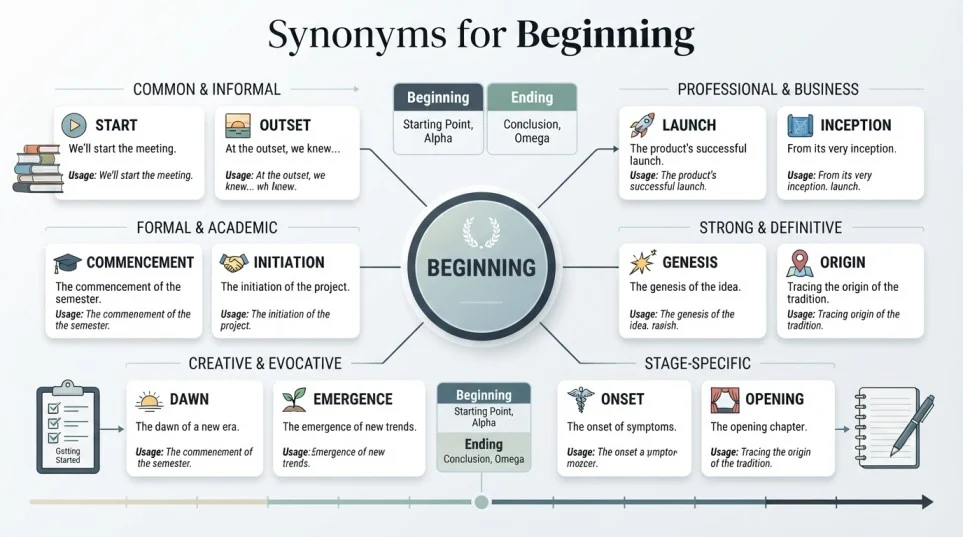
The best synonym depends on what you mean. “Start” works naturally in conversation, while “inception” suits formal or professional writing. “Dawn” can create a more emotional or literary feeling, while “onset” often describes the arrival of something significant.
This guide explains the meaning, tone, context, and practical use of synonyms for beginning so you can choose the right word instead of simply choosing a word that looks similar.
What Does Beginning Mean?
“Beginning” means the point at which something starts or comes into existence. Common alternatives include start for casual use, commencement for formal writing, inception for professional contexts, outset for formal prose, and dawn for creative or emotional writing.
Meaning, Tone and Context
Simple Definition
Beginning means the first part, stage, or moment of something. It can describe the start of an event, process, period, experience, story, relationship, or activity.
For example:
“The beginning of the semester was challenging.”
Here, “beginning” refers to the early part of the semester.
Part of Speech
“Beginning” can function mainly as a noun, but it is also connected to the verb “begin.”
As a noun:
“The beginning of the meeting was delayed.”
As part of a verb phrase:
“She is beginning a new project.”
The word can therefore relate to both the starting point and the action of starting.
Tone
“Beginning” is generally neutral. It does not automatically create a positive or negative feeling.
The tone changes depending on the surrounding words.
“The beginning of the new project was exciting.”
This sounds positive.
“The beginning of the conflict was difficult to identify.”
This sounds serious and neutral.
“The beginning of the story was mysterious.”
This creates a creative or intriguing tone.
Formality Level
“Beginning” is suitable for casual, academic, professional, and creative communication.
It is one of the safest choices when you want a natural word that does not sound overly formal.
Common Use Cases
Beginning commonly appears when discussing:
- Stories and books
- School semesters
- Business projects
- Relationships
- Historical periods
- Personal experiences
- Meetings and events
- Careers
- New habits
- Changes and developments
Important Word Forms
The main related forms include:
Begin, a verb meaning to start.
Began, the past tense of begin.
Begun, the past participle of begin.
Beginning, the noun or present participle.
Beginner, a person who is new to an activity or subject.
When and How to Use Beginning
Use “beginning” when you want to identify the first part or earliest stage of something.
It is especially useful when the starting point itself matters rather than simply the action of starting.
Professional Example
“The beginning of the project focused on defining clear objectives.”
Personal Example
“At the beginning of the year, I decided to exercise regularly.”
Academic Example
“At the beginning of the study, researchers established the criteria for participation.”
Creative Example
“The beginning of the story introduces a quiet town hiding an unusual secret.”
Another Word for Beginning
The best single replacement for “beginning” depends on your sentence.
“Start” is usually the most natural alternative for everyday communication. “Outset” works well in formal writing, while “commencement” sounds more official. “Inception” emphasizes the creation or origin of something.
For professional writing, choose “inception,” “outset,” “launch,” or “commencement” when the context supports them.
For academic writing, “onset,” “inception,” “origin,” and “commencement” can provide greater precision.
For casual conversation, “start” is usually the most natural choice.
For emotional writing, “dawn,” “birth,” or “awakening” can create a stronger feeling.
For creative writing, “dawn,” “genesis,” “opening,” or “emergence” can add imagery.
For resumes and workplace writing, “launch,” “initiation,” “inception,” or “commencement” may work depending on the sentence.
For social media captions, “start,” “new chapter,” “launch,” and “new beginning” often sound more natural.
For a stronger meaning, consider “inception,” “genesis,” or “onset” when the context supports them.
For a softer meaning, “opening,” “early stage,” or “first step” can sound approachable.
When Not to Use Beginning
“Beginning” is not always the most precise choice.
If you are describing a business product becoming available, “launch” may communicate the situation better.
Instead of:
“The beginning of our new service was successful.”
Use:
“The launch of our new service was successful.”
If you are describing the arrival of a medical or seasonal condition, “onset” may be more precise.
Instead of:
“The beginning of symptoms was sudden.”
Use:
“The onset of symptoms was sudden.”
If you are discussing the creation of an organization or movement, “inception” or “founding” may provide more specific information.
The key is to choose a word that communicates the exact kind of beginning you mean.
Words Commonly Confused With Beginning
Beginning vs. Start
Both refer to the point or action of starting something. “Start” is usually more conversational and direct, while “beginning” can sound slightly more descriptive.
Beginning vs. Origin
“Origin” refers to where something comes from or the source from which it developed. It does not always mean the first moment of an event.
Beginning vs. Inception
“Inception” refers to the point when something is established, created, or first conceived. It often sounds more formal than “beginning.”
Beginning vs. Onset
“Onset” usually refers to the arrival of something, especially something significant such as symptoms, weather, or a difficult period.
Beginning vs. Opening
“Opening” can refer to the first part of an event, speech, book, or performance. It can also mean an available opportunity or space.
Beginning vs. Commencement
“Commencement” means the start of something and is more formal. It is especially common in official, academic, and ceremonial contexts.
Best Synonym by Context for Beginning
Which Synonym Should You Choose?
Choosing the best synonym for beginning starts with identifying exactly what you mean.
If you simply mean that something started, use “start.”
If you mean the first stage of a formal process, consider “commencement” or “initiation.”
If you are discussing the creation of an organization, idea, or project, “inception” may be more precise.
If something arrives suddenly or marks the start of a condition, “onset” can be stronger.
If you are writing creatively, “dawn,” “birth,” or “genesis” can create more imagery.
Think about five factors before replacing the word: meaning, formality, emotional intensity, professional value, and sentence context.
A synonym should improve precision, not simply make your vocabulary sound more complicated.
Real Life Examples of “Beginning” in Sentences
School
“The beginning of the semester was busy, but the workload became easier after the first few weeks.”
Workplace
“The beginning of the project focused on research and planning.”
Writing
“The beginning of the article introduces the central problem.”
Conversation
“I missed the beginning of the movie, so I need someone to explain what happened.”
Social Media
“Every beginning creates an opportunity to try something new.”
Resume
“Managed the project from its beginning through completion.”
“At the beginning of our discussion, we agreed to review the timeline.”
Storytelling
“The beginning of her journey was uncertain, but each challenge gave her greater confidence.”
18 Synonyms for Beginning
Synonym Groups and Usage Differences
Professional vs. Personal Synonyms
Professional writing often benefits from words such as “inception,” “initiation,” “commencement,” and “launch.”
Personal communication usually sounds more natural with “start,” “beginning,” “first step,” or “new chapter.”
For example, a business report might say, “The initiative has evolved since its inception.”
A personal message might say, “This feels like the beginning of something wonderful.”
Formal vs. Conversational Synonyms
“Commencement,” “inception,” “onset,” and “initiation” are more formal.
“Start,” “opening,” and “kickoff” are more conversational.
Use formal vocabulary in reports, academic papers, official announcements, and serious business documents. Use conversational vocabulary in texts, casual emails, and everyday speech.
Academic Synonyms
Academic writing benefits from precise terms.
“Inception” works well when discussing the creation of an idea or research project.
“Onset” is useful when describing the arrival of a condition or phenomenon.
“Emergence” works well when something gradually becomes visible, established, or influential.
Professional and Business Synonyms
“Launch” is particularly useful for products, services, campaigns, and initiatives.
“Inception” works when discussing the history of a company, project, or strategy.
“Initiation” can describe the formal start of a process.
“Kickoff” is useful in workplace communication when the tone is relatively relaxed.
Creative or Literary Synonyms
Creative writers have more freedom to select words that create atmosphere.
“Dawn” can suggest hope or a new era.
“Birth” can represent the creation of an idea or relationship.
“Genesis” can emphasize origins.
“Emergence” can suggest something slowly becoming visible or understood.
Slang or Modern Synonyms
“Kickoff” is a modern, informal choice in American English, especially for meetings, events, projects, and sports.
It is acceptable in many workplace situations, but it may sound too casual for highly formal academic or legal writing.
Strongest vs. Weaker Synonyms
A useful intensity scale is:
Mild: opening, first step, start
Moderate: beginning, outset, commencement
More specific: initiation, launch, emergence
Stronger or more significant: onset, inception, genesis, advent
The strongest choice is not always the best choice. A precise word is more valuable than an impressive sounding word.
Emotional vs. Neutral Synonyms
“Start” and “beginning” are generally neutral.
“Birth,” “dawn,” and “new chapter” can create an emotional or optimistic feeling.
“Onset” can create a serious tone, especially when discussing illness, conflict, or difficult conditions.
“Genesis” can sound thoughtful, historical, or literary.
Antonyms of Beginning
Some words below are context dependent opposites rather than exact dictionary opposites. The most natural opposite of “beginning” is usually “end” or “ending.”
Comparison: Beginning vs. Similar Words
Beginning vs. Start
The main difference is tone. Both words can describe the first point of something, but “start” is generally more conversational.
“Start” is not necessarily stronger or weaker. It is simply more direct.
“Beginning” can sound slightly more descriptive.
Example:
“The start of the meeting was delayed.”
“The beginning of the meeting was delayed.”
Both are natural.
Beginning vs. Origin
“Origin” focuses on where something comes from, while “beginning” focuses on the first stage or point.
“Origin” is more precise when discussing history, sources, causes, or development.
Example:
“The origin of the tradition is unknown.”
“The beginning of the ceremony was delayed.”
Beginning vs. Inception
“Inception” focuses on the creation or establishment of something.
It is more formal than “beginning.”
Example:
“The project has changed considerably since its inception.”
“The beginning of the project involved extensive planning.”
Beginning vs. Onset
“Onset” describes the arrival of something, often something noticeable or significant.
It is more formal and specific than “beginning.”
Example:
“The onset of winter affected travel.”
“The beginning of winter brought colder weather.”
Beginning vs. Opening
“Opening” often refers to the first part of an event, speech, story, or discussion.
It can be more specific than “beginning” when referring to a presentation or performance.
Example:
“The opening of the speech was powerful.”
“The beginning of the speech explained the problem.”
Beginning vs. Commencement
“Commencement” means a formal beginning.
It sounds more official than “beginning” and is common in institutional, academic, and ceremonial language.
Example:
“The commencement of the ceremony was delayed.”
“The beginning of the ceremony was delayed.”
Common Phrases and Expressions with Beginning
1. At the beginning
Meaning:
Refers to the first part of an event, process, or period.
Example sentence:
“At the beginning of the semester, I created a weekly study schedule.”
2. From the beginning
Meaning:
Refers to something that has been true or present since the start.
Example sentence:
“She understood the importance of the project from the beginning.”
3. In the beginning
Meaning:
Refers to an early period, especially when describing how something developed.
Example sentence:
“In the beginning, the business operated from a small home office.”
4. At the very beginning
Meaning:
Emphasizes the earliest possible point.
Example sentence:
“Please explain the issue from the very beginning.”
5. A new beginning
Meaning:
A fresh opportunity or a new stage in life.
Example sentence:
“Moving to a new city gave her a sense of new beginning.”
6. Beginning to end
Meaning:
Refers to the complete duration of something.
Example sentence:
“I watched the documentary from beginning to end.”
7. The beginning of a new chapter
Meaning:
A transition into a new period of life or experience.
Example sentence:
“Graduation marked the beginning of a new chapter.”
8. A beginning and an end
Meaning:
Emphasizes that something has a complete life cycle.
Example sentence:
“Every project has a beginning and an end.”
Common Mistakes to Avoid
1. Using “Beginning” When a More Precise Word Is Better
If you are discussing a product becoming available, “launch” may be more informative than “beginning.”
2. Confusing “Beginning” With “Origin”
The origin of something explains where it came from. The beginning describes its first stage.
3. Using a Casual Synonym in Formal Writing
“Kickoff” can sound too informal in a formal research paper or official report.
Choose “commencement,” “initiation,” or another precise alternative when appropriate.
4. Using an Overly Dramatic Synonym
“Genesis” can sound unnecessarily grand when you simply mean “start.”
Use sophisticated vocabulary only when it adds meaning.
5. Repeating “Beginning” Too Often
Repeated use can make writing feel flat.
Instead of changing every occurrence, replace only the words where another choice improves clarity or style.
6. Choosing the Wrong Emotional Tone
“Dawn” can suggest hope, while “onset” can sound serious.
Always consider the feeling created by your synonym.
FAQs
What is the best synonym for beginning?
“Start” is the best general synonym for beginning because it is natural, clear, and suitable for most everyday situations.
What is a formal synonym for beginning?
“Commencement,” “inception,” “initiation,” and “outset” are formal alternatives. The best choice depends on whether you mean an official start or origin.
What is an informal synonym for beginning?
“Start” is the most common informal synonym. “Kickoff” can also work when referring to an event, project, meeting, or activity.
What is another word for beginning in professional writing?
“Inception,” “initiation,” “launch,” and “commencement” work well in professional writing when their specific meanings match the situation.
What is the difference between beginning and start?
Both words describe the first point of something. “Start” is usually more conversational, while “beginning” can sound more descriptive or neutral.
What is the opposite of beginning?
The most direct opposite of beginning is “end.” Other context dependent alternatives include ending, conclusion, finish, completion, and termination.
Conclusion
The word “beginning” describes the first point, stage, or part of something. It is a reliable and neutral word, but the right synonym can make your writing more precise.
Use “start” for everyday communication, “outset” for formal prose, “inception” for origins, “commencement” for official contexts, “launch” for products and initiatives, and “onset” when something arrives or develops.
For creative writing, “dawn,” “birth,” and “genesis” can add imagery and emotion.
The most useful vocabulary habit is not replacing every familiar word with a complicated synonym. Instead, choose the word that communicates your exact meaning, tone, and context.
Discover More Post:
- 25+ Synonyms for Access | Meanings, Examples, and Best …
- 25+ Synonyms for Acknowledge | Meanings, Examples, and …
- 25+ Synonyms for Attention | Meanings, Examples, and Best …