If you keep using the word “smell” in essays, emails, captions, stories, or everyday conversations, your writing can quickly become repetitive. The right alternative can make a description clearer, more professional, more emotional, or more vivid.
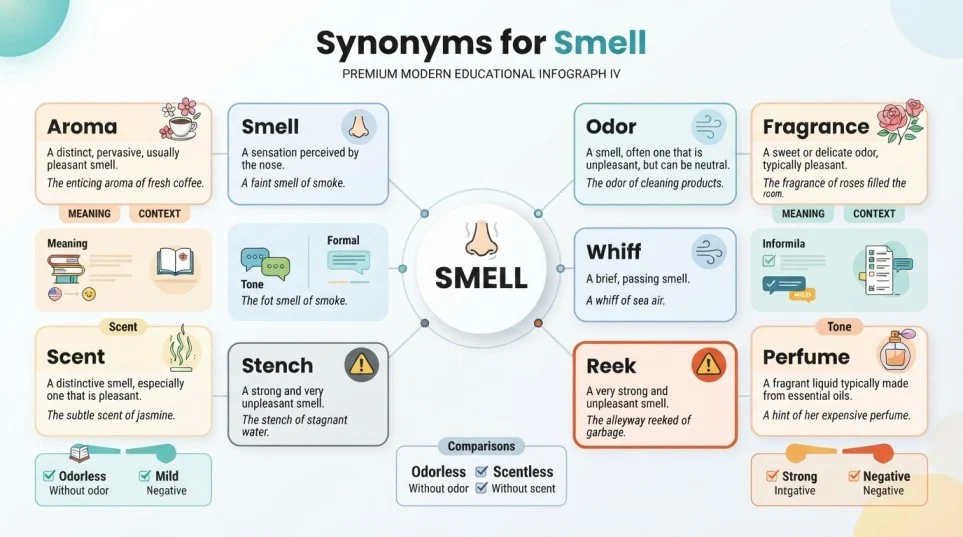
The best synonym depends on what you mean. You might need “scent” for a neutral description, “aroma” for something pleasant, “odor” for a noticeable or unpleasant smell, or “fragrance” for a distinctly pleasant scent.
This guide explains the meaning of smell, its tone, common alternatives, confusing words, intensity levels, and practical examples so you can choose the right word naturally.
What Does Smell Mean?
“Smell” refers to the quality or presence of an odor, or the ability to detect something through the nose. Common alternatives include scent, aroma, fragrance, odor, bouquet, whiff, stench, and perfume, depending on context and tone.
Meaning, Tone and Context
Simple Definition
“Smell” can refer to an odor that you notice through your sense of smell. It can describe something pleasant, unpleasant, neutral, strong, weak, natural, or artificial.
For example:
“The smell of fresh bread filled the kitchen.”
The word can also describe the act of detecting an odor.
For example:
“I can smell smoke.”
Part of Speech
“Smell” can function as both a noun and a verb.
As a noun:
“The smell of coffee woke me up.”
As a verb:
“She could smell the flowers from the window.”
It can also appear in related forms such as “smelled,” “smelling,” and “smelly.”
Tone
The tone of “smell” is generally neutral. It does not automatically tell the reader whether something is pleasant or unpleasant.
Compare these examples:
“The smell of roses filled the room.”
“The odor of garbage filled the room.”
“Smell” is neutral, while “odor” can suggest something noticeable or unpleasant depending on context.
Formality Level
“Smell” is an everyday word that works well in casual, professional, academic, and creative communication.
More specific alternatives may sound more polished or descriptive.
For example:
“The smell of the flowers was pleasant.”
“The fragrance of the flowers was delicate.”
Common Use Cases
You can use “smell” when discussing:
- Food
- Cooking
- Nature
- Cleaning
- Personal hygiene
- Perfume
- Chemicals
- Smoke
- Memories
- Sensory descriptions
- Scientific observations
- Everyday conversation
When and How to Use Smell
“Smell” is usually the safest general word because it does not automatically express approval or dislike.
Professional Example
“The office had a noticeable smell after the maintenance work.”
Personal Example
“I love the smell of freshly baked cookies.”
Academic Example
“The smell of the substance changed after it was heated.”
Creative Example
“The smell of rain drifted through the open window.”
The word works naturally across many settings, but a more specific synonym can make the sentence more precise.
Another Word for Smell
The best single replacement for “smell” depends on the intended meaning.
- For professional writing, “odor” or “scent” can work well.
- For academic writing, “odor” is often useful when describing a detectable characteristic objectively.
- For casual conversation, “scent” or simply “smell” sounds natural.
- For emotional writing, “fragrance” or “aroma” can create a pleasant mood.
- For creative writing, “scent,” “aroma,” “whiff,” or “bouquet” can add sensory detail.
- For resumes and workplace writing, “odor” is useful in technical, safety, cleaning, food, and environmental contexts.
- For social media captions, “aroma,” “fragrance,” “scent,” and “perfume” can sound more expressive.
- For a stronger negative meaning, consider “stench,” “reek,” or “foul odor.”
- For a softer meaning, use “scent,” “aroma,” or “odor,” depending on the situation.
When Not to Use Smell
“Smell” is not wrong in most situations, but it can be too general when precision matters.
Instead of:
“The room had a bad smell.”
You could write:
“The room had a strong odor.”
If the odor is extremely unpleasant:
“The room had a foul stench.”
For a pleasant food description:
“The restaurant was filled with the aroma of roasted garlic.”
For perfume:
“The fragrance was light and floral.”
The more precise word gives readers a clearer impression.
Words Commonly Confused With Smell
Smell vs. Scent
“Smell” is broader and can describe any noticeable odor. “Scent” often sounds more neutral, pleasant, or refined.
Smell vs. Odor
“Odor” is more formal and is frequently used for noticeable or unpleasant smells, especially in technical and professional contexts.
Smell vs. Aroma
“Aroma” usually describes a pleasant or appetizing smell, particularly food, drinks, spices, or plants.
Smell vs. Fragrance
“Fragrance” usually refers to a pleasant, often intentionally created scent from perfume, flowers, cosmetics, or similar products.
Smell vs. Stench
“Stench” describes an extremely unpleasant smell. It is much stronger and more negative than “smell.”
Smell vs. Perfume
“Perfume” can refer to a pleasant fragrance, especially one created or applied intentionally. It can also refer specifically to a scented cosmetic product.
Best Synonym by Context for Smell
| Context | Best Synonym | Why It Works | Example |
|---|---|---|---|
| Formal writing | Odor | Sounds objective and precise | The odor was detected near the storage area. |
| Academic writing | Odor | Works well for scientific descriptions | The chemical produced a distinctive odor. |
| Professional or business use | Odor | Appropriate for reports and workplace observations | Staff reported an unusual odor. |
| Resume | Scent awareness | Useful only in specialized sensory roles | The role required careful scent evaluation. |
| Casual conversation | Smell | Natural and familiar | I love the smell of coffee. |
| Creative writing | Scent | Adds sensory detail | The scent of pine filled the forest. |
| Emotional tone | Fragrance | Often suggests pleasant memories | Her fragrance reminded him of summer. |
| Strong intensity | Stench | Communicates an extremely unpleasant smell | A terrible stench came from the drain. |
| Soft or moderate tone | Scent | Neutral and less harsh | A faint scent of lavender remained. |
| Social media captions | Aroma | Works especially well for food and drinks | The aroma of fresh bread is irresistible. |
| Food writing | Aroma | Creates a pleasant sensory impression | The aroma of roasted coffee filled the café. |
| Perfume or cosmetics | Fragrance | Specifically suited to pleasant scented products | This fragrance has floral notes. |
| Environmental reporting | Odor | Clear and professional | The investigation focused on the source of the odor. |
| Negative description | Stench | Strongly negative | The garbage produced a horrible stench. |
| Very brief exposure | Whiff | Describes a short or small amount | I caught a whiff of smoke. |
Which Synonym Should You Choose?
Choose a synonym based on five questions.
What exactly do you mean?
Use “smell” for a general sensory reference. Use “scent” for a noticeable scent, “aroma” for a pleasant smell, and “stench” for a very unpleasant one.
How formal is the situation?
“Smell” works almost everywhere. “Odor” sounds more technical and professional.
How strong is the smell?
“Whiff” suggests a brief or small amount. “Stench” suggests an extremely unpleasant smell.
What emotional response do you want?
Use “fragrance” or “aroma” for pleasant associations. Use “stench” or “reek” for strongly negative reactions.
What is the sentence about?
Food often calls for “aroma.” Perfume usually calls for “fragrance.” Environmental or workplace reports often use “odor.”
Real Life Examples of Smell in Sentences
School
“The smell of fresh paint made the classroom feel different.”
Workplace
“The manager investigated the unusual smell near the equipment.”
Writing
“The smell of wet earth brought back memories of childhood.”
Conversation
“Can you smell the coffee?”
Social Media
“The smell of freshly baked bread makes mornings better.”
Resume or Workplace Context
“Monitored product quality using visual and sensory evaluation standards.”
“We noticed an unusual odor in the storage area and reported it to maintenance.”
Storytelling
“She followed the sweet scent of jasmine through the garden.”
18 Synonyms for Smell
| Synonym | Simple Meaning | Best Used For | Example Sentence |
|---|---|---|---|
| Scent | A noticeable smell | General descriptions | The scent of pine filled the cabin. |
| Odor | A noticeable smell, often neutral or unpleasant | Formal and professional writing | The odor became stronger near the doorway. |
| Aroma | A pleasant smell | Food and drinks | The aroma of coffee spread through the kitchen. |
| Fragrance | A pleasant or distinctive smell | Perfume, flowers, cosmetics | The fragrance of roses filled the room. |
| Perfume | A pleasant scent, often intentionally produced | Cosmetics and flowers | The perfume of the flowers attracted bees. |
| Bouquet | A collection of smells, especially in drinks | Wine and specialized descriptions | The wine had a rich floral bouquet. |
| Whiff | A small or brief amount of smell | Casual and sensory descriptions | I caught a whiff of smoke outside. |
| Stench | A very unpleasant smell | Strong negative descriptions | A terrible stench came from the trash bin. |
| Reek | A strong and unpleasant smell | Very negative descriptions | The old basement reeked of moisture. |
| Aroma | A pleasant or appetizing smell | Food and cooking | The aroma of garlic made everyone hungry. |
| Essence | The distinctive quality or characteristic scent of something | Creative and descriptive writing | The essence of citrus lingered in the room. |
| Redolence | A strongly noticeable or pleasant scent | Literary writing | The redolence of flowers surrounded the garden. |
| Odoriferousness | The quality of having a noticeable smell | Specialized descriptions | The plant was known for its odoriferousness. |
| Malodor | An unpleasant or offensive smell | Formal and technical writing | The inspection identified a persistent malodor. |
| Effluvium | An unpleasant or waste related emission or odor | Technical or literary contexts | The facility released an unpleasant effluvium. |
| Noseful | A noticeable amount of smell | Informal and humorous writing | The kitchen gave me a noseful of spicy smoke. |
| Tang | A distinctive sharp or noticeable quality in a smell | Food and descriptive writing | There was a sharp tang of vinegar in the air. |
| Reekiness | The quality of smelling strongly and unpleasantly | Informal descriptive use | The reekiness of the damp room was impossible to ignore. |
Note: Some entries above are specialized, literary, rare, or context dependent rather than everyday replacements. In normal US English, “scent,” “odor,” “aroma,” “fragrance,” “whiff,” “stench,” and “reek” are generally the most useful choices.
Synonym Groups and Usage Differences
Professional vs. Personal Synonyms
Professional writing often benefits from neutral words such as “odor,” “scent,” and “malodor.”
Personal writing can be more expressive. Words such as “aroma,” “fragrance,” “whiff,” and “stench” can communicate personal reactions more clearly.
Formal vs. Conversational Synonyms
For reports, workplace communication, and technical writing, “odor” is often more precise.
In conversation, “smell,” “scent,” “whiff,” and “reek” sound more natural depending on the meaning.
Academic Synonyms
Academic writing usually benefits from objective language.
“Odor” is especially useful when discussing chemistry, biology, environmental science, food science, or sensory research.
For example:
“The compound produced a distinctive odor when exposed to heat.”
Professional and Business Synonyms
In workplace communication, choose a word that describes the observation without exaggerating.
Instead of:
“There is a horrible smell.”
A professional report might say:
“There is a strong odor near the ventilation system.”
This sounds clearer and more objective.
Creative or Literary Synonyms
Creative writing often benefits from words that create sensory imagery.
“Scent,” “aroma,” “fragrance,” “whiff,” “redolence,” and “bouquet” can help establish setting and mood.
For example:
“A faint scent of cedar drifted through the cabin.”
Slang or Modern Synonyms
There is no single modern slang replacement for “smell” that works in every situation.
Casual expressions such as “reek” can be useful in conversation, but they are inappropriate when a neutral or professional tone is required.
Strongest vs. Weaker Synonyms
A useful intensity scale is:
Mild: scent, aroma, fragrance
Neutral: smell, odor
Noticeable: whiff, tang
Strong and negative: malodor, reek
Very strong and negative: stench
The exact intensity depends on context, but this scale can help you make a quick choice.
Emotional vs. Neutral Synonyms
Neutral words include “smell,” “odor,” and “scent.”
Positive words include “aroma,” “fragrance,” and “bouquet.”
Strongly negative words include “stench,” “reek,” and “malodor.”
Antonyms of Smell
“Smell” does not have 15 exact one word antonyms because it can function as both a noun and a verb. For the noun sense, the closest opposites describe the absence of an odor. For the verb sense, opposites can describe failing to detect or intentionally ignoring an odor.
The following table gives accurate contextual opposites rather than pretending that all 15 are dictionary perfect antonyms.
| Antonym or Contrast Term | Meaning | Example Sentence |
|---|---|---|
| Odorless | Having no noticeable odor | The water was completely odorless. |
| Scentless | Having no scent | The product was scentless. |
| Unscented | Made without added fragrance | She prefers unscented lotion. |
| Fragrance free | Containing no added fragrance | The store offers fragrance free products. |
| Neutral | Having no strong sensory character | The cleaner has a neutral scent. |
| Clean | Free from an unpleasant odor | The room smelled clean after ventilation. |
| Fresh | Having a clean or pleasant quality | Fresh air entered through the window. |
| Airy | Well ventilated and free from stale odors | The room felt airy after the windows opened. |
| Ventilated | Having air circulated to remove odors | The kitchen was properly ventilated. |
| Purified | Treated to remove unwanted substances or odors | The air was purified with a filtration system. |
| Masked | Covered by another smell | The odor was masked by a stronger fragrance. |
| Removed | Taken away from the environment | The unpleasant odor was removed. |
| Eliminated | Completely taken away | The source of the odor was eliminated. |
| Overlooked | Not noticed or detected | The faint odor was overlooked during the inspection. |
| Undetected | Not noticed or discovered | The odor remained undetected for several hours. |
Comparison: Smell vs. Similar Words
Smell vs. Scent
Main difference: “Smell” is broader, while “scent” often sounds more neutral, pleasant, or descriptive.
Which one is stronger: Neither is inherently stronger.
Which one is more formal: “Scent” can sound slightly more polished in descriptive writing.
Smell example: “I noticed a strange smell.”
Scent example: “A floral scent filled the room.”
Smell vs. Odor
Main difference: “Odor” is more formal and often appears in technical or professional descriptions.
Which one is stronger: “Odor” can suggest a noticeable smell, especially an unpleasant one.
Which one is more formal: “Odor.”
Smell example: “There was a strange smell.”
Odor example: “There was an unusual odor near the equipment.”
Smell vs. Aroma
Main difference: “Aroma” usually suggests a pleasant smell.
Which one is stronger: “Aroma” does not necessarily indicate greater intensity.
Which one is more formal: “Aroma” can sound more descriptive.
Smell example: “The smell of coffee filled the kitchen.”
Aroma example: “The aroma of freshly brewed coffee filled the kitchen.”
Smell vs. Fragrance
Main difference: “Fragrance” usually refers to a pleasant or intentionally created scent.
Which one is stronger: Neither is automatically stronger.
Which one is more formal: “Fragrance” can sound more polished.
Smell example: “I noticed the smell of the flowers.”
Fragrance example: “The fragrance of the flowers was delicate.”
Smell vs. Stench
Main difference: “Stench” specifically communicates an extremely unpleasant smell.
Which one is stronger: “Stench” is much stronger.
Which one is more formal: “Smell” is more neutral, while “stench” is strongly descriptive.
Smell example: “There was a bad smell near the dumpster.”
Stench example: “A terrible stench came from the dumpster.”
Smell vs. Reek
Main difference: “Smell” can be neutral, while “reek” strongly suggests an unpleasant smell.
Which one is stronger: “Reek” is stronger and negative.
Which one is more formal: Neither is especially formal. “Odor” is better for formal writing.
Smell example: “The room had a strange smell.”
Reek example: “The room reeked of smoke.”
Common Phrases and Expressions with Smell
1. Smell good
Meaning:
To have a pleasant odor.
Example sentence:
“This soap smells good after you wash your hands.”
2. Smell bad
Meaning:
To have an unpleasant odor.
Example sentence:
“The refrigerator smells bad because some food spoiled.”
3. Smell like
Meaning:
To have an odor similar to something else.
Example sentence:
“The kitchen smells like fresh bread.”
4. Smell of
Meaning:
To have the characteristic odor of something.
Example sentence:
“His jacket smelled of campfire smoke.”
5. Smell something fishy
Meaning:
To suspect that something is dishonest, suspicious, or incorrect.
Example sentence:
“I smelled something fishy when the numbers suddenly changed.”
6. Stop and smell the roses
Meaning:
To slow down and appreciate enjoyable parts of life.
Example sentence:
“Work is important, but sometimes you need to stop and smell the roses.”
7. Smell a rat
Meaning:
To suspect that someone is behaving dishonestly.
Example sentence:
“She smelled a rat when the contract suddenly changed.”
8. Smell test
Meaning:
A simple judgment about whether something seems reasonable or acceptable.
Example sentence:
“The proposal did not pass my smell test.”
Common Mistakes to Avoid
1. Using “smell” when a more precise word is better
“The smell of the coffee” is perfectly correct, but “the aroma of the coffee” creates a more pleasant and descriptive impression.
2. Confusing “odor” with a purely negative meaning
“Odor” can be neutral, although it frequently appears in descriptions of unpleasant smells.
3. Using a casual synonym in formal writing
Words such as “reek” can sound too conversational for professional reports. Use “odor” when objective language is needed.
4. Using an overly dramatic synonym
Do not call a mildly unpleasant smell a “stench” unless the intensity really justifies the word.
5. Repeating “smell” too often
Repeated use can make descriptive writing feel flat. Replace it selectively with “scent,” “aroma,” “fragrance,” or another precise term.
6. Choosing the wrong emotional tone
“Aroma” generally sounds pleasant, while “stench” sounds strongly unpleasant. Make sure the synonym matches your intended mood.
7. Treating every synonym as interchangeable
Words that refer to smells can have different levels of intensity, formality, and emotional meaning. Context matters more than simply finding a dictionary match.
FAQs
What is the best synonym for “smell”?
“Scent” is one of the most versatile alternatives. Use “aroma” for pleasant smells, “odor” for formal contexts, and “stench” for very unpleasant smells.
What is a formal synonym for “smell”?
“Odor” is a strong formal alternative, especially in technical, scientific, environmental, workplace, and professional writing where objective wording is important.
What is an informal synonym for “smell”?
“Whiff” works in casual descriptions of a brief amount of smell. “Reek” is also conversational but specifically describes a strong unpleasant smell.
What is another word for “smell” in professional writing?
“Odor” is usually the safest professional alternative. “Scent” can work when describing products, food, fragrances, or sensory characteristics.
What is the difference between “smell” and “scent”?
“Smell” is the broader everyday term. “Scent” often sounds more descriptive or pleasant, although it can also describe neutral or distinctive odors.
What is the opposite of “smell”?
There is no single perfect opposite for every sense of “smell.” For odors, “odorless” and “scentless” describe the absence of smell, while “undetected” can contrast with detecting an odor.
Conclusion
“Smell” is a versatile word that can describe an odor or the act of detecting one. Because it is broad and neutral, it works in everyday conversation, professional writing, academic descriptions, and creative work.
The best synonym depends on your purpose. Choose “scent” for a versatile descriptive alternative, “aroma” for pleasant food or drink smells, “fragrance” for pleasant scents, “odor” for formal or technical writing, and “stench” for extremely unpleasant smells.
The most useful vocabulary tip is to choose synonyms by meaning and tone rather than simply replacing one word with another. A precise word makes your writing clearer, more natural, and more memorable.
For final publication, verify definitions and specialized usage with trusted dictionaries such as Cambridge, Oxford, Merriam Webster, Collins, or Britannica.
Discover More Post:
- 25+ Synonyms for Access | Meanings, Examples, and Best …
- 25+ Synonyms for Acknowledge | Meanings, Examples, and …
- 25+ Synonyms for Attention | Meanings, Examples, and Best …