The word fix is useful because it can describe many everyday actions. You can fix a broken phone, fix a mistake, fix a problem, fix a schedule, or even fix a meal.
However, using fix repeatedly can make your writing sound basic or vague. A professional email may need resolve, an academic sentence may need correct, and a creative description may work better with restore or repair.
This guide explains synonyms for fix by meaning, tone, formality, and situation. You will learn which alternatives work best in school, business, conversation, resumes, emails, social media, and creative writing.
The goal is not simply to replace one word with another. The goal is to choose the word that communicates your exact meaning.
What Does Fix Mean?
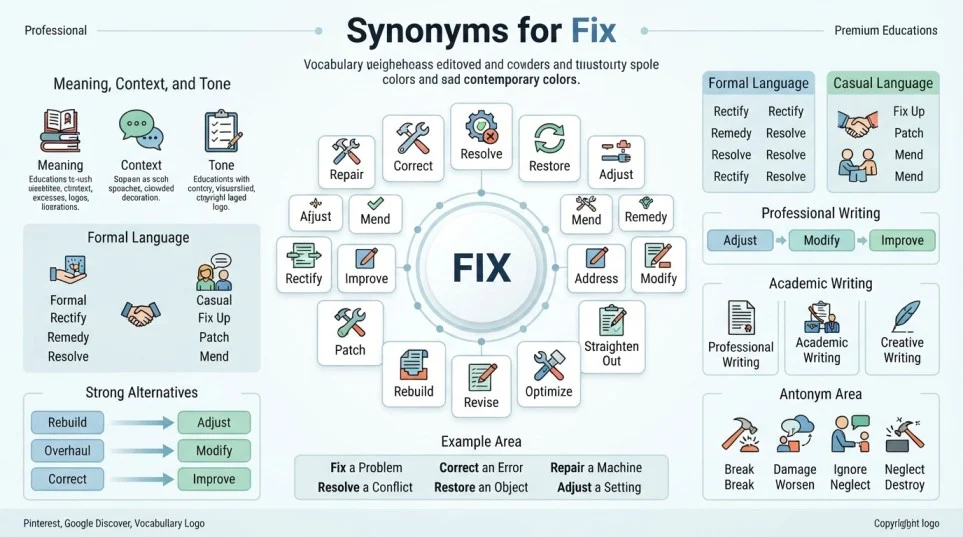
Fix usually means to repair, correct, solve, arrange, or make something work properly. Formal alternatives include resolve, correct, repair, restore, and rectify, while casual choices include patch, mend, sort out, and straighten out.
Meaning, Tone and Context
Simple Definition
Fix is a versatile verb that generally means to make something correct, functional, stable, or satisfactory.
For example:
I need to fix my laptop.
Here, fix means repair the laptop.
In another sentence:
We need to fix this scheduling problem.
Here, fix means solve or resolve the problem.
The meaning changes according to the object or situation that follows the word.
Part of Speech
Fix is primarily a verb, but it can also function as a noun and adjective in certain contexts.
As a verb:
She fixed the broken chair.
As a noun:
We found a quick fix for the problem.
As an adjective in informal usage:
He is fixated on getting the issue resolved.
The related word fixation refers to an intense focus or attachment, although it does not mean repair.
Tone
The word fix is usually neutral and highly versatile.
It can sound casual in everyday conversation:
Can you fix this?
It can also appear in professional communication:
We need to fix the reporting error before the meeting.
In more formal writing, a more precise verb can often communicate the intended action better.
Formality Level
Fix ranges from casual to neutral.
It is perfectly acceptable in everyday speech, emails, workplace conversations, and many forms of general writing. However, formal reports, academic papers, technical documents, and legal writing may benefit from more precise choices such as correct, resolve, rectify, repair, restore, or remedy.
Common Uses
You can use fix when talking about:
- Repairing damaged objects
- Correcting mistakes
- Solving problems
- Resolving conflicts
- Improving systems
- Adjusting settings
- Arranging plans
- Preparing food or drinks
- Addressing errors
- Restoring something to a useful condition
Important Word Forms
Common forms related to fix include:
Fix: present form
Fixed: past tense and past participle
Fixing: present participle
Fixes: third person singular form
Fixer: a person or thing that fixes something
Fixation: intense attention or attachment, with a different meaning from repair
When and How to Use Fix
Use fix when you want to communicate that something needs to be repaired, corrected, solved, adjusted, or made workable.
The important point is that the surrounding context determines which meaning applies.
Professional Example
Our technical team is working to fix the software issue before the next release.
Here, fix means resolve a technical problem.
Personal Example
I need to fix the loose handle on my kitchen cabinet.
Here, fix means repair something physically damaged.
Academic Example
The researcher corrected the calculation before submitting the final report.
In academic writing, corrected is more precise than fix because the action involves an error rather than physical damage.
Email Example
Could you please fix the formatting issue in the document before sending it to the client?
This is natural in workplace communication, although correct or resolve may sound more polished depending on the situation.
Another Word for Fix
There is no single perfect replacement for fix because the word has several meanings.
For professional writing, resolve is often useful when discussing problems or conflicts.
For academic writing, correct is usually better when discussing mistakes or inaccurate information.
For physical objects, repair is one of the strongest general alternatives.
For restoring something to an earlier condition, restore may be more accurate.
For serious problems, remedy can sound formal and deliberate.
For casual conversation, sort out, patch, and mend can work depending on the context.
Professional Writing
Best choices include:
Resolve
Address
Correct
Remedy
Example:
The team resolved the customer complaint within 24 hours.
Academic Writing
Best choices include:
Correct
Rectify
Address
Resolve
Example:
The researcher corrected the calculation error before publishing the findings.
Casual Conversation
Best choices include:
Sort out
Patch
Mend
Straighten out
Example:
I will sort out the problem tonight.
Emotional Writing
Best choices include:
Heal
Restore
Mend
Repair
Example:
They worked together to repair their damaged relationship.
Creative Writing
Best choices include:
Restore
Mend
Rebuild
Revive
Example:
Time slowly restored the old house to its former beauty.
Resume or Workplace Use
Better choices include:
Resolved
Improved
Corrected
Restored
Streamlined
Example:
Resolved recurring customer service issues and improved response times.
Social Media Captions
Casual alternatives work well:
Sorted out
Repaired
Restored
Upgraded
Example:
Finally sorted out the messy workspace.
Stronger Meaning
Use:
Rectify
Remedy
Resolve
These words can suggest a deliberate or thorough response to a problem.
Softer Meaning
Use:
Adjust
Improve
Tweak
These options suggest a smaller change rather than a major repair.
When Not to Use “Fix”
Although fix is convenient, it is sometimes too general.
When You Mean Correct
Instead of:
I fixed the spelling mistake.
You could write:
I corrected the spelling mistake.
Correct is more precise because the problem involves an error.
When You Mean Repair
Instead of:
The technician fixed the machine.
You could write:
The technician repaired the machine.
Repair clearly identifies physical or technical restoration.
When You Mean Resolve
Instead of:
The manager fixed the disagreement.
You could write:
The manager resolved the disagreement.
Resolve is better for disputes, conflicts, and complicated problems.
When You Mean Improve
Instead of:
We fixed the website design.
You could write:
We improved the website design.
If the website was not actually broken, improved is more accurate.
When You Mean Adjust
Instead of:
She fixed the settings.
You could write:
She adjusted the settings.
This works when the settings only needed modification rather than repair.
When You Need Formal Language
In a research paper, report, legal document, or formal proposal, fix may sound too broad.
A precise verb such as correct, resolve, rectify, remedy, restore, or address can make the sentence clearer.
Words Commonly Confused With Fix
Fix vs. Repair
Fix is broader and can describe solving many kinds of problems.
Repair specifically suggests restoring something damaged or malfunctioning.
I fixed the scheduling issue.
I repaired the damaged printer.
Fix vs. Correct
Correct means removing an error or making something accurate.
She corrected the incorrect figure.
Fix can include correction, but it is less specific.
Fix vs. Resolve
Resolve usually means successfully dealing with a problem, conflict, or question.
The manager resolved the customer complaint.
Fix is more general.
Fix vs. Improve
Improve means make something better.
Fix usually suggests that something is wrong and needs attention.
We improved the website.
We fixed the broken payment page.
Fix vs. Adjust
Adjust means making a small change to improve suitability, accuracy, or performance.
Adjust the screen brightness.
Fix suggests a problem that needs attention.
Fix vs. Restore
Restore means returning something to an earlier, better, or original condition.
The team restored the historic building.
Fix does not necessarily imply returning something to its original state.
Best Synonym by Context for Fix
| Context | Best Synonym | Why It Works | Example |
|---|---|---|---|
| Formal writing | Rectify | Clearly suggests correcting a problem | The company rectified the reporting error. |
| Academic writing | Correct | Precise for mistakes and inaccuracies | The student corrected the calculation. |
| Professional or business use | Resolve | Strong choice for problems and disputes | The team resolved the client issue. |
| Resume | Resolved | Shows action and problem solving | Resolved recurring customer complaints. |
| Casual conversation | Sort out | Natural and conversational | I will sort out the problem later. |
| Creative writing | Restore | Adds a sense of returning to an earlier condition | They restored the abandoned house. |
| Emotional tone | Mend | Suggests repairing relationships or emotional damage | They tried to mend their friendship. |
| Strong intensity | Remedy | Suggests a deliberate response to a serious problem | The policy was designed to remedy the issue. |
| Soft or moderate tone | Adjust | Suggests a small change | We adjusted the settings. |
| Social media captions | Patch | Casual and useful for temporary solutions | I patched the old bag for now. |
| Technical use | Repair | Clearly describes restoring equipment or systems | The engineer repaired the device. |
| Conflict | Resolve | Common and precise for disagreements | They resolved the dispute peacefully. |
| Mistake | Correct | Directly identifies an error | She corrected the typo. |
| System improvement | Optimize | Suggests improving performance | The developer optimized the database. |
| Physical damage | Mend | Natural for fabric or small objects | She mended the torn shirt. |
| Historical restoration | Restore | Indicates returning something to an earlier state | Experts restored the painting. |
| Website or design | Improve | Better when the item is not actually broken | We improved the website layout. |
Which Synonym Should You Choose?
Choosing the best synonym for fix depends on what you actually mean.
If Something Is Broken
Choose repair, mend, or restore.
The mechanic repaired the damaged engine.
If Something Is Incorrect
Choose correct or rectify.
The editor corrected the factual error.
If There Is a Problem
Choose resolve, address, or remedy.
The company resolved the billing problem.
If You Want to Make Something Better
Choose improve, enhance, or optimize.
The team improved the customer experience.
If You Need a Small Change
Choose adjust, modify, or tweak.
We adjusted the presentation before the meeting.
If You Are Writing Casually
Choose sort out, patch, or straighten out.
I need to sort out my schedule.
If You Want a Formal Tone
Choose rectify, remedy, resolve, or correct, depending on the meaning.
The best synonym is always the one that preserves the exact meaning of the original sentence.
Real Life Examples of Fix in Sentences
School
The teacher asked me to fix the errors in my essay.
A more academic version would be:
The teacher asked me to correct the errors in my essay.
Workplace
We need to fix the reporting problem before Friday.
A more professional alternative is:
We need to resolve the reporting problem before Friday.
Writing
I fixed several grammar mistakes in the article.
A more precise version is:
I corrected several grammar mistakes in the article.
Conversation
Do not worry. I will fix it.
This sounds natural and reassuring in casual speech.
Social Media
Finally fixed my old bike and took it out for a ride.
A more polished caption could say:
Finally restored my old bike and took it out for a ride.
Resume
Instead of:
Fixed customer problems quickly.
Use:
Resolved customer issues quickly and improved satisfaction.
The second version communicates professional value more clearly.
I have fixed the formatting issue in the attached report.
A slightly more formal version is:
I have corrected the formatting issue in the attached report.
Storytelling
She spent years trying to fix the old house.
A more descriptive version is:
She spent years restoring the old house to its former beauty.
18 Synonyms for Fix
| Synonym | Simple Meaning | Best Used For | Example Sentence |
|---|---|---|---|
| Repair | Make something damaged work again | Machines, devices, objects | The technician repaired the damaged computer. |
| Correct | Remove an error | Writing, facts, calculations | She corrected the mistake before submitting the assignment. |
| Resolve | Successfully deal with a problem | Conflicts, complaints, issues | The manager resolved the customer’s complaint. |
| Rectify | Correct something that is wrong | Formal and professional writing | The company took action to rectify the accounting error. |
| Remedy | Correct or improve a serious problem | Formal, legal, business contexts | The new policy was created to remedy the problem. |
| Restore | Return something to an earlier condition | Buildings, systems, relationships | Experts restored the historic theater. |
| Mend | Repair something damaged or strained | Clothing, objects, relationships | She mended the torn jacket. |
| Adjust | Make a small change | Settings, positions, plans | We adjusted the schedule to fit everyone. |
| Improve | Make something better | Quality, design, performance | The redesign improved the user experience. |
| Address | Deal with a problem or concern | Business, academic, professional writing | The report addresses several important concerns. |
| Modify | Change something to suit a purpose | Plans, designs, systems | The engineer modified the design. |
| Amend | Make an official change or correction | Documents, policies, agreements | The committee amended the policy. |
| Patch | Make a temporary or limited repair | Software, clothing, objects | The developer patched the security issue. |
| Rebuild | Construct again after damage | Structures, systems, relationships | The community rebuilt the damaged library. |
| Revise | Change something to improve it | Writing, plans, documents | The author revised the introduction. |
| Optimize | Improve performance or efficiency | Technology, business, systems | The team optimized the website for faster loading. |
| Straighten out | Resolve a confusing or difficult situation | Casual conversation | We need to straighten out the schedule. |
| Sort out | Deal with or organize a problem | Casual conversation and emails | I will sort out the paperwork tomorrow. |
Synonym Groups and Usage Differences
Professional vs. Personal Synonyms
Professional writing benefits from specific language.
Instead of saying:
We fixed the issue.
A business report could say:
We resolved the issue.
For physical equipment, use repaired.
For an error, use corrected.
For a broader concern, use addressed.
Personal conversations are more flexible. You can comfortably say:
I will fix it.
I need to sort this out.
Can you help me mend this?
The right choice depends on how formal the situation is.
Formal vs. Conversational Synonyms
Formal options include:
Rectify
Remedy
Resolve
Correct
Amend
Conversational options include:
Fix
Sort out
Patch
Mend
Straighten out
For a formal report, write:
The organization rectified the reporting error.
For a casual conversation, write:
We sorted out the problem.
Academic Synonyms
Academic writing usually benefits from precision.
Use correct when discussing mistakes.
Use address when discussing an issue or limitation.
Use resolve when a problem has been successfully settled.
Use rectify when discussing a formal correction.
Use amend when discussing changes to documents, policies, or established material.
For example:
The researchers corrected the calculation error.
This is more precise than:
The researchers fixed the calculation error.
Professional and Business Synonyms
In workplace communication, resolve is one of the most useful alternatives.
The support team resolved the customer’s issue.
Address is useful when the problem is being considered or handled.
The company addressed employee concerns.
Correct works well for errors.
The accounting department corrected the invoice.
Remedy works for formal descriptions of corrective action.
The new procedure was introduced to remedy recurring delays.
Creative or Literary Synonyms
Creative writing often benefits from words that carry imagery or emotion.
Restore can suggest returning something to former beauty.
They restored the abandoned mansion.
Mend can suggest emotional or physical repair.
She tried to mend the broken friendship.
Rebuild can suggest creating something again after loss.
They slowly rebuilt their lives.
Revive can suggest bringing something back to life or activity.
The festival revived the quiet town.
Slang or Modern Synonyms
There is no single slang replacement for fix that works in every context.
Expressions such as sort out, patch, and tweak are common in informal speech.
Sort out is useful for solving an everyday problem.
I need to sort out my schedule.
Patch often suggests a temporary or limited solution.
We patched the software problem until a permanent update was ready.
Tweak suggests a small adjustment.
I tweaked the design before publishing it.
These expressions should generally be avoided in highly formal academic or professional writing unless the context specifically supports conversational language.
Strongest vs. Weaker Synonyms
A useful intensity scale is:
Adjust, mild change
Tweak, very small change
Improve, general positive change
Correct, direct correction
Repair, restoration of damage
Resolve, successful handling of a problem
Remedy, deliberate correction of a serious problem
Rectify, formal and deliberate correction
The strongest choice depends on the situation rather than the word alone.
Emotional vs. Neutral Synonyms
Neutral choices include:
Fix
Correct
Adjust
Repair
Resolve
More emotional choices include:
Mend
Restore
Rebuild
Heal
For example:
They resolved their disagreement.
This is neutral.
They mended their relationship.
This carries more emotional meaning.
Antonyms of Fix
Because fix has several meanings, its antonyms depend on the intended sense.
| Antonym | Meaning | Example Sentence |
|---|---|---|
| Break | Damage something | Do not break the equipment. |
| Damage | Cause harm to something | The storm damaged the roof. |
| Worsen | Make a situation worse | The delay worsened the problem. |
| Ruin | Damage something severely | The leak ruined the furniture. |
| Harm | Cause injury or damage | The mistake harmed the company’s reputation. |
| Neglect | Fail to give needed attention | They neglected the maintenance for months. |
| Ignore | Refuse to address something | You cannot ignore the warning. |
| Disrupt | Prevent normal operation | The outage disrupted the service. |
| Complicate | Make something more difficult | The extra rule complicated the process. |
| Damage further | Make existing damage worse | The repair attempt damaged the device further. |
| Abandon | Leave without completing or repairing | They abandoned the unfinished project. |
| Undo | Reverse a change or action | The update undid the previous improvements. |
| Disturb | Interfere with normal condition | The construction disturbed the system. |
| Destroy | Cause complete or severe damage | The fire destroyed the old building. |
| Deteriorate | Become worse over time | The neglected structure continued to deteriorate. |
Comparison: Fix vs. Similar Words
Fix vs. Repair
Main difference: Fix is broad, while repair usually refers to restoring something damaged or malfunctioning.
Which one is stronger: Neither is automatically stronger. Repair is more specific.
Which one is more formal: Repair often sounds slightly more precise.
Examples:
I fixed the problem.
The mechanic repaired the engine.
Fix vs. Correct
Main difference: Correct focuses on errors, inaccuracies, or mistakes.
Which one is stronger: Correct is more precise when an error is involved.
Which one is more formal: Correct is often preferred in academic and professional writing.
Examples:
I fixed the typo.
I corrected the typo.
Fix vs. Resolve
Main difference: Resolve focuses on successfully dealing with a problem, conflict, or concern.
Which one is stronger: Resolve can sound more decisive.
Which one is more formal: Resolve is often more professional.
Examples:
We fixed the customer issue.
We resolved the customer issue.
Fix vs. Improve
Main difference: Fix suggests something is wrong, while improve simply means making something better.
Which one is stronger: Fix suggests a problem exists. Improve suggests progress.
Which one is more formal: Both can be professional.
Examples:
We fixed the broken checkout page.
We improved the checkout experience.
Fix vs. Adjust
Main difference: Adjust suggests a smaller modification rather than repairing a problem.
Which one is stronger: Fix generally suggests a more substantial problem.
Which one is more formal: Adjust is precise and works well in technical writing.
Examples:
We fixed the broken display.
We adjusted the display settings.
Fix vs. Restore
Main difference: Restore means returning something to a previous or original condition.
Which one is stronger: Restore can imply a broader transformation.
Which one is more formal: Restore works well in professional, historical, technical, and creative contexts.
Examples:
The technician fixed the machine.
Experts restored the historic machine to working condition.
Common Phrases and Expressions with “Fix”
1. Fix a Problem
Meaning:
To solve or correct something that is causing difficulty.
Example sentence:
We need to fix the problem before it affects customers.
2. Fix a Mistake
Meaning:
To correct an error.
Example sentence:
I noticed the mistake and fixed it before submitting the report.
3. Fix an Issue
Meaning:
To address and resolve a problem.
Example sentence:
The support team fixed the issue within a few hours.
4. Fix a Broken Item
Meaning:
To repair something that no longer works properly.
Example sentence:
My brother helped me fix the broken bicycle.
5. Fix a Date
Meaning:
To establish or arrange a specific date.
Example sentence:
We need to fix a date for the meeting.
6. Fix the Situation
Meaning:
To improve or resolve a difficult circumstance.
Example sentence:
We should work together to fix the situation.
7. Fix the Settings
Meaning:
To adjust settings so something works as intended.
Example sentence:
I fixed the settings on my new monitor.
8. Quick Fix
Meaning:
A fast solution that may not be permanent or comprehensive.
Example sentence:
The temporary update was only a quick fix.
Common Mistakes to Avoid
1. Using “Fix” When a More Precise Word Is Better
The sentence:
We fixed the error.
is understandable, but:
We corrected the error.
is more precise.
Choose the synonym that tells the reader exactly what happened.
2. Confusing Fix With Improve
Fix suggests something needs correction.
Improve means making something better, even if it was already working well.
Do not describe every improvement as a fix.
3. Using Casual Language in Formal Writing
Expressions such as sort out may sound natural in conversation but can be too casual for academic papers or formal reports.
Use resolve, address, or correct when appropriate.
4. Using an Overly Dramatic Synonym
Do not use rectify or remedy for every tiny adjustment.
For example, changing a font size does not necessarily require formal language.
Adjust or modify may be more natural.
5. Repeating “Fix” Too Often
Repeatedly writing:
fix the problem
fix the issue
fix the error
can make an article or report sound repetitive.
Replace the word with precise alternatives such as resolve, correct, repair, address, or adjust when the meaning changes.
6. Choosing the Wrong Emotional Tone
Mend can sound emotional when used with relationships.
Repair usually sounds more physical or technical.
Resolve sounds neutral and professional.
Make sure the synonym matches the emotional tone you want.
FAQs
What is the best synonym for fix?
The best synonym depends on meaning. Use repair for damage, correct for errors, resolve for problems, and restore for returning something to an earlier condition.
What is a formal synonym for fix?
Formal synonyms include rectify, remedy, resolve, correct, address, amend, and restore. The best choice depends on whether you mean correction, repair, or problem solving.
What is an informal synonym for fix?
Common informal alternatives include sort out, patch, mend, tweak, and straighten out. These work best in casual conversation and relaxed communication.
What is another word for fix in professional writing?
Resolve is often an excellent professional alternative to fix. Address, correct, repair, remedy, and rectify may be better depending on the specific situation.
What is the difference between fix and repair?
Fix has a broad meaning that includes solving and correcting problems. Repair usually refers specifically to restoring something damaged or malfunctioning.
What is the opposite of fix?
There is no single antonym for every meaning of fix. Depending on context, opposites include break, damage, worsen, neglect, ignore, ruin, and destroy.
Conclusion
The word fix is useful because it can describe repairing objects, correcting mistakes, solving problems, adjusting settings, and improving situations.
However, the best synonym depends on your exact meaning. Use repair for physical damage, correct for errors, resolve for problems, restore for returning something to an earlier condition, and adjust for smaller changes.
For professional and academic writing, precision usually matters more than simply finding a more sophisticated word.
A practical vocabulary tip is to ask yourself what kind of action you mean before replacing fix. Are you correcting, repairing, resolving, restoring, adjusting, or improving something? Once you identify the action, the right synonym becomes much easier to choose.
The best synonyms for fix are not necessarily the most formal words. They are the words that communicate your intended meaning clearly and naturally.
Discover More Post:
- 25+ Synonyms for Access | Meanings, Examples, and Best …
- 25+ Synonyms for Acknowledge | Meanings, Examples, and …
- 25+ Synonyms for Attention | Meanings, Examples, and Best …