The word “loving” is warm, positive, and easy to understand, but using it repeatedly can make your writing feel predictable. You may need a more precise word for an email, essay, caption, personal message, resume, or creative piece.
The best alternative depends on what you want to express. Someone can be affectionate, devoted, caring, passionate, tender, compassionate, or simply fond of another person.
This guide explains synonyms for loving by meaning, tone, formality, emotional intensity, and context. You will find practical examples to help you choose the right word instead of relying on the same expression every time.
What Does Loving Mean?
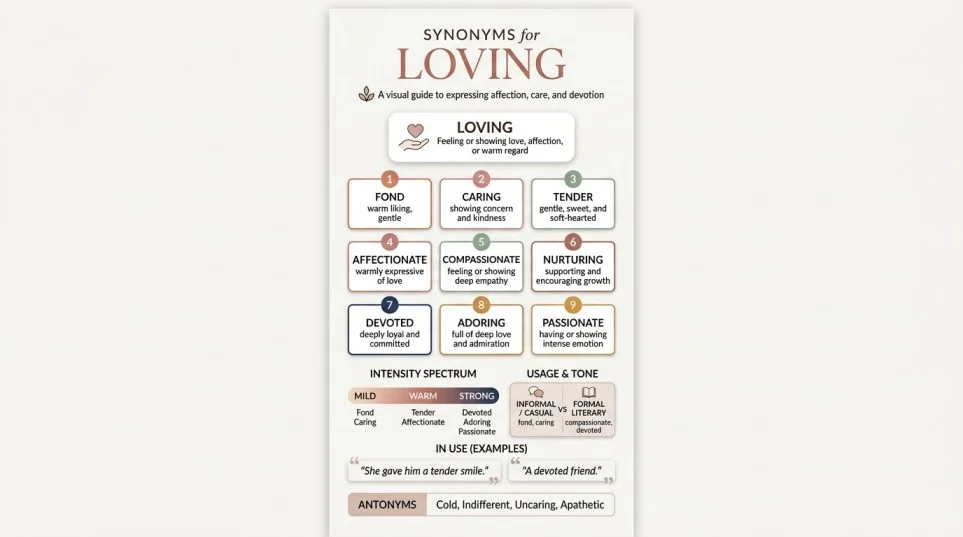
Loving means showing, feeling, or expressing strong affection, care, warmth, or emotional attachment toward someone or something. Depending on context, useful alternatives include affectionate, caring, devoted, fond, tender, adoring, compassionate, passionate, nurturing, and warmhearted.
Meaning, Tone and Context
Simple Definition
Loving describes a strong feeling of affection, care, warmth, or emotional attachment.
It can describe how someone feels toward another person, how they treat someone, or the emotional quality of something.
For example:
“She is a loving mother.”
“He gave his partner a loving smile.”
“They grew up in a loving family.”
Part of Speech
“Loving” is primarily an adjective when it describes a person, action, relationship, or atmosphere.
It can also function as the present participle of the verb “love.”
Examples include:
“Loving your family can shape your priorities.”
“She is loving and patient with her children.”
Tone
Loving almost always has a positive and emotionally warm tone.
It suggests affection, kindness, attachment, tenderness, or genuine concern.
The exact feeling depends on the sentence. “Loving” can describe romantic affection, family relationships, friendships, pets, communities, or a strong appreciation for an activity.
Formality Level
“Loving” is a neutral and widely understood word.
It works naturally in casual conversations, personal writing, professional contexts involving relationships, creative writing, social media, and many academic discussions.
However, a more precise alternative can sometimes communicate the intended meaning better.
Common Use Cases
Loving commonly describes:
- Romantic relationships
- Family relationships
- Friendships
- Parenting
- Caregiving
- Personal relationships
- Emotional support
- Compassionate behavior
- Strong appreciation
- Creative descriptions
Related Word Forms
The word family includes “love,” “loved,” “loving,” and “lovingly.”
Related nouns include “love” and “lover,” although “lover” has a more specific romantic meaning.
When and How to Use Loving
Use “loving” when you want to communicate genuine affection, emotional warmth, care, or strong attachment.
It is especially useful when the emotional meaning matters more than technical precision.
Personal
“She is a loving sister who always checks on her family.”
Professional
“The organization creates a loving and supportive environment for children.”
Academic
“Children often benefit from a loving and stable home environment.”
Social Media
“Feeling grateful for these loving people in my life.”
Creative
“He remembered her loving voice long after she had left.”
Another Word for Loving
There is no single replacement that works perfectly in every sentence.
- For professional writing, “caring” or “compassionate” may be more precise.
- For academic writing, “affectionate” or “nurturing” can work depending on the subject.
- For casual conversation, “fond” or “adoring” may sound natural.
- For emotional writing, “devoted,” “tender,” or “cherishing” can create greater emotional depth.
- For creative writing, “tender,” “passionate,” or “adoring” can make the description more vivid.
- For workplace writing, “supportive,” “caring,” or “compassionate” may be more appropriate than a strongly romantic word.
- For social media captions, “adoring,” “affectionate,” “devoted,” or “sweet” can sound natural.
- For a stronger meaning, consider “devoted,” “adoring,” or “passionate.”
- For a softer meaning, “fond,” “warm,” or “caring” may be better.
When Not to Use Loving
“Loving” may be too general when you need to explain exactly how someone feels or behaves.
For example:
“She is loving toward her students.”
This is positive, but “She is nurturing toward her students” gives a more specific impression of guidance and care.
Similarly:
“He is loving toward his partner.”
The sentence is natural, but “He is devoted to his partner” emphasizes loyalty and commitment.
In professional or academic writing, consider whether the word describes affection, compassion, support, commitment, or passion. Choosing the more precise concept can make your writing stronger.
Words Commonly Confused With Loving
Loving vs. Caring
“Loving” emphasizes affection and emotional attachment. “Caring” emphasizes concern for another person’s well being.
Loving vs. Affectionate
“Loving” can describe deep emotional attachment. “Affectionate” often focuses on openly expressing warmth or fondness.
Loving vs. Fond
“Fond” usually describes liking someone or something strongly. “Loving” generally communicates deeper affection.
Loving vs. Devoted
“Devoted” emphasizes loyalty, commitment, and dedication. “Loving” emphasizes affection and emotional warmth.
Loving vs. Passionate
“Passionate” suggests intense enthusiasm or desire. “Loving” can be much gentler and does not necessarily imply intensity.
Loving vs. Compassionate
“Compassionate” focuses on understanding suffering and wanting to help. “Loving” has a broader emotional meaning.
Best Synonym by Context for Loving
| Context | Best Synonym | Why It Works | Example |
|---|---|---|---|
| Formal writing | Affectionate | Clear and polished | She has an affectionate relationship with her family. |
| Academic writing | Nurturing | Describes supportive care precisely | A nurturing environment can help children develop confidence. |
| Professional use | Caring | Sounds natural and positive | She is a caring manager who listens to her team. |
| Resume | Compassionate | Highlights interpersonal qualities | Compassionate communication is central to effective caregiving. |
| Casual conversation | Fond | Natural and understated | I am very fond of my old neighbors. |
| Creative writing | Tender | Adds emotional depth | He gave her a tender smile. |
| Emotional writing | Devoted | Shows strong commitment | She remained devoted to her family. |
| Strong intensity | Adoring | Expresses very strong affection | The child looked at his father with an adoring smile. |
| Mild tone | Fond | Communicates affection without intensity | She is fond of her younger cousin. |
| Social media | Adoring | Warm and expressive | An adoring moment with my favorite people. |
| Family relationships | Nurturing | Highlights care and support | She created a nurturing home for her children. |
| Romantic relationships | Passionate | Emphasizes strong romantic feeling | They share a passionate relationship. |
| Friendship | Affectionate | Works well for warm personal bonds | He sent an affectionate message to his longtime friend. |
| Caregiving | Compassionate | Emphasizes empathy and care | The compassionate nurse reassured the patient. |
| Literary description | Tender | Creates a gentle emotional impression | She spoke in a tender voice. |
| Loyalty | Devoted | Emphasizes dedication | He is devoted to his partner. |
Which Synonym Should You Choose?
Start by identifying what “loving” means in your sentence.
- If you mean showing affection, choose “affectionate.”
- If you mean providing care, choose “caring.”
- If you mean strong commitment, choose “devoted.”
- If you mean strong romantic emotion, choose “passionate.”
- If you mean gentle emotion, choose “tender.”
- If you mean strong admiration or affection, choose “adoring.”
- If you mean supportive care, choose “nurturing.”
- If you mean empathy toward others, choose “compassionate.”
- If you mean mild affection, choose “fond.”
The best synonym should match both the emotional intensity and the relationship being described.
Real Life Examples of Loving in Sentences
School
“The teacher created a loving classroom where students felt comfortable asking questions.”
Workplace
“She has a caring leadership style that makes employees feel respected.”
Writing
“The author presents the grandmother as a tender and devoted figure.”
Conversation
“I am very fond of this neighborhood.”
Social Media
“Grateful for all the loving people who made this day special.”
Resume
“Compassionate professional with strong communication and caregiving skills.”
“Thank you for your kind and caring support during this difficult time.”
Storytelling
“He remembered his father’s loving advice whenever life became difficult.”
18 Synonyms for “Loving”
| Synonym | Simple Meaning | Best Used For | Example Sentence |
|---|---|---|---|
| Affectionate | Showing warm feelings | Relationships and personal writing | She gave her daughter an affectionate hug. |
| Caring | Showing concern for others | Family, work, and caregiving | He is a caring friend who always listens. |
| Adoring | Showing very strong affection | Romantic and family contexts | The puppy received an adoring look from its owner. |
| Fond | Having warm feelings or strong liking | Mild personal affection | She is fond of her childhood home. |
| Devoted | Deeply committed and loyal | Family and romantic relationships | He is devoted to his wife and children. |
| Tender | Gentle and emotionally warm | Emotional and creative writing | She gave him a tender smile. |
| Warmhearted | Naturally kind and affectionate | Personal descriptions | Everyone appreciated her warmhearted nature. |
| Compassionate | Showing empathy and concern | Professional and caregiving contexts | The compassionate counselor listened carefully. |
| Nurturing | Providing care and encouragement | Parenting and education | Her nurturing approach helped students grow. |
| Doting | Showing excessive or very obvious affection | Family and parenting | The doting grandfather brought gifts for his grandchildren. |
| Passionate | Showing intense feeling | Romantic or creative contexts | They share a passionate connection. |
| Cherishing | Treating someone or something as deeply valuable | Emotional and reflective writing | She spent years cherishing those family memories. |
| Amorous | Expressing romantic affection or desire | Romantic and literary contexts | The poem has an amorous tone. |
| Supportive | Giving emotional or practical encouragement | Work, friendship, and family | She has always been supportive of her friends. |
| Kindhearted | Naturally kind and caring | Character descriptions | The kindhearted volunteer helped every visitor. |
| Sweet | Pleasantly affectionate or kind | Casual speech and captions | That was such a sweet message. |
| Attached | Emotionally connected to someone or something | Personal relationships | The child became deeply attached to the family dog. |
| Sentimental | Showing strong emotional attachment to memories or relationships | Personal and creative writing | He felt sentimental when he visited his childhood home. |
Synonym Groups and Usage Differences
Professional vs. Personal Synonyms
Personal writing can comfortably use words such as “adoring,” “fond,” “tender,” and “devoted.”
Professional writing usually benefits from more precise words such as “caring,” “compassionate,” “supportive,” and “nurturing.”
For example, “She is an adoring manager” sounds unusual in most workplace situations. “She is a supportive manager” is clearer and more professional.
Formal vs. Conversational Synonyms
“Affectionate,” “compassionate,” “devoted,” and “nurturing” work well in polished writing.
“Fond,” “sweet,” and “caring” are generally more conversational.
Choose a word that fits the surrounding vocabulary rather than simply selecting the most sophisticated sounding option.
Academic Synonyms
Academic writing often requires precision.
“Nurturing” is useful when discussing child development or education.
“Compassionate” works well in discussions of healthcare and social services.
“Affectionate” can describe observable emotional behavior or relationships.
Professional and Business Synonyms
In workplace communication, “supportive,” “caring,” “compassionate,” and “kindhearted” can describe interpersonal qualities.
For resumes, choose words that communicate an actual professional strength.
For example:
“Compassionate healthcare professional with strong communication skills.”
This is more specific than simply saying:
“Loving healthcare professional.”
Creative or Literary Synonyms
Creative writing allows more emotional flexibility.
“Tender,” “adoring,” “devoted,” “passionate,” and “cherishing” can create stronger emotional imagery.
Choose the word based on the feeling you want readers to experience.
Slang or Modern Synonyms
There is no single slang replacement for “loving” that works in every situation.
Casual words such as “sweet” can communicate affection in social media posts and everyday conversation.
However, avoid casual expressions when writing academic papers, professional documents, or formal correspondence.
Strongest vs. Weaker Synonyms
A general intensity scale can look like this:
Mild: Fond
Gentle: Warm, affectionate
Moderate: Caring, supportive
Strong: Devoted, nurturing
Very strong: Adoring, passionate
The exact intensity depends on the sentence and relationship.
Emotional vs. Neutral Synonyms
“Loving,” “adoring,” “tender,” and “devoted” carry noticeable emotional warmth.
“Supportive,” “caring,” and “compassionate” can sound more practical and neutral.
Use emotional words when the feeling itself matters. Use neutral words when the behavior or quality matters more.
Antonyms of “Loving”
| Antonym | Meaning | Example Sentence |
|---|---|---|
| Hateful | Filled with strong dislike | His hateful comments hurt the people around him. |
| Hating | Feeling intense dislike | She was hating the unfair treatment. |
| Unloving | Showing little or no affection | He grew up in an unloving environment. |
| Cold | Lacking emotional warmth | His response seemed cold and distant. |
| Uncaring | Showing little concern | The uncaring response disappointed everyone. |
| Indifferent | Showing little interest or concern | She remained indifferent to their concerns. |
| Apathetic | Showing little emotion or interest | The apathetic reaction surprised the team. |
| Hostile | Unfriendly or aggressive | His hostile attitude made conversation difficult. |
| Cruel | Intentionally causing pain or suffering | The cruel behavior deeply upset the family. |
| Harsh | Severe or lacking gentleness | Her harsh words were difficult to forget. |
| Distant | Emotionally removed | He became distant after the disagreement. |
| Resentful | Holding negative feelings about someone | She felt resentful after being ignored. |
| Disapproving | Showing that something is considered wrong | His disapproving expression was obvious. |
| Unsympathetic | Lacking understanding of another person’s feelings | The unsympathetic response offered no comfort. |
| Callous | Insensitive to other people’s feelings | His callous remark made the situation worse. |
Comparison: Loving vs. Similar Words
“Loving” vs. “Caring”
The main difference is emotional emphasis.
“Loving” usually communicates affection and emotional attachment. “Caring” focuses more on concern and helpful behavior.
“Loving” is emotionally stronger.
“Caring” can sound more neutral and professional.
Example:
“She is a loving mother.”
“She is a caring teacher.”
“Loving” vs. “Affectionate”
“Affectionate” focuses on the expression of warm feelings.
“Loving” can describe both the feeling and the general quality of a relationship.
Neither is always stronger.
Example:
“He is loving toward his family.”
“He is affectionate with his children.”
“Loving” vs. “Fond”
“Fond” generally describes a warm liking or attachment.
“Loving” usually communicates deeper affection.
“Loving” is stronger.
Example:
“She is fond of her neighbor.”
“She has a loving relationship with her sister.”
“Loving” vs. “Devoted”
“Devoted” emphasizes loyalty, dedication, and commitment.
“Loving” emphasizes affection.
“Devoted” can be stronger when commitment is the main idea.
Example:
“He is a loving father.”
“He is devoted to his family.”
“Loving” vs. “Passionate”
“Passionate” suggests intense emotion, enthusiasm, or romantic desire.
“Loving” can describe deep affection without suggesting intensity.
“Passionate” is stronger in emotional intensity.
Example:
“They have a loving relationship.”
“They share a passionate relationship.”
“Loving” vs. “Compassionate”
“Compassionate” means understanding suffering and responding with care.
“Loving” is broader and can include affection without suffering being involved.
“Compassionate” is generally more precise in professional contexts.
Example:
“She is a loving friend.”
“She is a compassionate healthcare worker.”
Common Phrases and Expressions with “Loving”
1. Loving family
Meaning:
A family characterized by affection, care, and emotional support.
Example sentence:
“She grew up in a loving family that encouraged her dreams.”
2. Loving relationship
Meaning:
A relationship characterized by affection, care, and emotional connection.
Example sentence:
“They built a loving relationship based on trust.”
3. Loving parent
Meaning:
A parent who shows affection and genuine care for a child.
Example sentence:
“He is a loving parent who makes time for his children.”
4. Loving home
Meaning:
A home environment where people feel cared for and valued.
Example sentence:
“The child found a loving home with a supportive family.”
5. Loving heart
Meaning:
A figurative expression for someone who is naturally affectionate and caring.
Example sentence:
“She has a loving heart and always helps people in need.”
6. Loving memory
Meaning:
A warm emotional remembrance of someone or something.
Example sentence:
“We remember her in loving memory.”
7. Loving care
Meaning:
Care provided with genuine affection and concern.
Example sentence:
“The elderly man received loving care from his family.”
Common Mistakes to Avoid
1. Using “Loving” When a More Precise Word Is Better
“Loving” is broad.
- If you mean empathy, use “compassionate.” If you mean loyalty, use “devoted.” If you mean guidance, use “nurturing.”
2. Confusing Loving With Fond
“Fond” usually suggests warm liking, while “loving” often suggests deeper affection.
Do not assume the two words have identical emotional intensity.
3. Using a Casual Word in Formal Writing
Words such as “sweet” can work in conversation but may sound too casual in an academic paper.
Choose “affectionate,” “compassionate,” or another precise alternative when appropriate.
4. Choosing an Overly Dramatic Synonym
“Passionate” can sound excessive if you simply mean that someone is kind and caring.
Match the intensity of the synonym to the situation.
5. Repeating “Loving” Too Often
If several sentences use “loving,” your writing may become repetitive.
Replace selected instances with “affectionate,” “caring,” “tender,” “devoted,” or “nurturing” when the meaning remains accurate.
6. Choosing the Wrong Emotional Tone
“Adoring” is much more expressive than “fond.”
“Passionate” can imply romantic intensity.
“Compassionate” emphasizes empathy.
Always consider the exact feeling you want to communicate.
FAQs
What is the best synonym for “loving”?
The best synonym depends on context. “Affectionate” is a strong general choice, while “caring,” “devoted,” “tender,” or “passionate” may be better for specific meanings.
What is a formal synonym for “loving”?
“Affectionate,” “compassionate,” “devoted,” and “nurturing” can work as formal alternatives when their specific meanings fit the sentence.
What is an informal synonym for “loving”?
“Fond,” “sweet,” and “caring” can sound natural in everyday conversation, depending on the relationship and situation.
What is another word for “loving” in professional writing?
“Caring,” “compassionate,” “supportive,” and “nurturing” are useful professional alternatives because they describe specific qualities without sounding overly romantic.
What is the difference between “loving” and “affectionate”?
“Loving” suggests affection and emotional attachment, while “affectionate” more specifically emphasizes the outward expression of warmth and fondness.
What is the opposite of “loving”?
Common opposites include “unloving,” “uncaring,” “cold,” “indifferent,” “hostile,” “hateful,” and “callous,” depending on the intended meaning.
Conclusion
“Loving” is a warm and flexible word that expresses affection, care, emotional attachment, or devotion. It works naturally in personal conversations, relationship descriptions, social media, creative writing, and many other situations.
The best synonym depends on the exact meaning you want. Choose “affectionate” for expressed warmth, “caring” for concern, “devoted” for commitment, “tender” for gentle emotion, “nurturing” for supportive care, and “passionate” for intense feeling.
A useful vocabulary habit is to ask yourself what kind of love or care you actually mean before choosing a synonym. Precision makes your writing more natural, expressive, and effective.
Before publishing educational vocabulary content, verify definitions and usage with trusted dictionaries such as Cambridge, Oxford, Merriam Webster, Collins, or Britannica.
Discover More Post:
- 25+ Synonyms for Attention | Meanings, Examples, and Best …
- 25+ Synonyms for Marginalized | Meanings, Examples, and Best …
- 25+ Synonyms for Access | Meanings, Examples, and Best …