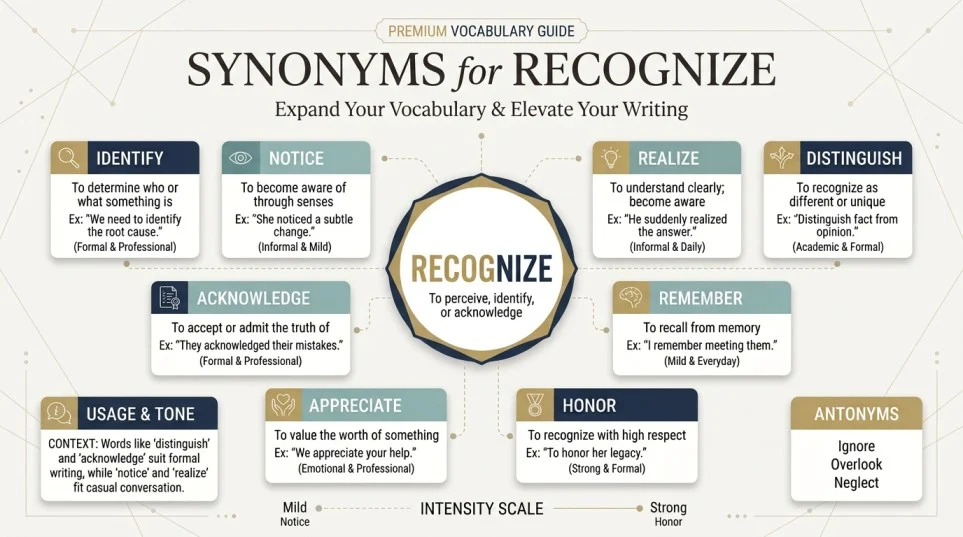
If you keep using the word “recognize” in your essays, emails, conversations, captions, or professional writing, you have plenty of alternatives. The best choice depends on what you mean by recognize.
You might mean identifying someone, noticing something, accepting a fact, remembering a person, appreciating an achievement, or officially acknowledging something. Each meaning calls for slightly different vocabulary.
This guide explains the most useful synonyms for recognize, including formal, academic, professional, casual, emotional, and creative alternatives. You will also learn which words sound natural in resumes, emails, essays, conversations, and everyday writing.
What Does “Recognize” Mean?
To recognize means to identify, notice, remember, accept, or acknowledge someone or something. Formal choices include acknowledge and identify, while casual options include know, spot, and remember.
Meaning, Tone and Context
Simple Definition
Recognize is a verb that generally means to identify someone or something because you know, remember, notice, or understand it.
It can also mean accepting a fact, giving credit to an achievement, or officially acknowledging someone or something.
For example:
“I recognized her voice immediately.”
Here, recognize means identify from previous knowledge.
Another example is:
“The company recognized his contribution to the project.”
Here, recognize means acknowledge or give credit.
Part of Speech
Recognize is primarily a verb.
Common forms include:
Recognize
Recognized
Recognizing
Recognition
Recognizable
Recognizably
The noun recognition refers to the act of identifying, acknowledging, appreciating, or honoring someone or something.
Tone
Recognize is generally neutral in tone. Its emotional effect depends on the context.
It can sound positive when discussing achievements, appreciation, or respect.
“The organization recognized her outstanding work.”
It can also be neutral when referring to identification.
“I recognized the building from the photograph.”
In some situations, recognize can be negative or serious when it involves accepting an unpleasant truth.
“He finally recognized the seriousness of the problem.”
Formality Level
Recognize works well in casual conversation, academic writing, business communication, professional documents, and formal speeches.
However, a more specific synonym can make your sentence clearer.
For example, “acknowledge” may be better when discussing responsibility or contributions, while “identify” may be more accurate when referring to finding out what something is.
Common Use Cases
Recognize is commonly used when you want to:
Identify a person or object
Notice a familiar face or voice
Understand or realize a fact
Acknowledge someone’s contribution
Accept a problem or situation
Remember something from the past
Give credit or praise
Officially honor an achievement
Distinguish one thing from another
When and How to Use “Recognize”
Use recognize when the idea involves identification, awareness, acceptance, memory, or acknowledgment.
Professional
“The manager recognized the team’s effort during the quarterly meeting.”
Here, recognize means publicly acknowledge or give credit.
Personal
“I recognized my old friend as soon as she walked into the room.”
Here, recognize means identify someone familiar.
Academic
“Researchers recognize the importance of controlling external variables.”
In this sentence, recognize means accept or understand the importance of something.
Emotional
“She finally recognized how much support her family had given her.”
Here, recognize means become aware of or appreciate something.
Another Word for “Recognize”
The best single replacement depends on the meaning.
If you mean identifying someone or something, identify is often the strongest choice.
If you mean accepting or acknowledging a fact, acknowledge works well.
If you mean noticing something, notice is more precise.
If you mean remembering someone, remember is clearer.
If you mean appreciating someone’s effort, appreciate may be more natural.
Professional Writing
Use acknowledge, identify, or credit, depending on the sentence.
Academic Writing
Use acknowledge, identify, observe, or establish when they accurately express the intended meaning.
Casual Conversation
Use know, spot, notice, or remember when appropriate.
Emotional Writing
Use appreciate, realize, understand, or acknowledge.
Creative Writing
Use notice, remember, discern, identify, or realize depending on the scene.
Resume or Workplace Use
Use acknowledge, honor, credit, or commend when describing professional recognition.
Social Media Captions
Use celebrate, honor, appreciate, or spot depending on your intended tone.
Stronger Meaning
Use acknowledge, admit, confirm, or identify when the sentence requires a more specific sense.
Softer Meaning
Use notice, observe, or appreciate when you want a gentler tone.
When Not to Use “Recognize”
Recognize can become vague when the sentence has a more precise meaning available.
For example:
“She recognized the problem.”
This is understandable, but it does not explain whether she noticed the problem, understood it, admitted it, or accepted responsibility for it.
A more precise version might be:
“She identified the problem.”
“She acknowledged the problem.”
“She noticed the problem.”
“She admitted the problem existed.”
The best synonym depends on the exact idea you want to communicate.
Avoid using recognize simply because it sounds formal. A simpler word is often clearer.
For example, “I recognized that I was tired” may work, but “I realized that I was tired” is often more natural when describing personal awareness.
Words Commonly Confused With “Recognize”
Recognize vs. Identify
Recognize usually involves familiarity or previous knowledge. Identify means determining exactly what someone or something is.
“I recognized the actor.”
“I identified the chemical.”
Recognize vs. Notice
Notice means becoming aware of something through observation. Recognize often adds the idea of familiarity or understanding.
“I noticed a strange sound.”
“I recognized the sound as a familiar alarm.”
Recognize vs. Acknowledge
Acknowledge means accepting, admitting, or giving credit to something. Recognize can have the same meaning, but it also has several other meanings.
“The company acknowledged the employee’s contribution.”
Recognize vs. Remember
Remember means bringing something from the past back into your mind. Recognize means identifying something or someone because it is familiar.
“I remembered her name.”
“I recognized her face.”
Recognize vs. Realize
Realize means becoming aware of or understanding something. Recognize can sometimes have this meaning, but realize is usually clearer for a new understanding.
“She realized she had made a mistake.”
Recognize vs. Appreciate
Appreciate means understanding the value, importance, or quality of something. Recognize can mean acknowledging value, but appreciate usually adds a stronger sense of gratitude or admiration.
“I appreciate your help.”
Best Synonym by Context for “Recognize”
| Context | Best Synonym | Why It Works | Example |
|---|---|---|---|
| Formal writing | Acknowledge | Clearly expresses acceptance or acknowledgment | The report acknowledges the limitations of the study. |
| Academic writing | Identify | Precise when naming or determining something | Researchers identified several important patterns. |
| Professional use | Acknowledge | Natural for contributions and issues | The director acknowledged the team’s efforts. |
| Resume | Commend | Highlights praise or professional recognition | The employee was commended for outstanding service. |
| Casual conversation | Spot | Sounds natural when identifying someone or something | I spotted my neighbor across the street. |
| Creative writing | Discern | Adds a thoughtful or literary tone | She could barely discern his face in the fog. |
| Emotional writing | Appreciate | Expresses value or gratitude | I appreciate everything you have done for me. |
| Strong intensity | Admit | Suggests accepting something that may be difficult | He finally admitted that the plan had failed. |
| Mild tone | Notice | Focuses on simple awareness | I noticed a small change in the room. |
| Social media captions | Celebrate | Works well when honoring achievement | Today we celebrate her incredible achievement. |
| Business communication | Credit | Clearly gives recognition for an action or result | We credit the team for the successful launch. |
| Identification | Identify | Directly expresses determining what something is | The witness identified the suspect. |
| Memory | Remember | Best when familiarity comes from memory | I remember meeting him years ago. |
| Awareness | Realize | Best for understanding something | She realized the mistake immediately. |
| Praise | Honor | Expresses respect and recognition | The school honored its retiring principal. |
| Official recognition | Award | Indicates formal recognition through a prize or distinction | The committee awarded her for her service. |
| Observation | Observe | Suitable for formal or careful noticing | The researchers observed a significant change. |
| US and UK usage | Recognize | The American spelling uses recognize | The organization recognized her achievement. |
Which Synonym Should You Choose?
Choosing the best synonym for recognize starts with identifying your intended meaning.
If you mean knowing who or what something is, choose identify, spot, or remember.
If you mean noticing something, choose notice or observe.
If you mean accepting a fact, choose acknowledge, admit, or realize.
If you mean giving someone credit, choose acknowledge, credit, commend, or honor.
If you mean showing appreciation, choose appreciate.
If you want a professional tone, prefer precise words such as acknowledge, identify, credit, or commend.
If you want a conversational tone, words such as spot, notice, know, and remember may sound more natural.
Always choose based on meaning first and formality second.
Real Life Examples of “Recognize” in Sentences
School
“The teacher recognized the student’s improvement throughout the semester.”
Workplace
“Our manager recognized the team’s effort during the presentation.”
Writing
“Good writers recognize when a sentence needs more context.”
Conversation
“Did you recognize the person standing near the entrance?”
Social Media
“Let’s recognize everyone who helped make this event possible.”
Resume
“Recognized for improving customer satisfaction and team performance.”
“I would like to recognize Sarah for her excellent work on the project.”
Storytelling
“From the sound of his footsteps, she recognized him immediately.”
18 Synonyms for “Recognize”
| Synonym | Simple Meaning | Best Used For | Example Sentence |
|---|---|---|---|
| Acknowledge | Accept or give recognition | Formal, academic, professional | The report acknowledges the team’s contribution. |
| Identify | Determine who or what something is | Academic, technical, professional | The technician identified the source of the problem. |
| Notice | Become aware of something | Casual, personal, general | She noticed a change in his expression. |
| Remember | Recall someone or something from the past | Personal, casual | I remember that restaurant from our last trip. |
| Realize | Become aware or understand | Academic, personal, emotional | He realized that the instructions were incomplete. |
| Appreciate | Understand value or feel gratitude | Emotional, professional, personal | We appreciate your continued support. |
| Admit | Accept that something is true | Emotional, formal, serious | She admitted that the original plan needed revision. |
| Observe | Notice carefully | Academic, formal, professional | The researchers observed a change in behavior. |
| Discern | Recognize something with careful perception | Formal, creative, literary | She could discern a faint light in the distance. |
| Spot | See or identify quickly | Casual, conversational | I spotted my brother in the crowd. |
| Know | Be familiar with someone or something | Casual, conversational | I know that actor from several movies. |
| Credit | Give someone responsibility or praise for a result | Professional, business | The company credits its success to strong teamwork. |
| Commend | Praise formally | Professional, formal | The supervisor commended her for excellent service. |
| Honor | Show respect or recognition | Formal, emotional, ceremonial | The community honored the volunteers. |
| Celebrate | Publicly appreciate or honor | Social media, personal, professional | We celebrate everyone who contributed to the project. |
| Detect | Discover or notice something | Technical, academic, professional | The device detected an unusual signal. |
| Distinguish | Recognize differences between things | Academic, formal | Students must distinguish facts from opinions. |
| Confirm | Establish that something is true or correct | Professional, formal | The manager confirmed the employee’s achievement. |
Synonym Groups and Usage Differences
Professional vs. Personal Synonyms
Professional writing often benefits from precise terms such as acknowledge, identify, credit, commend, and confirm.
Personal writing can use more natural words such as notice, remember, spot, know, and appreciate.
Compare these examples:
“The company acknowledged her contribution.”
“I noticed how hard she worked.”
The first sentence sounds professional. The second feels more personal and conversational.
Formal vs. Conversational Synonyms
Formal writing often favors acknowledge, identify, observe, discern, commend, and distinguish.
Casual conversation usually sounds more natural with notice, spot, know, remember, and appreciate.
For example:
Formal: “The researchers identified a significant pattern.”
Conversational: “I noticed something strange.”
Academic Synonyms
Academic writing requires precision.
Use identify when determining a specific person, factor, cause, or pattern.
Use acknowledge when accepting an idea, limitation, or contribution.
Use observe when describing something discovered through examination.
Use distinguish when explaining differences between concepts.
Avoid choosing an impressive sounding synonym if it changes the intended meaning.
Professional and Business Synonyms
Business communication frequently uses acknowledge, recognize, credit, commend, honor, and confirm.
For example:
“The company recognized the employee’s five years of service.”
A more specific version is:
“The company honored the employee for five years of service.”
The second sentence emphasizes respect and formal appreciation.
Creative or Literary Synonyms
Creative writing can benefit from words such as discern, notice, remember, detect, and realize.
These choices can create a more specific emotional or visual effect.
For example:
“Through the mist, she discerned the outline of a distant house.”
Discern is more atmospheric than simply saying “saw.”
Slang or Modern Synonyms
There is no single slang equivalent that works for every meaning of recognize.
In casual American speech, spot can replace recognize when the meaning is identifying someone or something quickly.
For example:
“I spotted him at the concert.”
This is appropriate in conversation but may sound too casual in an academic paper.
Strongest vs. Weaker Synonyms
The intensity depends on the sense of recognize.
Mild:
Notice
Observe
Spot
Moderate:
Recognize
Identify
Remember
Realize
Stronger or more deliberate:
Acknowledge
Admit
Commend
Honor
The strongest choice is not always the best choice. Precision matters more than intensity.
Emotional vs. Neutral Synonyms
Neutral choices include identify, notice, observe, detect, and distinguish.
More emotional choices include appreciate, honor, commend, celebrate, and remember.
For example:
“The committee identified her contribution.”
“The committee honored her contribution.”
The second sentence communicates more respect and emotional significance.
Antonyms of “Recognize”
Because recognize has several meanings, its opposite changes with context. The following words work as antonyms for particular senses of recognize.
| Antonym | Meaning | Example Sentence |
|---|---|---|
| Overlook | Fail to notice | The manager overlooked an important detail. |
| Ignore | Choose not to pay attention | He ignored the warning signs. |
| Miss | Fail to notice or identify | I missed the small change in the document. |
| Forget | Fail to remember | She forgot his name. |
| Misidentify | Identify incorrectly | The witness misidentified the person. |
| Misunderstand | Interpret incorrectly | They misunderstood the purpose of the message. |
| Deny | Refuse to accept as true | He denied responsibility for the mistake. |
| Reject | Refuse to accept or acknowledge | The committee rejected the claim. |
| Disregard | Treat something as unimportant | The employee disregarded the instructions. |
| Dismiss | Refuse to consider seriously | She dismissed the concern too quickly. |
| Be unaware | Have no knowledge of something | He was unaware of the change. |
| Disown | Refuse to acknowledge a relationship or responsibility | The organization disowned the statement. |
| Conceal | Keep something from being noticed or known | The report concealed the underlying issue. |
| Forget about | Fail to keep something in mind | They forgot about the original agreement. |
| Fail to acknowledge | Refuse or neglect to give recognition | The report failed to acknowledge the team’s contribution. |
Comparison: “Recognize” vs. Similar Words
Recognize vs. Identify
The main difference is familiarity.
Recognize often means knowing someone or something because you have encountered it before. Identify means determining exactly what it is.
Recognize is not necessarily stronger or weaker. Identify is usually more precise in technical and academic contexts.
Example:
“I recognized the actor.”
“The scientist identified the substance.”
Recognize vs. Notice
Recognize can involve familiarity, while notice simply means becoming aware.
Notice is often milder and more observational.
Example:
“I noticed a new painting.”
“I recognized the painting from the museum.”
Recognize vs. Acknowledge
Acknowledge focuses on accepting, admitting, or giving credit.
Recognize can express all of those ideas, but it can also mean identifying someone.
Acknowledge is often more formal.
Example:
“The author acknowledged the source.”
“The author recognized the source.”
Recognize vs. Remember
Remember is about recalling something from memory.
Recognize is about identifying something as familiar.
Example:
“I remembered her birthday.”
“I recognized her voice.”
Recognize vs. Realize
Realize focuses on gaining understanding or awareness.
Recognize can sometimes communicate this idea, but realize is generally more direct.
Example:
“She realized she was wrong.”
“She recognized the importance of the issue.”
Recognize vs. Appreciate
Appreciate emphasizes value, gratitude, or understanding.
Recognize can mean giving credit, but appreciate usually carries more emotional warmth.
Example:
“We recognize your contribution.”
“We appreciate your contribution.”
The second sounds more personal and grateful.
Common Phrases and Expressions with “Recognize”
1. Recognize the importance
Meaning:
To understand or acknowledge that something matters.
Example sentence:
“Students should recognize the importance of consistent practice.”
2. Recognize the value
Meaning:
To understand the usefulness or worth of something.
Example sentence:
“Successful teams recognize the value of clear communication.”
3. Recognize an achievement
Meaning:
To officially or publicly acknowledge someone’s success.
Example sentence:
“The organization recognized her achievement at the annual event.”
4. Recognize a contribution
Meaning:
To give someone credit for helping or creating something.
Example sentence:
“The director recognized his contribution to the project.”
5. Recognize a pattern
Meaning:
To notice a repeated structure or trend.
Example sentence:
“Experienced analysts can recognize patterns in complex data.”
6. Recognize the difference
Meaning:
To understand that two things are not the same.
Example sentence:
“Children gradually learn to recognize the difference between fact and opinion.”
7. Recognize someone by name
Meaning:
To know someone because their name is familiar.
Example sentence:
“I recognize her name, but I have never met her.”
8. Recognize the signs
Meaning:
To notice or understand indications of a situation.
Example sentence:
“Learning to recognize the signs of stress can help you respond earlier.”
Common Mistakes to Avoid
1. Using Recognize When Identify Is Better
If you are determining exactly what something is, identify is often more precise.
Weak:
“The technician recognized the source of the error.”
Better:
“The technician identified the source of the error.”
2. Confusing Recognize With Remember
Remember concerns recalling information. Recognize concerns identifying something as familiar.
“I remembered her address” is different from “I recognized her handwriting.”
3. Using a Casual Synonym in Formal Writing
Words such as spot and know can sound too conversational in academic or formal contexts.
Choose identify, acknowledge, or observe when they accurately express your meaning.
4. Using an Overly Dramatic Synonym
Do not use honor, celebrate, or commend when you simply mean notice.
“The researcher noticed a pattern” is clearer than “The researcher honored a pattern.”
5. Repeating Recognize Too Often
Repeated use can make writing feel flat.
Instead of writing “recognize” several times, consider identify, acknowledge, notice, appreciate, or distinguish when the meaning remains accurate.
6. Choosing the Wrong Emotional Tone
Appreciate and honor add warmth, while identify and detect are more neutral.
Match the synonym to the emotional purpose of the sentence.
FAQs
What is the best synonym for recognize?
The best synonym depends on meaning. Identify works for identification, acknowledge for acceptance or credit, notice for awareness, and appreciate for value or gratitude.
What is a formal synonym for recognize?
Acknowledge is a strong formal synonym when you mean accepting or giving credit. Identify is better when you mean determining exactly what something is.
What is an informal synonym for recognize?
Spot is a natural informal choice when you mean seeing or identifying someone or something. Notice and know can also work in casual conversation.
What is another word for recognize in professional writing?
Acknowledge, identify, credit, commend, honor, and confirm can replace recognize in professional writing when they accurately express the intended meaning.
What is the difference between recognize and identify?
Recognize often means identifying something familiar, while identify means determining exactly what someone or something is. Identify is usually more precise.
What is the opposite of recognize?
Possible opposites include overlook, ignore, miss, forget, misidentify, deny, reject, and disregard. The best opposite depends on the meaning of recognize.
Conclusion
Recognize is a versatile verb that can mean identify, notice, remember, understand, acknowledge, appreciate, or give credit. Because it covers several meanings, the best synonym depends heavily on context.
For formal and professional writing, acknowledge, identify, credit, and commend are useful when they match the intended meaning. For casual conversation, notice, spot, know, and remember often sound more natural.
When writing an essay, email, resume, caption, or professional message, do not replace recognize simply to sound more sophisticated. First decide what you actually mean, then choose the most precise word.
A useful vocabulary habit is to ask yourself one question: Am I identifying, noticing, remembering, understanding, or acknowledging something? Your answer will usually point you toward the best synonym.
Discover More Post:
- 25+ Synonyms for Attention | Meanings, Examples, and Best …
- 25+ Synonyms for Marginalized | Meanings, Examples, and Best …
- 25+ Synonyms for Access | Meanings, Examples, and Best …