The word “balance” appears everywhere. You might use it when discussing work and life, writing an essay, describing a fair decision, talking about finances, or explaining how something stays steady.
But repeating “balance” can make your writing feel predictable. The right alternative can make your meaning more precise, whether you are writing an email, resume, essay, caption, presentation, or personal message.
This guide explains synonyms for balance by meaning, tone, formality, and situation. You will learn which alternatives work best in professional, academic, personal, emotional, and creative writing.
What Does “Balance” Mean?
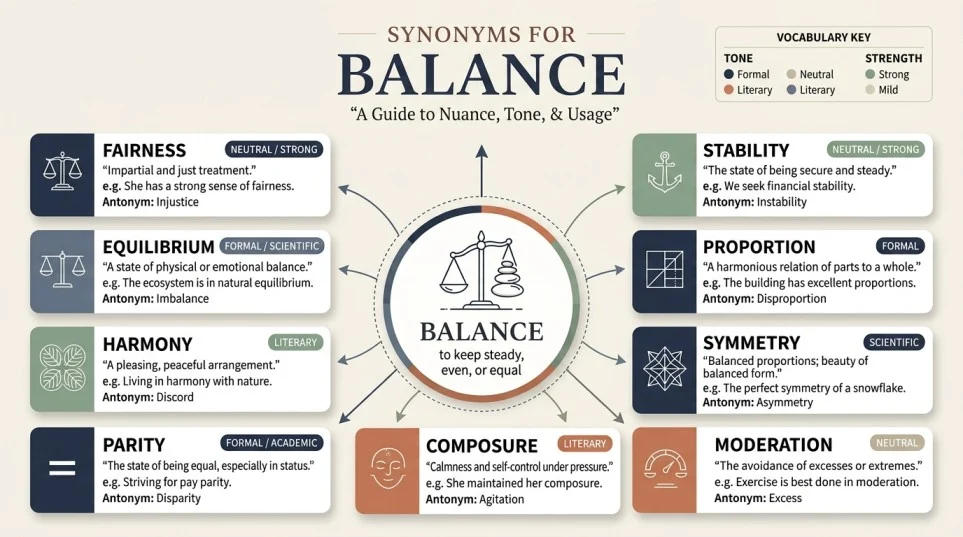
Balance means a state of stability, fairness, equal distribution, or controlled proportion between different elements. Depending on context, useful synonyms include equilibrium, harmony, stability, parity, fairness, poise, proportion, and composure.
Meaning, Tone and Context
Simple Definition
Balance means keeping different elements in a stable, equal, fair, or appropriate relationship.
The word can describe physical stability, emotional control, financial amounts, competing priorities, visual design, or fair treatment.
For example:
“Finding a balance between work and rest can improve your productivity.”
Here, balance means maintaining a healthy relationship between two competing priorities.
Part of Speech
“Balance” can function as both a noun and a verb.
As a noun:
“She maintains a good balance between work and family.”
As a verb:
“He balanced his studies with a part time job.”
It can also appear in related forms such as balanced, balancing, and imbalance.
Tone
Balance is generally neutral and positive.
It often suggests fairness, stability, moderation, control, or harmony. In some contexts, it can also refer simply to a remaining amount, such as a bank balance.
Formality Level
Balance works comfortably in formal, professional, academic, and casual English.
It is a flexible word, which is one reason it is so common. However, a more specific synonym can sometimes communicate your intended meaning more accurately.
Common Use Cases
Balance is frequently used when discussing:
- Work and personal life
- Physical stability
- Financial accounts
- Fairness and equality
- Emotional control
- Competing opinions
- Visual composition
- Time management
- Health and lifestyle
- Business decisions
- Academic arguments
- Personal priorities
When and How to Use “Balance”
Use “balance” when you want to communicate stability, fairness, moderation, or an appropriate relationship between different elements.
Professional Example
“Our team needs to balance customer expectations with available resources.”
Here, balance means managing two competing considerations responsibly.
Personal Example
“She is trying to balance her career with family responsibilities.”
The word suggests that both areas deserve appropriate attention.
Academic Example
“The essay presents a balance between supporting evidence and opposing viewpoints.”
Here, balance refers to an appropriate treatment of different perspectives.
Emotional Example
“He maintained his balance during a difficult conversation.”
In this context, balance suggests emotional control and composure.
Another Word for “Balance”
The best single replacement depends on what you mean.
- For professional writing, “equilibrium” or “stability” may work well when discussing systems, resources, or competing factors.
- For academic writing, “equilibrium,” “proportion,” or “parity” can provide greater precision.
- For casual conversation, “stability,” “harmony,” or “fairness” may sound more natural.
- For emotional writing, “composure” and “poise” can be stronger choices.
- For creative writing, “harmony,” “symmetry,” or “equilibrium” can create a more expressive effect.
- For resumes and workplace writing, “stability,” “coordination,” “proportion,” and “equilibrium” can be useful depending on the sentence.
- For social media captions, “harmony,” “peace,” “stability,” and “moderation” may feel more natural.
- For a stronger meaning, consider “equilibrium,” “stability,” or “parity,” depending on the intended sense.
- For a softer meaning, “harmony,” “moderation,” or “alignment” may work better.
When Not to Use “Balance”
“Balance” is useful, but it can sometimes be too broad.
- If you mean equal treatment, “fairness” or “equality” may be more precise.
- If you mean physical steadiness, “stability” may communicate the idea more directly.
- If you mean emotional control, “composure” or “poise” may be stronger.
- If you mean equal representation, “parity” may be more accurate.
- If you mean visual arrangement, “symmetry” or “proportion” could be a better choice.
For example:
General: “The design needs more balance.”
More precise: “The design needs better symmetry.”
General: “The discussion needs balance.”
More precise: “The discussion needs a fair representation of both viewpoints.”
The more precisely you identify the intended meaning, the more useful your synonym becomes.
Words Commonly Confused With “Balance”
Balance vs. Stability
Balance refers to maintaining an appropriate relationship among different elements. Stability emphasizes the ability to remain steady or resistant to change.
Balance vs. Equality
Equality means treating people or things as equal. Balance can involve fairness without requiring everything to be exactly equal.
Balance vs. Harmony
Harmony describes elements working together smoothly. Balance focuses more strongly on proportion, stability, or competing elements.
Balance vs. Equilibrium
Equilibrium refers to a stable state created by opposing or competing forces. It is often more formal and technical than balance.
Balance vs. Symmetry
Symmetry involves matching or corresponding parts. Balance does not always require matching elements.
Balance vs. Moderation
Moderation means avoiding extremes. Balance can involve moderation, but it can also refer to stability, fairness, or proportion.
Best Synonym by Context for “Balance”
| Context | Best Synonym | Why It Works | Example |
|---|---|---|---|
| Formal writing | Equilibrium | Sounds precise and polished | The system reached equilibrium. |
| Academic writing | Proportion | Clearly describes relative amounts | The study considers the proportion of each group. |
| Professional or business use | Stability | Highlights dependable conditions | The company is seeking financial stability. |
| Resume | Coordination | Shows the ability to manage different responsibilities | Demonstrated strong coordination across multiple projects. |
| Casual conversation | Harmony | Sounds natural and approachable | She wants more harmony in her daily routine. |
| Creative writing | Symmetry | Adds a visual or artistic quality | The room had a pleasing sense of symmetry. |
| Emotional tone | Composure | Emphasizes emotional control | She maintained her composure under pressure. |
| Strong intensity | Equilibrium | Suggests a carefully maintained stable state | The organization restored equilibrium after the disruption. |
| Soft or moderate tone | Moderation | Suggests avoiding extremes | He believes in moderation rather than strict rules. |
| Social media captions | Harmony | Works well for lifestyle and personal themes | Creating more harmony in everyday life. |
| US usage | Balance | Common and flexible in everyday English | She is working toward a better work life balance. |
| UK usage | Balance | Also standard and widely understood | He is looking for a better balance between work and family. |
Which Synonym Should You Choose?
Start by identifying what “balance” means in your sentence.
- If you mean physical steadiness, choose stability, steadiness, or equilibrium.
- If you mean fair treatment, choose fairness, equality, or parity.
- If you mean emotional control, choose composure or poise.
- If you mean smooth cooperation, choose harmony or alignment.
- If you mean relative amounts, choose proportion.
- If you mean avoiding extremes, choose moderation.
- If you mean matching visual elements, choose symmetry.
- If you mean a stable relationship between opposing forces, choose equilibrium.
For professional communication, favor precise words that explain the specific relationship you are describing. For casual communication, simpler alternatives often sound more natural.
Real Life Examples of “Balance” in Sentences
School
“Students need to balance studying with enough rest.”
Workplace
“Our manager encourages employees to balance productivity with sustainable workloads.”
Writing
“The author creates a balance between factual information and personal observations.”
Conversation
“I am trying to find a better balance between work and free time.”
Social Media
“Finding balance is one of my biggest goals this year.”
Resume
“Successfully balanced multiple projects while meeting strict deadlines.”
“We should balance the proposed changes with the needs of our customers.”
Storytelling
“She searched for balance after years of living between two very different worlds.”
18 Synonyms for “Balance”
| Synonym | Simple Meaning | Best Used For | Example Sentence |
|---|---|---|---|
| Equilibrium | A stable state between opposing forces | Formal and technical writing | The market eventually reached equilibrium. |
| Stability | A condition of being steady and secure | Business, personal, and physical contexts | The new policy improved financial stability. |
| Harmony | A pleasing or cooperative relationship | Personal and creative writing | The colors create harmony throughout the room. |
| Poise | Calm confidence and controlled behavior | Emotional and professional contexts | She answered the difficult question with poise. |
| Composure | Calm emotional control | Stressful or emotional situations | He kept his composure during the meeting. |
| Fairness | Treatment that is just and reasonable | Social and professional contexts | Employees expect fairness in workplace decisions. |
| Equality | Equal status, treatment, or opportunity | Social and academic contexts | The organization promotes equality in education. |
| Parity | Equality in status, amount, or level | Formal and professional contexts | The two departments have reached parity in staffing. |
| Proportion | The appropriate relationship between amounts | Academic, design, and analytical writing | The image has a pleasing proportion of light and space. |
| Symmetry | Corresponding or matching arrangement | Art, design, and visual description | The building is known for its impressive symmetry. |
| Moderation | Avoiding excessive amounts or extremes | Lifestyle and behavioral contexts | A healthy routine often requires moderation. |
| Steadiness | The quality of remaining stable | Physical and emotional contexts | Her steadiness helped the team remain calm. |
| Alignment | A state of agreement or proper arrangement | Business and professional writing | The plan brings our goals into alignment. |
| Coordination | Organizing different activities or elements effectively | Workplace and organizational contexts | Good coordination kept the project on schedule. |
| Counterweight | Something that offsets another force or influence | Physical and figurative contexts | The second argument provides a useful counterweight to the first. |
| Offset | Something that compensates for another factor | Finance, business, and analytical writing | The savings helped offset the additional expense. |
| Evenness | A condition of being consistent or uniform | Surfaces, distribution, and performance | The evenness of the lighting improved the photograph. |
| Self control | The ability to regulate thoughts, feelings, or actions | Personal and emotional contexts | Her self control helped her respond thoughtfully. |
Synonym Groups and Usage Differences
Professional vs. Personal Synonyms
Professional writing often benefits from words that identify the exact type of balance involved.
“Stability,” “equilibrium,” “alignment,” “coordination,” and “proportion” can work well in workplace contexts.
Personal writing may sound more natural with “harmony,” “moderation,” “poise,” or “stability.”
For example:
Professional: “The strategy aims to improve financial stability.”
Personal: “I want more harmony between my work and personal life.”
Formal vs. Conversational Synonyms
Formal writing often favors “equilibrium,” “parity,” “proportion,” and “stability.”
Conversational English usually sounds more natural with “balance,” “fairness,” “harmony,” or “steadiness.”
In a formal report, write:
“The two factors eventually reached equilibrium.”
In casual conversation, write:
“I am trying to find some balance.”
Academic Synonyms
Academic writing benefits from precision.
- Use “equilibrium” when discussing competing forces or systems.
- Use “proportion” when discussing relative amounts.
- Use “parity” when discussing comparable levels or status.
- Use “equality” when discussing equal treatment, rights, or opportunities.
Professional and Business Synonyms
In business communication, “balance” can refer to financial conditions, competing priorities, workloads, resources, or strategic decisions.
“Stability” is useful for financial or organizational conditions.
“Alignment” works well when discussing goals.
“Coordination” is appropriate when discussing teams or activities.
“Parity” works when comparing levels, results, or status.
Creative or Literary Synonyms
Creative writing can benefit from words that create atmosphere or imagery.
“Harmony” suggests elements working beautifully together.
“Symmetry” creates a visual impression.
“Poise” can describe graceful physical or emotional control.
“Equilibrium” can suggest a carefully maintained state between opposing forces.
Slang or Modern Synonyms
There is no single slang synonym that replaces “balance” accurately in every context.
Modern casual expressions such as “keeping things even,” “staying grounded,” or “finding your center” may work in lifestyle or personal writing.
They are usually less appropriate for academic or formal business writing.
Strongest vs. Weaker Synonyms
A useful intensity scale depends on the meaning.
Mild: moderation
Moderate: balance
Clear stability: steadiness
Strong stability: stability
Highly controlled state: equilibrium
Strong emotional control: composure
Strong social equality: parity
The strongest word is not always the best word. Precision matters more than intensity.
Emotional vs. Neutral Synonyms
“Balance,” “proportion,” and “stability” can remain fairly neutral.
“Harmony” often adds a positive emotional quality.
“Poise” suggests confidence and grace.
“Composure” suggests emotional strength under pressure.
“Fairness” adds a moral or social dimension.
Choose an emotional synonym only when that additional meaning is useful.
Antonyms of “Balance”
The most accurate opposite depends on which meaning of balance you intend.
| Antonym | Meaning | Example Sentence |
|---|---|---|
| Imbalance | A lack of appropriate balance | The budget has a serious imbalance. |
| Instability | A lack of steadiness | Political instability affected the market. |
| Inequality | Unequal treatment or distribution | The report examines economic inequality. |
| Disparity | A significant difference between things | There is a large disparity between the two results. |
| Disharmony | A lack of agreement or cooperation | The conflict created disharmony within the group. |
| Disproportion | An unsuitable relationship between amounts | The design suffers from a disproportion of elements. |
| Bias | An unfair preference toward one side | The article was criticized for bias. |
| Partiality | Unfair preference for one person or side | The decision showed partiality toward one group. |
| Excess | An amount beyond what is appropriate | Excess spending created financial problems. |
| Deficiency | An amount that is insufficient | A deficiency of resources delayed the project. |
| Disorder | A lack of organized arrangement | The room was left in complete disorder. |
| Unevenness | A lack of consistency or uniformity | The unevenness of the surface was easy to notice. |
| Unsteadiness | A lack of physical or emotional stability | His unsteadiness made the movement difficult. |
| Extremity | A condition far from moderation | The policy moved from moderation toward extremity. |
| Turmoil | A state of severe disorder or confusion | The organization experienced months of turmoil. |
Comparison: “Balance” vs. Similar Words
Balance vs. Equilibrium
The main difference is formality and precision. Balance is broader and more common, while equilibrium often describes a stable state created by competing forces.
Equilibrium is generally more technical and formal.
Balance: “She found a balance between work and family.”
Equilibrium: “The forces eventually reached equilibrium.”
Balance vs. Stability
Balance focuses on an appropriate relationship among elements. Stability focuses on remaining steady or secure.
Stability is stronger when discussing dependable conditions.
Balance: “The plan creates a balance between cost and quality.”
Stability: “The new policy improved financial stability.”
Balance vs. Harmony
Balance focuses on proportion or stability. Harmony emphasizes smooth cooperation or pleasing interaction.
Harmony is usually more positive and expressive.
Balance: “The design has a good balance of colors.”
Harmony: “The colors work together in harmony.”
Balance vs. Equality
Equality means equal status, rights, treatment, or opportunity.
Balance does not necessarily require everything to be equal.
Equality is more precise for social or legal discussions.
Balance: “The discussion should have balance.”
Equality: “The policy promotes equality in education.”
Balance vs. Proportion
Proportion describes the relationship between amounts, sizes, or parts.
It is more precise than balance when the issue involves relative size or quantity.
Balance: “The room needs better balance.”
Proportion: “The furniture is too large for the proportion of the room.”
Balance vs. Moderation
Moderation means avoiding excess or extremes.
Balance is broader and can refer to stability, fairness, or proportion.
Balance: “She wants a better balance between work and rest.”
Moderation: “He believes in moderation when making lifestyle choices.”
Common Phrases and Expressions with “Balance”
1. Work life balance
Meaning: A healthy relationship between professional responsibilities and personal life.
Example sentence: “The company introduced flexible schedules to support better work life balance.”
2. Strike a balance
Meaning: Find an appropriate middle point between competing needs.
Example sentence: “The teacher tries to strike a balance between structure and creativity.”
3. Find a balance
Meaning: Discover an appropriate way to manage competing priorities.
Example sentence: “I am still trying to find a balance between studying and working.”
4. Maintain balance
Meaning: Continue keeping different elements stable or appropriately arranged.
Example sentence: “Athletes need to maintain balance during difficult movements.”
5. Lose your balance
Meaning: Become physically unsteady or unstable.
Example sentence: “He lost his balance while walking across the wet floor.”
6. On balance
Meaning: Considering all relevant factors overall.
Example sentence: “On balance, the advantages of the proposal outweigh its disadvantages.”
7. Balance the books
Meaning: Make financial records agree with the actual amounts.
Example sentence: “The accountant stayed late to balance the books.”
8. Balance of power
Meaning: A situation in which competing groups have relatively comparable power or influence.
Example sentence: “The agreement changed the balance of power in the region.”
Common Mistakes to Avoid
1. Using “Balance” When a More Precise Word Is Better
“Balance” can be vague.
If you mean emotional control, “composure” may be clearer.
Instead of:
“She showed balance during the crisis.”
Use:
“She showed composure during the crisis.”
2. Confusing Balance With Equality
Balance does not always mean equal amounts.
A balanced plan can give different amounts of attention to different priorities while still remaining appropriate.
3. Using a Casual Synonym in Formal Writing
Expressions such as “staying grounded” can sound informal.
For a research paper or professional report, “stability” or “equilibrium” may be more suitable.
4. Choosing an Overly Dramatic Synonym
“Equilibrium” may sound excessive when discussing a simple daily routine.
Sometimes the original word “balance” is the clearest choice.
5. Repeating Balance Too Often
If “balance” appears several times in one paragraph, replace some uses with accurate alternatives such as stability, harmony, proportion, or moderation.
Do not replace every occurrence automatically. Repetition is less problematic when the original word is the most precise choice.
6. Choosing the Wrong Emotional Tone
“Fairness” introduces a social and ethical meaning.
“Composure” introduces emotional control.
“Harmony” introduces cooperation.
Make sure the synonym adds the meaning you actually intend.
7. Using Slang in Academic or Professional Writing
Modern phrases can be useful in casual content but may weaken formal writing.
Choose precise vocabulary for essays, reports, resumes, and business communication.
FAQs
What is the best synonym for “balance”?
The best synonym depends on meaning. Use equilibrium for stability, fairness for just treatment, harmony for cooperation, and composure for emotional control.
What is a formal synonym for “balance”?
“Equilibrium” is one of the strongest formal synonyms for balance when describing a stable relationship between competing forces or conditions.
What is an informal synonym for “balance”?
In casual conversation, “harmony,” “stability,” or simply “keeping things even” can work depending on the intended meaning.
What is another word for “balance” in professional writing?
Professional alternatives include stability, equilibrium, alignment, coordination, parity, and proportion. The best choice depends on the specific business context.
What is the difference between balance and equilibrium?
Balance is broader and more common. Equilibrium is more formal and often describes a stable state created by opposing or competing forces.
What is the opposite of “balance”?
Common opposites include imbalance, instability, inequality, disparity, disharmony, disproportion, bias, and unsteadiness, depending on the context.
Conclusion
“Balance” is a flexible word that can describe stability, fairness, proportion, emotional control, or a healthy relationship between competing priorities.
The best synonym depends on your exact meaning. Use “equilibrium” for a formal stable state, “stability” for dependable conditions, “harmony” for cooperation, “fairness” for just treatment, “proportion” for relative amounts, and “composure” for emotional control.
When choosing synonyms for balance, do not simply search for a replacement that looks similar. Ask what you really mean, consider the tone, and choose the word that communicates that specific idea most clearly.
A useful vocabulary habit is to replace a repeated word only when the alternative improves precision. The goal is not to use complicated words. The goal is to choose the right word for the situation.
Discover More Post:
- 25+ Synonyms for Attention | Meanings, Examples, and Best …
- 25+ Synonyms for Marginalized | Meanings, Examples, and Best …
- 25+ Synonyms for Access | Meanings, Examples, and Best …