Do you use just in almost every sentence? It can mean only, recently, exactly, fairly, or morally right, which makes it useful but surprisingly easy to overuse.
Whether you are writing an email, essay, resume, caption, story, or everyday message, choosing a more precise alternative can make your writing clearer and more expressive.
This guide explains the different meanings of just, shows natural synonyms, and helps you choose the right word for formal, academic, professional, emotional, creative, and casual situations.
What Does “Just” Mean?
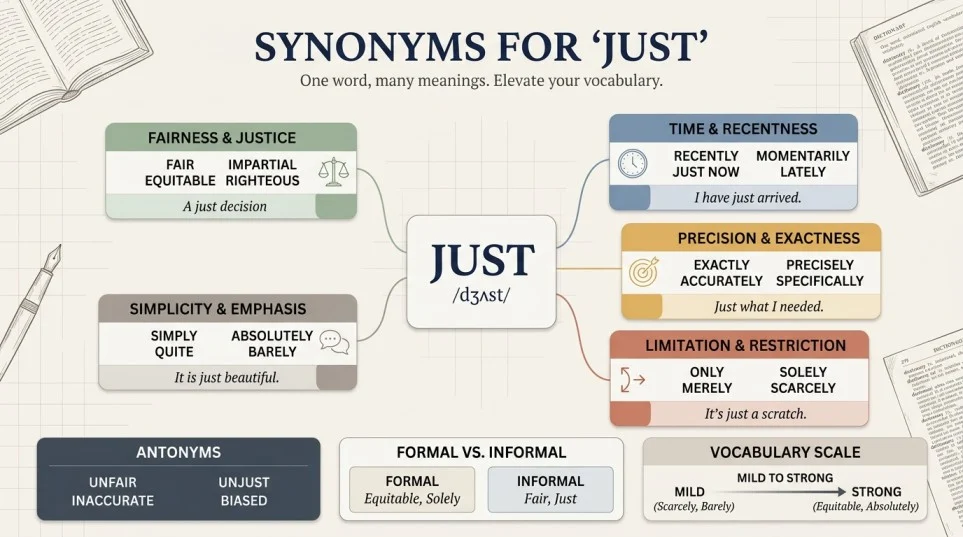
Just can mean only, simply, recently, exactly, fairly, or morally fair. Common alternatives include only, merely, simply, recently, exactly, fairly, precisely, and equitable, depending on the intended meaning and context.
Meaning, Tone and Context
The word just has several meanings, so its best synonym depends heavily on how it appears in a sentence.
Simple Definition
Just commonly means only or merely.
Example:
I just need five minutes.
Here, just means only.
It can also mean recently.
She just arrived.
In another context, just means exactly.
That is just what I needed.
As an adjective, just can describe something fair, reasonable, or morally right.
The judge made a just decision.
Part of Speech
Just can function mainly as an adverb and adjective.
As an adverb, it can modify verbs, adjectives, or other expressions.
Example:
He just called me.
As an adjective, it can describe something fair or morally correct.
Example:
They demanded a just solution.
Tone
The tone of just depends on its meaning.
- When it means only or simply, it is usually neutral and conversational.
- When it describes fairness, it has a positive moral or ethical tone.
- When it means recently, it is neutral.
Formality Level
Just is common in everyday English and is acceptable in professional and academic writing.
However, repeated use can make writing less precise.
In formal writing, alternatives such as merely, precisely, recently, fairly, or equitable can sometimes communicate the intended meaning more clearly.
Common Use Cases
You may see just in:
- Everyday conversation
- Emails
- Academic writing
- Business communication
- Social media
- Personal messages
- Storytelling
- Arguments about fairness
- Explanations
- Requests and instructions
Related Forms
Unlike many vocabulary words, just does not have a large family of direct forms with the same meaning.
Related words include:
Justice: fairness or the principle of treating people fairly.
Justly: in a fair or morally right manner.
Justification: a reason or explanation supporting an action or decision.
Justifiable: capable of being defended as reasonable or appropriate.
When and How to Use “Just”
Use just when the meaning is clear from context and a short, natural expression works best.
Professional
I just wanted to follow up on our meeting.
This is natural in a friendly professional email.
Personal
I just wanted to check how you are doing.
Here, just softens the statement.
Academic
The study just examines one aspect of the issue.
In academic writing, only or merely may be more precise depending on the intended meaning.
Emotional
I just cannot believe what happened.
Here, just adds emphasis to the emotional reaction.
Another Word for “Just”
There is no single replacement that works in every sentence because just has several meanings.
- For professional writing, simply, only, recently, or precisely may work depending on context.
- For academic writing, merely, only, and precisely can provide greater precision.
- For casual conversation, simply, only, and exactly are natural choices.
- For emotional writing, simply or really may sometimes preserve the intended emphasis.
- For creative writing, simply, exactly, barely, or recently may fit depending on the scene.
- For resumes and workplace writing, removing just can sometimes make a statement stronger.
Instead of:
I just helped improve customer satisfaction.
Write:
I helped improve customer satisfaction.
- For social media captions, simply, only, and exactly can work when they match the intended meaning.
- For a stronger meaning, use exactly, precisely, or completely, when appropriate.
- For a softer meaning, simply can sometimes replace just naturally.
When Not to Use “Just”
Avoid just when it makes your meaning vague.
For example:
We just improved the process.
This does not clearly explain whether just means recently, only, or simply.
A clearer sentence might be:
We recently improved the process.
You should also avoid unnecessary uses of just in professional communication.
I just wanted to ask if you could review this.
A more confident version is:
Could you review this?
In academic writing, repeated uses of just can weaken precision.
Instead of:
This study just looks at consumer behavior.
Consider:
This study examines consumer behavior.
The best choice depends on the exact meaning you want to communicate.
Words Commonly Confused With “Just”
Just vs. Only
Just and only can both mean no more than or nothing beyond something.
I just need one minute.
I only need one minute.
Only is often more precise when limitation is the main idea.
Just vs. Simply
Both can mean in a straightforward or uncomplicated way.
She simply explained the problem.
She just explained the problem.
Simply can sound more deliberate, while just is usually more conversational.
Just vs. Recently
When just means something happened a short time ago, recently can be clearer.
He just arrived.
He recently arrived.
Recently emphasizes recency without the conversational quality of just.
Just vs. Exactly
When just means precisely or exactly, exactly is often the clearer choice.
That is just what I wanted.
That is exactly what I wanted.
Just vs. Fair
When just describes fairness, fair is often the more familiar everyday word.
The decision was just.
The decision was fair.
Just can sound more formal or moral, while fair is common in everyday speech.
Just vs. Right
Both can sometimes describe moral correctness.
It was a just decision.
It was the right decision.
Just emphasizes fairness, while right can emphasize correctness or suitability.
Best Synonym by Context for “Just”
| Context | Best Synonym | Why It Works | Example |
|---|---|---|---|
| Formal writing | Merely | Clearly communicates limitation | The policy merely addresses one issue. |
| Academic writing | Precisely | Adds exactness | The results precisely identify the trend. |
| Professional use | Simply | Sounds clear and natural | We simply need additional information. |
| Resume | Only | Clearly communicates scope | I only managed accounts in the western region. |
| Casual conversation | Simply | Natural and conversational | I simply forgot about it. |
| Creative writing | Exactly | Adds precision and emphasis | That was exactly the moment she remembered. |
| Emotional tone | Really | Can strengthen emotional emphasis | I really cannot believe it. |
| Strong intensity | Precisely | Gives a sense of exactness | That is precisely the problem. |
| Soft tone | Simply | Can make a statement less forceful | I simply wanted to help. |
| Social media | Only | Short and direct | Only good vibes today. |
| Recent events | Recently | Clearly expresses time | The company recently announced changes. |
| Fairness | Fair | Directly expresses equitable treatment | Everyone deserves a fair opportunity. |
| Moral context | Righteous | Suggests moral correctness | He believed the cause was righteous. |
| Exact location | Exactly | Clearly expresses precision | This is exactly where we met. |
| Simple explanation | Simply | Signals straightforwardness | Simply put, the plan failed. |
| Limited amount | Merely | Emphasizes a small or limited role | It was merely a suggestion. |
| Professional emphasis | Precisely | Sounds exact and confident | That is precisely what we need. |
| Everyday emphasis | Exactly | Natural and familiar | That is exactly how I feel. |
Which Synonym Should You Choose?
Start by identifying what just means in your sentence.
- If it means only, consider only or merely.
- If it means simply, use simply.
- If it means recently, use recently.
- If it means exactly, use exactly or precisely.
- If it means fair, consider fair, equitable, or impartial.
Then consider the audience.
Academic readers usually benefit from precise vocabulary. Professional readers generally prefer direct wording. Casual readers may respond better to familiar language.
Also consider emotional intensity.
Words such as merely can make something sound limited or dismissive, while precisely adds confidence and exactly adds emphasis.
Real Life Examples of “Just” in Sentences
School
I just finished my assignment.
A more precise alternative can be:
I recently finished my assignment.
Workplace
I just wanted to confirm the meeting time.
A more direct professional version is:
I wanted to confirm the meeting time.
Writing
The article just explains the basic concept.
More precise:
The article simply explains the basic concept.
Conversation
I just need a little more time.
Here, just naturally softens the request.
Social Media
Just enjoying a quiet afternoon.
This casual use works naturally in a caption.
Resume
Instead of:
I just helped the sales team.
Use:
I supported the sales team.
The second version presents the contribution more confidently.
I just wanted to follow up on my previous message.
A more direct version is:
I am following up on my previous message.
Storytelling
She had just reached the door when the phone rang.
Here, just communicates that the action happened immediately before another event.
18 Synonyms for “Just”
| Synonym | Simple Meaning | Best Used For | Example Sentence |
|---|---|---|---|
| Only | No more than | Limitation | I only need one copy. |
| Merely | Nothing more than | Formal or academic limitation | It was merely a suggestion. |
| Simply | In an uncomplicated way | Explanation and professional writing | We simply need more information. |
| Exactly | In a precise way | Emphasis and accuracy | That is exactly what I meant. |
| Precisely | Exactly or accurately | Formal and professional writing | That is precisely the issue. |
| Recently | Not long ago | Time | She recently joined the company. |
| Fairly | In a fair manner or reasonably | Evaluation and fairness | The proposal was fairly assessed. |
| Fair | Reasonable and impartial | Everyday fairness | Everyone deserves a fair chance. |
| Equitably | In an impartial and fair way | Formal discussions of fairness | The resources were distributed equitably. |
| Impartially | Without favoritism | Legal and professional contexts | The complaint was reviewed impartially. |
| Righteously | In a morally right manner | Moral or literary writing | He believed he had acted righteously. |
| Barely | Only just or almost not | Small degree or narrow margin | She barely caught the train. |
| Nearly | Almost | Approximation | We nearly missed the deadline. |
| Recently | A short time ago | Recent events | The team recently changed its strategy. |
| Directly | Without an intermediary | Clear action or communication | She directly addressed the concern. |
| Correctly | In an accurate way | Accuracy | The form was correctly completed. |
| Rightly | In a correct or justified way | Formal explanation | The decision was rightly criticized. |
| Legitimately | In a valid or lawful way | Formal and legal contexts | The concern was legitimately raised. |
Note: Some alternatives overlap with only one meaning of just. They should not be substituted automatically in every sentence.
Synonym Groups and Usage Differences
Professional vs. Personal Synonyms
Professional writing often benefits from precise alternatives.
Instead of saying:
I just wanted to ask.
You can write:
I wanted to ask.
For personal communication, just often sounds warmer and less formal.
I just wanted to see how you were doing.
The word can soften a request without changing its basic meaning.
Formal vs. Conversational Synonyms
Just is highly common in conversation.
Simply is also conversational but can sound slightly more deliberate.
Merely is more formal and often emphasizes limitation.
Precisely and exactly are useful when accuracy or emphasis matters.
Academic Synonyms
Academic writing should favor precision.
- When just means only, only or merely may be appropriate.
- When it means exactly, precisely can be stronger.
- When it means recently, recently is usually clearer.
Always select the synonym according to the intended meaning rather than replacing just automatically.
Professional and Business Synonyms
Business writing often becomes stronger when unnecessary uses of just are removed.
Compare:
I just wanted to provide an update.
With:
I wanted to provide an update.
The second version is more direct and confident.
When precision matters, use alternatives such as recently, precisely, only, or simply.
Creative or Literary Synonyms
Creative writing gives just several useful roles.
- It can establish timing:
She had just entered the room.
- It can add emphasis:
That was just the beginning.
It can express limitation:
He was just a boy.
In literary writing, the best replacement depends strongly on rhythm and emotional effect.
Slang or Modern Synonyms
There is no single slang equivalent for every meaning of just.
Informal English often keeps just because it is short and flexible.
Words such as only, simply, and exactly are also common in casual speech.
Avoid forcing slang into academic essays, resumes, or formal business communication.
Strongest vs. Weaker Synonyms
A useful intensity scale is:
Mild: simply
Neutral: only
More limiting: merely
Precise: exactly
Highly precise: precisely
Very limited: barely
These words are not interchangeable in every situation. The scale describes common communicative effect rather than exact dictionary intensity.
Emotional vs. Neutral Synonyms
Just can be emotionally neutral or can subtly soften a statement.
I just need some time.
Simply can sound calm and explanatory.
I simply do not understand.
Exactly can add emphasis.
That is exactly how I feel.
Merely can sometimes sound dismissive.
It was merely a mistake.
Antonyms of “Just”
Because just has several meanings, its antonyms also depend on the intended sense.
| Antonym | Meaning | Example Sentence |
|---|---|---|
| Unfair | Not equitable | The decision was unfair. |
| Unjust | Not morally or legally fair | The punishment was unjust. |
| Biased | Favoring one side | The report was biased. |
| Partial | Showing favoritism | The judgment appeared partial. |
| Inaccurate | Not correct | The information was inaccurate. |
| Incorrect | Wrong | The answer was incorrect. |
| Vague | Not precise | His explanation was vague. |
| Broad | Covering more than a narrow limit | The policy has a broad scope. |
| Excessive | More than necessary | The fee was excessive. |
| Recently | Not an antonym in every sense | This is not an antonym of just in all contexts. |
| Eventually | At a later time | They eventually reached an agreement. |
| Permanently | For an indefinite or lasting period | The office was permanently closed. |
| Complicated | Not simple | The process became complicated. |
| Indirectly | Not directly | She indirectly addressed the issue. |
| Wrongfully | In an unjust or improper manner | The employee was wrongfully dismissed. |
Important: There is no universal antonym for just because the word has multiple meanings. The appropriate opposite changes with the sentence.
Comparison: “Just” vs. Similar Words
Just vs. Only
Main difference: Both can express limitation, but only is often more explicit.
Which is stronger: Only can make the limitation clearer.
Which is more formal: Both are acceptable, although only is often preferred for precision.
Examples:
I just need one document.
I only need one document.
Just vs. Simply
Main difference: Both can mean in an uncomplicated manner.
Which is stronger: Neither is consistently stronger.
Which is more formal: Simply can sound slightly more deliberate.
Examples:
Just explain what happened.
Simply explain what happened.
Just vs. Merely
Main difference: Both can express limitation, but merely often emphasizes that something is less important or extensive than expected.
Which is stronger: Merely can sound more dismissive.
Which is more formal: Merely is more formal.
Examples:
It was just a suggestion.
It was merely a suggestion.
Just vs. Exactly
Main difference: Just can mean exactly, but exactly makes precision explicit.
Which is stronger: Exactly usually provides stronger emphasis.
Which is more formal: Precisely is more formal than either.
Examples:
That is just what I needed.
That is exactly what I needed.
Just vs. Recently
Main difference: Recently specifically refers to time, while just has several meanings.
Which is stronger: Neither is stronger.
Which is more formal: Recently is often clearer in formal writing.
Examples:
She just arrived.
She recently arrived.
Just vs. Fair
Main difference: Just can mean morally fair, while fair is the more common everyday term.
Which is stronger: Just can carry a stronger ethical or moral sense.
Which is more formal: Just can sound more formal in discussions of justice.
Examples:
They wanted a just outcome.
They wanted a fair outcome.
Common Phrases and Expressions with “Just”
1. Just in case
Meaning:
Used when taking action as a precaution.
Example sentence:
Bring an umbrella just in case it rains.
2. Just about
Meaning:
Almost or approximately.
Example sentence:
We are just about ready to leave.
3. Just now
Meaning:
A very short time ago or at this exact moment, depending on context.
Example sentence:
She called me just now.
4. Just as
Meaning:
At the same time that something happens, or in the same way.
Example sentence:
Just as we arrived, the meeting started.
5. Just because
Meaning:
For the simple reason that something is true, sometimes without another explanation.
Example sentence:
You cannot ignore the rule just because you dislike it.
6. Just enough
Meaning:
The exact amount required.
Example sentence:
We have just enough time to finish.
7. Just what I needed
Meaning:
Something that is especially suitable or timely.
Example sentence:
A cup of coffee is just what I needed this morning.
8. Just like
Meaning:
Similar to someone or something.
Example sentence:
She sings just like her mother.
Common Mistakes to Avoid
1. Using “Just” When a More Precise Word Is Better
The company just changed its policy.
If you mean recently, write:
The company recently changed its policy.
2. Confusing “Just” With “Only”
The two can overlap, but they are not identical in every context.
Always check whether the sentence expresses limitation, timing, precision, or another meaning.
3. Using Casual Language in Formal Writing
Repeatedly writing just in formal communication can make statements sound unnecessarily conversational.
Consider whether removing it creates a stronger sentence.
4. Using an Overly Dramatic Synonym
Do not replace just with an intense word unless the meaning requires it.
For example, righteously is inappropriate when you simply mean fairly.
5. Repeating “Just” Too Often
I just wanted to say that I just finished the report and just wanted to ask about the meeting.
A cleaner version is:
I finished the report and wanted to ask about the meeting.
6. Choosing the Wrong Emotional Tone
Merely can sound dismissive, while precisely can sound emphatic.
Choose the word that matches the attitude you want to communicate.
FAQs
What is the best synonym for “just”?
The best synonym depends on meaning. Use only for limitation, recently for time, exactly for precision, and fair when discussing equitable treatment.
What is a formal synonym for “just”?
Formal alternatives include merely, precisely, equitably, impartially, and legitimately, depending on which meaning of just you need.
What is an informal synonym for “just”?
Common informal alternatives include only, simply, and exactly. In many everyday sentences, keeping just is the most natural choice.
What is another word for “just” in professional writing?
Professional alternatives include only, simply, recently, and precisely. The correct choice depends on whether you mean limitation, simplicity, timing, or accuracy.
What is the difference between “just” and “only”?
Just can mean only, but it has several additional meanings. Only is more specifically associated with limitation, restriction, or exclusivity.
What is the opposite of “just”?
There is no single opposite. When just means fair, unjust or unfair may work. When it means exact, inaccurate may be appropriate.
Conclusion
The word just is short, common, and highly flexible. It can mean only, simply, recently, exactly, fairly, or morally right.
The best synonym depends on the meaning you intend. Use only for limitation, merely for formal limitation, recently for time, exactly for emphasis, precisely for accuracy, and fair or equitable for fairness.
The most useful vocabulary habit is to ask what just actually means in your sentence before choosing a replacement. That small step can make your writing clearer, more confident, and more precise.
Discover More Post:
- 25+ Synonyms for Attention | Meanings, Examples, and Best …
- 25+ Synonyms for Marginalized | Meanings, Examples, and Best …
- 25+ Synonyms for Access | Meanings, Examples, and Best …