Have you ever written an email, essay, caption, or professional message and realized you have used the word hopeful several times? Finding the right alternative can make your writing more precise and expressive.
The best synonym depends on what you mean. You might want to sound optimistic, confident, encouraged, expectant, positive, or emotionally inspired.
This guide explains the meaning of hopeful, shows how it works in real situations, and helps you choose a natural alternative for school, work, conversations, social media, resumes, and creative writing.
What Does “Hopeful” Mean?
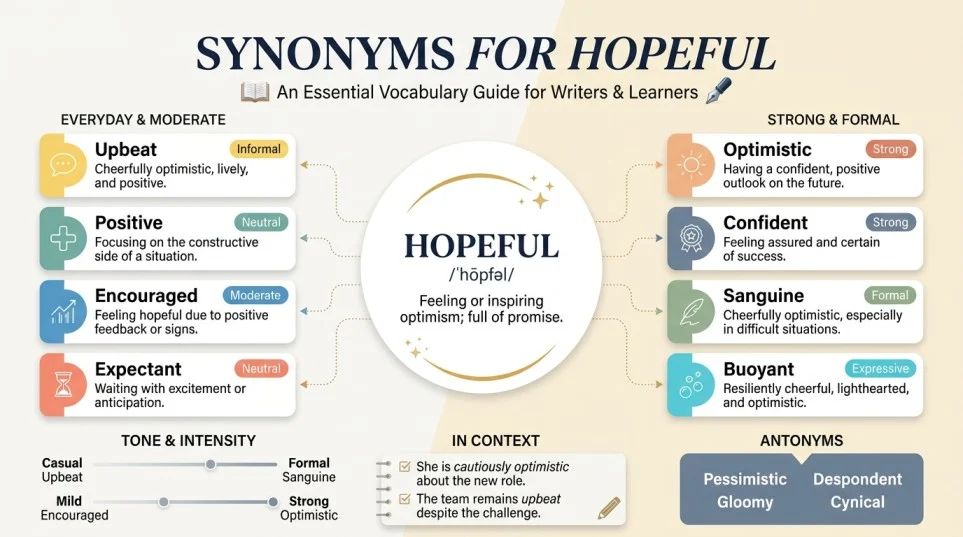
Hopeful means feeling or showing optimism that something good will happen. Depending on context, useful alternatives include optimistic for formal writing, upbeat for casual language, expectant for anticipation, and encouraged for emotional situations.
Meaning, Tone and Context
Simple Definition
Hopeful describes someone who expects or wants a positive outcome. It can describe a person’s feelings, attitude, expectations, or outlook about the future.
For example:
She is hopeful about getting the new position.
This means she believes there is a reasonable possibility that she will get the position and feels positive about the outcome.
Part of Speech
Hopeful is primarily an adjective.
It describes a person, feeling, attitude, situation, or outlook.
Examples:
He remains hopeful about the future.
We are hopeful that the project will succeed.
Tone
Hopeful usually has a positive and encouraging tone. It suggests optimism without necessarily guaranteeing success.
The word can become more emotional when it describes someone’s personal wishes or difficult circumstances.
Formality Level
Hopeful works well in casual conversation, professional communication, academic writing, emails, essays, and creative writing.
However, a more specific synonym can sometimes make formal writing clearer.
For example, optimistic may sound more precise when discussing an outlook or forecast.
Common Use Cases
Hopeful commonly appears when discussing:
- Future plans
- Career opportunities
- Relationships
- Personal goals
- Recovery
- Academic results
- Business outcomes
- Social change
- New opportunities
- Personal aspirations
Related Word Forms
The noun form is hope.
The adverb form is hopefully.
The related adjective hopeless describes a situation or attitude where there appears to be little or no possibility of improvement.
The opposite concept is hopelessness.
When and How to Use “Hopeful”
Use hopeful when someone believes that a positive outcome is possible or genuinely wants that outcome to happen.
It is especially useful when the result is uncertain.
Professional
The team is hopeful that the new strategy will improve customer satisfaction.
This sounds positive while still acknowledging that success is not guaranteed.
Personal
I am hopeful that we can work through this situation together.
Here, hopeful communicates emotional optimism.
Academic
Researchers remain hopeful that future studies will provide clearer evidence.
The word works naturally when discussing possible future developments.
Social Media
Feeling hopeful about everything this new chapter might bring.
This style is warm and suitable for a personal caption.
Another Word for “Hopeful”
The best single replacement for hopeful is often optimistic.
Optimistic works especially well when you are describing a positive attitude toward the future.
However, the best choice changes according to context.
Professional Writing
Use optimistic when discussing expectations, plans, forecasts, or outcomes.
The company remains optimistic about future growth.
Academic Writing
Use optimistic or expectant depending on the intended meaning.
The researchers are optimistic about the potential findings.
Casual Conversation
Use upbeat, positive, or encouraged.
She feels upbeat about her chances.
Emotional Writing
Use encouraged, heartened, or sanguine when the emotional meaning is important.
He felt encouraged after receiving the message.
Creative Writing
Use expectant, aspiring, buoyant, or sanguine when you want a more distinctive voice.
Resume or Workplace Use
Use optimistic, confident, or positive when describing professional outlook.
Maintained a positive approach during periods of organizational change.
Social Media Captions
Use positive, upbeat, excited, or optimistic.
Staying optimistic about what comes next.
Stronger Meaning
Use confident when the person has a stronger belief that success will happen.
Softer Meaning
Use positive or encouraged when you want to communicate optimism without sounding certain.
When Not to Use “Hopeful”
Hopeful is not always the most precise word.
If someone strongly believes an outcome will happen, confident may be better.
Hopeful: She is hopeful about winning.
Confident: She is confident that she will win.
The second sentence communicates greater certainty.
Hopeful can also sound vague when you need to explain exactly why an outcome is likely.
Vague: The company is hopeful about the future.
More precise: The company is optimistic about continued revenue growth.
The second sentence gives readers more information about the type of optimism involved.
Words Commonly Confused With “Hopeful”
Hopeful vs. Optimistic
Hopeful often emphasizes desire or expectation for something positive.
Optimistic usually emphasizes a positive outlook or belief that things will turn out well.
Hopeful vs. Confident
Hopeful allows more uncertainty.
Confident suggests a stronger belief that the desired result will happen.
Hopeful vs. Positive
Positive is broader. It can describe an attitude, reaction, result, or quality.
Hopeful specifically relates to favorable expectations or desired future outcomes.
Hopeful vs. Expectant
Expectant emphasizes anticipation that something is likely or about to happen.
Hopeful can express a desire even when the outcome remains uncertain.
Hopeful vs. Encouraged
Encouraged describes a feeling that becomes more positive because of support, evidence, progress, or a favorable development.
Hopeful vs. Wishful
Wishful can suggest that someone wants an outcome without having enough evidence that it is realistic.
Hopeful does not necessarily imply unrealistic thinking.
Best Synonym by Context for “Hopeful”
| Context | Best Synonym | Why It Works | Example |
|---|---|---|---|
| Formal writing | Optimistic | Clear and professional | The organization is optimistic about future results. |
| Academic writing | Optimistic | Fits analytical discussions of future outcomes | Researchers are optimistic about the next phase. |
| Professional use | Positive | Sounds constructive and practical | She maintains a positive outlook at work. |
| Resume | Confident | Communicates professional assurance | Confident in my ability to adapt to new challenges. |
| Casual conversation | Upbeat | Natural and conversational | He sounds upbeat about his new job. |
| Creative writing | Sanguine | Adds a refined emotional tone | She remained sanguine despite the uncertainty. |
| Emotional writing | Encouraged | Shows renewed emotional strength | He felt encouraged by their support. |
| Strong intensity | Confident | Expresses stronger certainty | She is confident about the result. |
| Soft intensity | Positive | Communicates optimism gently | I am feeling positive about the changes. |
| Social media | Upbeat | Short and expressive | Staying upbeat through every new beginning. |
| Future expectations | Expectant | Emphasizes anticipation | The audience was expectant as the results approached. |
| Personal goals | Aspiring | Focuses on desired achievement | She is an aspiring writer with ambitious goals. |
Which Synonym Should You Choose?
Start by identifying exactly what hopeful means in your sentence.
- If you mean a generally positive outlook, choose optimistic.
- If you mean strong belief in success, choose confident.
- If you mean a cheerful attitude, choose upbeat or buoyant.
- If you mean emotional encouragement after positive news, choose encouraged or heartened.
- If you mean anticipation of something expected to happen, choose expectant.
- If you want a literary or sophisticated tone, sanguine can work well.
The most effective synonym is not always the most unusual word. Choose the word that preserves the original meaning and sounds natural in your sentence.
Real Life Examples of “Hopeful” in Sentences
School
I am hopeful that my final exam results will reflect the effort I put into studying.
Workplace
The manager is hopeful that the new process will reduce unnecessary delays.
Writing
The final paragraph leaves the reader with a hopeful impression.
Conversation
I am hopeful things will get easier soon.
Social Media
Feeling hopeful about the next chapter of life.
Resume
Maintained a positive and hopeful outlook during periods of significant change.
We are hopeful that we can reach an agreement that works for everyone.
Storytelling
Despite everything she had lost, she remained hopeful about what the morning might bring.
18 Synonyms for “Hopeful”
| Synonym | Simple Meaning | Best Used For | Example Sentence |
|---|---|---|---|
| Optimistic | Expecting a positive result | Formal and professional writing | The team is optimistic about the project’s future. |
| Positive | Having a favorable attitude | General and professional use | She has a positive outlook on the changes. |
| Upbeat | Cheerful and confident | Casual conversation | He sounded upbeat during the interview. |
| Expectant | Anticipating something | Formal and descriptive writing | The audience waited with an expectant sense of excitement. |
| Confident | Strongly believing in success | Workplace and professional contexts | She is confident about her ability to succeed. |
| Encouraged | Feeling more positive because of support or progress | Emotional and personal writing | The students felt encouraged by their teacher’s feedback. |
| Heartened | Made more hopeful or confident | Emotional and literary writing | We were heartened by the community’s response. |
| Sanguine | Calmly optimistic | Formal and literary writing | He remained sanguine despite the uncertain circumstances. |
| Buoyant | Cheerfully optimistic and resilient | Creative and descriptive writing | Her buoyant attitude lifted everyone’s spirits. |
| Aspiring | Having strong ambitions or goals | Career and personal development | He is an aspiring entrepreneur with ambitious plans. |
| Assured | Showing confidence or certainty | Formal and professional writing | Her assured response impressed the interview panel. |
| Promising | Showing signs of a favorable outcome | Results and future prospects | The early results are promising. |
| Anticipatory | Relating to expectation about something coming | Formal descriptive writing | There was an anticipatory excitement in the room. |
| Wishful | Hoping for something that may not be realistic | Critical or cautionary contexts | His plan seemed more wishful than practical. |
| Forward looking | Focused positively on the future | Business and strategic writing | The organization adopted a forward looking approach. |
| Constructive | Focused on improvement and positive progress | Professional communication | Her constructive attitude helped the team move forward. |
| Positive minded | Inclined toward favorable thinking | Personal development and informal writing | His positive minded approach helped him handle setbacks. |
| Aspirational | Focused on desired future achievement | Branding and professional writing | The campaign presents an aspirational vision for the future. |
Synonym Groups and Usage Differences
Professional vs. Personal Synonyms
Professional writing often benefits from optimistic, positive, confident, constructive, and promising.
Personal writing can use more emotional words such as encouraged, heartened, buoyant, and upbeat.
For example:
The company is optimistic about expansion.
I feel encouraged by your support.
Both sentences express positive expectations, but their situations are different.
Formal vs. Conversational Synonyms
Formal writing can use optimistic, sanguine, expectant, assured, and aspirational.
Conversational language usually sounds more natural with positive, upbeat, confident, and encouraged.
The word sanguine is correct but may sound unusually formal in everyday conversation.
Academic Synonyms
Academic writing usually benefits from precise words such as optimistic, expectant, promising, and confident.
Choose based on evidence.
If evidence supports a favorable expectation, optimistic may be appropriate.
If the evidence is only beginning to look favorable, promising may be more accurate.
Professional and Business Synonyms
For emails, presentations, reports, and workplace communication, optimistic, positive, confident, constructive, and promising are strong choices.
For example:
The early findings are promising.
This sounds more specific than simply saying:
The early findings are hopeful.
Creative or Literary Synonyms
Creative writing gives you more room to use expressive alternatives.
Words such as sanguine, buoyant, heartened, expectant, and aspirational can add emotional or descriptive depth.
Use them carefully so the vocabulary matches the overall voice of the story.
Slang or Modern Synonyms
There is no single slang equivalent that works as a direct replacement for hopeful in every situation.
Casual expressions such as feeling good, staying positive, and looking on the bright side can communicate a similar idea.
These expressions are better for conversation, captions, texts, and informal posts than for academic essays or formal reports.
Strongest vs. Weaker Synonyms
A useful intensity scale is:
Positive → Hopeful → Optimistic → Confident → Assured
This is not an absolute ranking because context changes the strength of each word.
Positive can simply describe a favorable attitude.
Hopeful suggests a desired positive outcome.
Optimistic suggests a stronger positive expectation.
Confident suggests stronger belief that success is likely.
Assured can communicate an especially strong sense of certainty.
Emotional vs. Neutral Synonyms
For neutral writing, use optimistic, positive, expectant, or promising.
For emotional writing, use encouraged, heartened, buoyant, or sanguine.
The emotional choices can create more personality, while neutral choices are easier to use in reports and professional communication.
Antonyms of “Hopeful”
| Antonym | Meaning | Example Sentence |
|---|---|---|
| Hopeless | Feeling that nothing good can happen | He felt hopeless after repeated setbacks. |
| Pessimistic | Expecting a negative result | She remained pessimistic about the outcome. |
| Discouraged | Having lost confidence or enthusiasm | The team became discouraged after the defeat. |
| Doubtful | Uncertain that something will happen | He was doubtful about the proposal’s success. |
| Uncertain | Not confident about an outcome | We are uncertain about what will happen next. |
| Despairing | Feeling that there is little reason for hope | Her despairing mood worried her friends. |
| Negative | Focused on unfavorable possibilities | His negative attitude affected the discussion. |
| Cynical | Distrusting positive motives or outcomes | She was cynical about the promised reforms. |
| Resigned | Accepting an unfavorable situation | He seemed resigned to the difficult decision. |
| Defeated | Feeling that failure has overcome you | The players looked defeated after the loss. |
| Disheartened | Losing hope or confidence | The criticism left her disheartened. |
| Gloomy | Expecting or reflecting something unpleasant | The forecast gave him a gloomy outlook. |
| Doubting | Lacking confidence or belief | She remained doubting about the plan. |
| Despondent | Deeply discouraged or low in spirit | He became despondent after the rejection. |
| Unpromising | Showing little sign of a positive outcome | The initial results looked unpromising. |
Comparison: Hopeful vs. Similar Words
Hopeful vs. Optimistic
The main difference is that hopeful can emphasize desire for a good result, while optimistic emphasizes a positive expectation.
Optimistic is generally stronger as an expression of positive outlook.
Neither word is inherently more formal, although optimistic is especially common in professional and academic writing.
Example:
I am hopeful that I will get the position.
I am optimistic about my chances of getting the position.
Hopeful vs. Confident
Hopeful allows more uncertainty.
Confident suggests stronger belief that success is likely.
Confident is especially useful in professional contexts when you want to communicate ability or certainty.
Example:
She is hopeful about getting the promotion.
She is confident that her experience qualifies her for the promotion.
Hopeful vs. Positive
Positive has a broader meaning.
Hopeful specifically relates to favorable expectations about the future.
Positive is more flexible and usually sounds natural in both casual and professional language.
Example:
He is hopeful about the outcome.
He has a positive attitude toward the challenge.
Hopeful vs. Expectant
Expectant focuses on anticipation.
Hopeful focuses on positive expectation or desire.
Expectant can sound more formal and is often used when something is anticipated.
Example:
The team is hopeful about the results.
The team is expectant as the results approach.
Hopeful vs. Encouraged
Encouraged usually describes a positive feeling caused by something that has already happened.
Hopeful can exist before any encouraging event occurs.
Example:
She is hopeful about the interview.
She felt encouraged after receiving positive feedback.
Hopeful vs. Wishful
Hopeful can be realistic.
Wishful can suggest that someone wants something despite limited evidence.
Example:
We are hopeful that sales will improve.
Assuming sales will double immediately may be wishful thinking.
Common Phrases and Expressions with “Hopeful”
1. Hopeful About the Future
Meaning:
Feeling positive about what is likely to happen in the future.
Example sentence:
She remains hopeful about the future despite recent difficulties.
2. Hopeful That Something Will Happen
Meaning:
Expecting or wishing for a particular positive outcome.
Example sentence:
We are hopeful that the discussion will lead to a solution.
3. Remain Hopeful
Meaning:
Continue to feel optimistic even when circumstances are difficult.
Example sentence:
The family remained hopeful throughout the long recovery.
4. Stay Hopeful
Meaning:
Continue maintaining a positive outlook.
Example sentence:
Stay hopeful and keep working toward your goal.
5. Hopeful Outlook
Meaning:
A generally positive expectation about the future.
Example sentence:
The new plan gives the organization a more hopeful outlook.
6. Hopeful Sign
Meaning:
Something that provides evidence or encouragement that a positive result may occur.
Example sentence:
The improvement was a hopeful sign for the patient.
7. Hopeful Future
Meaning:
A future that appears likely to contain positive opportunities or results.
Example sentence:
The young graduates are looking toward a hopeful future.
Common Mistakes to Avoid
1. Using Hopeful When You Mean Certain
Hopeful does not automatically mean certain.
If you strongly believe something will happen, confident may be more accurate.
2. Confusing Hopeful With Optimistic
These words overlap, but optimistic often describes a broader positive outlook.
Hopeful can focus more directly on a desired outcome.
3. Using Casual Language in Formal Writing
Words such as upbeat can sound too conversational in a research paper or formal business report.
Choose optimistic or positive when appropriate.
4. Using an Overly Dramatic Synonym
Sanguine or buoyant may sound excessive when a simple sentence only needs positive.
Always consider the tone of the surrounding text.
5. Repeating Hopeful Too Often
Repeated use can make writing feel flat.
Replace it with optimistic, positive, encouraged, expectant, or confident when the meaning remains accurate.
6. Choosing the Wrong Emotional Tone
Wishful can imply unrealistic thinking.
Do not use it as a neutral replacement for hopeful unless that nuance is intended.
7. Using Rare Vocabulary Without a Reason
A sophisticated synonym is not automatically better.
In most professional and academic situations, clear language is more effective than unnecessarily unusual vocabulary.
FAQs
What is the best synonym for hopeful?
Optimistic is usually the best general synonym for hopeful because it clearly communicates a positive expectation and works well in professional, academic, and everyday writing.
What is a formal synonym for hopeful?
Optimistic is an excellent formal synonym. Sanguine can also work in formal or literary contexts, but it sounds more sophisticated and less common.
What is an informal synonym for hopeful?
Upbeat and positive are natural informal alternatives. They work well in conversations, texts, personal posts, and casual social media captions.
What is another word for hopeful in professional writing?
Optimistic, confident, positive, and promising are useful professional alternatives. The best choice depends on whether you mean attitude, certainty, or future potential.
What is the difference between hopeful and optimistic?
Hopeful can emphasize wanting or expecting a positive outcome, while optimistic usually emphasizes a positive general outlook about future events or circumstances.
What is the opposite of hopeful?
The most direct opposite is hopeless. Other alternatives include pessimistic, discouraged, doubtful, disheartened, despondent, and negative, depending on the intended meaning.
Conclusion
Hopeful describes a positive expectation or desire for a favorable outcome. It is useful in personal conversations, professional communication, academic writing, essays, captions, emails, and creative work.
The best synonym depends on your intended meaning. Use optimistic for a positive outlook, confident for stronger certainty, upbeat for casual language, encouraged for emotional situations, and expectant for anticipation.
When choosing another word for hopeful, focus on meaning first and style second. A precise, natural synonym will usually make your writing stronger than an unusual word chosen only to sound sophisticated.
A simple vocabulary tip is to ask yourself one question before replacing hopeful: Am I describing optimism, certainty, anticipation, encouragement, or desire? Your answer will usually reveal the best word.
Discover More Post:
- 25+ Synonyms for Attention | Meanings, Examples, and Best …
- 25+ Synonyms for Marginalized | Meanings, Examples, and Best …
- 25+ Synonyms for Access | Meanings, Examples, and Best …