Do you keep using the word reality in essays, emails, conversations, captions, or professional writing? The word is useful, but repeating it can make your writing feel predictable.
The best alternative depends on what you mean. You might need truth for factual accuracy, actuality for formal writing, real world for practical situations, or state of affairs for a professional discussion.
This guide explains the meaning, tone, context, synonyms, antonyms, common mistakes, and practical uses of reality so you can choose the right word naturally.
What Does Reality Mean?
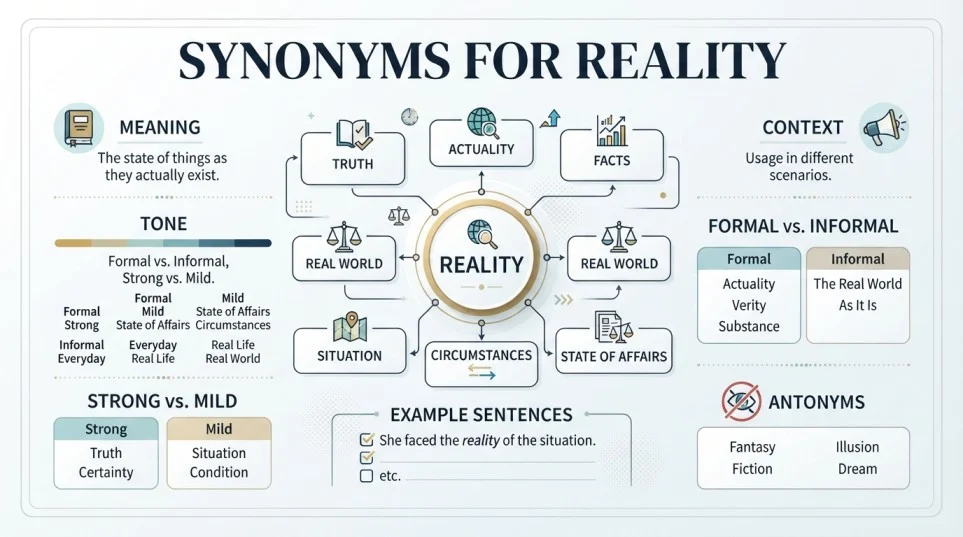
Reality means the actual state of things, rather than an imagined, false, or hypothetical situation. Useful alternatives include truth in factual contexts, actuality in formal writing, real world in practical contexts, and real life in casual conversation.
Meaning, Tone and Context
Simple Definition
Reality refers to what actually exists or happens, rather than what someone imagines, assumes, wishes for, or believes without evidence.
For example:
The reality is that the project needs more time.
Here, reality refers to the actual situation.
Part of Speech
Reality is a noun.
Common related forms include:
| Word | Part of Speech | Meaning |
|---|---|---|
| Reality | Noun | The actual state of things |
| Real | Adjective | Existing or genuine |
| Really | Adverb | In an actual or genuine way |
| Realistic | Adjective | Based on practical facts or circumstances |
| Realism | Noun | Recognition of things as they actually are |
| Realistically | Adverb | In a practical or fact based way |
Tone
Reality is usually neutral. It can become serious, emotional, philosophical, or critical depending on the sentence.
For example:
We need to face reality.
This sentence can sound serious or slightly confrontational.
Reality finally exceeded my expectations.
Here, the tone is positive.
Formality Level
Reality works in almost every type of communication.
It is suitable for:
- Academic writing
- Professional communication
- Business discussions
- Personal conversations
- Essays
- Creative writing
- Social media
- Speeches
- Emails
- News and general discussion
Common Use Cases
The word often appears when discussing:
- Facts
- Practical circumstances
- Real life experiences
- Truth
- Expectations versus actual results
- Physical existence
- Social conditions
- Personal experiences
- Imaginary versus actual situations
- Philosophical questions
When and How to Use Reality
Use reality when you want to emphasize what actually exists or happens.
Professional
The reality of the current market requires companies to control unnecessary expenses.
Personal
Moving away from home helped me understand the reality of adult responsibilities.
Academic
The study examines the relationship between perception and reality.
Social Media
Sometimes reality is very different from what we see online.
These examples show why reality is versatile. It can describe factual circumstances, personal experiences, social conditions, or the difference between appearance and truth.
Another Word for “Reality”
The best single replacement depends on your intended meaning.
- If you mean what is true, use truth.
- If you mean what actually exists or happens, use actuality.
- If you mean practical everyday circumstances, use real world or real life.
- If you mean the current situation, use state of affairs or circumstances.
Professional Writing
Best choices: actuality, state of affairs, circumstances, facts
Example:
The report examines the actual state of affairs in the industry.
Academic Writing
Best choices: actuality, truth, objectivity, existence
Example:
Researchers continue to debate the relationship between perception and actuality.
Casual Conversation
Best choices: real life, truth, facts, situation
Example:
Things are very different in real life.
Emotional Writing
Best choices: truth, real life, experience, actuality
Example:
Accepting the truth was difficult, but it helped me move forward.
Creative Writing
Best choices: existence, actuality, truth, physical world
Example:
She struggled to distinguish between the dream and the physical world.
Resume or Workplace Use
Best choices: facts, circumstances, conditions, state of affairs
Example:
Evaluated market conditions before developing the new strategy.
Social Media Captions
Best choices: real life, truth, facts, real world
Example:
Social media shows the highlights, but real life tells the whole story.
Stronger Meaning
Use truth when you want to emphasize factual correctness.
Softer Meaning
Use situation or circumstances when you want to describe what is happening without making the statement sound philosophical or absolute.
When Not to Use Reality
Although reality is versatile, it can sometimes be too broad.
When You Need a Specific Fact
Instead of:
The reality proves that the company made a mistake.
Use:
The facts show that the company made a mistake.
Facts is more precise because it points directly to verifiable information.
When You Mean a Current Situation
Instead of:
The reality at the company is complicated.
Use:
The situation at the company is complicated.
Situation sounds more natural when discussing current circumstances.
When You Mean Practical Everyday Life
Instead of:
The reality of studying abroad surprised me.
You could write:
Life abroad surprised me.
Or:
Real life abroad was different from what I expected.
When You Need a Formal Academic Term
In some academic discussions, actuality or existence may provide greater precision than reality.
Words Commonly Confused With Reality
Reality vs. Truth
Reality refers to what actually exists or happens. Truth refers to what is factually correct.
Reality: The reality of the situation was difficult.
Truth: The truth was difficult to accept.
Reality vs. Fact
A fact is a specific piece of information that can be verified. Reality is broader.
Fact: The company lost money last year.
Reality: The company is facing financial pressure.
Reality vs. Situation
A situation describes particular circumstances at a given time. Reality can have a broader meaning.
The situation requires immediate attention.
Reality is often more complicated than expectations.
Reality vs. Existence
Existence focuses on whether something exists. Reality can refer to existence, actual conditions, or what genuinely happens.
The existence of the species was confirmed.
The reality of climate change affects communities worldwide.
Reality vs. Authenticity
- Authenticity describes whether something is genuine or original. Reality describes what actually exists or happens.
The authenticity of the artwork was questioned.
The reality of the situation became clear later.
- Reality vs. Illusion
- Reality describes what is actually present. Illusion describes something that appears real but is not.
She learned to distinguish reality from illusion.
Best Synonym by Context for “Reality”
| Context | Best Synonym | Why It Works | Example |
|---|---|---|---|
| Formal writing | Actuality | Sounds precise and formal | The study considers the actuality of the proposed conditions. |
| Academic writing | Truth | Useful for factual or philosophical discussion | Researchers continue to debate the truth of the claim. |
| Professional or business use | State of affairs | Clearly describes current circumstances | The report summarizes the current state of affairs. |
| Resume | Facts | Emphasizes measurable information | Reviewed facts before making recommendations. |
| Casual conversation | Real life | Natural and familiar | Things are different in real life. |
| Creative writing | Existence | Adds philosophical or literary depth | He questioned his own existence. |
| Emotional tone | Truth | Can express personal acceptance | She finally accepted the truth. |
| Strong intensity | Truth | Emphasizes factual certainty | The truth cannot be ignored. |
| Soft or moderate tone | Situation | Sounds less absolute | The situation is more complicated than expected. |
| Social media captions | Real life | Short, natural, and relatable | Real life is not always picture perfect. |
| US usage | Reality | Very common and broadly understood | The reality is different from the expectation. |
| UK usage | Reality | Also standard and natural | The reality of the situation became clear. |
Which Synonym Should You Choose?
Start by asking what reality means in your sentence.
- If you mean something that can be verified, choose fact or truth.
- If you mean the actual state of something, choose actuality.
- If you mean current circumstances, choose situation, conditions, or state of affairs.
- If you mean everyday experience, choose real life.
- If you mean whether something genuinely exists, choose existence.
- If you are writing creatively, existence, physical world, or actuality can add greater depth.
Also consider tone. Truth can sound direct and powerful, while circumstances is often softer and more neutral.
Real Life Examples of “Reality” in Sentences
School
Students sometimes discover that the reality of college requires more independent study than they expected.
Workplace
The manager explained the reality of the project timeline during the meeting.
Writing
Good nonfiction should distinguish clearly between assumption and reality.
Conversation
The reality is that we simply do not have enough time today.
Social Media
Online posts rarely show the full reality of someone’s life.
Resume
My internship gave me a better understanding of the reality of professional communication.
I understand your concerns, but the current reality is that we need additional resources.
Storytelling
When she opened the door, the reality before her was stranger than anything she had imagined.
18 Synonyms for “Reality”
The following 18 choices are useful alternatives, but they are not interchangeable in every sentence. Several work best in specific contexts.
| Synonym | Simple Meaning | Best Used For | Example Sentence |
|---|---|---|---|
| Actuality | What actually exists or happens | Formal and philosophical writing | The report examines the actuality of the proposed outcome. |
| Truth | What is factually or genuinely correct | Factual and emotional writing | He finally accepted the truth. |
| Fact | A verifiable piece of information | Academic and professional writing | The facts changed the direction of the discussion. |
| Real world | Practical life outside theory or imagination | Business, education, and casual writing | The course prepares students for the real world. |
| Real life | Everyday existence and experience | Casual and personal communication | Real life rarely follows a perfect plan. |
| State of affairs | Current circumstances or conditions | Professional and formal writing | The report describes the current state of affairs. |
| Circumstances | Conditions surrounding an event | Professional and personal writing | Given the circumstances, we made a reasonable decision. |
| Conditions | Existing factors affecting a situation | Business, science, and formal writing | Economic conditions have changed considerably. |
| Situation | A particular set of current circumstances | General and professional communication | We need to understand the situation before responding. |
| Experience | Something personally lived or encountered | Personal and emotional writing | Her experience gave her a clearer view of reality. |
| Existence | The state of being real or present | Academic and philosophical writing | The debate concerns the existence of an objective world. |
| Objectivity | A view based on facts rather than personal bias | Academic and professional contexts | The researcher tried to maintain objectivity. |
| Substance | Real or meaningful content rather than appearance | Formal and literary writing | The proposal has substance beyond its attractive presentation. |
| Tangibility | The quality of being concrete or perceptible | Formal and descriptive contexts | The plan gained tangibility once the budget was approved. |
| Authenticity | The quality of being genuine or real | Personal, cultural, and creative contexts | The writer valued the authenticity of her voice. |
| Verity | Truth or a true statement | Formal and literary writing | The author questioned the verity of the historical account. |
| Concreteness | The quality of being definite and tangible | Academic and professional writing | The proposal needs greater concreteness before approval. |
| Physical world | The material world that can be physically experienced | Scientific, philosophical, and creative contexts | The character struggled to separate dreams from the physical world. |
Synonym Groups and Usage Differences
Professional vs. Personal Synonyms
Professional writing often benefits from precise words such as facts, conditions, circumstances, and state of affairs.
Personal writing can sound more natural with truth, real life, experience, and situation.
Compare:
The facts indicate a change in customer behavior.
Real life taught me that plans can change quickly.
The first sentence is analytical. The second is personal.
Formal vs. Conversational Synonyms
For formal reports, actuality, state of affairs, conditions, and verity can work when their specific meanings fit.
For conversations and informal emails, truth, real life, facts, and situation are usually more natural.
Academic Synonyms
Academic writing benefits from precision rather than unnecessary complexity.
- Use actuality when discussing what actually occurs.
- Use existence when discussing whether something exists.
- Use objectivity when discussing impartial analysis.
- Use truth when discussing factual or philosophical claims.
Professional and Business Synonyms
Business communication often requires practical language.
Facts, conditions, circumstances, and state of affairs are especially useful.
For example:
Based on current market conditions, the company should reconsider its expansion plan.
This is more specific than simply saying:
Based on reality, the company should reconsider its expansion plan.
Creative or Literary Synonyms
Creative writing allows more abstract choices.
Existence, actuality, physical world, truth, and verity can create a reflective or philosophical tone.
For example:
He wondered whether his memories belonged to reality or merely to another version of existence.
Slang or Modern Synonyms
There is no single slang synonym that replaces reality accurately in every situation.
Expressions such as real life and the real world are informal and widely understood.
They work well in conversation, captions, blogs, and personal writing, but formal reports usually benefit from more precise wording.
Strongest vs. Weaker Synonyms
A simple intensity scale can help:
Mild: situation, circumstances
Moderate: conditions, state of affairs, real life
Direct: facts, actuality
Strong: truth
Abstract: existence, physical world
The strongest option depends on the sentence. A powerful word is not always a better word.
Emotional vs. Neutral Synonyms
Truth can carry strong emotional weight.
Real life feels personal and conversational.
Facts sounds objective.
Conditions sounds analytical.
Situation is generally neutral.
Choose based on the emotional effect you want rather than simply replacing the original word.
Antonyms of “Reality”
Some of the following are contextual opposites rather than perfect dictionary opposites. They describe ideas that contrast with actual existence, truth, or real circumstances.
| Antonym | Meaning | Example Sentence |
|---|---|---|
| Unreality | The state of seeming unreal | The scene created a feeling of unreality. |
| Illusion | Something that appears real but is not | The magician created the illusion of disappearance. |
| Fantasy | An imagined situation or idea | The novel takes place in a world of fantasy. |
| Fiction | An invented story or account | The film is based on fiction rather than history. |
| Falsehood | Something untrue | The investigation exposed the falsehood. |
| Deception | Deliberate action intended to mislead | The advertisement relied on deception. |
| Delusion | A strongly held belief that conflicts with reality | His belief proved to be a delusion. |
| Myth | A traditional or widely repeated idea that may not be factual | The historian challenged the popular myth. |
| Imagination | The ability to create ideas or images that are not physically present | Her imagination transformed the ordinary scene. |
| Dream | An imagined or desired experience | His plan remained a dream for many years. |
| Hallucination | A perception without an external source | The experience was later identified as a hallucination. |
| Pretense | An attempt to make something appear different from what it is | Their friendship was merely a pretense. |
| Fabrication | Something invented or deliberately made up | The story was exposed as a fabrication. |
| Hypothetical | Based on an imagined possibility rather than an actual event | The discussion focused on a hypothetical scenario. |
| Nonexistence | The state of not existing | The theory concerns the existence or nonexistence of the object. |
Comparison: Reality vs. Similar Words
Reality vs. Truth
Main difference: Reality describes what exists or happens, while truth describes what is factually correct.
Which one is stronger: Truth can sound more direct and absolute.
Which one is more formal: Both are suitable for formal writing.
Examples:
Reality can be difficult to accept.
The truth can be difficult to accept.
Reality vs. Fact
Main difference: A fact is a specific piece of verified information. Reality is broader.
Which one is stronger: Fact is more precise.
Which one is more formal: Both work well, depending on context.
Examples:
The reality of the situation was unexpected.
The fact that sales declined was unexpected.
Reality vs. Situation
Main difference: Situation refers to particular circumstances. Reality can refer to a broader state of existence or actual conditions.
Which one is stronger: Reality often sounds more significant.
Which one is more formal: Both are widely accepted in professional writing.
Examples:
We need to understand the reality of the market.
We need to understand the current situation.
Reality vs. Existence
Main difference: Existence focuses specifically on whether something is present or real.
Which one is stronger: Neither is inherently stronger.
Which one is more formal: Existence is especially useful in academic and philosophical writing.
Examples:
The debate concerns the nature of reality.
The debate concerns the existence of an objective world.
Reality vs. Authenticity
Main difference: Authenticity means genuineness or originality. Reality means actual existence or actual circumstances.
Which one is stronger: Neither is stronger because they address different concepts.
Which one is more formal: Both can work in formal writing.
Examples:
The reality of the situation became clear.
The authenticity of the document was confirmed.
Reality vs. Actuality
Main difference: Both can refer to what actually exists or happens, but actuality often sounds more formal and abstract.
Which one is stronger: Actuality can sound more precise in philosophical or formal discussions.
Which one is more formal: Actuality is generally more formal.
Examples:
We must consider the reality of the problem.
We must consider the actuality of the problem.
Common Phrases and Expressions with “Reality”
1. Face reality
Meaning: Accept a situation as it actually is.
Example sentence:
We need to face reality and adjust the plan.
2. In reality
Meaning: In actual fact, rather than according to appearances or assumptions.
Example sentence:
The task looked simple, but in reality it required several weeks.
3. Reality check
Meaning: An event or realization that causes someone to recognize actual circumstances.
Example sentence:
The unexpected expenses gave us a reality check.
4. The reality is
Meaning: Used to introduce an important fact or practical condition.
Example sentence:
The reality is that we need more time.
5. Escape from reality
Meaning: A temporary way of avoiding ordinary problems or circumstances.
Example sentence:
Reading fiction can provide a welcome escape from reality.
6. A harsh reality
Meaning: An unpleasant fact or difficult circumstance.
Example sentence:
Losing the contract was a harsh reality for the small company.
7. Become a reality
Meaning: To move from an idea or plan into actual existence.
Example sentence:
Years of planning finally helped the project become a reality.
8. Beyond reality
Meaning: Something that seems to go beyond ordinary experience or what is normally considered real.
Example sentence:
The landscape looked almost beyond reality.
Common Mistakes to Avoid
1. Using “Reality” When a More Precise Word Is Better
Instead of saying:
The reality proves my point.
Use:
The facts support my point.
Facts is clearer when you are referring to evidence.
2. Confusing Reality With Truth
Reality and truth overlap, but they are not identical.
Reality concerns what exists or happens. Truth concerns what is factually correct.
3. Using a Casual Synonym in Formal Writing
Phrases such as real life and the real world can sound too conversational in some academic or professional contexts.
Consider actuality, conditions, or circumstances when appropriate.
4. Choosing an Overly Dramatic Synonym
Not every difficult situation needs a word such as harsh reality.
If the situation is neutral, simply use situation, conditions, or circumstances.
5. Repeating “Reality” Too Often
Repeated use can make an essay or article sound monotonous.
Replace it with a precise alternative when the meaning allows it.
6. Choosing the Wrong Emotional Tone
Truth can sound more forceful than situation.
If you want to sound diplomatic, circumstances may be better.
7. Using Slang in Academic or Professional Writing
Informal expressions such as real life can be useful in personal communication, but precise formal vocabulary is usually better in research papers and business reports.
FAQs
What is the best synonym for reality?
The best synonym depends on context. Truth works for factual meaning, actuality for formal writing, and real life for everyday experiences.
What is a formal synonym for reality?
Actuality is a strong formal synonym when referring to what actually exists or happens. State of affairs also works for current circumstances.
What is an informal synonym for reality?
Real life and the real world are natural informal alternatives. They work especially well in conversations, blogs, captions, and personal writing.
What is another word for reality in professional writing?
Useful professional alternatives include facts, conditions, circumstances, situation, and state of affairs, depending on the intended meaning.
What is the difference between reality and truth?
Reality describes what actually exists or happens, while truth describes what is factually correct. The words overlap but emphasize different aspects.
What is the opposite of reality?
Common contextual opposites include unreality, illusion, fantasy, fiction, falsehood, delusion, and fabrication.
Conclusion
Reality refers to what actually exists, happens, or can be recognized as genuine. It is a flexible noun that works in casual conversation, academic writing, professional communication, creative writing, and everyday speech.
The best synonym depends on your meaning. Choose truth for factual or emotional emphasis, actuality for formal contexts, facts for verifiable information, real life for everyday experience, and circumstances or state of affairs for practical situations.
The most useful vocabulary habit is simple: do not replace a word merely because you want variety. Choose a synonym that preserves the original meaning while improving precision, tone, and clarity.
Discover More Post:
- 25+ Synonyms for Attention | Meanings, Examples, and Best …
- 25+ Synonyms for Marginalized | Meanings, Examples, and Best …
- 25+ Synonyms for Access | Meanings, Examples, and Best …