Do you find yourself using the word “before” repeatedly in emails, essays, captions, conversations, or professional writing? The word is useful, but repeating it can make your writing feel flat.
The right alternative can make your meaning more precise. You might choose “prior to” for formal writing, “earlier” for everyday conversation, or “in advance” when talking about preparation.
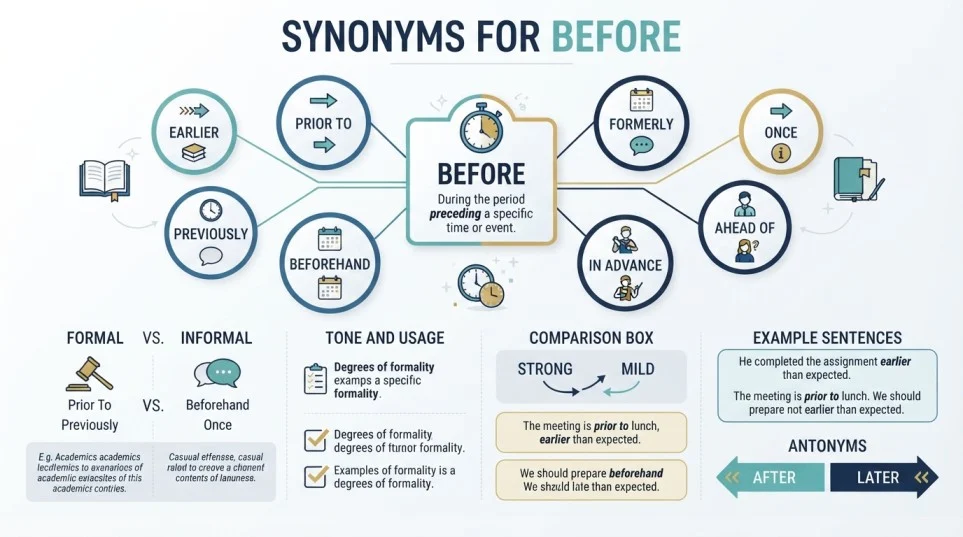
This guide explains the meaning of “before,” its tone and grammar, useful alternatives, common mistakes, antonyms, and the best word choices for different situations.
What Does Before Mean?
“Before” refers to something happening earlier in time, earlier than another event, or in front of something. Useful alternatives include “prior to” for formal writing, “earlier” for casual use, “previously” for professional writing, and “in advance” for preparation.
Meaning, Tone and Context
Simple Definition
“Before” generally means earlier than a particular time, event, action, or point of reference.
For example:
“Please call me before noon.”
Here, the call must happen earlier than noon.
“Before” can also describe position when something is physically in front of another person or object.
“She stood before the audience.”
It can also introduce a situation that must happen first.
“Finish your homework before you watch television.”
Part of Speech
“Before” can function as several parts of speech.
As a preposition:
“Wash your hands before dinner.”
As a conjunction:
“Call me before you leave.”
As an adverb:
“I have seen that movie before.”
It can also appear in expressions and phrases that describe sequence, preparation, or an earlier period.
Tone
“Before” is neutral in tone. It is neither strongly positive nor negative.
It is also highly flexible. It works naturally in casual conversation, academic writing, business communication, personal writing, and creative work.
Formality Level
“Before” is appropriate at almost every level of formality.
However, alternatives such as “prior to” may sound more formal, while expressions such as “ahead of” may sound more conversational or business oriented depending on the sentence.
Common Use Cases
“Before” commonly appears when discussing:
- Time
- Sequence
- Deadlines
- Preparation
- Historical events
- Previous experiences
- Instructions
- Procedures
- Personal memories
- Professional schedules
Related Forms and Expressions
“Before” does not have many traditional word forms because it can serve different grammatical functions.
Useful related expressions include:
“beforehand”
“prior”
“previous”
“previously”
“preceding”
“earlier”
“formerly”
“in advance”
When and How to Use Before
“Before” is usually the best choice when you want a simple, natural way to show that something happens earlier than another event or point in time.
Professional Example
“Please review the document before the meeting.”
This is clear and natural for workplace communication.
Personal Example
“I had met her before the party.”
Here, “before” refers to an earlier personal experience.
Academic Example
“Researchers had examined this issue before the new study was published.”
The word clearly establishes chronological order.
Social Media Example
“Have you seen this movie before?”
This sounds natural and conversational.
Another Word for Before
The best single replacement depends on what “before” means in the sentence.
For professional writing, “prior to” or “previously” can work well.
For academic writing, “prior to,” “previously,” and “earlier” are useful choices.
For casual conversation, “earlier” is often the most natural alternative.
For emotional writing, “once” or “in earlier days” can create a more reflective feeling.
For creative writing, “formerly,” “ere,” or “once” may add historical or literary character.
For resumes and workplace documents, “previously” can describe earlier responsibilities or positions.
For social media captions, “earlier,” “once,” and “back then” can sound natural.
For a stronger sense of preparation, “in advance” is usually better.
For a softer, everyday alternative, “earlier” is often the easiest choice.
When Not to Use Before
Although “before” is extremely useful, it can sometimes be too general.
Compare:
“Submit the form before the meeting.”
“Submit the form prior to the meeting.”
The second sentence sounds more formal, although the first is simpler and often preferable.
“Before” can also be vague when the reader needs a precise time.
Instead of:
“Please arrive before the event.”
Consider:
“Please arrive 15 minutes before the event.”
The more precise version gives the reader useful information.
Avoid replacing every occurrence of “before” with a complicated synonym. A synonym is helpful only when it improves clarity, tone, or variety.
Words Commonly Confused With Before
Before vs. Prior To
“Before” is neutral and natural. “Prior to” is more formal and is often used in official or professional writing.
Example:
“Please eat before the appointment.”
“Please complete the form prior to the appointment.”
Before vs. Earlier
“Earlier” generally refers to a previous point in time.
Example:
“I saw her earlier.”
“Before” often connects one event with another.
Example:
“I saw her before the meeting.”
Before vs. Previously
“Previously” means at an earlier time and is especially useful when referring to an earlier action or situation.
Example:
“The company previously used a different system.”
Before vs. Ahead Of
“Ahead of” can mean earlier than a scheduled event, but it often carries the idea of preparation or being early.
Example:
“Please prepare the presentation ahead of the meeting.”
Before vs. Until
“Before” means earlier than something.
“Until” means continuing up to a particular time.
Example:
“Finish the report before Friday.”
“Work on the report until Friday.”
The meanings are different.
Before vs. Formerly
“Formerly” means in the past, especially when something had a previous name, position, condition, or identity.
Example:
“The building was formerly a library.”
Best Synonym by Context for Before
Which Synonym Should You Choose?
Choosing the right alternative depends on what you want the sentence to communicate.
If you simply mean earlier in time, choose “earlier.”
If you need a formal expression, choose “prior to.”
If you are describing an earlier action or condition, choose “previously.”
If you are discussing preparation, “in advance” is often more precise.
If you are describing something from the past with a reflective feeling, “once” can work well.
If you are writing about an earlier identity, position, or condition, “formerly” may be the strongest choice.
Always consider the audience. A simple word is often better than an unnecessarily complicated synonym.
Real Life Examples of Before in Sentences
School
“Read the assigned chapter before class.”
Workplace
“Please review the presentation before the client meeting.”
Writing
“Check your facts before publishing the article.”
Conversation
“I have heard that story before.”
Social Media
“Take a screenshot before you close the page.”
Resume
“Before joining the company, I worked in customer service.”
“Please send the revised document before Friday.”
Storytelling
“Before sunrise, the travelers had already reached the village.”
18 Synonyms for Before
Note that some entries above are contextual alternatives rather than interchangeable replacements in every sentence. “Ere” and “afore” are literary or archaic, while “in anticipation of” emphasizes expectation and preparation.
Synonym Groups and Usage Differences
Professional vs. Personal Synonyms
Professional writing often benefits from “prior to,” “previously,” “prior,” and “ahead of.”
Personal communication usually sounds more natural with “before,” “earlier,” “once,” or “back then.”
For example:
Professional:
“Please review the policy prior to implementation.”
Personal:
“I read the policy before I signed it.”
Formal vs. Conversational Synonyms
“Prior to” is more formal than “before.”
“Previously” is more formal and precise than “earlier” in many professional contexts.
“Back then” is distinctly conversational.
Choose the simplest expression that matches your audience.
Academic Synonyms
Academic writing often uses “previously,” “prior to,” “preceding,” and “at an earlier time.”
These choices can help establish chronology without making the writing unnecessarily complicated.
Example:
“The preceding section examined the historical background.”
Professional and Business Synonyms
Business writing frequently uses “prior to,” “ahead of,” “previously,” and “in advance.”
Example:
“Please submit all documents prior to the scheduled review.”
For everyday workplace emails, however, “before” may be clearer and more approachable.
Creative or Literary Synonyms
Creative writing gives you more freedom.
“Once,” “ere,” “afore,” “formerly,” and “back then” can create different moods.
“Once” can suggest nostalgia.
“Ere” can create an old fashioned or poetic atmosphere.
“Formerly” can emphasize change from a previous condition.
Slang or Modern Synonyms
“Back then” is informal rather than true slang. It works well in social posts, personal stories, and casual conversations.
Avoid it in academic papers, formal reports, and highly professional documents unless the context is intentionally conversational.
Strongest vs. Weaker Synonyms
A useful scale depends on the intended meaning.
Mild and neutral:
“before”
“earlier”
“previously”
More specific:
“beforehand”
“ahead of”
“in advance”
Formal:
“prior to”
“preceding”
Historical or literary:
“formerly”
“once”
“ere”
The strongest choice is not always the most formal word. Precision matters more than complexity.
Emotional vs. Neutral Synonyms
“Before” and “earlier” are generally neutral.
“Previously” is also relatively neutral and factual.
“Once” can create nostalgia.
“Back then” can sound personal and reflective.
“Formerly” may emphasize how something has changed.
Antonyms of Before
Some of the following are contextual opposites rather than strict dictionary antonyms. They describe a later time or an event that follows the reference point.
Comparison: Before vs. Similar Words
“Before” vs. “Prior To”
The main difference is formality.
“Before” is neutral and broadly useful.
“Prior to” is more formal and is common in official or professional documents.
Neither is inherently stronger.
Examples:
“Please call before the appointment.”
“Please call prior to the appointment.”
“Before” vs. “Earlier”
“Before” commonly connects two events.
“Earlier” usually identifies a previous point in time.
Examples:
“I left before the meeting.”
“I left earlier.”
“Before” is better when the reference event matters. “Earlier” works well when the exact reference is already understood.
“Before” vs. “Previously”
“Previously” means at an earlier time and often describes an earlier condition, action, or experience.
Example:
“The company previously operated from a smaller office.”
“Before” would usually need a clearer reference point.
“Before” vs. “Ahead Of”
“Ahead of” can mean earlier than a scheduled event or earlier than expected.
Example:
“The team finished ahead of schedule.”
“Before” is broader.
Example:
“The team finished before Friday.”
“Before” vs. “Formerly”
“Formerly” focuses on a previous identity, role, status, or condition.
Example:
“The building was formerly a hotel.”
“Before” focuses more broadly on chronological order.
Example:
“The building was renovated before the hotel opened.”
“Before” vs. “Once”
“Once” can mean at one time in the past.
Example:
“She once lived in Chicago.”
“Before” normally establishes an earlier relationship between events.
Example:
“She lived in Chicago before moving to Denver.”
Common Phrases and Expressions with Before
1. Before Long
Meaning:
Soon or after a short period.
Example sentence:
“Before long, the new business became profitable.”
2. Beforehand
Meaning:
Before a particular event or action.
Example sentence:
“Please read the instructions beforehand.”
3. The Day Before
Meaning:
The previous day.
Example sentence:
“We completed the preparation the day before.”
4. Long Before
Meaning:
A considerable amount of time earlier.
Example sentence:
“The town existed long before the highway was built.”
5. Shortly Before
Meaning:
A short time earlier.
Example sentence:
“She arrived shortly before the presentation began.”
6. Just Before
Meaning:
Immediately or very shortly earlier.
Example sentence:
“I received the message just before dinner.”
7. Beforehand Planning
Meaning:
Planning completed before an event or action.
Example sentence:
“Good beforehand planning helped the team avoid delays.”
8. Before You Know It
Meaning:
Something happens sooner than expected.
Example sentence:
“Keep practicing, and before you know it, the skill will feel natural.”
Common Mistakes to Avoid
1. Replacing Every “Before” With a Formal Word
Not every sentence needs “prior to.”
“Before dinner” usually sounds more natural than “prior to dinner.”
2. Confusing “Before” With “Until”
“Before” means earlier than a point.
“Until” describes an action or condition continuing up to a point.
These words should not be treated as interchangeable.
3. Using Casual Language in Formal Writing
Expressions such as “back then” may sound inappropriate in a formal academic essay.
Use “previously,” “formerly,” or another precise alternative when appropriate.
4. Using an Overly Dramatic Synonym
Words such as “ere” can sound poetic or old fashioned.
They may be distracting in ordinary business communication.
5. Repeating “Before” Too Often
Repetition is not always wrong, but frequent repetition can make longer writing feel monotonous.
Use “earlier,” “previously,” “prior to,” or “in advance” when the meaning genuinely changes or the sentence benefits from variety.
6. Choosing a Synonym With the Wrong Meaning
“Formerly” is not a universal replacement for “before.”
It usually refers to a previous identity, condition, or status.
7. Confusing “Ahead Of” With Every Use of “Before”
“Ahead of” often suggests being early or preparing for an event.
It does not always work where “before” simply means earlier than another event.
FAQs
What is the best synonym for “before”?
“Earlier” is often the best general alternative, while “prior to” works well in formal writing and “in advance” is better when preparation is the main idea.
What is a formal synonym for “before”?
“Prior to” is one of the most common formal alternatives. “Previously” and “preceding” can also work depending on the grammatical context.
What is an informal synonym for “before”?
“Earlier” is a natural informal alternative. “Back then” can work when referring to an earlier period in a personal or conversational way.
What is another word for “before” in professional writing?
“Prior to” and “previously” are useful professional alternatives. Choose “prior to” for timing and “previously” for earlier actions or situations.
What is the difference between “before” and “earlier”?
“Before” often establishes a relationship between two events, while “earlier” refers generally to a previous time.
What is the opposite of “before”?
“After” is the clearest opposite in most situations. Other contextual opposites include “later,” “afterward,” “subsequently,” and “following.”
Conclusion
“Before” is a flexible and neutral word used to describe something that happens earlier than another event, time, or point of reference.
The best synonym depends on the situation. Use “earlier” for everyday communication, “prior to” for formal writing, “previously” for earlier actions or conditions, and “in advance” when preparation is important.
For creative or emotional writing, “once,” “formerly,” and “back then” can create a stronger sense of history or reflection.
The most useful vocabulary tip is simple: do not replace a familiar word just to sound sophisticated. Choose the alternative that makes your meaning clearer, matches your audience, and fits the sentence naturally.
Discover More Post:
- 25+ Synonyms for Attention | Meanings, Examples, and Best …
- 25+ Synonyms for Marginalized | Meanings, Examples, and Best …
- 25+ Synonyms for Access | Meanings, Examples, and Best …