Do you often use the word short when describing a message, story, meeting, person, or piece of writing? Although it is a simple and common English word, repeating it can make your communication sound less expressive. Choosing a more precise alternative can make your writing clearer and more engaging.
Understanding synonyms for short helps you communicate the exact meaning you intend. For example, brief works well for a quick meeting, concise describes writing that communicates clearly in fewer words, and compact suits something designed to take up little space. This guide explores practical alternatives, their meanings, differences, and real world examples so you can choose the right expression for academic, professional, casual, and creative communication.
What Does “Short” Mean?
Short means having little length, height, duration, or extent. Common synonyms include brief, concise, compact, limited, and small. For formal writing, choose concise or succinct. In everyday conversation, brief or little may sound more natural.
Meaning, Tone and Context
The word short describes something that has less length, height, duration, or extent than expected or compared with something else.
Its exact meaning depends on the situation. A short email contains few words, a short person has limited height, and a short meeting takes little time.
Simple Definition
Short means:
- Having little physical length or height.
- Lasting for a limited amount of time.
- Containing few words or details.
- Having a limited amount or supply.
- Being insufficient or less than necessary in certain expressions.
Part of Speech
Short is primarily an adjective, but it can also function as an adverb and appear in several common expressions.
| Word Form | Meaning | Example |
|---|---|---|
| Short | Limited in length or duration | We watched a short film. |
| Shorter | Having less length or duration | This version is shorter. |
| Shortest | Having the least length or duration | It was the shortest route. |
| Shortly | Soon or briefly | The meeting will begin shortly. |
| Shortness | The quality of being short | The shortness of the presentation was appreciated. |
Tone and Formality
| Feature | Description |
|---|---|
| Tone | Neutral |
| Formality | Suitable for casual and professional communication |
| Positive use | Short and effective presentation |
| Negative use | Short supply of essential materials |
| Common contexts | Writing, conversations, measurements, time, and descriptions |
Short is generally neutral. However, expressions such as being short with someone can suggest irritation or impatience.
When and How to Use “Short”
Use short when you want to describe something that has limited length, height, duration, or quantity.
It is especially useful when the exact measurement is unimportant or when the context already makes the meaning clear.
Here are seven realistic examples.
1. Professional: Please keep the presentation short and focused so we can finish on time.
2. Academic: The student submitted a short summary of the research findings.
3. Personal: We had a short conversation before leaving for dinner.
4. Creative: She wore a short blue dress to the summer celebration.
5. Email: I am sending a short update about the project’s progress.
6. Social Media: A short caption can sometimes communicate more than a lengthy paragraph.
7. Casual Conversation: We took a short walk around the neighborhood.
Another Word for “Short”
The best replacement for short depends on what you are describing.
For example, brief is useful for limited time, concise works for clear writing, and compact describes something that occupies little space.
Here are the most useful alternatives by situation.
| Context | Best Alternative | Example |
|---|---|---|
| Professional writing | Concise | Please provide a concise report. |
| Academic writing | Succinct | The researcher offered a succinct explanation. |
| Casual conversation | Brief | We had a brief chat. |
| Emotional writing | Fleeting | It was a fleeting moment of happiness. |
| Creative writing | Momentary | A momentary silence filled the room. |
| Resume writing | Concise | Created concise project summaries. |
| Social media captions | Brief | Keep your caption brief. |
| Stronger meaning | Terse | His response was unexpectedly terse. |
| Softer meaning | Compact | The compact design saves space. |
Best Single Replacement
Brief is often the most versatile alternative when short refers to time or length.
However, if you are describing writing, concise is usually more informative because it suggests clarity and efficiency, not simply fewer words.
When Not to Use “Short”
Although short is useful, it is not always the most precise word.
Sometimes a more specific synonym communicates your intended meaning more effectively.
Consider these situations:
1. When describing professional writing
Instead of:
The report should be short.
Use:
The report should be concise.
Concise suggests that the report communicates important information without unnecessary wording.
2. When describing a limited period
Instead of:
We had a short break.
Use:
We had a brief break.
Brief sounds natural when describing a limited amount of time.
3. When describing a small object
Instead of:
She bought a short table.
Use:
She bought a compact table.
Compact describes an object that occupies relatively little space.
4. When describing an unfriendly response
Instead of:
He gave me a short answer.
Use:
He gave me a curt response.
Curt suggests that someone responds abruptly or rudely.
5. When describing something temporary
Instead of:
It was a short feeling of happiness.
Use:
It was a fleeting feeling of happiness.
Fleeting emphasizes that an experience lasted only a moment.
Words Commonly Confused With “Short”
Several English words have similar meanings but are not interchangeable in every situation.
| Word | Difference | Best Used For |
|---|---|---|
| Brief | Emphasizes limited time or length | Meetings and conversations |
| Concise | Emphasizes clarity with few words | Reports and professional writing |
| Compact | Describes something occupying little space | Products and designs |
| Small | Describes overall size | Objects and quantities |
| Little | Describes a small amount or size | Everyday conversation |
| Terse | Suggests unusually brief or abrupt communication | Responses and remarks |
For example, a concise explanation is clear and efficient, while a terse explanation may sound unfriendly or incomplete.
Best Synonym by Context for “Short”
Choosing the right synonym makes your communication more natural and accurate.
The following table highlights the best alternatives for different writing and speaking situations.
| Context | Best Synonym | Why It Works | Example |
|---|---|---|---|
| Formal writing | Brief | Sounds professional and clear | We received a brief statement. |
| Academic writing | Concise | Communicates information efficiently | The paper includes a concise overview. |
| Business communication | Succinct | Suggests clarity and precision | Her presentation was succinct. |
| Resume | Concise | Highlights efficient communication | Prepared concise client reports. |
| Casual conversation | Brief | Sounds natural | I had a brief conversation. |
| Creative writing | Fleeting | Adds a sense of passing time | A fleeting smile crossed her face. |
| Emotional writing | Momentary | Emphasizes a temporary feeling | She experienced momentary relief. |
| Strong intensity | Terse | Suggests abrupt communication | His terse reply surprised everyone. |
| Soft or moderate tone | Compact | Suggests limited physical space | They live in a compact apartment. |
| Social media captions | Brief | Works well for concise messages | Keep the caption brief. |
| Physical dimensions | Stubby | Describes something unusually short and thick | The puppy had stubby legs. |
| Limited duration | Fleeting | Highlights something that passes quickly | Fame can be fleeting. |
Quick recommendation: Use brief for general situations, concise for writing, compact for physical objects, and fleeting for temporary experiences.
Which Synonym Should You Choose?
Selecting the best synonym requires understanding what short actually describes in your sentence.
Use these practical guidelines.
1. Consider the Meaning
Identify whether you are describing physical size, writing length, time, or quantity.
- For time, choose brief or fleeting.
- For writing, choose concise or succinct.
- For physical space, choose compact.
- For a small amount, choose limited or scant.
2. Consider Formality
Your audience and communication style influence the best word choice.
- Formal: Concise, succinct, abbreviated.
- Professional: Brief, compact, concise.
- Casual: Little, small, brief.
- Creative: Fleeting, momentary, transient.
3. Consider Emotional Intensity
Some alternatives communicate more than limited length.
For example, terse can suggest irritation, while fleeting can create a reflective or emotional feeling.
4. Consider Professional Value
In workplace communication, concise and succinct often communicate efficiency and clarity.
For example, saying “Please provide a concise overview” sounds more specific than simply asking for a short overview.
5. Check the Complete Sentence
A synonym should preserve the original meaning.
A compact room is not necessarily a brief room, and a fleeting opportunity is not simply a concise opportunity.
Real Life Examples of “Short” in Sentences
Here are practical examples showing how different synonyms can improve everyday communication.
| Situation | Example Sentence |
|---|---|
| School | The teacher requested a concise explanation of the chapter. |
| Workplace | Please send a brief update before the meeting. |
| Writing | The editor suggested a more succinct introduction. |
| Conversation | We enjoyed a brief chat after class. |
| Social Media | A fleeting moment can become a beautiful memory. |
| Resume | Developed concise reports for senior management. |
| I am sharing a brief overview of the proposal. | |
| Storytelling | A momentary silence changed the atmosphere of the room. |
| Shopping | This compact device fits easily into a backpack. |
| Travel | We took a quick trip to the countryside. |
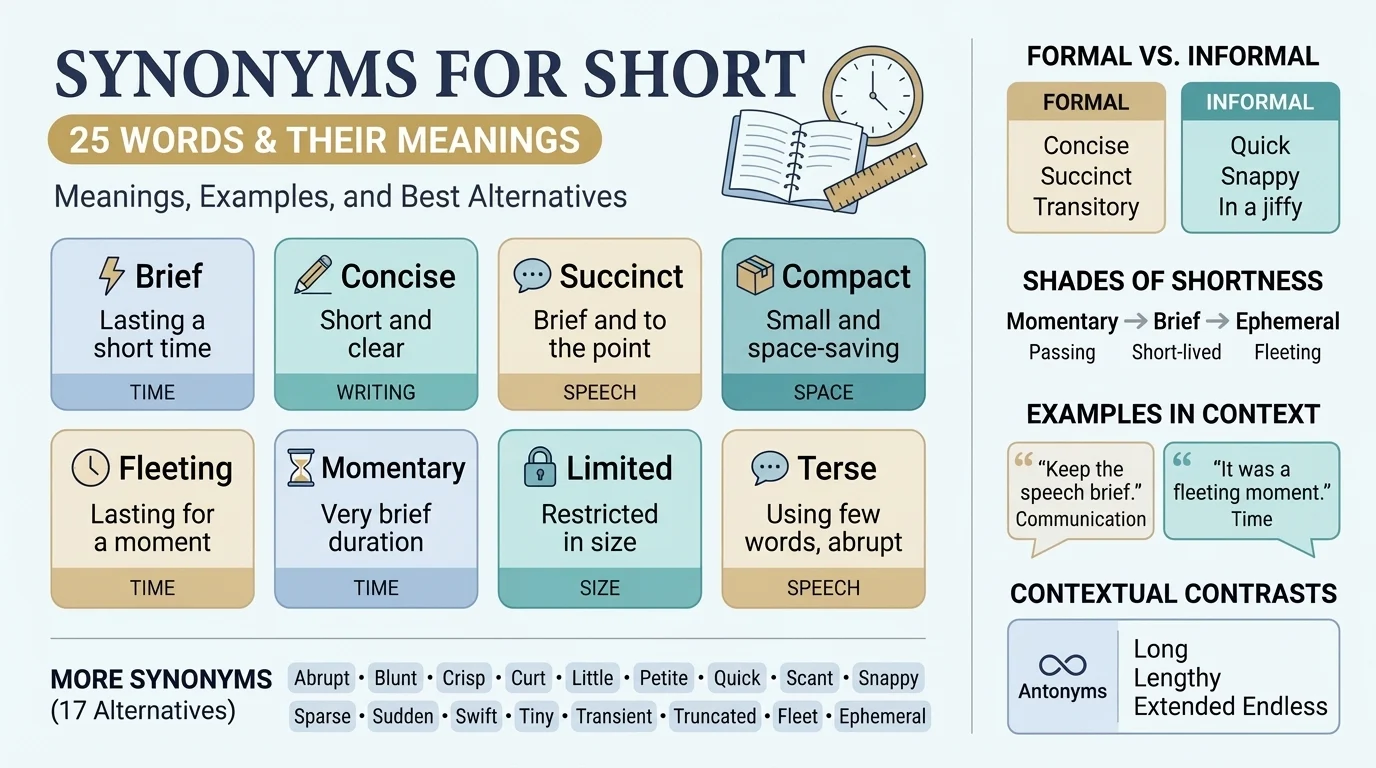
25 Synonyms for “Short”
The following 25 words offer alternatives for different meanings of short, including limited duration, physical dimensions, writing length, and communication style.
Not every alternative works in every sentence, so consider the usage guidance before replacing the original word.
| Synonym | Simple Meaning | Best Used For | Example Sentence |
|---|---|---|---|
| 1. Brief | Lasting a little time | Meetings and conversations | We had a brief discussion. |
| 2. Concise | Clear and using few words | Professional and academic writing | Her concise explanation was helpful. |
| 3. Succinct | Expressing ideas in very few words | Formal communication | He gave a succinct answer. |
| 4. Terse | Very brief, sometimes abrupt | Responses and remarks | She sent a terse message. |
| 5. Compact | Taking up little space | Objects and designs | The compact camera fits in my bag. |
| 6. Abbreviated | Made shorter than the original | Documents and names | We received an abbreviated version. |
| 7. Truncated | Cut off or shortened | Text and technical content | The truncated message was incomplete. |
| 8. Curt | Brief and potentially rude | Personal communication | His curt reply ended the discussion. |
| 9. Laconic | Using very few words | Speech and writing | Her laconic response surprised us. |
| 10. Pithy | Brief but meaningful | Speeches and quotations | He delivered a pithy observation. |
| 11. Fleeting | Lasting for a very short time | Experiences and emotions | It was a fleeting opportunity. |
| 12. Momentary | Lasting only a moment | Temporary situations | A momentary pause followed. |
| 13. Transient | Temporary or passing | Formal and literary writing | The excitement was transient. |
| 14. Temporary | Lasting for a limited period | Situations and arrangements | We found a temporary solution. |
| 15. Limited | Restricted in amount or extent | Resources and opportunities | The project has a limited budget. |
| 16. Scant | Very small or insufficient | Quantities and resources | There was scant evidence available. |
| 17. Small | Limited in physical size | Objects and measurements | They purchased a small desk. |
| 18. Little | Small in size or amount | Casual communication | She lives in a little house. |
| 19. Low | Not reaching much height | Physical measurements | The building has a low ceiling. |
| 20. Stubby | Short and thick | Physical descriptions | The dog had stubby legs. |
| 21. Stunted | Having restricted growth | Plants and development | The plant remained stunted. |
| 22. Clipped | Abruptly brief or shortened | Speech and writing | He spoke in clipped sentences. |
| 23. Summary | Condensed into the main points | Documents and explanations | I read a summary of the article. |
| 24. Quick | Taking little time | Activities and actions | We had a quick lunch. |
| 25. Swift | Happening or moving quickly | Actions and movement | The team made a swift decision. |
Important usage note: Some words in this list describe only a particular sense of short. For example, stubby relates to physical dimensions, while succinct describes communication. Always match the replacement to the original meaning.
Synonym Groups and Usage Differences
Different synonyms create different impressions. Understanding these distinctions helps you select language that sounds natural rather than simply replacing one word with another.
- Professional vs. Personal Synonyms
- Professional communication generally benefits from words that emphasize clarity and efficiency.
- Professional alternatives:
- Concise
- Succinct
- Brief
- Compact
- Abbreviated
Personal alternatives:
- Little
- Small
- Quick
- Fleeting
- Momentary
Example:
Professional: Please provide a concise summary of the discussion.
Personal: We had a quick chat before leaving.
Formal vs. Conversational Synonyms
Formal synonyms are useful in academic documents, business reports, and professional correspondence.
| Formal Words | Conversational Words |
|---|---|
| Concise | Brief |
| Succinct | Quick |
| Abbreviated | Little |
| Laconic | Small |
| Transient | Temporary |
For everyday conversation, brief and quick usually sound natural.
For formal writing, concise and succinct can communicate a more precise meaning.
Academic Synonyms
Academic writing requires accuracy and clarity.
These alternatives are particularly useful:
- Concise: A clear explanation without unnecessary information.
- Succinct: A compact expression of an idea.
- Abbreviated: A shortened version of a text or expression.
- Limited: Something restricted in scope or quantity.
- Transient: A temporary condition or phenomenon.
Example:
The researcher provided a concise interpretation of the experimental results.
This sentence sounds more precise than saying the researcher provided a short interpretation.
Professional and Business Synonyms
In business communication, the best alternative depends on the document or conversation.
| Situation | Recommended Word | Example |
|---|---|---|
| Business email | Brief | Here is a brief project update. |
| Presentation | Concise | Keep your presentation concise. |
| Executive summary | Succinct | Include a succinct overview. |
| Product description | Compact | This compact device saves space. |
| Performance review | Concise | Write concise performance notes. |
For resumes, concise is particularly useful when describing communication skills or summarizing professional achievements.
Creative or Literary Synonyms
Creative writing often benefits from alternatives that create imagery or communicate a feeling.
Consider these options:
- Fleeting: Something that disappears quickly.
- Momentary: Something that lasts only an instant.
- Transient: Something temporary or passing.
- Clipped: Speech delivered in abrupt, brief expressions.
- Laconic: A communication style using very few words.
Example:
A fleeting glimpse of sunlight appeared through the clouds.
This creates a more descriptive image than simply saying a short glimpse appeared.
Slang or Modern Synonyms
There are several informal expressions that can communicate the idea of something taking little time.
- Quick
- Mini
- Bite sized
- Snappy
- Tiny
Examples:
- Let’s have a quick chat.
- I watched a mini documentary.
- She shared a bite sized lesson.
- Give me a snappy summary.
These expressions work well in casual conversations, blogs, and social media.
However, avoid slang or overly casual expressions in academic papers, formal reports, and serious professional documents.
Strongest vs. Weaker Synonyms
Not all synonyms communicate the same degree of brevity.
Here is a practical scale based on how strongly each word emphasizes limited length or duration.
| Intensity | Word | Meaning |
|---|---|---|
| Mild | Small | Limited physical size |
| Mild | Brief | Limited length or time |
| Moderate | Compact | Designed to occupy little space |
| Moderate | Concise | Efficiently expressed |
| Strong | Succinct | Expressed in very few words |
| Strong | Terse | Extremely brief, sometimes abrupt |
| Strong | Fleeting | Passing very quickly |
| Strong | Momentary | Lasting only an instant |
The strongest option depends on the meaning you want to express, not simply the number of letters in the word.
Emotional vs. Neutral Synonyms
Some alternatives remain factual, while others introduce emotional meaning.
| Neutral Synonyms | Emotional or Expressive Synonyms |
|---|---|
| Brief | Fleeting |
| Compact | Momentary |
| Small | Terse |
| Limited | Clipped |
| Concise | Curt |
For example, “a brief meeting” is neutral, while “a fleeting moment of joy” creates a more emotional impression.
Antonyms of “Short”
The opposite of short depends on whether you are describing length, height, duration, or communication.
The following table includes 15 useful antonyms across these different meanings.
| Antonym | Meaning | Example Sentence |
|---|---|---|
| 1. Long | Having greater length or duration | We watched a long movie. |
| 2. Lengthy | Taking a considerable amount of time or space | The report was lengthy. |
| 3. Extended | Continuing for a longer period | They enjoyed an extended vacation. |
| 4. Prolonged | Lasting longer than usual | The prolonged meeting exhausted everyone. |
| 5. Extensive | Covering a large amount or range | She conducted extensive research. |
| 6. Elaborate | Detailed and developed | He gave an elaborate explanation. |
| 7. Detailed | Including many specific details | The report contains a detailed analysis. |
| 8. Verbose | Using more words than necessary | His verbose response confused readers. |
| 9. Wordy | Containing too many words | The introduction sounds wordy. |
| 10. Full length | Having the complete intended length | We watched the full length documentary. |
| 11. Tall | Having greater height | The tall building dominates the skyline. |
| 12. High | Extending upward to a considerable height | The fence is unusually high. |
| 13. Lofty | Reaching a considerable height | The house has a lofty ceiling. |
| 14. Long lasting | Continuing for a long time | They built a long lasting friendship. |
| 15. Drawn out | Continuing longer than necessary | The discussion became drawn out. |
Note: These antonyms are context dependent. For example, tall is the opposite of short when describing height, while lengthy is more appropriate when discussing written material or duration.
Comparison: Short vs. Similar Words
Understanding the differences between related words prevents awkward word choices.
Short vs. Brief
Main difference: Short describes limited length, height, or duration. Brief usually emphasizes limited time or communication length.
Which is stronger? Neither is universally stronger. Brief is more specific to time and communication.
Which is more formal? Both are appropriate in professional writing.
Examples:
- Short: We watched a short video.
- Brief: We had a brief conversation.
Short vs. Concise
Main difference: Short refers to limited length, while concise means expressing information clearly without unnecessary words.
Which is stronger? Concise communicates a more specific quality of writing.
Which is more formal? Concise is especially suitable for academic and professional writing.
Examples:
- Short: She wrote a short report.
- Concise: She wrote a concise report.
Short vs. Compact
Main difference: Short generally refers to length or duration. Compact emphasizes an object or design that occupies little space.
Which is stronger? Compact gives a more specific description of physical size.
Which is more formal? Both are appropriate in formal communication.
Examples:
- Short: He bought a short table.
- Compact: He bought a compact table.
Short vs. Small
Main difference: Short describes limited length or height, while small describes overall size.
Which is stronger? Neither is inherently stronger.
Which is more formal? Both are neutral and widely accepted.
Examples:
- Short: The rope is too short.
- Small: The box is too small.
Short vs. Terse
Main difference: Short describes limited length, while terse describes communication that uses very few words and may sound abrupt.
Which is stronger? Terse often creates a stronger impression.
Which is more formal? Both can appear in formal writing, although terse carries a more specific tone.
Examples:
- Short: He gave a short response.
- Terse: He gave a terse response.
Short vs. Fleeting
Main difference: Short describes limited duration or length, while fleeting specifically describes something that passes quickly.
Which is stronger? Fleeting creates a stronger sense of something disappearing quickly.
Which is more formal? Both are suitable for formal writing, but fleeting has a more expressive tone.
Examples:
- Short: We enjoyed a short moment together.
- Fleeting: We shared a fleeting moment of happiness.
Common Phrases and Expressions with “Short”
The word short appears in many common English expressions. Understanding these phrases can improve both everyday speaking and professional writing.
1. In Short
Meaning: To summarize something using only the main points.
Example sentence: In short, the project needs more funding.
2. Short Notice
Meaning: A limited amount of warning or preparation time.
Example sentence: Thank you for attending the meeting on such short notice.
3. Short of
Meaning: Lacking something or not having enough of it.
Example sentence: We are short of time today.
4. Fall Short
Meaning: To fail to reach an expected standard or goal.
Example sentence: The final results fell short of our expectations.
5. Cut Short
Meaning: To end something earlier than planned.
Example sentence: The outdoor event was cut short because of heavy rain.
6. For Short
Meaning: Used to introduce a shorter version of a name or expression.
Example sentence: Her full name is Elizabeth, but everyone calls her Liz for short.
7. Short and Sweet
Meaning: Brief, pleasant, and effective.
Example sentence: The manager kept the announcement short and sweet.
8. Come Up Short
Meaning: To fail to achieve a desired result.
Example sentence: The team came up short in the final round.
Common Mistakes to Avoid
Even familiar English words can create problems when used without considering context.
Here are seven mistakes to avoid when choosing synonyms for short.
1. Using Short When Concise Is Better
Incorrect: Please make the business report short.
Better: Please make the business report concise.
Concise emphasizes clarity and efficiency, which are important in professional writing.
2. Confusing Brief With Concise
Brief refers to limited length or duration. Concise describes information that is clear and efficiently expressed.
A report can be brief but still confusing. A concise report is both efficient and clear.
3. Using Terse in Positive Situations
Terse can suggest that someone is abrupt or unfriendly.
Avoid describing a friendly explanation as terse unless you specifically mean that it contains very few words and sounds abrupt.
4. Using Compact for Writing
Compact generally describes physical size or arrangement.
Instead of saying “a compact essay,” consider “a concise essay” when you mean that the writing uses words efficiently.
5. Using Overly Dramatic Synonyms
Fleeting and transient can sound expressive or literary.
They are not always appropriate for ordinary situations.
For example, “a brief meeting” is more natural than “a transient meeting.”
6. Repeating Short Too Often
Using the same adjective repeatedly can make your writing monotonous.
Replace it with an appropriate alternative such as brief, concise, compact, or limited.
7. Using Casual Expressions in Academic Writing
Words such as mini, tiny, and quick may sound too informal in certain academic contexts.
Choose precise alternatives that match the tone of your assignment or research.
FAQs
1. What is the best synonym for short?
Brief is one of the most versatile synonyms for short. However, concise is better for writing, compact for physical objects, and fleeting for temporary experiences.
2. What is a formal synonym for short?
Concise, succinct, abbreviated, and limited are useful formal alternatives. The best choice depends on whether you are describing writing, time, or quantity.
3. What is an informal synonym for short?
Quick, little, small, and mini are common informal alternatives. They work naturally in everyday conversations, casual messages, and social media captions.
4. What is another word for short in professional writing?
Concise is an excellent choice for professional writing because it emphasizes clear communication. Brief and succinct are also useful in business emails and reports.
5. What is the difference between short and brief?
Short describes limited length, height, or duration. Brief generally emphasizes limited time or communication length, making it useful for meetings and conversations.
6. What is the opposite of short?
Long is the most common opposite of short when discussing length or duration. Tall is appropriate when describing height, while lengthy describes extended writing.
Conclusion
Short is a versatile English word used to describe limited length, height, duration, or quantity. However, choosing a more precise alternative can make your writing and communication more effective.
Use brief for conversations and limited periods, concise for professional and academic writing, compact for physical objects, and fleeting for temporary experiences. Words such as succinct, terse, and momentary offer additional meaning when the context requires more precision.
The most useful vocabulary tip is to understand the meaning of a sentence before replacing a word. A good synonym should improve clarity, preserve the original meaning, and match the tone of your audience.
Remember: The best synonym for short is not necessarily the most sophisticated word. It is the word that communicates your intended meaning naturally and accurately.
Discover More Post:
- 50+ Synonyms for Punishment | Powerful Alternatives, Real …
- 50+ Synonyms for Rare | Discover Unique Words That Make …
- 50+ Synonyms for Correct | Meanings, Examples, and Best …