When you use the word prove repeatedly in essays, emails, work reports, or everyday conversations, your writing can start to sound repetitive. Choosing a more precise word can help you explain your ideas clearly, present evidence, and make your message more convincing.
This guide explores synonyms for prove and explains how each alternative works in real situations. You will learn the difference between words such as demonstrate, verify, establish, confirm, and substantiate. You will also find practical examples, formal and informal alternatives, antonyms, and common expressions. Whether you are writing a school assignment, preparing a business presentation, updating your resume, or improving your vocabulary, the right word can make your meaning clearer and more accurate.
What Does Prove Mean?
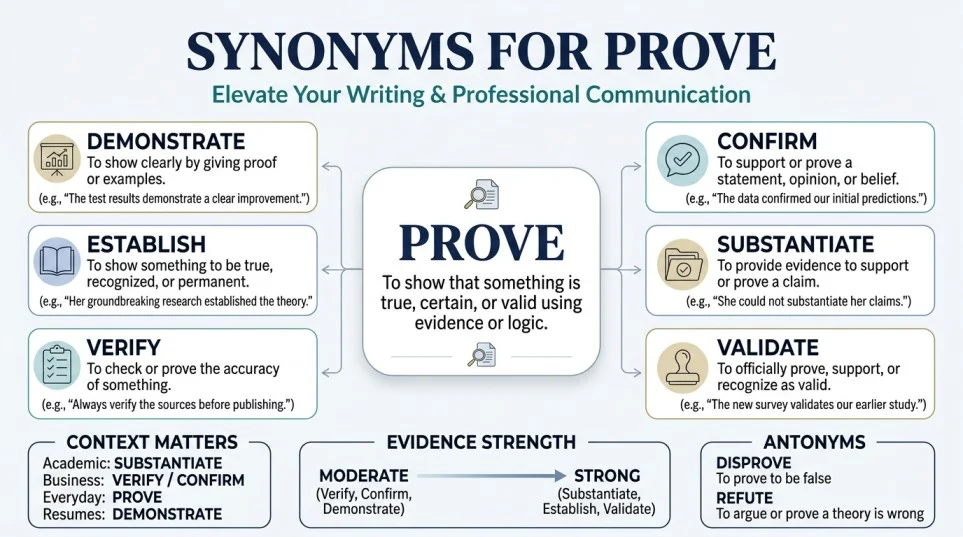
To prove means to show that something is true through evidence, facts, reasoning, or demonstration. Common synonyms include demonstrate, establish, verify, confirm, substantiate, and validate. Formal writing often favors establish or substantiate, while confirm and show work well in everyday communication.
Meaning, Tone and Context
What does prove mean?
The word prove means to show that a statement, belief, claim, or idea is true by providing enough evidence or a convincing explanation. It can also mean demonstrating a skill, ability, or quality through actions.
For example, a scientist may prove a theory through strong evidence, while an employee may prove their value by consistently delivering excellent results.
Part of speech
Prove is a verb. It describes an action involving evidence, reasoning, demonstration, or confirmation.
Common word forms include:
| Word Form | Meaning | Example |
|---|---|---|
| Prove | Show that something is true | The results prove our point. |
| Proved | Past tense of prove | She proved her ability. |
| Proven | Established through evidence or experience | He has a proven record of success. |
| Proof | Evidence that supports a claim | We need proof of payment. |
| Provable | Capable of being proved | The statement is provable. |
| Provenly | Rare and generally awkward in modern usage | Use demonstrably or demonstrative wording instead. |
In most writing, proven is the natural adjective for an established record, method, or result. Proof is the related noun.
Tone and formality
Prove is a neutral, widely understood word. It works in academic writing, business communication, personal conversations, scientific discussions, and legal contexts.
However, the word does not always mean the same thing in every situation. Confirm may mean checking information, demonstrate may mean showing how something works, and substantiate usually means supporting a claim with evidence.
Common uses of prove
People commonly use prove when they need to:
- Support a claim with evidence.
- Show that a method or idea works.
- Establish someone’s ability or reliability.
- Confirm that information is accurate.
- Demonstrate a result through testing or observation.
The best replacement depends on what you are trying to establish and how strong your evidence is.
When and How to Use Prove
Use prove when you want to show that a claim is true, establish a fact, demonstrate an ability, or support an idea with evidence. Choose a synonym when it communicates the specific action more clearly.
Professional example: The sales figures demonstrate that the new strategy is working.
Academic example: The experiment provides evidence to support the researcher’s conclusion.
Personal example: I wanted to prove to my family that I could manage the responsibility.
Email example: Could you please verify the figures before we publish the report?
Each example uses a different approach. Demonstrate highlights results, support focuses on evidence, prove emphasizes establishing truth or ability, and verify focuses on checking accuracy.
Another Word for Prove
The best single replacement for prove is usually demonstrate when you want to show that something is true through evidence or results. However, establish, verify, confirm, and substantiate can be better choices in specific situations.
| Situation | Best Alternative | Why It Works |
|---|---|---|
| Professional writing | Demonstrate | Clearly presents results or ability. |
| Academic writing | Establish | Emphasizes a conclusion supported by evidence. |
| Casual conversation | Show | Simple, natural, and easy to understand. |
| Emotional writing | Validate | Emphasizes that a feeling or experience is legitimate. |
| Creative writing | Reveal | Highlights the discovery of a truth or quality. |
| Resume or workplace | Demonstrate | Connects skills to measurable results. |
| Social media captions | Show | Sounds direct and conversational. |
| Stronger evidential claim | Substantiate | Emphasizes support through evidence. |
| Checking a fact | Verify | Focuses on accuracy and correctness. |
| Confirming existing information | Confirm | Shows that something is correct or expected. |
Remember that validate does not always mean proving a statement is objectively true. It can mean recognizing that an experience, feeling, method, or result is legitimate.
When Not to Use Prove
Although prove is useful, it can sound too general when your sentence requires a more specific meaning.
For example, a report that says the results prove the strategy worked may sound stronger than the available evidence allows. If the results only suggest a connection, support or indicate may be more accurate.
Consider these situations:
| Less Precise Sentence | Better Alternative | Reason |
|---|---|---|
| The numbers prove the trend. | The numbers demonstrate the trend. | Demonstrate emphasizes what the data shows. |
| Please prove the information. | Please verify the information. | Verify means checking accuracy. |
| Her results prove the claim. | Her results substantiate the claim. | Substantiate emphasizes supporting evidence. |
| He proved the instructions. | He demonstrated the procedure. | Demonstrate describes showing how something is done. |
| The report proves our conclusion. | The report supports our conclusion. | Support is safer when evidence is not conclusive. |
Do not use a stronger synonym simply to make your writing sound impressive. Use the word that matches the strength of your evidence.
Words Commonly Confused With Prove
Several words related to prove overlap in meaning, but each emphasizes a different action.
| Word | Main Difference | Best Use |
|---|---|---|
| Demonstrate | Show something clearly through evidence, results, or action. | Explaining findings or showing ability. |
| Verify | Check whether information is accurate. | Checking figures, identities, and facts. |
| Confirm | Establish that something is correct or expected. | Checking details or reinforcing existing information. |
| Establish | Show that a fact, principle, or conclusion is well supported. | Research, formal arguments, and reports. |
| Validate | Confirm that something is acceptable, sound, or legitimate. | Testing methods, results, or experiences. |
| Substantiate | Support a claim with evidence. | Formal reports, investigations, and academic arguments. |
The key difference is purpose. Verification checks accuracy, confirmation reinforces information, demonstration shows something clearly, and substantiation supplies support for a claim.
Best Synonym by Context for Prove
The following table matches common situations with the most suitable alternatives.
| Context | Best Synonym | Why It Works | Example |
|---|---|---|---|
| Formal writing | Establish | Sounds precise and authoritative. | The evidence establishes a clear connection. |
| Academic writing | Substantiate | Emphasizes evidence supporting an argument. | The sources substantiate the central claim. |
| Business communication | Demonstrate | Connects evidence to results. | The report demonstrates improved performance. |
| Resume | Showcase | Highlights skills and achievements. | My portfolio showcases my design skills. |
| Casual conversation | Show | Simple and natural. | Let me show you that it works. |
| Creative writing | Reveal | Suggests discovery or uncovering a truth. | Her actions revealed her loyalty. |
| Emotional writing | Validate | Recognizes an experience or feeling as legitimate. | His response validated her concerns. |
| Strong evidential support | Substantiate | Emphasizes credible supporting evidence. | The documents substantiate the allegation. |
| Moderate evidence | Suggest | Avoids claiming complete certainty. | The findings suggest a possible link. |
| Social media captions | Show | Direct and engaging. | Let your work show your progress. |
| Scientific testing | Verify | Focuses on checking accuracy. | Researchers verified the measurements. |
| Legal discussion | Establish | Describes meeting the relevant evidential standard. | The prosecution must establish the required elements. |
| Product testing | Validate | Focuses on whether a product or method meets requirements. | The team validated the new process. |
| Personal achievement | Demonstrate | Shows ability through actions. | She demonstrated strong leadership. |
US and UK usage
Prove, demonstrate, establish, verify, and substantiate are common in both American and British English. There is no major US versus UK distinction that requires a different synonym.
For a US audience, show, demonstrate, confirm, and verify are practical choices for everyday and workplace writing. In formal documents, select the word that accurately describes the evidence or action.
Which Synonym Should You Choose?
Choosing the right alternative depends on five things.
1. Meaning: Ask what you are trying to do. Are you showing a result, checking a fact, or supporting a claim? Use demonstrate, verify, or substantiate accordingly.
2. Formality: Use show in conversation, demonstrate in workplace communication, and establish or substantiate in formal arguments when appropriate.
3. Strength of evidence: If the evidence is conclusive within the relevant context, establish or demonstrate may fit. If the evidence is limited, suggest or support may be more accurate.
4. Professional value: In a resume, use demonstrate or showcase to connect your skills to actual achievements. Whenever possible, include measurable results.
5. Sentence context: Read the full sentence after replacing prove. A synonym is only suitable if the sentence remains accurate and natural.
For example, you can say that an employee demonstrated leadership, a researcher verified the results, and a report substantiated a claim. Each verb highlights a different action.
Real Life Examples of Prove in Sentences
Here are practical examples showing how to replace prove with a more precise word.
| Situation | Example Sentence |
|---|---|
| School | The experiment demonstrated how temperature affects the reaction. |
| Workplace | Our quarterly results confirm that customer satisfaction has improved. |
| Writing | The final paragraph reinforces the essay’s main argument. |
| Conversation | I can show you how to fix the problem. |
| Social media | Let your progress speak for itself. |
| Resume | Demonstrated leadership by coordinating a team project. |
| Please verify the attached figures before Friday. | |
| Storytelling | Her courage revealed her true character. |
| Research | The findings support the original hypothesis. |
| Business presentation | Customer feedback substantiates the need for improvement. |
These examples also show why repeating prove is unnecessary. A specific verb can make a sentence more informative without making it longer.
18 Synonyms for Prove
These 18 alternatives cover common meanings of prove, from showing a result to checking facts or supporting a claim. Some are direct synonyms, while others work only in specific contexts.
| Synonym | Simple Meaning | Best Used For | Example Sentence |
|---|---|---|---|
| 1. Demonstrate | Show clearly through actions or evidence | Reports, skills, presentations | The results demonstrate the value of the new approach. |
| 2. Establish | Show that something is supported as true | Research, formal arguments | The study established a link between the two factors. |
| 3. Substantiate | Support a claim with evidence | Academic and professional writing | The records substantiate her explanation. |
| 4. Verify | Check whether something is accurate | Facts, figures, details | Please verify the address before sending the package. |
| 5. Confirm | Show that information is correct or expected | Emails and everyday communication | The manager confirmed the meeting time. |
| 6. Validate | Confirm that something is sound or acceptable | Testing and quality checks | The team validated the results of the test. |
| 7. Show | Make something clear or visible | Casual conversation and simple writing | His actions show how much he cares. |
| 8. Support | Provide reasons or evidence for a claim | Essays, reports, discussions | The latest figures support our conclusion. |
| 9. Corroborate | Provide additional evidence for something | Investigations and research | A second witness corroborated her account. |
| 10. Authenticate | Confirm that something is genuine | Documents, art, digital records | Experts authenticated the historical letter. |
| 11. Certify | Officially confirm that a requirement has been met | Credentials and compliance | The agency certified the product as compliant. |
| 12. Attest | State or confirm something as true | Formal statements and declarations | The witness attested to the accuracy of the record. |
| 13. Testify | Give evidence, especially in a legal setting | Court proceedings | The witness testified about what she had seen. |
| 14. Illustrate | Explain or make a point clear with examples | Teaching and presentations | This example illustrates the importance of preparation. |
| 15. Reveal | Make a hidden fact or quality known | Stories and discoveries | The investigation revealed a serious error. |
| 16. Indicate | Point toward a conclusion or possibility | Reports and data analysis | The survey results indicate growing interest. |
| 17. Evidence | Show that something exists or is true | Formal and analytical writing | The documents evidence a change in ownership. |
| 18. Document | Record information that supports a claim or event | Workplace records and research | The photographs document the damage. |
Important usage note: These words are not interchangeable in every sentence. Evidence is often a noun, but it can also be a verb in formal writing. Document commonly means recording or providing a record, rather than proving something conclusively.
Synonym Groups and Usage Differences
Professional vs. Personal Synonyms
In professional settings, demonstrate, establish, verify, and substantiate are useful because they communicate evidence, results, or accuracy.
In personal conversations, show, confirm, and reveal usually sound more natural. For example, you might show a friend how a device works, confirm your plans for the weekend, or reveal a surprise.
Formal vs. Conversational Synonyms
Formal language is useful when accuracy, evidence, or accountability matters. Conversational language works best when the goal is simple understanding.
| Formal Alternative | Conversational Alternative |
|---|---|
| Substantiate | Back up |
| Establish | Show |
| Verify | Check |
| Demonstrate | Show |
| Corroborate | Back up with more evidence |
| Confirm | Make sure or confirm |
The phrase back up is informal but useful when discussing evidence. For a research paper or legal document, substantiate or corroborate may be more suitable.
Academic Synonyms
Academic writing benefits from verbs that explain the relationship between evidence and conclusions.
Use establish when research supports a conclusion, substantiate when evidence supports a claim, demonstrate when findings clearly show a result, and indicate when evidence points toward a possibility without settling the question.
For example, the data indicate a possible relationship is more cautious than the data establish a relationship. Choose the wording that matches the study’s findings.
Professional and Business Synonyms
In workplace communication, select verbs that describe the actual task.
- Demonstrate: Show skills, performance, or results.
- Verify: Check information for accuracy.
- Confirm: Make sure an arrangement or detail is correct.
- Validate: Test whether a process or solution meets requirements.
- Substantiate: Provide evidence for a business claim.
- Showcase: Highlight achievements or abilities, especially in resumes and portfolios.
A resume should demonstrate achievements through specific results rather than make unsupported claims about your abilities.
Creative or Literary Synonyms
Creative writing sometimes needs a word that creates a sense of discovery, emotion, or change.
Reveal works when a hidden truth becomes known. Illustrate helps explain an idea through a scene or example. Show can communicate a character’s qualities through behavior rather than direct description.
For example, instead of writing the character proved her loyalty, you could write the character revealed her loyalty by returning to help her friend.
Slang or Modern Synonyms
There is no single slang word that replaces prove in every situation. Informal expressions such as back up, show, and put it to the test can work in casual speech.
Examples include:
- Back it up with facts.
- Show me that it works.
- Put the idea to the test.
These expressions are natural in conversation and some social media captions. In formal reports, academic essays, and legal documents, more precise language is usually preferable.
Strongest vs. Weaker Synonyms
The strength of a synonym depends on the evidence and the claim. The following scale describes how strongly a word generally presents a conclusion, not a universal ranking of proof.
| Level | Word | Typical Meaning |
|---|---|---|
| 1. Cautious | Suggest | Points toward a possibility. |
| 2. Moderate | Indicate | Signals a likely pattern or conclusion. |
| 3. Supportive | Support | Provides reasons or evidence for a claim. |
| 4. Clear | Demonstrate | Shows something through evidence or results. |
| 5. Strong | Substantiate | Provides meaningful support for a claim. |
| 6. Conclusive in context | Establish | Shows that a fact or conclusion is sufficiently supported. |
No word automatically makes weak evidence strong. Even establish should be used carefully when the evidence is incomplete or disputed.
Emotional vs. Neutral Synonyms
Neutral synonyms focus on facts and evidence. Emotional alternatives may emphasize recognition, discovery, or personal meaning.
| Neutral Word | More Expressive Word | Difference |
|---|---|---|
| Show | Reveal | Suggests that something hidden becomes known. |
| Confirm | Validate | Can recognize a feeling or experience as legitimate. |
| Demonstrate | Showcase | Highlights a quality or achievement. |
| Support | Reinforce | Emphasizes strengthening an existing idea. |
| Indicate | Expose | Suggests uncovering something hidden, sometimes negative. |
Use neutral words for factual reports. Use expressive alternatives when the emotional effect or narrative meaning matters.
Antonyms of Prove
The opposite of prove depends on what you mean. If prove means establishing that a claim is true, disprove and refute are strong opposites. Other words describe challenging, rejecting, weakening, or failing to support a claim.
The following 15 words are context dependent opposites or contrasting terms, not exact antonyms in every situation.
| Antonym | Meaning | Example Sentence |
|---|---|---|
| 1. Disprove | Show that a claim is false | The new evidence disproved the original theory. |
| 2. Refute | Show that an argument is wrong | She refuted the accusation with clear records. |
| 3. Debunk | Expose a false belief or claim | Researchers debunked the popular myth. |
| 4. Contradict | State the opposite of a claim or conflict with it | The second report contradicted the first. |
| 5. Invalidate | Make an argument or result no longer valid | The missing data invalidated the conclusion. |
| 6. Undermine | Weaken confidence in a claim | The inconsistency undermined his explanation. |
| 7. Falsify | Show something to be false or deliberately alter information | The results falsified the initial prediction. |
| 8. Deny | State that something is not true | The company denied the allegation. |
| 9. Dispute | Challenge whether something is correct | Experts disputed the reported figures. |
| 10. Challenge | Question the truth or validity of something | The new findings challenged the accepted view. |
| 11. Reject | Refuse to accept an idea or claim | The committee rejected the unsupported proposal. |
| 12. Discredit | Damage the credibility of a person or claim | The fabricated evidence discredited the report. |
| 13. Rebut | Answer an argument with opposing evidence or reasoning | The lawyer rebutted the claim with testimony. |
| 14. Question | Express doubt about the truth of something | The reviewer questioned the reliability of the results. |
| 15. Withhold | Keep information or evidence from being shared | The witness withheld important information. |
Withhold is a contextual contrast rather than a direct antonym. It describes keeping evidence unavailable, not necessarily showing that a claim is false.
Comparison: Prove vs. Similar Words
Prove vs. Demonstrate
Main difference: Prove emphasizes establishing truth, while demonstrate emphasizes showing something through evidence, results, or action.
Strength: Prove can imply a stronger conclusion when the evidence is sufficient.
Formality: Both work in formal and everyday writing.
Examples:
Prove: The documents proved that the payment had been made.
Demonstrate: The results demonstrated that the new process was effective.
Prove vs. Verify
Main difference: Prove establishes that a claim is true, while verify checks whether information is accurate.
Strength: Prove generally makes a broader claim about truth.
Formality: Both are suitable for professional and academic contexts.
Examples:
Prove: The investigation proved that the records were altered.
Verify: Please verify the account number before submitting the form.
Prove vs. Confirm
Main difference: Prove establishes truth through evidence or reasoning, while confirm checks or reinforces information that is believed or expected to be correct.
Strength: Prove usually makes the stronger claim.
Formality: Both work in formal and informal communication.
Examples:
Prove: The evidence proved that the device was defective.
Confirm: The technician confirmed that the device needed repair.
Prove vs. Establish
Main difference: Prove focuses on showing that something is true. Establish emphasizes making a fact, relationship, or conclusion accepted on sufficient grounds.
Strength: Both can be strong. Establish often sounds measured and formal.
Formality: Establish is especially useful in research, business reports, and formal arguments.
Examples:
Prove: The experiment proved that the original calculation was incorrect.
Establish: The research established a relationship between the two variables.
Prove vs. Substantiate
Main difference: Prove aims to establish truth, while substantiate focuses on providing evidence that supports a claim.
Strength: Substantiate emphasizes the quality and relevance of supporting evidence.
Formality: Substantiate is more formal than prove in many everyday contexts.
Examples:
Prove: The records proved that the transaction occurred.
Substantiate: The records substantiated the customer’s complaint.
Prove vs. Validate
Main difference: Prove establishes truth, while validate confirms that something is sound, acceptable, or meets a standard.
Strength: Neither is universally stronger. The right choice depends on the claim.
Formality: Both are common in professional and technical writing.
Examples:
Prove: The evidence proved that the claim was false.
Validate: The testing team validated the software before its release.
Common Phrases and Expressions with Prove
1. Prove a point
Meaning: Show that an argument or opinion is correct.
Example sentence: The final experiment helped the student prove her point.
2. Prove someone wrong
Meaning: Show that another person’s statement or belief is incorrect.
Example sentence: The team proved the critics wrong by meeting its goals.
3. Prove yourself
Meaning: Show your ability, value, or reliability through actions.
Example sentence: She proved herself by completing the project ahead of schedule.
4. Prove a theory
Meaning: Provide evidence that supports a proposed explanation.
Example sentence: The researchers collected more data to test and potentially establish their theory.
5. Prove beyond a reasonable doubt
Meaning: Meet the high standard of proof required for a criminal conviction in the US legal system.
Example sentence: The prosecution must prove the defendant’s guilt beyond a reasonable doubt.
6. The proof is in the pudding
Meaning: The real value of something becomes clear from its results.
Example sentence: The new training program looks promising, but the proof is in the pudding.
7. Put something to the test
Meaning: Test whether an idea, product, or method actually works.
Example sentence: We put the new software to the test before recommending it to customers.
8. Prove a claim with evidence
Meaning: Use relevant facts or records to support a statement.
Example sentence: The journalist used public records to support the claim in the report.
Common Mistakes to Avoid
1. Using prove when verify is more accurate
Incorrect: Prove that the email address is correct.
Better: Verify that the email address is correct.
Verify is usually the more natural choice when you are checking existing information.
2. Treating every synonym as an exact replacement
Incorrect: The report authenticated the team’s performance.
Better: The report demonstrated the team’s performance.
Authenticate generally refers to confirming that something is genuine, not showing how well someone performed.
3. Making claims that are too strong
Incorrect: The survey proves that everyone prefers the new design.
Better: The survey suggests that many respondents prefer the new design.
A survey may indicate a trend without establishing what everyone thinks.
4. Using formal language in casual conversations
Unnatural: I will substantiate that the restaurant is open.
Natural: I will check whether the restaurant is open.
Choose everyday wording when a formal term adds no useful meaning.
5. Repeating prove too often
Repetitive: The results prove the claim, and the report proves the conclusion.
Better: The results support the claim, while the report establishes the conclusion.
Vary your vocabulary according to the role each piece of evidence plays.
6. Using an overly dramatic synonym
Incorrect: The attendance record exposed the fact that three people arrived late.
Better: The attendance record showed that three people arrived late.
Expose can suggest wrongdoing or an unpleasant discovery. Use it only when that implication fits.
FAQs
1. What is the best synonym for prove?
Demonstrate is a strong general alternative to prove. Establish, verify, confirm, and substantiate may be more accurate depending on the evidence and purpose.
2. What is a formal synonym for prove?
Substantiate and establish are useful formal synonyms. Substantiate emphasizes supporting evidence, while establish focuses on demonstrating a fact or conclusion sufficiently.
3. What is an informal synonym for prove?
Show is the simplest informal synonym for prove. Back up is also natural when discussing evidence, reasons, or support for a statement.
4. What is another word for prove in professional writing?
Demonstrate works well for results and skills, verify for accuracy, and substantiate for claims that need evidence in reports or business communication.
5. What is the difference between prove and demonstrate?
Prove emphasizes establishing truth, while demonstrate means showing something clearly through evidence, examples, results, or actions. Their meanings overlap in many situations.
6. What is the opposite of prove?
Disprove is a direct opposite when prove means establishing truth. Refute, debunk, and invalidate can also work when challenging a claim or argument.
Conclusion
Prove means showing that something is true through evidence, facts, reasoning, or actions. The best synonyms for prove include demonstrate, establish, verify, confirm, substantiate, and validate, but each word serves a different purpose.
Use demonstrate to describe results or abilities, verify to check accuracy, establish to present a supported conclusion, and substantiate to support a claim with evidence. In casual conversation, show is often the most natural choice.
The most useful vocabulary tip is to choose synonyms based on meaning rather than variety alone. A precise word makes your writing clearer, more trustworthy, and easier to understand.
Discover More Post:
- 50+ Synonyms for Dedication | Meanings, Examples, and Best …
- 50+ Synonyms for For | Expert Word Choices to Elevate Your …
- 50+ Synonyms for Vivid | Meanings, Examples, and Best …