Have you ever written “vivid” several times because you want to describe something colorful, memorable, detailed, or emotionally powerful? The word is useful, but the right alternative can make your writing much more precise.
Finding the best synonyms for vivid depends on what you are describing. A vivid photograph may be colorful, a vivid memory may be memorable, and a vivid story may be evocative or graphic.
This guide explains the meaning, tone, context, and practical use of each alternative. You will also find professional, academic, creative, emotional, conversational, and social media choices.
What Does Vivid Mean?
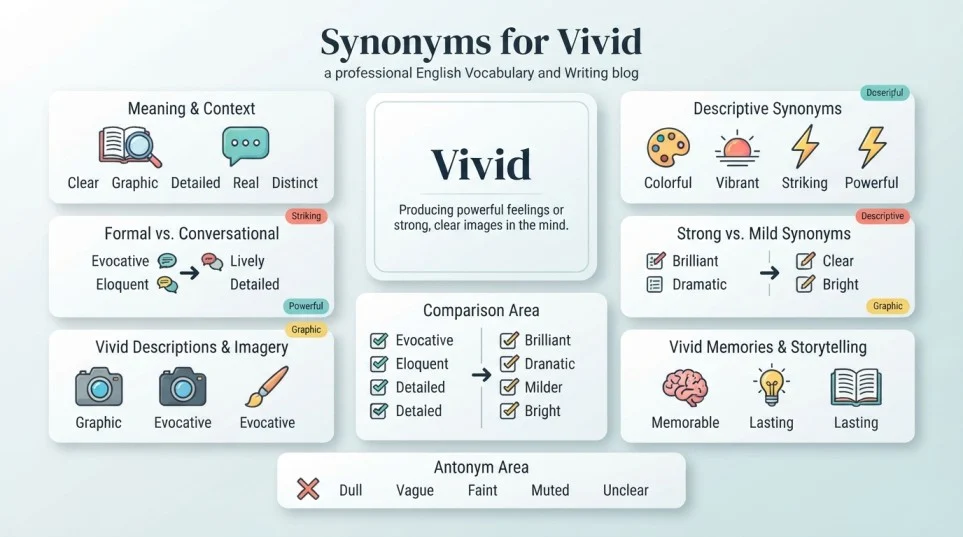
Vivid means extremely clear, detailed, bright, lively, or powerful in a way that creates a strong impression. Good alternatives include striking for formal writing, colorful for descriptions, evocative for emotions, graphic for detail, and lively for conversation.
Meaning, Tone and Context
Simple Definition
Vivid describes something that is unusually clear, detailed, bright, lively, or powerful. It often makes an image, memory, description, feeling, or experience easy to imagine.
For example:
She gave a vivid description of the mountain village.
The sentence suggests that her description was detailed and easy to picture.
Part of Speech
Vivid is an adjective.
Common forms and related words include:
Vividly: In a vivid or highly expressive way.
Vividness: The quality of being vivid.
There is no commonly used verb form that directly corresponds to vivid.
Tone
Vivid is generally positive or neutral.
It can suggest beauty, clarity, intensity, strong emotion, or memorable detail. In some contexts, however, vivid can describe disturbing or unpleasant details.
For example:
He remembered the accident in vivid detail.
Here, vivid emphasizes the strength and clarity of the memory rather than suggesting that the memory was pleasant.
Formality Level
Vivid works well in casual, professional, academic, and creative writing.
It is especially useful when discussing descriptions, imagery, memories, colors, storytelling, dreams, experiences, photographs, and emotions.
Common Use Cases
Vivid commonly describes:
- Colors
- Images
- Memories
- Dreams
- Descriptions
- Stories
- Imagination
- Emotions
- Experiences
- Writing
- Language
- Mental pictures
When and How to Use Vivid
Use vivid when you want to show that something creates a strong, clear impression in the mind.
Professional Example
The presentation included vivid examples that helped the team understand the customer experience.
Personal Example
I still have a vivid memory of visiting the beach with my family as a child.
Academic Example
The author uses vivid imagery to help readers visualize the effects of the storm.
Creative Example
The novel paints a vivid picture of life in a crowded coastal city.
Vivid is particularly effective when a simple word such as clear does not fully express the strength or richness of the description.
Another Word for Vivid
The best replacement depends on the exact meaning you want.
| Situation | Recommended Word |
|---|---|
| Professional writing | Striking |
| Academic writing | Evocative |
| Casual conversation | Bright |
| Emotional writing | Powerful |
| Creative writing | Descriptive |
| Resume or workplace use | Memorable |
| Social media captions | Vibrant |
| Stronger meaning | Graphic |
| Softer meaning | Clear |
If you need one broad replacement, striking is often a strong choice when vivid means noticeable or impressive.
For descriptions that create mental pictures, descriptive or evocative may be more precise.
When Not to Use Vivid
Do not automatically use vivid whenever you mean “good,” “interesting,” or “clear.”
For example:
The employee gave a vivid explanation of the software.
This is understandable, but clear or detailed may be more natural if the explanation is simply easy to understand.
Similarly:
She had a vivid opinion about the issue.
This sounds unusual because vivid normally describes the way an idea is expressed or experienced, not simply the fact that someone has an opinion.
A more precise sentence would be:
She had a strong opinion about the issue.
Choosing a more specific synonym can make your writing sound more natural and accurate.
Words Commonly Confused With Vivid
Vivid vs. Clear
Vivid suggests strong detail, imagery, color, or impression.
Clear mainly means easy to understand, see, or recognize.
He gave a clear explanation.
He gave a vivid description of the accident.
Vivid vs. Bright
Bright usually relates to light, color, intelligence, or cheerful qualities.
Vivid can describe color, but it also applies to memories, descriptions, dreams, and emotions.
The flowers were bright red.
She had a vivid memory of the garden.
Vivid vs. Graphic
Graphic often means extremely detailed or explicit.
Vivid is broader and does not necessarily suggest disturbing or explicit content.
The writer gave a vivid description of the landscape.
The report included graphic details about the injury.
Vivid vs. Colorful
Colorful can describe strong colors, but it can also describe interesting or unusual people, language, or experiences.
Vivid focuses more strongly on intensity, clarity, and mental impact.
The artist used colorful fabrics.
The author created a vivid scene.
Vivid vs. Descriptive
Descriptive means providing details about something.
Vivid suggests that those details create a particularly strong mental impression.
Her writing is descriptive.
Her writing creates vivid images in the reader’s mind.
Vivid vs. Lively
Lively suggests energy, movement, enthusiasm, or animation.
Vivid emphasizes clarity, intensity, detail, or strong imagery.
The discussion was lively.
The speaker gave a vivid account of the event.
Best Synonym by Context for Vivid
| Context | Best Synonym | Why It Works | Example |
|---|---|---|---|
| Formal writing | Striking | Sounds polished and precise | The report contains striking visual evidence. |
| Academic writing | Evocative | Works well for imagery and emotional associations | The poem uses evocative language. |
| Professional or business use | Memorable | Highlights lasting impact | The campaign created a memorable customer experience. |
| Resume | Memorable | Emphasizes strong communication or impact | Delivered memorable presentations to clients. |
| Casual conversation | Bright | Natural for colors and visual descriptions | The room has bright yellow walls. |
| Creative writing | Descriptive | Highlights detailed language | Her descriptive prose brings the setting to life. |
| Emotional tone | Powerful | Emphasizes emotional force | He shared a powerful memory from childhood. |
| Strong intensity | Graphic | Suggests unusually detailed imagery | The article contains graphic descriptions of the event. |
| Soft or moderate tone | Clear | Less intense and more neutral | She gave a clear account of what happened. |
| Social media captions | Vibrant | Works naturally for colors and energetic scenes | A vibrant afternoon in the city. |
| Visual description | Colorful | Directly relates to strong colors | The market was filled with colorful fabrics. |
| Memory | Memorable | Emphasizes lasting recall | It was a memorable trip. |
| Storytelling | Evocative | Creates strong mental or emotional associations | The speaker used evocative details. |
| Photography | Striking | Highlights immediate visual impact | The photographer captured a striking image. |
| Writing style | Expressive | Highlights communication of feeling or ideas | Her writing is expressive and engaging. |
Which Synonym Should You Choose?
Start by asking what you mean by vivid.
- If you mean strong visual impact, choose striking, colorful, bright, or vibrant.
- If you mean strong emotional impact, choose powerful, evocative, or expressive.
- If you mean rich detail, choose descriptive, graphic, or detailed.
- If you mean easy to remember, choose memorable.
- If you mean energetic or animated, choose lively or animated.
The best synonym is not necessarily the most impressive sounding word. It is the word that communicates your exact meaning without changing the tone.
Real Life Examples of Vivid in Sentences
School
The student used vivid examples to explain the effects of climate change.
Workplace
The marketing team created a vivid presentation that helped executives understand the new campaign.
Writing
The novelist uses vivid descriptions to make the setting feel real.
Conversation
My grandmother still has a vivid memory of her first trip abroad.
Social Media
The sunset painted the sky in vivid shades of orange and pink.
Resume
Created memorable presentations for clients and senior management.
Your report provides a clear and vivid explanation of the customer journey.
Storytelling
The storyteller gave such a vivid account of the journey that everyone felt as if they had been there.
18 Synonyms for Vivid
| Synonym | Simple Meaning | Best Used For | Example Sentence |
|---|---|---|---|
| Striking | Very noticeable or impressive | Visual impact and formal writing | The photographer captured a striking portrait. |
| Vibrant | Full of strong color or energy | Colors, places, experiences | The city has a vibrant cultural scene. |
| Colorful | Full of bright or varied colors | Visual descriptions | The garden was filled with colorful flowers. |
| Graphic | Extremely detailed or explicit | Strong descriptions | The article provides a graphic account of the event. |
| Evocative | Creating strong feelings or memories | Literature and emotional writing | The song has an evocative quality that recalls summer evenings. |
| Descriptive | Giving useful and detailed information | Writing and explanations | Her descriptive essay made the setting easy to imagine. |
| Lively | Full of energy and movement | Conversation and writing | The teacher led a lively classroom discussion. |
| Bright | Full of light or strong color | Colors and visual settings | She wore a bright blue jacket. |
| Intense | Very strong in degree or feeling | Emotions and experiences | He experienced an intense sense of relief. |
| Lucid | Very clear and easy to understand | Formal and academic writing | The professor gave a lucid explanation of the theory. |
| Clear | Easy to understand or visualize | General and professional writing | The instructions provide a clear picture of the process. |
| Animated | Full of energy or expression | Speech and personality | Her animated storytelling kept everyone interested. |
| Expressive | Showing thoughts or feelings strongly | Writing, art, speech | His expressive voice added emotion to the performance. |
| Picturesque | Visually attractive and scenic | Places and landscapes | They stopped to photograph the picturesque village. |
| Memorable | Easy to remember | Experiences and professional communication | The conference was a memorable experience. |
| Detailed | Containing many specific points | Reports and descriptions | The manager provided a detailed account of the project. |
| Rich | Full of meaningful detail or variety | Writing, culture, and description | The novel offers a rich portrait of family life. |
| Powerful | Having strong emotional or mental impact | Emotional writing and storytelling | Her speech delivered a powerful message about resilience. |
Synonym Groups and Usage Differences
Professional vs. Personal Synonyms
In professional writing, striking, memorable, clear, detailed, and powerful are often more suitable than highly dramatic alternatives.
Personal writing allows more emotional choices such as evocative, vibrant, lively, and expressive.
For example:
The report provides a detailed analysis of customer behavior.
A personal version could say:
I have a vivid memory of meeting those customers for the first time.
Formal vs. Conversational Synonyms
Formal writing often benefits from striking, evocative, lucid, detailed, and descriptive.
Conversational English often sounds more natural with bright, clear, colorful, lively, or memorable.
Choose the synonym that matches the audience rather than automatically choosing the most sophisticated word.
Academic Synonyms
Academic writing benefits from precise language.
Useful choices include descriptive, evocative, detailed, lucid, and striking, depending on the subject.
For example:
The researcher provides a detailed account of the participants’ responses.
This is more precise than using vivid simply to make the sentence sound sophisticated.
Professional and Business Synonyms
For emails, presentations, reports, resumes, and workplace communication, consider clear, memorable, striking, powerful, and detailed.
For example:
The presentation used striking visuals to communicate the company’s findings.
This sounds more specific than simply saying the presentation was vivid.
Creative or Literary Synonyms
Creative writing often benefits from evocative, picturesque, expressive, descriptive, rich, and vibrant.
These words can help communicate atmosphere, imagery, emotion, and sensory detail.
For example:
The writer creates an evocative portrait of a quiet coastal town.
Slang or Modern Synonyms
There is no single slang replacement for vivid that works in every situation.
Words such as awesome, epic, or wild may sometimes communicate intensity in casual speech, but they are not direct synonyms.
They should generally be avoided in academic writing, formal reports, resumes, and professional communication.
Strongest vs. Weaker Synonyms
A simple intensity guide can help:
Mild: Clear, descriptive, detailed
Moderate: Lively, colorful, expressive, vibrant
Strong: Striking, powerful, intense, evocative
Very strong in detail: Graphic
Intensity depends on context. A word such as graphic can sound much stronger than vivid when describing disturbing material.
Emotional vs. Neutral Synonyms
- For neutral descriptions, use clear, detailed, or descriptive.
- For emotional writing, use evocative, powerful, expressive, or intense.
- For visual writing, use colorful, bright, vibrant, or striking.
Antonyms of Vivid
The opposite of vivid changes according to the sense being used. The following words work as contextual antonyms for clarity, color, detail, energy, or intensity.
| Antonym | Meaning | Example Sentence |
|---|---|---|
| Dull | Lacking brightness or interest | The room looked dull without natural light. |
| Bland | Lacking strong character or color | The design felt bland and uninspiring. |
| Muted | Soft or reduced in intensity | The painting uses muted colors. |
| Faint | Weak or difficult to notice | She had only a faint memory of the event. |
| Vague | Not clearly expressed or defined | His answer was vague and incomplete. |
| Unclear | Difficult to understand or see | The instructions were unclear. |
| Indistinct | Not sharply defined | The distant mountains appeared indistinct. |
| Lifeless | Lacking energy or animation | The presentation felt lifeless. |
| Colorless | Lacking noticeable color or excitement | The walls were plain and colorless. |
| Drab | Dull and lacking visual interest | The office had a drab appearance. |
| Boring | Not interesting or engaging | The lecture became boring after an hour. |
| Subdued | Quiet or restrained in intensity | The room had subdued lighting. |
| Flat | Lacking depth, energy, or impact | The story felt flat despite its interesting subject. |
| Pale | Light in color or lacking strong intensity | The flowers had pale pink petals. |
| Hazy | Unclear or poorly defined | My memory of that afternoon is hazy. |
Comparison: Vivid vs. Similar Words
Vivid vs. Striking
Main difference: Vivid emphasizes clarity, detail, color, or strong impression. Striking emphasizes immediate notice or impact.
Stronger: Striking can sound stronger when describing visual impact.
More formal: Striking often works especially well in formal and professional writing.
Vivid example: The writer created a vivid image of the forest.
Striking example: The photograph presents a striking view of the forest.
Vivid vs. Colorful
Main difference: Colorful primarily relates to color or variety. Vivid has a broader meaning.
Stronger: Vivid can be stronger when describing memories or descriptions.
More formal: Both can work in formal writing, depending on context.
Vivid example: She has a vivid memory of the journey.
Colorful example: The market was filled with colorful fabrics.
Vivid vs. Descriptive
Main difference: Descriptive means containing details. Vivid suggests that the details create a particularly strong impression.
Stronger: Vivid usually suggests greater intensity.
More formal: Descriptive is often more precise in academic contexts.
Vivid example: His vivid storytelling made the audience feel present.
Descriptive example: His descriptive essay explains every stage of the journey.
Vivid vs. Graphic
Main difference: Graphic suggests extremely detailed or explicit description. Vivid is broader and can be positive or neutral.
Stronger: Graphic is generally stronger when describing explicit details.
More formal: Both can be formal, but graphic can carry a more serious tone.
Vivid example: The documentary contains vivid accounts from survivors.
Graphic example: The report includes graphic details of the injuries.
Vivid vs. Lively
Main difference: Vivid focuses on clarity, detail, or intensity. Lively focuses on energy and animation.
Stronger: Vivid can be stronger for imagery, while lively can be stronger for activity.
More formal: Vivid is generally more versatile in formal writing.
Vivid example: She gave a vivid description of the landscape.
Lively example: The discussion became lively after the presentation.
Vivid vs. Bright
Main difference: Bright usually describes light, color, intelligence, or cheerfulness. Vivid has a wider range of uses.
Stronger: Vivid is stronger for memories and descriptions.
More formal: Vivid is more versatile in formal writing.
Vivid example: He recalled the event in vivid detail.
Bright example: The room was decorated with bright colors.
Common Phrases and Expressions with Vivid
1. Vivid imagination
Meaning:
A strong ability to imagine detailed people, places, events, or situations.
Example sentence:
Children often have a vivid imagination that turns ordinary objects into exciting adventures.
2. Vivid memory
Meaning:
A memory that remains unusually clear and strong.
Example sentence:
She has a vivid memory of her first day at college.
3. Vivid description
Meaning:
A description that creates a strong mental picture.
Example sentence:
The journalist provided a vivid description of the crowded streets.
4. Vivid imagery
Meaning:
Language that creates strong mental pictures.
Example sentence:
The poem uses vivid imagery to describe the changing seasons.
5. Vivid colors
Meaning:
Colors that are bright, strong, or highly noticeable.
Example sentence:
The artist used vivid colors throughout the painting.
6. Vivid dream
Meaning:
A dream that feels unusually clear or realistic.
Example sentence:
I had a vivid dream about traveling through an unfamiliar city.
7. Vivid detail
Meaning:
A highly clear or memorable detail.
Example sentence:
The witness remembered the scene in vivid detail.
8. Vivid picture
Meaning:
A clear mental or visual representation.
Example sentence:
The article gives readers a vivid picture of life in the region.
Common Mistakes to Avoid
1. Using Vivid When Clear Is More Precise
Do not use vivid simply because you want a stronger sounding adjective.
If something is easy to understand, clear may be the better choice.
2. Confusing Vivid With Bright
Bright is especially useful for light and color.
Vivid can describe color, but it also describes memories, descriptions, dreams, emotions, and imagery.
3. Using Casual Words in Formal Writing
Words such as awesome, epic, or wild may express intensity in conversation, but they are usually inappropriate for academic or professional documents.
4. Choosing an Overly Dramatic Synonym
Graphic can be much stronger than vivid.
Do not use graphic unless the content is genuinely explicit or highly detailed.
5. Repeating Vivid Too Often
Repeated use can make your writing feel predictable.
Instead, choose alternatives based on the exact meaning you want to communicate.
6. Choosing the Wrong Emotional Tone
Powerful, intense, and graphic can add emotional weight.
If you want a neutral description, clear, detailed, or descriptive may work better.
FAQs
What is the best synonym for vivid?
The best synonym depends on context. Striking works for visual impact, evocative for emotion, descriptive for detail, and vibrant for strong color.
What is a formal synonym for vivid?
Striking, evocative, descriptive, lucid, and expressive can work as formal alternatives, depending on whether you mean visual impact, emotion, clarity, or detail.
What is an informal synonym for vivid?
Bright, colorful, lively, and memorable can work naturally in casual conversation, although the best choice depends on what you are describing.
What is another word for vivid in professional writing?
Striking, memorable, clear, detailed, and powerful are useful professional alternatives. Choose the word that matches the intended meaning.
What is the difference between vivid and colorful?
Vivid can describe memories, descriptions, emotions, dreams, and colors. Colorful mainly emphasizes strong colors, variety, or interesting character.
What is the opposite of vivid?
Common contextual opposites include dull, vague, faint, muted, unclear, indistinct, lifeless, drab, flat, and hazy.
Conclusion
The word vivid describes something that creates a strong impression through clarity, detail, color, energy, or emotional force.
The best synonym depends on your purpose. Choose striking for noticeable impact, vibrant for color or energy, evocative for emotion, descriptive for detail, memorable for lasting impact, and powerful for emotional strength.
A useful vocabulary habit is to ask what you specifically mean before replacing a word. If vivid means colorful, choose a color related alternative. If it means emotionally powerful, choose an emotional alternative. Precision makes your writing more natural and effective.
Before publishing a vocabulary article, verify definitions and nuanced usage with trusted dictionaries such as Cambridge, Oxford, Merriam Webster, Collins, or Britannica.
Discover More Post:
- 25+ Synonyms for Kids | Meanings, Examples, and Best …
- 25+ Synonyms for Found | Meanings, Examples, and Best …
- 25+ Synonyms for Frustrated | Meanings, Examples, and Best …