Do you often use the word massive when describing a building, a business success, a problem, or a large amount of work? Although massive is a useful word, repeating it in essays, emails, captions, and professional writing can make your language sound less varied. Choosing a more precise word can help readers understand exactly what you mean.
This guide explains synonyms for massive, their meanings, and the situations where each word works best. You will learn how to describe physical size, large quantities, major achievements, serious problems, and powerful effects. With clear examples and practical recommendations, you can choose vocabulary that sounds natural in everyday American English, academic writing, and workplace communication.
What Does Massive Mean?
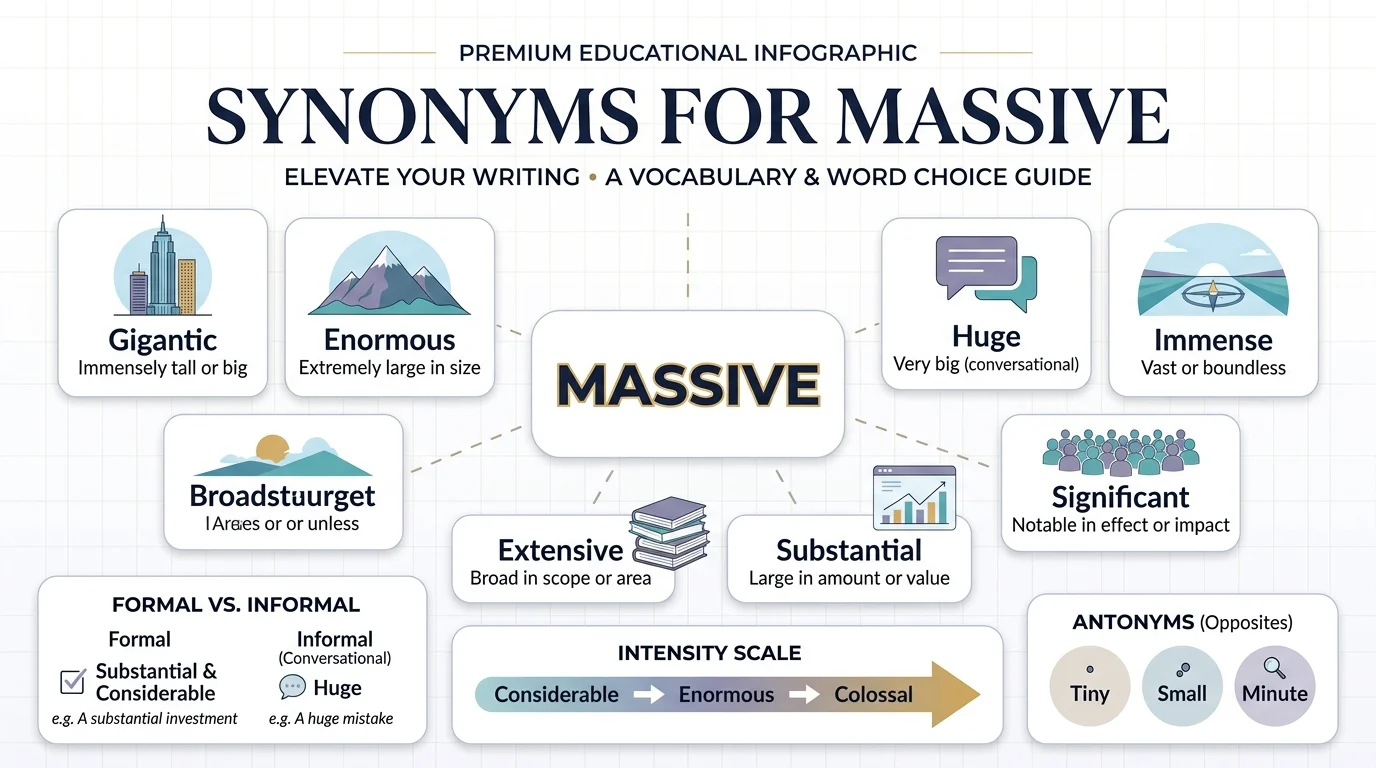
Massive means very large, heavy, or substantial in size, amount, scale, or effect. Common synonyms include huge, enormous, gigantic, immense, colossal, extensive, substantial, and considerable. The best choice depends on whether you are describing physical size, business growth, a serious problem, or a powerful impact.
Meaning, Tone and Context
What Does Massive Mean?
Massive describes something that is exceptionally large, extensive, heavy, or significant in scale. It can refer to physical objects, large quantities, major changes, or events with a strong impact.
For example, a massive building has an impressive size, while a massive investment involves a very large amount of money.
Part of Speech
Massive is an adjective. It describes a noun by showing that something has great size, scale, weight, or extent.
Examples:
- The company built a massive warehouse.
- The campaign attracted massive public interest.
- We faced a massive increase in demand.
Tone and Formality
Massive is generally neutral. It can sound positive when describing success, impressive when describing physical size, or negative when describing debt, damage, or problems.
It works in everyday conversations, news reports, business communication, and many forms of creative writing. In academic or professional writing, words such as substantial, extensive, and considerable may communicate the intended meaning more precisely.
Common Uses of Massive
Massive commonly describes:
- Physical objects, such as buildings, rocks, and machines.
- Quantities, such as massive amounts of data or money.
- Events, such as massive public gatherings.
- Problems, such as massive delays or losses.
- Achievements, such as massive improvements in performance.
- Effects, such as a massive change in public opinion.
Related Word Forms
| Word | Part of Speech | Meaning |
|---|---|---|
| Massive | Adjective | Very large or substantial |
| Massively | Adverb | To a very large degree or extent |
| Massiveness | Noun | The quality of being massive |
| Mass | Noun | A large body, amount, or quantity |
When and How to Use Massive
Use massive when ordinary words such as big or large do not fully express the scale of something. It often suggests a striking size, amount, or effect.
1. Professional Context
The company made a massive investment in new technology.
Here, massive emphasizes the scale of the investment. Substantial may be a better choice when a more measured business tone is needed.
2. Academic Context
The researchers collected a massive amount of data during the study.
The word emphasizes the large quantity of information. Extensive may be more precise when describing the scope of the research.
3. Personal Context
Moving to another country was a massive change for our family.
Massive communicates how significant the change felt. Major is a more restrained alternative.
4. Social Media Context
We received massive support for our latest project.
Massive adds enthusiasm and emphasizes the amount of support. Tremendous is another natural option when expressing appreciation.
Another Word for Massive
The best single replacement for massive is usually huge or enormous when describing physical size. For formal writing, substantial or extensive may be more suitable. For emotional or creative writing, colossal, immense, or tremendous can add stronger emphasis.
Choose the replacement according to what you want to describe.
| Situation | Best Alternative | Example |
|---|---|---|
| Professional writing | Substantial | The team achieved substantial growth. |
| Academic writing | Extensive | The study involved extensive testing. |
| Casual conversation | Huge | That house is huge. |
| Emotional writing | Immense | She felt immense relief. |
| Creative writing | Colossal | A colossal statue stood at the entrance. |
| Resume or workplace use | Significant | I contributed to significant cost savings. |
| Social media captions | Enormous | An enormous thank you to everyone who helped. |
| Stronger meaning | Gargantuan | A gargantuan structure dominated the skyline. |
| Softer meaning | Considerable | We made considerable progress. |
Which Replacement Is Best?
Use huge for simple, everyday descriptions. Choose enormous or gigantic when you want to emphasize physical size. Use substantial for measurable amounts or business results, extensive for broad coverage, and significant for importance or impact.
Remember that these words are related, but they are not interchangeable in every sentence.
When Not to Use Massive
Massive is useful, but it can sound vague when readers need specific information. A more precise synonym often makes a sentence clearer.
1. When You Need an Exact Amount
Vague: The company spent a massive amount on equipment.
Clearer: The company spent $2 million on equipment.
Use a precise figure when reliable data is available.
2. When You Mean Importance Rather Than Size
Vague: She played a massive role in the project.
Better: She played a crucial role in the project.
Crucial emphasizes how necessary her contribution was, rather than how large it was.
3. When You Need a Formal Tone
Casual: We saw massive growth last year.
More formal: We recorded substantial growth last year.
Substantial often fits business reports and professional documents better.
4. When the Description Sounds Overstated
Overstated: I have a massive concern about a small scheduling change.
More natural: I have a minor concern about the scheduling change.
Match the intensity of the word to the real situation.
5. When You Need to Describe Scope
General: The team completed massive research.
More precise: The team conducted extensive research.
Extensive describes broad or wide ranging coverage more naturally.
Words Commonly Confused With Massive
Massive is related to several words that describe size, amount, or importance. Their meanings overlap, but each has a slightly different focus.
| Word | Main Difference | Best Used For |
|---|---|---|
| Huge | Very large in everyday language | Casual descriptions |
| Enormous | Extremely large in size or amount | Strong emphasis |
| Immense | Extremely great in size, extent, or degree | Scale, distance, feelings |
| Substantial | Large enough to matter | Amounts, resources, progress |
| Extensive | Covering a broad area or range | Research, damage, work |
| Significant | Important or meaningful, not necessarily large | Results, changes, effects |
For example, a huge room is large, extensive research covers a wide range, and a significant discovery matters because of its importance.
Best Synonym by Context for Massive
The most effective synonym depends on the situation, the intended meaning, and the level of emphasis.
| Context | Best Synonym | Why It Works | Example |
|---|---|---|---|
| Formal writing | Substantial | Sounds measured and professional | The project required substantial funding. |
| Academic writing | Extensive | Highlights broad coverage | The team conducted extensive research. |
| Business communication | Significant | Emphasizes an important result | Sales showed significant improvement. |
| Resume | Considerable | Communicates meaningful contribution | Managed considerable project resources. |
| Casual conversation | Huge | Simple and natural | That dog is huge. |
| Creative writing | Colossal | Creates a vivid image | A colossal tower rose above the city. |
| Emotional writing | Immense | Expresses a strong feeling | They felt immense gratitude. |
| Strong intensity | Gargantuan | Suggests extraordinary size | A gargantuan wave struck the shore. |
| Moderate tone | Considerable | Avoids excessive emphasis | We made considerable progress. |
| Social media captions | Enormous | Adds energy and emphasis | An enormous thank you to our supporters. |
| Physical objects | Gigantic | Highlights impressive dimensions | A gigantic boulder blocked the road. |
| Large quantities | Vast | Emphasizes a great amount | The archive contains vast amounts of data. |
A Note on American and British English
Massive is widely understood in both American and British English. Huge, enormous, substantial, and considerable are also common in both varieties.
The main differences usually come from tone and context rather than spelling or regional meaning. Choose the word that best fits your audience and sentence.
Which Synonym Should You Choose?
Use these practical guidelines to select the most accurate alternative.
- Consider the meaning. If you describe physical size, choose huge, enormous, or gigantic. If you describe importance, consider significant or crucial.
- Match the level of formality. Huge works well in conversation. Substantial and considerable often sound more appropriate in reports, proposals, and formal emails.
- Check the intensity. Enormous and immense express strong emphasis. Considerable is more restrained, while colossal and gargantuan can sound dramatic.
- Think about professional value. On a resume, describe measurable achievements using significant, substantial, or considerable, supported by specific results whenever possible.
- Read the complete sentence. Extensive works naturally with research, while substantial often fits funding, evidence, progress, or growth.
The best synonym is not always the strongest one. It is the word that expresses your meaning clearly without exaggeration.
Real Life Examples of Massive in Sentences
These examples show how massive and its alternatives work in common situations.
School
The students completed an extensive research project on climate change.
Extensive describes the broad scope of the project.
Workplace
Our department achieved substantial savings by improving its workflow.
Substantial emphasizes the meaningful amount of money saved.
Writing
The author describes an enormous mountain that rises above the village.
Enormous helps readers imagine the mountain’s impressive size.
Conversation
That was a huge mistake, but we learned from it.
Huge sounds natural in everyday conversation.
Social Media
An enormous thank you to everyone who supported our launch.
Enormous adds warmth and enthusiasm to the message.
Resume
Contributed to significant improvements in customer satisfaction.
Significant communicates an important result. Add a reliable percentage or other measurable outcome when available.
We appreciate your considerable effort in completing this project on time.
Considerable expresses appreciation in a professional and respectful way.
Storytelling
A colossal gate stood before the ancient castle.
Colossal creates a strong visual image and adds drama to the story.
18 Synonyms for Massive
The following 18 words are useful alternatives to massive. Some focus on physical size, while others describe quantity, scope, importance, or intensity.
| Synonym | Simple Meaning | Best Used For | Example Sentence |
|---|---|---|---|
| Huge | Very large | Everyday conversation | They bought a huge television. |
| Enormous | Extremely large | Objects and quantities | An enormous crowd gathered outside. |
| Gigantic | Extremely large in physical size | Buildings, animals, objects | A gigantic ship entered the harbor. |
| Immense | Extremely great in size or degree | Space, feelings, scale | She felt immense pride in her work. |
| Colossal | Exceptionally large or impressive | Dramatic descriptions | The team faced a colossal challenge. |
| Gargantuan | Unusually or astonishingly large | Creative writing and vivid descriptions | A gargantuan statue stood in the square. |
| Mammoth | Very large or demanding | Projects, tasks, structures | The company began a mammoth renovation project. |
| Tremendous | Very great in amount or degree | Success, effort, support | We received tremendous support from our customers. |
| Vast | Extremely extensive or wide ranging | Land, knowledge, quantities | The library holds a vast collection of books. |
| Substantial | Large enough to be important | Funding, growth, evidence | The business made a substantial investment. |
| Considerable | Fairly large or important | Effort, progress, amounts | She made considerable progress this semester. |
| Extensive | Covering a wide area or range | Research, damage, experience | The engineers carried out extensive testing. |
| Significant | Important or meaningful | Changes, results, improvements | The new process produced significant savings. |
| Major | Important or large in scale | Events, problems, changes | The city announced a major construction project. |
| Monumental | Exceptionally important or impressive | Achievements, tasks, events | Finishing the project was a monumental achievement. |
| Astronomical | Extremely high or large, especially in figures | Costs, prices, numbers | The repair costs were astronomical. |
| Sweeping | Broad in scope or effect | Reforms, changes, decisions | The government introduced sweeping reforms. |
| Herculean | Requiring extraordinary effort or strength | Difficult tasks and challenges | Restoring the damaged building required a Herculean effort. |
Important usage note: These words are not exact substitutes in every sentence. Astronomical is especially useful for unusually high figures, sweeping describes broad changes, and Herculean emphasizes effort rather than physical size.
Synonym Groups and Usage Differences
Professional vs. Personal Synonyms
Professional writing usually benefits from clear and measured vocabulary. Substantial, considerable, significant, and extensive work well in business reports, presentations, and workplace emails.
Personal writing can be more expressive. Huge, enormous, immense, and tremendous often sound natural when describing excitement, surprise, pride, or gratitude.
For example, a business report might mention substantial growth, while a personal post might celebrate a huge achievement.
Formal vs. Conversational Synonyms
Use substantial, considerable, extensive, and significant when you want a measured tone. These words fit formal emails, academic papers, proposals, and reports.
In casual conversation, huge, gigantic, and enormous are easy to understand. Colossal and gargantuan can also work, but they may sound exaggerated in ordinary situations.
Academic Synonyms
Academic writing benefits from words that explain the type of scale being discussed.
- Extensive: Use it for research, reviews, investigations, or coverage across a broad area.
- Substantial: Use it for a meaningful amount of evidence, funding, or change.
- Significant: Use it for an important result or, in statistical contexts, a result that meets a defined statistical criterion.
- Considerable: Use it to describe a relatively large amount of effort, variation, or progress.
Avoid using massive repeatedly in research papers when a more specific term communicates the finding more clearly.
Professional and Business Synonyms
For emails, presentations, business reports, and resumes, choose words that communicate scale without exaggeration.
| Purpose | Recommended Word | Example |
|---|---|---|
| Business growth | Substantial | The company recorded substantial growth. |
| Better performance | Significant | The team achieved significant improvements. |
| Broad experience | Extensive | She has extensive experience in sales. |
| Large workload | Considerable | The project required considerable effort. |
| Important change | Major | The company announced a major change. |
On a resume, pair the word with evidence. For example, significant savings becomes more convincing when you provide a verified amount or percentage.
Creative or Literary Synonyms
Creative writing often benefits from words that help readers picture a scene or feel its scale.
Colossal and gargantuan make physical objects seem extraordinary. Monumental suggests importance or an impressive achievement. Immense can communicate a powerful feeling, while mammoth can make a project sound demanding.
Choose the word that supports the image or emotion you want to create.
Slang or Modern Synonyms
Huge is common in casual American English and works in many informal settings. Expressions such as extremely big or ridiculously large can add humor or excitement.
These expressions are informal rather than precise synonyms. They may work in social media captions or friendly messages, but they are usually unsuitable for academic papers, formal proposals, and professional reports.
Strongest vs. Weaker Synonyms
The following scale is a general guide to perceived intensity, not a strict ranking. The strength of each word depends on its context.
| Intensity | Word | Example |
|---|---|---|
| Mild | Considerable | We made considerable progress. |
| Moderate | Substantial | The project received substantial funding. |
| Strong | Huge | A huge crowd filled the stadium. |
| Very strong | Enormous | An enormous wave hit the coast. |
| Dramatic | Colossal | A colossal structure dominated the landscape. |
| Highly dramatic | Gargantuan | A gargantuan creature emerged from the forest. |
Use the strongest words when the scale truly deserves that level of emphasis. A dramatic word can distract readers if the situation is ordinary.
Emotional vs. Neutral Synonyms
Some synonyms emphasize measurable size, while others add feeling or judgment.
More neutral choices: Substantial, extensive, considerable, and significant.
More expressive choices: Tremendous, immense, colossal, and gargantuan.
For example, substantial support sounds measured, while tremendous support sounds more enthusiastic. Immense relief communicates a powerful emotion, rather than physical size.
Antonyms of Massive
An antonym describes an opposite meaning. Since massive can refer to physical size, quantity, or scale, the best opposite depends on the sentence.
| Antonym | Meaning | Example Sentence |
|---|---|---|
| Tiny | Extremely small | A tiny bird sat on the branch. |
| Small | Limited in size | They rented a small apartment. |
| Little | Small in size or amount | We had little time to prepare. |
| Miniature | Made or designed on a very small scale | She collected miniature houses. |
| Minute | Extremely small | A minute crack appeared in the glass. |
| Microscopic | Too small to see clearly without magnification | Microscopic organisms live in the water. |
| Compact | Small and efficiently arranged | The compact device fits in a pocket. |
| Slight | Small in amount or degree | We noticed a slight improvement. |
| Limited | Restricted in size, amount, or scope | The team had limited resources. |
| Modest | Moderate or not especially large | The business earned a modest profit. |
| Narrow | Small in width or range | They walked along a narrow path. |
| Minor | Less important or serious | The repair involved a minor issue. |
| Insignificant | Too small or unimportant to matter much | The difference was insignificant. |
| Negligible | So small that it can be ignored in context | The change had a negligible effect. |
| Diminutive | Unusually small | A diminutive plant grew between the rocks. |
Some words are opposites only in certain contexts. For example, narrow is the opposite of massive when describing width, while insignificant contrasts with massive when the intended meaning is importance or impact.
Comparison: Massive vs. Similar Words
Massive vs. Huge
Massive often suggests great size, weight, or scale, while huge is a simpler, more conversational word. Neither is always stronger, although massive can suggest a solid or imposing size.
Huge is more common in everyday conversation. Massive also works in formal and descriptive writing.
Examples:
- Massive: The company operates a massive distribution center.
- Huge: We saw a huge whale during our trip.
Massive vs. Enormous
Both words describe something extremely large. Enormous often emphasizes the degree of size or amount, while massive can suggest physical bulk or overall scale.
Enormous is common in general writing, and both words suit formal and informal contexts.
Examples:
- Massive: The building has a massive stone foundation.
- Enormous: The project required an enormous amount of money.
Massive vs. Immense
Massive often describes something physically large or substantial. Immense can describe physical size, a broad extent, or an intense feeling.
Immense is especially useful in emotional or descriptive writing.
Examples:
- Massive: A massive wall surrounded the property.
- Immense: The family felt immense relief after the emergency ended.
Massive vs. Substantial
Massive often creates an impression of exceptional size or scale. Substantial describes an amount, contribution, or change that is large enough to matter.
Substantial usually sounds more measured in professional writing.
Examples:
- Massive: The company faced massive financial losses.
- Substantial: The company received substantial financial support.
Massive vs. Extensive
Massive emphasizes great size or scale. Extensive emphasizes broad coverage, range, or scope.
Extensive is usually the better choice for research, testing, experience, and investigations.
Examples:
- Massive: The storm caused massive damage.
- Extensive: The engineers conducted extensive safety tests.
Massive vs. Significant
Massive emphasizes size, amount, or scale. Significant emphasizes importance or meaningful impact, even when something is not physically large.
Significant often fits reports, research, and professional communication.
Examples:
- Massive: The factory installed a massive new machine.
- Significant: The new machine delivered significant energy savings.
Common Phrases and Expressions with Massive
1. Massive Amount
Meaning: A very large quantity of something.
Example sentence: The project required a massive amount of planning.
2. Massive Success
Meaning: An achievement that attracts considerable attention or produces excellent results.
Example sentence: The product launch was a massive success.
3. Massive Impact
Meaning: A very strong effect on people, events, or outcomes.
Example sentence: The new policy had a massive impact on local businesses.
4. Massive Crowd
Meaning: A very large group of people gathered in one place.
Example sentence: A massive crowd attended the championship celebration.
5. Massive Improvement
Meaning: A very large or noticeable positive change.
Example sentence: Daily practice led to a massive improvement in her writing.
6. Massive Problem
Meaning: A problem that is extremely serious or difficult to manage.
Example sentence: The unexpected system failure created a massive problem for the team.
7. Massive Investment
Meaning: A very large commitment of money or other resources.
Example sentence: The company made a massive investment in renewable energy.
8. Massive Change
Meaning: A major shift in conditions, behavior, or circumstances.
Example sentence: Working remotely brought a massive change to their daily routine.
Common Mistakes to Avoid
1. Using Massive When a More Precise Word Is Better
Massive does not explain exactly what makes something large or important.
Instead of writing massive research, write extensive research. Instead of massive importance, consider great importance or significant impact.
2. Confusing Size With Importance
Massive usually emphasizes size or scale, while significant emphasizes importance.
A small discovery can be significant without being massive.
3. Using Casual Words in Formal Writing
Huge is perfectly acceptable in many situations, but substantial or considerable may suit a formal business report better.
Choose vocabulary that matches the document and audience.
4. Exaggerating a Minor Situation
Calling a small delay massive may make your writing sound dramatic.
Use minor, slight, or modest when the situation involves a limited problem or change.
5. Repeating Massive Too Often
Repeatedly using massive can make an article or essay feel monotonous.
Vary your vocabulary with accurate alternatives such as enormous, substantial, extensive, and immense.
6. Choosing the Wrong Emotional Tone
Gargantuan can sound dramatic or playful, while substantial sounds measured and factual.
Use expressive language for storytelling and casual posts. Prefer precise wording for professional communication.
FAQs
1. What Is the Best Synonym for Massive?
Huge is an excellent everyday synonym for massive. Enormous and gigantic emphasize physical size, while substantial and extensive work better for many professional or academic situations.
2. What Is a Formal Synonym for Massive?
Substantial is a strong formal alternative when describing amounts, funding, or growth. Extensive is more suitable for broad research, investigations, experience, or coverage.
3. What Is an Informal Synonym for Massive?
Huge is a natural informal synonym for massive in American English. Enormous also works in conversation when you want to emphasize an impressive size or quantity.
4. What Is Another Word for Massive in Professional Writing?
Consider substantial, significant, extensive, or considerable. Choose substantial for amounts, significant for important results, and extensive for broad work or experience.
5. What Is the Difference Between Massive and Enormous?
Both words describe something extremely large. Massive can suggest bulk or overall scale, while enormous emphasizes an exceptionally great size or amount.
6. What Is the Opposite of Massive?
Tiny, small, and minute are common opposites when discussing physical size. Minor and insignificant can contrast with massive when the intended meaning concerns importance or impact.
Conclusion
Massive means very large, substantial, or extensive in size, quantity, or scale. Useful synonyms include huge, enormous, gigantic, immense, substantial, extensive, and significant, but each communicates a slightly different idea.
For everyday conversation, huge is a simple and natural choice. In professional writing, substantial and considerable often sound more measured. In academic work, extensive can describe broad research, while significant highlights an important finding.
Discover More Post:
- 50+ Synonyms for Dedication | Meanings, Examples, and Best …
- 50+ Synonyms for For | Expert Word Choices to Elevate Your …
- 50+ Synonyms for Vivid | Meanings, Examples, and Best …