Have you ever used the word punishment several times in an essay, email, story, or everyday conversation? Finding a better word can make your writing clearer, more natural, and more interesting. The right alternative depends on what happened and why someone faces a consequence.
This guide explores synonyms for punishment, their meanings, and how to use them in different situations. You will learn which words work best in academic writing, professional communication, personal conversations, and creative stories. You will also discover the differences between penalties, discipline, sanctions, and other related terms. By understanding their tone and meaning, you can choose words that express your message accurately without sounding too harsh or too casual.
What Does Punishment Mean?
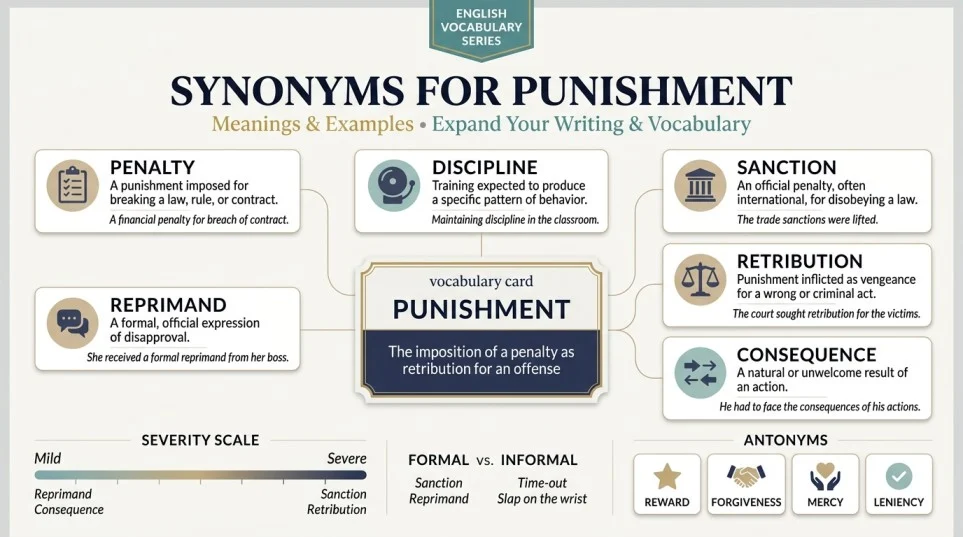
Punishment is a penalty or consequence given to someone for breaking a rule, committing an offense, or doing something wrong. Common synonyms include penalty, discipline, sanction, reprimand, and retribution, depending on the situation and severity.
Meaning, Tone and Context
What Does Punishment Mean?
Punishment is a consequence imposed on a person because of an action considered wrong, harmful, or against established rules. It may aim to discourage future misconduct, enforce rules, or hold someone accountable.
For example, a student might receive detention for breaking school rules. A driver might pay a fine for speeding. A court might impose a sentence after a criminal conviction.
Part of Speech
Punishment is a noun. It refers to the consequence itself or the act of making someone face a consequence for their behavior.
Examples:
- The punishment for cheating was suspension.
- The coach explained the consequences of breaking team rules.
- The court ordered a financial penalty for the offense.
Tone and Formality
The word punishment usually has a serious or negative tone because it involves an undesirable consequence. However, its emotional effect depends on the situation.
In education, it may describe a disciplinary measure. Law, it can refer to a penalty imposed for an offense. In personal writing, it may suggest anger, blame, or a desire for justice.
Punishment is suitable for both everyday and formal communication. More specific terms, such as fine, suspension, reprimand, or sentence, can make the intended meaning clearer.
Common Word Forms
| Word Form | Meaning | Example |
|---|---|---|
| Punish | To impose a consequence | The school may punish repeated misconduct. |
| Punishment | A consequence for wrongdoing | The punishment was fair. |
| Punished | Subjected to a consequence | The player was punished for breaking the rules. |
| Punishing | Extremely demanding or exhausting, depending on context | It was a punishing work schedule. |
| Punitive | Intended to punish | The company adopted a punitive policy. |
| Punishable | Subject to punishment | The offense is punishable under the law. |
The word punishing can also describe a difficult experience, such as a punishing workout. In that use, it does not necessarily mean an official penalty.
When and How to Use Punishment
Use punishment when you need to describe a consequence for wrongdoing or rule breaking. Choose a more precise word when the type of consequence is known.
Academic context: The study examined whether punishment changes student behavior.
Professional context: The employee received a formal reprimand for repeatedly ignoring safety procedures.
Personal context: My parents explained the punishment before taking away my gaming privileges.
Creative context: The king demanded retribution for the betrayal of his kingdom.
Each example uses a different term because the setting and purpose are different. A reprimand is a formal expression of disapproval, while retribution suggests a response to wrongdoing intended to deliver justice or repayment.
Another Word for Punishment
The best single replacement for punishment is often penalty. However, discipline, sanction, reprimand, and retribution may be more accurate in specific contexts.
| Situation | Best Alternative | Example |
|---|---|---|
| Professional writing | Disciplinary action | The company took disciplinary action after the investigation. |
| Academic writing | Consequence | The research explored the consequences of misconduct. |
| Casual conversation | Trouble | He got in trouble for missing curfew. |
| Emotional writing | Retribution | She believed the betrayal deserved retribution. |
| Creative writing | Vengeance | The character sought vengeance against the traitor. |
| Resume or workplace policy | Corrective action | Management introduced corrective action to address repeated errors. |
| Social media captions | Consequence | Every choice has a consequence. |
| A serious legal offense | Sentence | The judge imposed a lengthy sentence. |
| A financial violation | Fine | The driver received a fine for speeding. |
| A mild response to misconduct | Reprimand | The manager issued a reprimand after the incident. |
Remember that these words are not always interchangeable. A fine is a specific financial penalty, while vengeance describes a desire to retaliate. Corrective action may focus on improving behavior rather than making someone suffer.
When Not to Use Punishment
Punishment is not always the most accurate word. In some situations, it may sound too harsh, too broad, or too emotional.
When the consequence is financial: Use fine instead of punishment when referring to money paid for an offense.
Example: The driver received a fine for illegal parking.
When the goal is improvement: Use correction, guidance, or corrective action when the focus is on helping someone change their behavior.
Example: The supervisor offered guidance instead of immediately issuing a formal warning.
When the issue is legal: Use sentence, sanction, or penalty when the exact legal consequence matters.
Example: The court imposed a sentence after considering the evidence.
When someone simply faces a difficult experience: Avoid punishment if no one is imposing a consequence.
Example: The exhausting hike was challenging, not a punishment.
When the situation is informal: Trouble may sound more natural in conversation.
Example: She got in trouble for arriving home late.
Words Commonly Confused With Punishment
Several words are related to punishment but carry different meanings.
| Word | Meaning | Main Difference |
|---|---|---|
| Discipline | Training or control of behavior | May teach better behavior rather than simply impose a penalty. |
| Penalty | A consequence for breaking a rule or law | Often refers to a specific, defined consequence. |
| Consequence | The result of an action | Can be positive, negative, intended, or unintended. |
| Retribution | A response intended to repay wrongdoing | Often carries a stronger sense of justice or revenge. |
| Revenge | Retaliation driven by a desire to get even | Usually more personal and emotional. |
| Sanction | An official penalty or restriction | Common in legal, political, institutional, and professional settings. |
The key difference is purpose. Discipline can guide behavior, a penalty enforces a rule, and a consequence describes a result. Retribution and revenge involve responding to a wrong, but revenge is generally more personal and emotionally driven.
Best Synonym by Context for Punishment
The best synonym depends on the setting, the reason for the consequence, and how formal the writing needs to be.
| Context | Best Synonym | Why It Works | Example |
|---|---|---|---|
| Formal writing | Penalty | Clear and broadly applicable | The penalty was announced after the hearing. |
| Academic writing | Consequence | Supports objective discussion | The consequences of cheating can affect academic progress. |
| Professional or business use | Disciplinary action | Fits workplace policies | The company took disciplinary action. |
| Resume or workplace records | Corrective action | Emphasizes improvement | The team introduced corrective action to prevent future errors. |
| Casual conversation | Trouble | Sounds natural and familiar | He got in trouble for lying. |
| Creative writing | Retribution | Adds dramatic weight | The ruler demanded retribution. |
| Emotional writing | Revenge | Expresses personal retaliation | He wanted revenge after the betrayal. |
| Strong intensity | Severe penalty | Highlights the seriousness of a consequence | The violation resulted in a severe penalty. |
| Mild or moderate response | Reprimand | Describes a formal expression of disapproval | The student received a reprimand. |
| Social media captions | Consequence | Short and easy to understand | Actions have consequences. |
| Legal context in the United States | Sentence | Refers to a court imposed criminal penalty | The judge announced the sentence. |
| School setting | Detention | Names a specific school consequence | The student received detention for disrupting class. |
| Sports | Penalty | Identifies a rule violation | The referee called a penalty. |
| Financial misconduct | Fine | Specifies a monetary consequence | The business paid a fine. |
| International relations | Sanction | Describes an official restriction or penalty | The government introduced economic sanctions. |
Which Synonym Is Best?
For most general writing, penalty is a reliable alternative to punishment. For academic discussions, consequence is often more neutral. Workplace policies, disciplinary action is more precise. For legal writing, use the exact term for the outcome, such as fine, sentence, or sanction.
Which Synonym Should You Choose?
Use these practical guidelines to select the right word.
- Consider the meaning. If the consequence involves money, choose fine. If it involves a court’s decision, sentence may be appropriate.
- Match the level of formality. Use penalty or sanction in formal documents. Use trouble in everyday conversation.
- Check the emotional intensity. Retribution and revenge sound stronger than reprimand or correction. Do not use an intense word for a minor issue.
- Think about the purpose. Choose discipline when behavior management or learning is important. Choose corrective action when the goal is to improve a process or behavior.
- Look at the full sentence. A word may be correct in meaning but awkward in context. Read the sentence aloud to check whether it sounds natural.
- Avoid unnecessary repetition. If punishment appears several times in one paragraph, replace some instances with accurate alternatives. Do not change every occurrence if the original word remains the clearest choice.
Real Life Examples of Punishment in Sentences
These examples show how punishment and its alternatives work in everyday situations.
School: The school assigned detention after the student repeatedly disrupted class.
Workplace: The employee received a formal reprimand for ignoring company procedures.
Writing: The essay explains why harsh penalties may not always improve behavior.
Conversation: My brother got in trouble for borrowing my laptop without asking.
Social media: Every decision comes with consequences, so choose wisely.
Resume or professional records: I helped develop corrective action procedures to reduce repeated workplace errors.
Email: Please review the disciplinary policy before deciding what action is appropriate.
Storytelling: The king demanded retribution after discovering the betrayal.
Legal setting: The judge imposed a sentence that reflected the seriousness of the offense.
Sports: The team lost possession after the referee called a penalty.
These examples demonstrate why context matters. Replacing punishment with a precise term helps readers understand the exact situation without needing extra explanation.
18 Synonyms for Punishment
The following words offer different shades of meaning. Some describe a general penalty, while others identify a particular action or express a stronger emotional response.
| Synonym | Simple Meaning | Best Used For | Example Sentence |
|---|---|---|---|
| 1. Penalty | A consequence for breaking a rule | General and formal writing | The penalty for late payment was clearly stated. |
| 2. Discipline | Measures used to correct or control behavior | Schools, parenting, and workplaces | Consistent discipline helped the team follow safety rules. |
| 3. Sanction | An official penalty or restriction | Legal and institutional writing | The organization imposed sanctions for serious misconduct. |
| 4. Reprimand | A formal expression of disapproval | Workplace and school settings | The manager gave him a reprimand for missing the deadline. |
| 5. Reproof | An expression of criticism or disapproval | Formal or literary writing | Her careless remark earned a quiet reproof. |
| 6. Censure | Strong formal disapproval | Official statements and public conduct | The board issued a censure after reviewing the complaint. |
| 7. Retribution | A response intended to repay wrongdoing | Serious or dramatic writing | The hero sought retribution for the injustice. |
| 8. Revenge | Retaliation to get even with someone | Emotional and personal writing | She planned revenge after the betrayal. |
| 9. Fine | Money paid as a penalty | Traffic and financial violations | The driver paid a fine for speeding. |
| 10. Sentence | A court imposed criminal penalty | Legal writing | The court announced its sentence on Friday. |
| 11. Forfeiture | Loss of a right, property, or privilege | Legal and contractual contexts | The violation led to forfeiture of the deposit. |
| 12. Detention | Being kept in a place as a consequence | School settings | The student served detention after class. |
| 13. Suspension | Temporary removal from a role or activity | Schools and workplaces | The player received a suspension for misconduct. |
| 14. Expulsion | Removal from an institution | Serious school or organizational violations | Repeated violations led to his expulsion. |
| 15. Correction | An action intended to fix a mistake | Education and behavior improvement | The teacher focused on correction rather than humiliation. |
| 16. Admonition | A warning or serious expression of disapproval | Formal and literary writing | The director offered an admonition about safety. |
| 17. Consequence | A result of an action | General and academic writing | She accepted the consequences of her decision. |
| 18. Penitence | Sincere regret for wrongdoing | Religious, moral, or literary contexts | His penitence showed that he understood the harm he had caused. |
Some terms are related alternatives rather than exact synonyms. For example, penitence describes regret, not a penalty imposed by another person. Correction focuses on fixing behavior, while a sentence refers to a legal outcome. Choose the term that matches the meaning you intend.
Synonym Groups and Usage Differences
Professional vs. Personal Synonyms
Professional writing benefits from clear, neutral language. Words such as penalty, sanction, reprimand, and disciplinary action describe formal responses to misconduct.
Personal writing may use trouble, revenge, or retribution when the emotional meaning matters. For example, a parent might say a child got in trouble, while a fictional character might seek revenge after a betrayal.
Formal vs. Conversational Synonyms
Formal words work well in reports, essays, policies, and official emails. Penalty, sanction, censure, and reprimand are useful choices when the situation requires a serious tone.
Conversational alternatives include trouble and consequence. For example, saying he got in trouble sounds more natural in everyday speech than saying he received a disciplinary sanction.
Academic Synonyms
In academic writing, choose words that explain the issue without adding unnecessary emotion.
Useful options include:
- Consequence, for discussing the results of behavior.
- Penalty, for describing a defined response to rule breaking.
- Sanction, for an official measure imposed by an institution.
- Disciplinary measure, for an action intended to address misconduct.
- Deterrent, for something intended to discourage unwanted behavior.
Example: The research examined whether disciplinary measures reduced repeated misconduct among students.
Use deterrent carefully. It describes something intended to prevent behavior, not necessarily the punishment itself.
Professional and Business Synonyms
Workplace writing should identify the action taken and, where relevant, its purpose.
Use reprimand for a formal expression of disapproval, disciplinary action for an official workplace response, and corrective action for steps taken to fix a problem.
Example: The supervisor documented the incident and recommended corrective action to prevent similar mistakes.
Avoid using revenge or vengeance in professional reports unless you are discussing a specific personal motive.
Creative or Literary Synonyms
Creative writing often needs words that convey emotion, conflict, or moral judgment.
Retribution can suggest a response to wrongdoing. Vengeance expresses a desire to get even. Censure suggests strong disapproval, while penance describes an act intended to show remorse or make amends.
Example: The fallen prince accepted years of penance for the harm he had caused.
These terms can make a story more vivid, but they should match the character, setting, and intended meaning.
Slang or Modern Synonyms
There is no single slang word that accurately replaces punishment in every situation. Informal phrases such as getting in trouble or paying the price may work in casual conversations and social media posts.
Example: He ignored the rules and ended up paying the price.
The phrase paying the price can refer to a consequence, but it does not always mean an official punishment. Avoid slang in academic essays, legal documents, and formal workplace reports.
Strongest vs. Weaker Synonyms
The following scale provides a general guide to intensity. The exact strength depends on the situation.
| Intensity | Word or Phrase | Typical Meaning |
|---|---|---|
| Mild | Reminder | A prompt to follow a rule |
| Mild | Correction | An attempt to fix behavior or an error |
| Moderate | Reprimand | Formal disapproval |
| Moderate | Fine | A financial penalty |
| Strong | Suspension | Temporary removal from a role or activity |
| Strong | Expulsion | Removal from an institution |
| Very strong | Severe penalty | A serious consequence |
| Emotionally intense | Retribution | A response intended to repay wrongdoing |
| Emotionally intense | Vengeance | Retaliation driven by a desire to get even |
This scale combines different kinds of consequences, so it is not a universal ranking. For example, a fine can be more serious than a suspension depending on the circumstances.
Emotional vs. Neutral Synonyms
Neutral words describe what happened without strongly expressing an opinion. Penalty, consequence, fine, and suspension are often suitable for factual explanations.
Emotionally charged words communicate stronger feelings. Revenge and vengeance suggest personal retaliation, while retribution may suggest a demand for justice. Penance emphasizes remorse and an effort to make amends.
Compare these examples:
Neutral: The court imposed a penalty for the offense.
Emotional: The victim’s family demanded retribution for the harm caused.
The second sentence carries more emotional weight. Choose it only when that feeling is part of the intended message.
Antonyms of Punishment
Punishment does not have 15 exact opposites. However, the following words describe contrasting ideas, such as reward, forgiveness, freedom, and the absence of penalties.
| Antonym | Meaning | Example Sentence |
|---|---|---|
| 1. Reward | Something given for good work or behavior | The student received a reward for helping classmates. |
| 2. Praise | Expression of approval | The teacher offered praise for the student’s honesty. |
| 3. Commendation | Formal recognition of good conduct | Her commendation recognized years of dedicated service. |
| 4. Appreciation | Recognition of someone’s value or effort | The manager showed appreciation for the team’s hard work. |
| 5. Approval | Acceptance or favorable judgment | The proposal received approval from the committee. |
| 6. Forgiveness | Choosing not to hold an offense against someone | He asked for forgiveness after admitting his mistake. |
| 7. Pardon | Official or personal release from a penalty or blame | The governor granted a pardon under the applicable law. |
| 8. Absolution | Release from blame or responsibility, often in a moral or religious context | She sought absolution for her past actions. |
| 9. Clemency | Mercy that reduces the severity of a penalty | The prisoner requested clemency. |
| 10. Mercy | Compassion that limits harsh treatment | The judge showed mercy when considering the circumstances. |
| 11. Leniency | A less severe response than might otherwise be expected | The school showed leniency toward the first time offender. |
| 12. Rewarding recognition | Positive acknowledgment of achievement | The organization offered rewarding recognition for excellent work. |
| 13. Exoneration | Official clearance from blame or wrongdoing | New evidence led to his exoneration. |
| 14. Acquittal | A legal finding that a defendant is not guilty | The jury returned a verdict of acquittal. |
| 15. Immunity | Protection from a particular legal obligation or consequence | The agreement provided immunity under specified conditions. |
These words are not interchangeable. Reward and praise are positive responses, while acquittal and exoneration concern findings of innocence or the removal of blame. Pardon and clemency concern relief from legal consequences in particular circumstances.
Comparison: Punishment vs. Similar Words
Punishment vs. Penalty
Main difference: Punishment is a broad term for a consequence imposed for wrongdoing. A penalty is often a specific consequence established by a rule or law.
Which is stronger? Neither is automatically stronger. Severity depends on the penalty or punishment involved.
Which is more formal? Both can be formal, but penalty is especially common in rules and regulations.
Examples:
Punishment: The school explained the punishment for cheating.
Penalty: The rules specify a penalty for cheating.
Punishment vs. Discipline
Main difference: Punishment focuses on a consequence, while discipline can involve teaching, guidance, structure, and correction.
Which is stronger? Punishment often sounds harsher, although either can describe a serious response.
Which is more formal? Both work in formal settings. Discipline is especially common in education and behavior management.
Examples:
Punishment: The student received punishment for disrupting class.
Discipline: The school used consistent discipline to encourage better behavior.
Punishment vs. Consequence
Main difference: Punishment is generally imposed in response to wrongdoing. A consequence is any result of an action, whether positive or negative.
Which is stronger? Punishment usually sounds more negative.
Which is more formal? Both are suitable for formal writing. Consequence is often more neutral.
Examples:
Punishment: The employee faced punishment for falsifying records.
Consequence: The employee faced consequences after the investigation.
Punishment vs. Retribution
Main difference: Punishment is a broad term for an imposed penalty. Retribution suggests a response intended to repay wrongdoing or deliver what is viewed as deserved justice.
Which is stronger? Retribution often sounds more emotionally intense.
Which is more formal? Both can appear in formal writing, but retribution is more specialized and often more dramatic.
Examples:
Punishment: The court imposed punishment for the crime.
Retribution: The character sought retribution for the injustice.
Punishment vs. Revenge
Main difference: Punishment can be an official or rule based response. Revenge is usually a personal act intended to get even with someone.
Which is stronger? Revenge often carries a stronger emotional meaning.
Which is more formal? Punishment is more suitable for policies and factual reports. Revenge is common in personal and creative writing.
Examples:
Punishment: The organization imposed punishment for the violation.
Revenge: He planned revenge against the person who betrayed him.
Punishment vs. Sanction
Main difference: Punishment is a general term. A sanction is an official penalty, restriction, or measure imposed by an authority or institution.
Which is stronger? Neither word is inherently stronger. A sanction can range from a formal warning to a major restriction.
Which is more formal? Sanction is especially useful in legal, political, institutional, and business writing.
Examples:
Punishment: The employee received punishment for violating the policy.
Sanction: The professional association imposed a sanction for misconduct.
Common Phrases and Expressions with Punishment
1. Deserve punishment
Meaning: To be considered worthy of a penalty because of wrongdoing.
Example sentence: The committee decided that repeated violations deserved punishment.
2. Face punishment
Meaning: To be subjected to a penalty or disciplinary response.
Example sentence: Anyone who breaks the safety rules may face punishment.
3. Punishment for a crime
Meaning: A penalty imposed for criminal conduct.
Example sentence: The law sets out the possible punishment for the crime.
4. Strict punishment
Meaning: A severe or firm response to wrongdoing.
Example sentence: The school introduced strict punishment for repeated bullying.
5. Fair punishment
Meaning: A consequence considered reasonable in relation to the offense.
Example sentence: The manager wanted to ensure fair punishment for the policy violation.
6. Fear of punishment
Meaning: Concern about facing a negative consequence.
Example sentence: Some students follow the rules because they fear punishment.
7. Punishment does not fit the crime
Meaning: A consequence is not proportionate to the offense.
Example sentence: Taking away every privilege for a minor mistake may make the punishment seem disproportionate to the offense.
8. Corporal punishment
Meaning: Physical punishment intended to cause pain as a response to misconduct.
Example sentence: The article examines the debate surrounding corporal punishment in schools.
This expression is often used in discussions of education, parenting, law, and human rights.
Common Mistakes to Avoid
1. Using Punishment When a Specific Word Is Better
Punishment is broad. If the consequence is a financial charge, use fine. If a student must stay after school, use detention.
Less precise: The driver received punishment.
More precise: The driver received a fine for speeding.
2. Confusing Punishment With Consequence
A consequence is not always a penalty. Missing a bus because you left home late is a consequence, but it is not necessarily punishment.
Use punishment when a penalty is imposed or intended. Use consequence when describing the result of an action more generally.
3. Using Casual Language in Formal Writing
Phrases such as got in trouble and paid the price can sound natural in conversation, but they may be too informal for official reports.
Instead, use disciplinary action, penalty, or sanction when those terms accurately describe the situation.
4. Choosing an Overly Dramatic Synonym
Revenge, vengeance, and retribution can sound excessive when describing a minor mistake.
For example, a student who forgets homework may receive a reprimand. Calling the response vengeance would usually exaggerate the situation.
5. Repeating Punishment Too Often
Repeatedly using the same noun can make a paragraph feel dull. Replace it with accurate alternatives such as penalty, consequence, or disciplinary measure where appropriate.
Do not force a synonym into every sentence. Clear meaning matters more than variety.
6. Treating Related Words as Exact Synonyms
Discipline, correction, and penitence have distinct meanings. Discipline can guide behavior, correction addresses an error, and penitence expresses remorse.
Choose the word that fits the action, not simply one that looks similar in a thesaurus.
FAQs
1. What Is the Best Synonym for Punishment?
Penalty is often the best general synonym for punishment. Use reprimand for formal disapproval, fine for a financial consequence, and sanction for an official penalty.
2. What Is a Formal Synonym for Punishment?
Penalty, sanction, and disciplinary action are useful formal alternatives. The best choice depends on whether you mean a defined penalty, an official restriction, or a workplace response.
3. What Is an Informal Synonym for Punishment?
Trouble is a common informal alternative in everyday speech. For example, he got in trouble for breaking the rules sounds natural in casual conversation.
4. What Is Another Word for Punishment in Professional Writing?
Disciplinary action is suitable for workplace policies and employee conduct reports. Penalty and sanction also work when the situation involves a defined rule or official restriction.
5. What Is the Difference Between Punishment and Discipline?
Punishment refers to a consequence for wrongdoing. Discipline can also involve teaching, guidance, and consistent behavior management intended to encourage improvement.
6. What Is the Opposite of Punishment?
Reward is a common opposite when contrasting negative consequences with positive responses. Forgiveness, mercy, and leniency can also express relief from harsh treatment, depending on context.
Conclusion
Punishment means a consequence imposed for wrongdoing or breaking a rule. Its best synonyms include penalty, discipline, sanction, reprimand, and retribution, but each word has a different purpose and tone.
Use penalty for a general or defined consequence, discipline when behavior management matters, and sanction for an official response. Choose more emotional words, such as revenge or vengeance, only when personal retaliation is part of the meaning.
A useful vocabulary tip is to identify the exact action before replacing a word. If you know whether the situation involves a fine, warning, suspension, or legal sentence, you can select a clearer and more natural alternative.
Discover More Post:
- 50+ Synonyms for Dedication | Meanings, Examples, and Best …
- 50+ Synonyms for For | Expert Word Choices to Elevate Your …
- 50+ Synonyms for Vivid | Meanings, Examples, and Best …