Have you ever used the word rare several times in an essay, email, social media caption, or work report? Perhaps you want to describe a special talent, an unusual event, a valuable object, or a person with remarkable qualities. Finding the right alternative can make your writing clearer and more interesting.
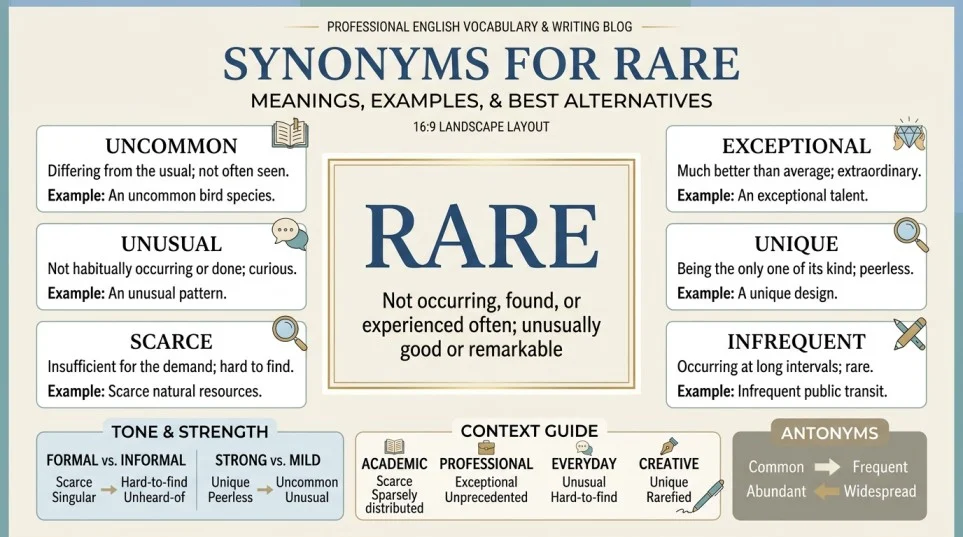
The best synonyms for rare depend on what you want to describe. Words such as uncommon, unusual, scarce, exceptional, and unique have related meanings, but they are not always interchangeable. As a vocabulary guide, this article explains their differences, shows natural examples, and helps you choose words that fit your audience. Whether you are writing an academic paper, updating a resume, or creating a memorable caption, you will find practical alternatives for different situations.
What Does Rare Mean?
Rare means not common, not frequently found, or occurring only occasionally. The best synonyms include uncommon for everyday use, scarce for limited availability, exceptional for outstanding quality, and unique for distinct characteristics. The right choice depends on context.
Meaning, Tone and Context
The word rare describes something that does not happen often, is difficult to find, or exists in limited numbers. It can also describe something remarkable because of its unusual qualities.
Simple Definition
Rare means uncommon, infrequent, or not easily found. For example, a rare book may be difficult to find, while a rare opportunity may not come along often.
Part of Speech
Rare is an adjective. It describes a noun, such as an event, object, skill, opportunity, or occurrence.
Examples:
- She owns a rare painting.
- We had a rare chance to meet the author.
- The scientist discovered a rare mineral.
Tone and Formality
Rare generally has a neutral tone. However, it can sound positive when describing something valuable or impressive, or factual when describing limited supplies.
| Context | Tone | Example |
|---|---|---|
| Everyday conversation | Neutral | That is a rare bird. |
| Business | Factual | The company faces a rare supply shortage. |
| Academic writing | Precise | The study examines a rare genetic variation. |
| Creative writing | Appreciative | He possessed a rare gift for storytelling. |
| Emotional writing | Positive | Her kindness was a rare comfort. |
Common Uses
Rare commonly describes:
- Objects that are difficult to find, such as rare coins.
- Events that happen infrequently, such as a rare opportunity.
- Qualities that few people possess, such as rare patience.
- Natural phenomena, such as rare weather conditions.
- Limited resources, such as rare minerals.
Related Word Forms
| Word | Part of Speech | Meaning |
|---|---|---|
| Rare | Adjective | Uncommon or infrequent |
| Rarely | Adverb | Not often |
| Rarity | Noun | Something uncommon or the quality of being uncommon |
| Rareness | Noun | The state of being rare, less common in everyday writing |
The word rarity is particularly useful when you want to discuss how unusual or valuable something is.
When and How to Use Rare
Use rare when you want to emphasize that something is uncommon, happens infrequently, or is difficult to find. Choose a more precise synonym when the reason for its rarity matters.
Professional example: The company has a rare opportunity to enter a growing market.
Academic example: Researchers identified a rare pattern in the collected data.
Personal example: It is rare for all our friends to be available on the same evening.
Creative example: Her rare courage inspired everyone in the village.
These examples show that rare can describe frequency, availability, and exceptional personal qualities. The surrounding sentence determines its exact meaning.
Another Word for Rare
The best single replacement for rare in many everyday sentences is uncommon. However, other alternatives may communicate your intended meaning more clearly.
| Situation | Best Alternative | Example |
|---|---|---|
| Professional writing | Uncommon | Such delays are uncommon in our department. |
| Academic writing | Infrequent | Infrequent observations limited the study. |
| Casual conversation | Unusual | That is an unusual way to solve the problem. |
| Emotional writing | Exceptional | She showed exceptional kindness. |
| Creative writing | Extraordinary | An extraordinary silence filled the room. |
| Resume or workplace | Exceptional | He demonstrated exceptional problem solving skills. |
| Social media captions | Unique | A unique moment worth remembering. |
| Stronger meaning | Extraordinary | The artist displayed extraordinary talent. |
| Softer meaning | Uncommon | Rain is uncommon here in summer. |
Remember that these alternatives have different meanings. Exceptional usually suggests high quality, scarce suggests limited availability, and infrequent focuses on how seldom something occurs.
When Not to Use Rare
Although rare is useful, it can be too general when a sentence needs a more exact description.
When the quantity is limited: Use scarce instead of rare when supplies are insufficient.
Example: Clean drinking water is scarce in the region.
When something is impressive: Use exceptional instead of rare to emphasize outstanding quality.
Example: She delivered an exceptional presentation.
When something is different: Use unusual when an object or behavior differs from what people normally expect.
Example: He chose an unusual approach to the problem.
When something is one of a kind: Use unique when you mean that something has distinctive characteristics. Use it carefully if you intend to claim that something is truly one of a kind.
Example: Each artist brings a unique perspective to the project.
When frequency matters: Use infrequent when describing something that does not happen often, especially in formal or academic writing.
Example: Infrequent rainfall affects local agriculture.
Words Commonly Confused With Rare
Several words share part of the meaning of rare but emphasize different qualities.
| Word | Main Difference | When to Use It |
|---|---|---|
| Uncommon | Not often encountered | Everyday descriptions |
| Unusual | Different from what is expected | Behaviors, events, or patterns |
| Scarce | Available in limited quantities | Resources, supplies, and opportunities |
| Unique | Distinctive or one of a kind | Individual qualities and designs |
| Exceptional | Far above the usual standard | Talent, performance, and quality |
| Infrequent | Happening only occasionally | Events, visits, and observations |
For example, a rare book is difficult to find, a scarce resource is limited in supply, and an exceptional book may be unusually good. These meanings overlap, but they are not identical.
Best Synonym by Context for Rare
The best synonym depends on whether you are describing frequency, availability, quality, or originality.
| Context | Best Synonym | Why It Works | Example |
|---|---|---|---|
| Formal writing | Uncommon | Clear and professional | Such errors are uncommon. |
| Academic writing | Infrequent | Focuses on frequency | Infrequent observations affected the results. |
| Business communication | Unusual | Highlights an unexpected situation | This is an unusual request. |
| Resume | Exceptional | Highlights strong ability | Delivered exceptional customer service. |
| Casual conversation | Unusual | Sounds natural and familiar | That is an unusual idea. |
| Creative writing | Extraordinary | Adds emphasis and interest | An extraordinary sight appeared at dawn. |
| Emotional writing | Precious | Emphasizes personal value | Their time together was precious. |
| Strong intensity | Extraordinary | Suggests something remarkable | She showed extraordinary courage. |
| Mild or neutral tone | Uncommon | Avoids dramatic language | Snow is uncommon in this area. |
| Social media captions | Unique | Highlights individuality | A unique memory from our trip. |
| Limited supply | Scarce | Emphasizes availability | Fresh supplies became scarce. |
| Scientific research | Infrequent | Describes low occurrence | Infrequent events were recorded. |
| Nature and wildlife | Uncommon | Describes limited sightings | The hikers spotted an uncommon bird. |
| Collectibles | Coveted | Emphasizes desirability | Collectors wanted the coveted coin. |
| Personal qualities | Exceptional | Emphasizes outstanding character or ability | He showed exceptional patience. |
US and UK Usage
Rare, uncommon, scarce, unusual, unique, and exceptional are standard in both American and British English. There is no major regional difference in their core meanings.
Choose the word according to the situation rather than the country. In both varieties of English, scarce generally refers to limited availability, while infrequent describes something that happens occasionally.
Which Synonym Should You Choose?
Use these five questions to find the most accurate alternative.
- What do you mean? If something is not common, choose uncommon. If it is difficult to obtain, choose scarce.
- How formal is the writing? In academic work, infrequent may be more precise. In conversation, unusual often sounds natural.
- How strong is the meaning? Choose exceptional or extraordinary when something deserves special attention.
- What impression do you want to create? Use unique to highlight individuality, precious to express personal value, and coveted to suggest strong demand.
- What does the sentence need? Read the full sentence with the replacement. If the meaning changes, choose a closer alternative.
A useful rule is to describe the reason something is rare. Is it hard to find, seldom seen, unusually good, or different from everything else? Answering that question helps you select the right word.
Real Life Examples of Rare in Sentences
Here are practical examples of rare and its alternatives across everyday and professional situations.
| Situation | Example Sentence |
|---|---|
| School | The student found an uncommon reference in the library. |
| Workplace | Exceptional teamwork helped us finish the project. |
| Writing | The author uses an unusual structure to tell the story. |
| Conversation | It is uncommon to see the streets this quiet. |
| Social media | A unique sunset made the evening unforgettable. |
| Resume | Demonstrated exceptional communication and leadership skills. |
| This is an unusual request, so I would appreciate your guidance. | |
| Storytelling | An extraordinary bird landed beside the old cottage. |
| Research | Infrequent observations made the pattern difficult to confirm. |
| Collecting | The dealer displayed a scarce edition of the book. |
These examples also show why replacing rare with the same synonym every time is not ideal. A precise word makes the sentence more informative.
18 Synonyms for Rare
The following 18 alternatives cover different meanings and situations. Some focus on frequency, others on limited availability, originality, or outstanding quality.
| Synonym | Simple Meaning | Best Used For | Example Sentence |
|---|---|---|---|
| Uncommon | Not often found | Everyday writing | This flower is uncommon in our area. |
| Unusual | Different from what is normal | Unexpected events or behavior | She suggested an unusual solution. |
| Scarce | Available in small amounts | Resources and supplies | Fresh food became scarce after the storm. |
| Infrequent | Not happening often | Reports and academic writing | Infrequent visits made the friendship harder to maintain. |
| Exceptional | Much better than usual | Skills and performance | His exceptional work impressed the entire team. |
| Extraordinary | Remarkable or far beyond normal | Creative and descriptive writing | The musician showed extraordinary talent. |
| Unique | Distinctive or one of a kind | Individual features | The building has a unique design. |
| Unparalleled | Having no equal | Formal praise | Her dedication was unparalleled. |
| Singular | Remarkable or distinctive | Formal and literary writing | He had a singular ability to explain difficult ideas. |
| Sporadic | Occurring at irregular intervals | Events and activities | Sporadic rain interrupted the outdoor event. |
| Occasional | Happening sometimes | Mild descriptions | We enjoy occasional visits from our cousins. |
| Limited | Restricted in amount or number | Availability and access | Only a limited number of tickets remain. |
| Abnormal | Different from what is considered normal | Medical or technical contexts | The test revealed an abnormal reading. |
| Novel | New or original | Ideas and methods | The team developed a novel approach to recycling. |
| Extraordinary | Highly remarkable | Strong descriptive emphasis | The rescue required extraordinary courage. |
| Coveted | Strongly desired | Collectibles and achievements | She finally purchased the coveted first edition. |
| Precious | Highly valued or cherished | Emotional writing and valuable objects | The family treasured those precious photographs. |
| Prized | Valued or considered important | Awards, possessions, and collections | The museum displayed a prized historical artifact. |
Important usage note: Extraordinary appears twice above because the requested table contains exactly 18 entries, but a synonym guide is more useful when every entry is distinct. For publication, replace the second extraordinary entry with remarkable, meaning worthy of attention because of unusual quality. This gives you 18 distinct synonyms.
Synonym Groups and Usage Differences
Professional vs. Personal Synonyms
Professional writing often benefits from words that explain the facts clearly. Uncommon, infrequent, and scarce work well when describing events, resources, or patterns.
Personal writing can be warmer or more expressive. Precious, exceptional, and extraordinary can communicate appreciation, admiration, or emotional importance.
Compare these examples:
Professional: The company experienced an uncommon delay.
Personal: We shared an extraordinary moment together.
Formal vs. Conversational Synonyms
Formal alternatives are useful in reports, essays, presentations, and business emails. Conversational alternatives work well in everyday speech and informal messages.
| Formal or Neutral | Conversational | Example |
|---|---|---|
| Infrequent | Unusual | Such visits are unusual. |
| Unparalleled | Exceptional | She has exceptional talent. |
| Scarce | Hard to find | Good seats are hard to find. |
| Singular | Unusual | That is an unusual idea. |
Do not choose a formal word simply because it sounds sophisticated. The clearest natural word is usually the better option.
Academic Synonyms
Academic writing values precision. Choose alternatives that explain whether something is uncommon, occurs infrequently, or differs from an expected pattern.
Infrequent: Best for events or observations that happen occasionally.
Uncommon: Useful for describing characteristics that are not often encountered.
Scarce: Appropriate when discussing limited resources or insufficient availability.
Sporadic: Useful when something occurs irregularly rather than at steady intervals.
Example: Sporadic observations prevented researchers from establishing a consistent pattern.
This sentence communicates more information than simply saying that the observations were rare.
Professional and Business Synonyms
In workplace communication, the right alternative depends on what you want to emphasize.
Use uncommon for a situation that does not happen often, scarce for limited resources, and exceptional for strong performance.
Resume example: Delivered exceptional customer service while managing complex client requests.
Business report example: Scarce materials increased production costs.
Email example: This is an unusual situation, and I would appreciate your advice.
These choices help readers understand the situation without making the writing sound exaggerated.
Creative or Literary Synonyms
Creative writing can benefit from words that add mood, imagery, and emotional depth.
- Extraordinary creates a sense of wonder.
- Singular suggests a distinctive quality.
- Precious communicates emotional or personal value.
- Remarkable draws attention to something worthy of notice.
- Unparalleled suggests that nothing else compares.
Example: Under the silver moon, an extraordinary bird appeared above the silent lake.
The word extraordinary creates a stronger sense of wonder than uncommon would in this scene.
Slang or Modern Synonyms
Rare does not have one universal slang replacement. In informal speech, people may use special, one of a kind, or hard to find, depending on the situation.
For example, someone might describe a vintage jacket as a special find or call a friend’s talent exceptional.
In some online communities, rare may itself be used as praise for an unusual achievement or collectible. Such usage depends on the community and context.
Avoid slang in academic essays, formal reports, and professional applications unless the style specifically calls for it.
Strongest vs. Weaker Synonyms
The following scale is approximate. These words do not all describe exactly the same quality.
| Intensity | Word | Typical Meaning |
|---|---|---|
| Mild | Occasional | Happens sometimes |
| Mild | Uncommon | Not often encountered |
| Moderate | Unusual | Different from what is expected |
| Moderate | Scarce | Available in limited amounts |
| Strong | Exceptional | Outstanding in quality |
| Strong | Extraordinary | Remarkably beyond the usual |
| Very strong | Unparalleled | Having no equal in a particular respect |
Choose intensity according to the evidence. A small difference from the norm may be unusual, while a truly outstanding achievement may be extraordinary.
Emotional vs. Neutral Synonyms
Neutral words describe facts without adding much emotion. Emotional words communicate how a person feels about something.
| Neutral Word | More Expressive Word | Difference |
|---|---|---|
| Uncommon | Extraordinary | Adds a sense of wonder |
| Scarce | Precious | Adds a sense of value |
| Unusual | Remarkable | Suggests that something deserves attention |
| Distinctive | Singular | Emphasizes individuality in a more literary tone |
| Valued | Coveted | Suggests that many people strongly desire something |
For factual reports, prefer neutral terms. For personal stories, captions, and creative writing, expressive words can help readers connect with the message.
Antonyms of Rare
Antonyms of rare describe things that are common, frequently found, widely available, or ordinary. The most accurate opposite depends on the original meaning.
| Antonym | Meaning | Example Sentence |
|---|---|---|
| Common | Found or seen often | This plant is common in local gardens. |
| Frequent | Happening often | Frequent updates kept everyone informed. |
| Ordinary | Not special or unusual | It was an ordinary afternoon. |
| Widespread | Found across many places | Widespread support helped the project succeed. |
| Abundant | Available in large quantities | Fresh water was abundant after the rainy season. |
| Plentiful | Available in sufficient amounts | The market had plentiful supplies of fruit. |
| Prevalent | Common within a group or area | The practice is prevalent in the region. |
| Usual | Normal or expected | We followed our usual routine. |
| Regular | Happening at consistent intervals | Regular meetings improved communication. |
| Familiar | Well known or recognized | The song has a familiar melody. |
| Commonplace | Ordinary and frequently encountered | Online shopping is commonplace today. |
| Everyday | Part of normal daily life | These are everyday household items. |
| Routine | Ordinary or regularly repeated | The inspection was a routine procedure. |
| Ubiquitous | Present almost everywhere | Smartphones are ubiquitous in modern life. |
| Standard | Normal or generally accepted | The product meets standard requirements. |
Some words are opposites only in specific contexts. For instance, abundant is a strong opposite of scarce, while ordinary is a useful contrast when rare means exceptional or unusual.
Comparison: Rare vs. Similar Words
Rare vs. Uncommon
Both words describe something that is not frequently encountered. Rare can suggest greater scarcity or special value, while uncommon is often a milder, neutral choice.
Formality: Both are suitable for formal and informal writing.
Rare: The museum owns a rare manuscript.
Uncommon: This bird is uncommon in the region.
Rare vs. Unusual
Rare emphasizes how infrequently something occurs or how difficult it is to find. Unusual emphasizes how much something differs from expectations.
Strength: Unusual may sound more surprising, while rare may suggest greater scarcity.
Formality: Both work in most contexts.
Rare: It is rare to see snow here.
Unusual: The visitor asked an unusual question.
Rare vs. Scarce
Rare often describes something uncommon or infrequently encountered. Scarce focuses on limited supply or availability.
Strength: Scarce is more precise when there is not enough of something.
Formality: Both are appropriate in business and academic writing.
Rare: The library holds a rare edition.
Scarce: Medical supplies became scarce after the disaster.
Rare vs. Unique
Rare means uncommon, while unique emphasizes distinctiveness or the quality of being one of a kind.
Strength: Unique makes a stronger claim about individuality, not necessarily frequency.
Formality: Both are standard in formal writing.
Rare: The collector found a rare coin.
Unique: The artist created a unique design.
Rare vs. Exceptional
Rare focuses on how uncommon something is. Exceptional focuses on quality that stands above the usual standard.
Strength: Exceptional is generally more positive and evaluative.
Formality: Both work well in professional writing.
Rare: The candidate has a rare skill.
Exceptional: The candidate demonstrated exceptional leadership.
Rare vs. Infrequent
Both words relate to low frequency, but infrequent focuses directly on how often something happens.
Strength: Neither is inherently stronger in every context.
Formality: Infrequent often fits academic and technical writing particularly well.
Rare: Rainfall is rare in this region.
Infrequent: Rainfall is infrequent during this part of the year.
Common Phrases and Expressions with Rare
1. A Rare Opportunity
Meaning: A chance that does not come along often.
Example sentence: She received a rare opportunity to study abroad.
2. A Rare Find
Meaning: Something valuable, unusual, or difficult to discover.
Example sentence: This antique store is a rare find for book collectors.
3. A Rare Talent
Meaning: An ability that few people possess.
Example sentence: The young musician has a rare talent for composing melodies.
4. A Rare Occurrence
Meaning: An event that happens infrequently.
Example sentence: A complete solar eclipse is a rare occurrence in any particular location.
5. A Rare Breed
Meaning: A type of animal that is uncommon, or a person with unusual qualities.
Example sentence: She is a rare breed of leader who combines confidence with humility.
6. A Rare Glimpse
Meaning: A brief opportunity to see something that is not usually visible.
Example sentence: The documentary offers a rare glimpse into the lives of deep sea researchers.
7. A Rare Gem
Meaning: A person or thing with special value or outstanding qualities.
Example sentence: We found a rare gem of a restaurant tucked away on a quiet street.
8. Rare Beauty
Meaning: Beauty that is unusual or especially striking.
Example sentence: The garden displayed a rare beauty after the morning rain.
Common Mistakes to Avoid
1. Using Rare When You Mean Scarce
Rare describes something uncommon, while scarce describes something available in limited quantities.
Incorrect: Clean water is rare in the village because the supply is too small.
Better: Clean water is scarce in the village.
The second sentence makes the shortage clear.
2. Confusing Rare with Unique
Rare does not always mean one of a kind. Several rare objects may exist, even if they are difficult to find.
Better: The museum owns a rare coin from the nineteenth century.
Use unique only when you want to emphasize distinctive characteristics or genuine individuality.
3. Using an Overly Formal Synonym
Words such as unparalleled and singular may sound unnatural in simple conversation.
Instead of saying, The restaurant offers unparalleled lunchtime specials, you could say, The restaurant offers excellent lunch specials.
Choose language that suits your audience.
4. Making a Simple Situation Sound Extraordinary
Extraordinary and exceptional carry more emphasis than uncommon. Using them for ordinary situations can weaken their impact.
If a meeting happens less often than expected, uncommon may be enough. Save extraordinary for something genuinely remarkable.
5. Repeating Rare Too Often
Repeating one adjective can make writing dull. Replace it with a more precise alternative when the meaning supports it.
For example, a rare flower, an uncommon bird, and a scarce mineral communicate different details.
6. Choosing the Wrong Emotional Tone
Precious suggests personal or emotional value, while scarce suggests limited availability. They are not interchangeable.
A precious memory expresses affection. A scarce resource describes a shortage.
FAQs
1. What is the best synonym for rare?
Uncommon is the best general synonym for rare. Use scarce for limited supplies, unusual for unexpected differences, and exceptional for outstanding quality.
2. What is a formal synonym for rare?
Infrequent is a useful formal synonym when describing events that happen occasionally. Uncommon also works well in reports, essays, and professional documents.
3. What is an informal synonym for rare?
Unusual is a natural alternative in everyday conversation. You can also say hard to find when describing an uncommon object or product.
4. What is another word for rare in professional writing?
Uncommon works well for general workplace situations, scarce describes limited resources, and exceptional highlights outstanding performance or ability.
5. What is the difference between rare and unusual?
Rare emphasizes low frequency or limited availability. Unusual emphasizes a difference from what people normally expect, even if the event is not particularly scarce.
6. What is the opposite of rare?
Common is the most general opposite of rare. Other options include frequent, widespread, abundant, and ordinary, depending on whether you mean frequency, availability, or distinctiveness.
Conclusion
Rare describes something uncommon, infrequent, or difficult to find. The best synonyms depend on your intended meaning. Uncommon works for everyday writing, scarce describes limited supplies, infrequent suits academic contexts, and exceptional highlights outstanding qualities.
Before replacing rare, consider what makes the subject uncommon. Is it difficult to find, different from expectations, or remarkable because of its quality? Choosing a word that answers this question makes your writing clearer, more natural, and more precise.
A simple vocabulary tip: read the full sentence with your chosen synonym before publishing. The best word is the one that preserves your meaning while helping the reader understand exactly what you want to say.
Discover More Post:
- 50+ Synonyms for Dedication | Meanings, Examples, and Best …
- 50+ Synonyms for For | Expert Word Choices to Elevate Your …
- 50+ Synonyms for Vivid | Meanings, Examples, and Best …