Rules help people understand what is expected, what is allowed, and what actions they should avoid. However, using the word rules repeatedly in essays, workplace emails, school assignments, or everyday conversations can make your writing sound repetitive. Choosing a more precise word can make your message clearer and more professional.
The best alternative depends on your meaning and audience. Guidelines may sound helpful, regulations often suggest official requirements, and policies describe established decisions or procedures. As a vocabulary writer, student, or professional, understanding these differences helps you choose words that fit the situation. This guide explores synonyms for rules, their meanings, natural examples, common mistakes, and the best alternatives for formal writing, academic work, business communication, and casual conversation.
What Do Rules Mean?
Rules are instructions or requirements that explain what people can or cannot do in a particular situation. Common synonyms include guidelines, regulations, policies, principles, standards, requirements, and instructions. The best choice depends on whether the context is formal, academic, professional, casual, or creative.
Meaning, Tone and Context
What Does Rules Mean?
Rules are statements that describe what is permitted, expected, required, or prohibited. They help maintain order, guide behavior, and establish consistent expectations in different situations.
For example, a school may have rules about attendance, a company may establish rules for workplace conduct, and a game may use rules to determine how players compete.
Part of Speech
Rules is the plural form of the noun rule. The word can also function as a verb when it means to control or govern something, as in the sentence, The committee rules on disputed cases.
The noun and verb have different meanings, so context matters when selecting a replacement.
Tone and Formality
Rules is a neutral, widely understood word. Its tone can feel strict or supportive depending on how it is used.
- Neutral: Follow the rules of the game.
- Formal: All employees must comply with applicable regulations.
- Supportive: These guidelines can help you improve your writing.
- Strict: Violations of the requirements may result in penalties.
Common Uses of Rules
Rules commonly appear in schools, workplaces, sports, government, social groups, games, online communities, and personal routines.
The word also appears in phrases such as ground rules, house rules, classroom rules, and rules of conduct.
Related Word Forms
| Word Form | Meaning | Example |
|---|---|---|
| Rule | A single instruction or requirement | Each rule serves a purpose. |
| Rules | Multiple instructions or requirements | The rules apply to everyone. |
| Rulebook | A collection of rules | Read the rulebook before playing. |
| Ruling | An official decision | The judge issued a ruling. |
| Ruler | A person who governs, or a measuring tool | The ruler introduced new laws. |
| Rule based | Organized according to established rules | The system uses a rule based process. |
When and How to Use Rules
Use rules when discussing expectations, restrictions, procedures, or accepted ways of doing something. The word works in formal and informal settings because it is clear and familiar.
1. Academic Context
Students must follow the rules for submitting their assignments.
2. Professional Context
Please review the company rules before using the shared equipment.
3. Personal Context
Our family has a few simple rules about screen time.
4. Social Media Context
Every community needs clear rules to keep discussions respectful.
In each example, rules communicates expectations. However, a more specific term may explain the purpose or authority behind those expectations more clearly.
Another Word for Rules
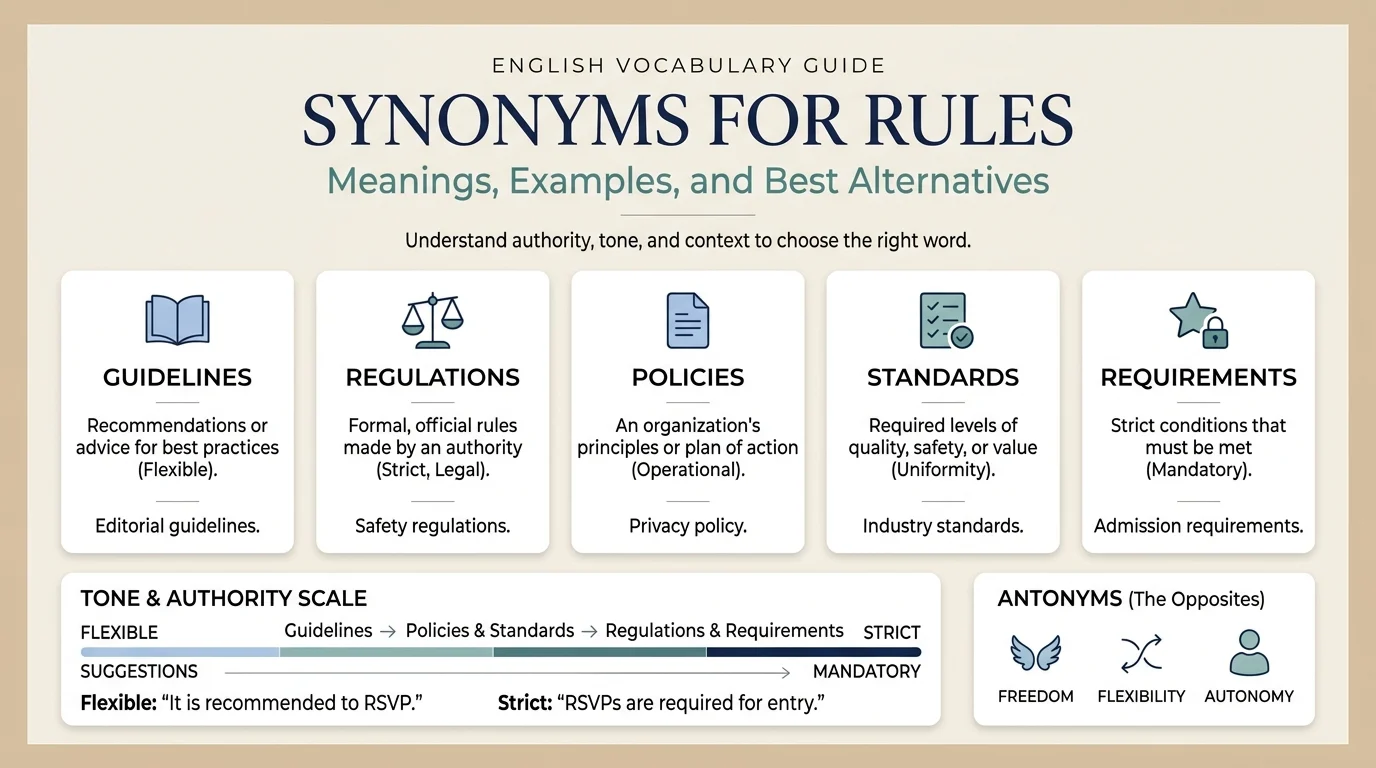
The best single replacement for rules is often guidelines when the instructions offer advice or direction rather than strict requirements. For legally binding requirements, regulations may be more accurate. For an organization’s established decisions, policies can be a better fit.
Here are useful alternatives by situation.
| Context | Best Alternative | Example |
|---|---|---|
| Professional writing | Policies | Please review our workplace policies. |
| Academic writing | Principles | The study follows established research principles. |
| Casual conversation | Guidelines | Check the guidelines before you begin. |
| Emotional writing | Boundaries | Healthy boundaries protect personal space. |
| Creative writing | Customs | The village follows ancient customs. |
| Resume or workplace use | Standards | Maintained high standards of quality and safety. |
| Social media captions | Guidelines | Read the community guidelines first. |
| Stronger meaning | Regulations | Businesses must follow relevant regulations. |
| Softer meaning | Suggestions | These suggestions may improve your results. |
Remember that these words are related, but they are not interchangeable in every sentence. Choose the alternative that preserves the original meaning.
When Not to Use Rules
Although rules is useful, some situations call for a more precise word.
When the instructions are flexible: Use guidelines instead of rules when people have room to make their own decisions.
Example: These guidelines help new employees learn the process.
When the requirements have legal authority: Use regulations or laws when discussing official requirements established by an authorized body.
Example: The business must comply with environmental regulations.
When describing an organization’s decisions: Use policies when explaining how a company or institution handles a particular issue.
Example: Our refund policy explains when customers can receive their money back.
When discussing personal limits: Use boundaries when explaining what behavior you will accept in a relationship.
Example: She established clear boundaries around her personal time.
When discussing basic beliefs: Use principles when describing ideas that guide decisions or behavior.
Example: Fairness is one of the team’s core principles.
A specific synonym helps readers understand not only what is expected, but also why the expectation exists and how strictly it should be followed.
Words Commonly Confused With Rules
Several words have meanings close to rules, but each has a different purpose.
| Word | Main Difference | Best Used For |
|---|---|---|
| Guidelines | Offer direction and may allow flexibility | Advice, procedures, and recommendations |
| Regulations | Establish official requirements | Government, safety, and regulated industries |
| Policies | State an organization’s approach or position | Companies, schools, and institutions |
| Laws | Requirements established and enforced through a legal system | Legal rights and obligations |
| Standards | Define expected levels of quality or performance | Quality control, education, and professional work |
| Principles | Express basic beliefs or ideas that guide decisions | Ethics, reasoning, and personal values |
These differences are especially important in academic and professional writing. A policy may explain an organization’s position, while a regulation may impose a specific requirement.
Best Synonym by Context for Rules
The most suitable synonym depends on the setting, the authority behind the requirement, and how much flexibility people have.
| Context | Best Synonym | Why It Works | Example |
|---|---|---|---|
| Formal writing | Regulations | Sounds official and precise | The regulations apply to all applicants. |
| Academic writing | Principles | Emphasizes ideas guiding a method | The research follows ethical principles. |
| Professional or business use | Policies | Describes organizational decisions | Employees must follow company policies. |
| Resume | Standards | Highlights quality and performance | Maintained safety standards across daily operations. |
| Casual conversation | Guidelines | Sounds clear without being overly strict | Check the guidelines before joining. |
| Creative writing | Customs | Suggests traditions within a group | Ancient customs shaped the kingdom. |
| Emotional writing | Boundaries | Expresses personal limits | He learned to respect her boundaries. |
| Strong intensity | Restrictions | Emphasizes limits on actions | New restrictions limit access to the area. |
| Soft or moderate tone | Suggestions | Makes advice sound optional | My suggestions may help you get started. |
| Social media captions | Guidelines | Fits online community expectations | Follow the community guidelines. |
| Legal context | Laws | Refers to legally established requirements | Local laws protect public safety. |
| Technical documentation | Specifications | Describes exact technical requirements | The device must meet the specifications. |
| Workplace safety | Protocols | Describes established steps for a situation | Follow emergency protocols during an evacuation. |
| Sports | Regulations | Refers to formal competition requirements | Players must follow league regulations. |
| Family life | House rules | Describes expectations at home | Our house rules include cleaning up after meals. |
US and UK English generally use many of these words in the same way. The more important distinction is the meaning of the word, not the variety of English.
Which Synonym Should You Choose?
Use these practical questions to find the right word.
1. What kind of requirement is it?
Choose laws for legal obligations, regulations for official requirements, policies for organizational decisions, and guidelines for flexible direction.
2. How formal is the situation?
For reports and business documents, policies, standards, and regulations often sound appropriate. For everyday conversations, rules and guidelines are usually easier to understand.
3. How strict is the requirement?
Restrictions emphasize limits. Requirements communicate what must be done. Suggestions communicate optional advice.
4. Does the word describe behavior or quality?
Choose principles for beliefs and values, standards for expected quality, and protocols for established steps that people should follow.
5. Who will read your writing?
Students may need simple, familiar words. Professionals may benefit from precise terms that match workplace procedures. General audiences usually respond well to clear language rather than unnecessarily complicated vocabulary.
The best synonym is the word that communicates your meaning accurately, not the word that sounds the most impressive.
Real Life Examples of Rules in Sentences
The following examples show how different alternatives work in everyday situations.
| Situation | Example Sentence |
|---|---|
| School | Students must follow the classroom guidelines. |
| Workplace | All staff members must comply with company policies. |
| Academic writing | The experiment followed established scientific principles. |
| Conversation | Do you know the rules for this game? |
| Social media | Please read the community guidelines before posting. |
| Resume | Applied established safety standards during daily operations. |
| Please review the updated procedures before the meeting. | |
| Storytelling | The kingdom’s ancient customs shaped every royal ceremony. |
| Family | We agreed on a few house rules for our new home. |
| Public safety | Visitors must observe all posted restrictions. |
These examples show why context matters. A rule in a game may be a regulation, while a personal expectation may be better described as a boundary or agreement.
18 Synonyms for Rules
The following 18 alternatives cover common meanings of rules. Some describe strict requirements, while others refer to advice, standards, beliefs, or established practices.
| Synonym | Simple Meaning | Best Used For | Example Sentence |
|---|---|---|---|
| 1. Guidelines | Instructions that offer direction | Flexible advice and procedures | Follow the guidelines when preparing your application. |
| 2. Regulations | Official requirements | Legal, safety, and industry contexts | The company follows all relevant regulations. |
| 3. Policies | Official positions or organizational decisions | Business and institutional communication | Our policies explain how complaints are handled. |
| 4. Principles | Basic ideas that guide behavior | Ethics, education, and reasoning | Honesty is one of our guiding principles. |
| 5. Standards | Expected levels of quality or behavior | Work, education, and performance | The product meets international standards. |
| 6. Requirements | Conditions that must be met | Applications, contracts, and projects | A valid ID is one of the requirements. |
| 7. Instructions | Directions explaining what to do | Tasks, products, and learning | Read the instructions before assembling the desk. |
| 8. Laws | Legally established requirements | Government and legal matters | Drivers must obey traffic laws. |
| 9. Restrictions | Limits on what is permitted | Access, activities, and permissions | The building has restrictions on visitor access. |
| 10. Protocols | Established steps for handling situations | Safety, healthcare, and technical work | Staff followed the emergency protocols. |
| 11. Procedures | Accepted ways of completing tasks | Workplaces and administrative processes | The new procedures reduce processing errors. |
| 12. Directives | Official instructions from an authority | Management and government | The team acted on the director’s directives. |
| 13. Commands | Direct orders that expect action | Military, computing, and strict authority | The officer issued clear commands. |
| 14. Orders | Instructions given by someone with authority | Management, law enforcement, and urgent situations | Workers followed the supervisor’s orders. |
| 15. Criteria | Standards used to judge or select something | Evaluation and decision making | The judges published their selection criteria. |
| 16. Specifications | Exact details or technical requirements | Engineering and product design | The machine meets the required specifications. |
| 17. Customs | Traditional practices accepted by a group | Culture, history, and storytelling | Local customs shape the annual celebration. |
| 18. Conventions | Accepted practices or shared standards | Writing, society, and professional settings | Academic conventions guide how sources are cited. |
Some alternatives refer to particular kinds of rules rather than direct replacements in every sentence. For example, criteria are used to evaluate something, while customs are practices shaped by tradition.
Synonym Groups and Usage Differences
Professional vs. Personal Synonyms
Professional settings often require clear and consistent terms. Policies, procedures, standards, and protocols work well when describing workplace expectations.
Personal situations may call for softer words. Boundaries, agreements, and expectations can describe how people manage relationships, shared responsibilities, and personal choices.
Example: The company updated its policies, while the couple agreed on boundaries that respected their individual needs.
Formal vs. Conversational Synonyms
Formal writing benefits from specific words such as regulations, directives, requirements, and standards. These alternatives help readers understand the authority or purpose behind an instruction.
In casual conversations, rules, guidelines, and house rules usually sound more natural. You rarely need a technical word when a simple one explains the situation clearly.
Academic Synonyms
Academic writing often uses principles, criteria, conventions, standards, and requirements.
For example, an essay may discuss the principles of scientific reasoning, the criteria for evaluating evidence, or the conventions of academic writing.
Choose the word that matches your subject. Regulations may be appropriate in a study of government policy, but principles may work better in a discussion of ethical reasoning.
Professional and Business Synonyms
Business communication frequently uses policies, procedures, protocols, requirements, and standards.
Use policies to describe organizational decisions, procedures to explain how tasks are completed, and standards to communicate expected quality.
For example, an email could say, Please follow the updated procedures for processing customer requests. This is more precise than simply asking employees to follow the rules.
Creative or Literary Synonyms
Creative writing can use customs, traditions, codes, commandments, and principles to give a setting or character more depth.
Customs can suggest a community’s shared history. Codes may suggest loyalty or secrecy. Commandments can create a religious or authoritative tone.
For example, The village lived by ancient customs suggests a traditional community more vividly than The village followed old rules.
Slang or Modern Synonyms
There is no single modern slang word that accurately replaces rules in every situation. Informal expressions such as house rules, ground rules, and the way things work can sound natural in conversation.
For example, Let’s set some ground rules before we start the project.
Avoid casual expressions in legal documents, academic papers, or formal business reports when a precise term is available.
Strongest vs. Weaker Synonyms
The intensity of a synonym depends on its context. The following scale shows how different words may sound when describing expectations or restrictions.
| Intensity | Word or Phrase | Typical Meaning |
|---|---|---|
| 1. Very mild | Suggestions | Optional advice |
| 2. Mild | Guidelines | Flexible direction |
| 3. Moderate | Standards | Expected levels of quality or behavior |
| 4. Firm | Requirements | Conditions that must be met |
| 5. Strict | Restrictions | Limits on permitted actions |
| 6. Authoritative | Directives | Instructions issued by an authority |
| 7. Highly authoritative | Orders | Commands that expect compliance |
This is a general guide rather than a universal ranking. A regulation may be more binding than an order in one situation, while the reverse may be true in another.
Emotional vs. Neutral Synonyms
Neutral alternatives include rules, procedures, standards, and requirements. They focus on expectations without necessarily expressing strong feelings.
More personal or emotionally meaningful alternatives include boundaries, traditions, and codes of conduct. These can suggest personal values, group identity, or a desire for respect.
Compare these sentences:
Neutral: The team established clear procedures for handling disagreements.
Personal: She established boundaries to protect her time and well being.
The second sentence communicates a personal need rather than simply describing an organized process.
Antonyms of Rules
Rules do not have one universal opposite. The best antonym depends on whether rules refer to restrictions, instructions, authority, or established expectations.
The following 15 words and phrases express contrasting ideas in suitable contexts.
| Antonym | Meaning | Example Sentence |
|---|---|---|
| 1. Freedom | The ability to act or choose without unnecessary control | The community values freedom of expression. |
| 2. Liberty | The state of being free from certain restrictions | Citizens defended their liberty. |
| 3. Flexibility | The ability to adapt to changing needs | The manager allows flexibility in scheduling. |
| 4. Autonomy | The ability to make independent decisions | The team enjoys autonomy over its daily work. |
| 5. Independence | Freedom from outside control or support | The organization gained independence. |
| 6. Lawlessness | A state in which laws are not respected or enforced | The report described growing lawlessness. |
| 7. Disorder | A lack of order or organization | The sudden change created disorder. |
| 8. Chaos | A state of extreme confusion | The missing instructions caused chaos. |
| 9. Anarchy | A condition without effective governing authority | The novel depicts a society descending into anarchy. |
| 10. Unrestricted access | Access without specified limitations | Members have unrestricted access to the archive. |
| 11. Permission | Approval to do something | Visitors received permission to enter. |
| 12. Exemption | Release from a particular requirement | She received an exemption from the attendance requirement. |
| 13. Discretion | Freedom to make a judgment or decision | The supervisor has discretion over scheduling. |
| 14. Improvisation | Acting without a fixed plan or prepared procedure | The performers relied on improvisation. |
| 15. Spontaneity | Acting naturally without extensive planning | The event encouraged spontaneity. |
Not all these words are direct antonyms of rules. Freedom and flexibility contrast with restrictions, while chaos and lawlessness describe possible results when order or enforcement is absent.
Comparison: Rules vs. Similar Words
Rules vs. Guidelines
Rules usually establish expectations that people are expected to follow. Guidelines offer direction and may allow more flexibility.
Rules often sound stricter, while guidelines tend to sound more supportive. Both are common in everyday and professional English.
Example: Employees must follow safety rules.
Example: These guidelines can help employees improve their performance.
Rules vs. Regulations
Rules can be informal or formal. Regulations usually refer to official requirements established by an authority.
Regulations often carry a more formal or legally significant tone, although their exact force depends on the context.
Example: The coach explained the rules of the game.
Example: The agency published new regulations for the industry.
Rules vs. Policies
Rules describe specific expectations or restrictions. Policies express an organization’s position or approach to an issue and may contain several rules or procedures.
Policies are usually more organizational in tone, while rules can apply to almost any setting.
Example: The library has rules about noise.
Example: The library’s borrowing policy explains how long members may keep books.
Rules vs. Standards
Rules tell people what is allowed or expected. Standards define an accepted level of quality, performance, or conduct.
Standards are particularly useful in education, business, manufacturing, and professional evaluations.
Example: The school has rules about attendance.
Example: The school maintains high academic standards.
Rules vs. Laws
Rules may be established by a family, school, company, club, or game. Laws are established through a legal system and may carry legal penalties.
Laws generally have greater formal legal authority, although particular rules may also be legally enforceable.
Example: Our family has rules about screen time.
Example: Drivers must follow traffic laws.
Rules vs. Principles
Rules describe particular expectations or actions. Principles are broader ideas that guide decisions, conduct, or reasoning.
Principles often focus on the values behind a decision, while rules explain what to do in a specific situation.
Example: The club has rules about fair play.
Example: Fairness is a guiding principle for every team member.
Common Phrases and Expressions with Rules
1. Ground Rules
Meaning: Basic expectations established before an activity or discussion begins.
Example sentence: The teacher established ground rules for respectful classroom discussions.
2. Rules of Conduct
Meaning: Standards that describe acceptable behavior within a group or organization.
Example sentence: All participants must follow the rules of conduct.
3. Rules and Regulations
Meaning: A phrase covering established requirements, often in an official setting.
Example sentence: Visitors must understand the site’s rules and regulations before entering.
4. Follow the Rules
Meaning: To act according to established requirements.
Example sentence: Every player is expected to follow the rules of the competition.
5. Break the Rules
Meaning: To act against an established requirement or expectation.
Example sentence: Students may face consequences if they break the school rules.
6. Bend the Rules
Meaning: To interpret or apply a rule less strictly than usual.
Example sentence: The coach refused to bend the rules for one player.
7. House Rules
Meaning: Expectations that apply within a home or private setting.
Example sentence: Our house rules include putting away personal belongings after use.
8. As a Rule
Meaning: Generally or in most situations.
Example sentence: As a rule, the office closes early on Fridays.
Common Mistakes to Avoid
1. Using Rules When a More Precise Word Is Needed
Rules is broad, so it may not explain the type of expectation clearly enough.
Less precise: Follow the rules for submitting the application.
More precise: Follow the application requirements before submitting your form.
2. Confusing Rules With Guidelines
Guidelines may allow judgment, while rules often establish firmer expectations.
Incorrect choice for a strict requirement: Please consider these guidelines for mandatory safety equipment.
Better: Please follow the safety requirements for protective equipment.
3. Using Casual Language in Formal Writing
Expressions such as house rules may sound inappropriate in a formal policy document.
Instead of writing, These are our office house rules, write, These are our workplace policies or procedures, depending on the intended meaning.
4. Choosing an Overly Strong Synonym
Not every expectation is a command or restriction. Using an intense word can make a simple situation sound unnecessarily strict.
Instead of saying, The teacher issued commands about essay formatting, say, The teacher provided instructions for formatting essays.
5. Repeating Rules Too Often
Repeated words can make a paragraph feel dull, but replacing every occurrence with a synonym can also sound unnatural.
Use rules where it is clearest, then choose precise alternatives such as requirements, guidelines, or policies when the meaning changes.
6. Choosing the Wrong Emotional Tone
Boundaries are appropriate for personal limits, while regulations are suitable for official requirements.
Calling personal boundaries regulations may sound cold or overly formal. Calling legal requirements suggestions may make them sound optional when they are not.
FAQs
1. What Is the Best Synonym for Rules?
Guidelines is a useful general alternative when instructions allow flexibility. Regulations, policies, and requirements are better when the situation calls for official or mandatory language.
2. What Is a Formal Synonym for Rules?
Regulations is a formal synonym when discussing official requirements. Policies, standards, and requirements are also suitable, depending on whether you mean organizational decisions, quality expectations, or mandatory conditions.
3. What Is an Informal Synonym for Rules?
Ground rules and house rules are natural informal expressions. They work well when discussing shared expectations at home, among friends, or before starting an activity.
4. What Is Another Word for Rules in Professional Writing?
Policies, procedures, standards, and protocols are common choices in professional writing. Select policies for organizational positions, procedures for processes, and protocols for established steps.
5. What Is the Difference Between Rules and Regulations?
Rules can be formal or informal expectations. Regulations generally refer to official requirements established by an authority, especially in government, industry, and safety contexts.
6. What Is the Opposite of Rules?
Freedom is a useful opposite when rules mean restrictions. Flexibility, autonomy, and unrestricted access can also express contrasting ideas, depending on the sentence.
Conclusion
Rules are instructions or requirements that guide behavior and explain what is expected in a particular situation. The best synonyms include guidelines for flexible advice, regulations for official requirements, policies for organizational decisions, and standards for expected quality.
The key is to consider meaning, tone, and context before choosing an alternative. A formal report may need precise language, while a casual conversation often benefits from simple words.
Discover More Post:
- 50+ Synonyms for Dedication | Meanings, Examples, and Best …
- 50+ Synonyms for For | Expert Word Choices to Elevate Your …
- 50+ Synonyms for Vivid | Meanings, Examples, and Best …