Have you ever used the word humble several times in an essay, email, social media caption, or professional profile? You may want to describe someone who is modest, respectful, or free from pride, but repeating the same word can make your writing less interesting. Choosing the right alternative helps you express your meaning more clearly.
This guide to synonyms for humble explains the meaning of the word and how its alternatives differ in tone and use. You will find practical examples for school, work, everyday conversations, resumes, and creative writing. Whether you need a formal word for an essay or a simple expression for a friendly conversation, these suggestions will help you choose a natural and accurate replacement.
What Does Humble Mean?
Humble means modest, respectful, and not overly proud of your abilities or achievements. The best synonyms include modest, unassuming, grounded, self effacing, and unpretentious, depending on whether you are writing professionally, academically, casually, emotionally, or creatively.
Meaning, Tone and Context
What Does Humble Mean?
The word humble describes someone who does not think they are better than others. A humble person can recognize their strengths without boasting or demanding special attention.
Humble can also describe a simple lifestyle, a modest beginning, or a situation that reminds someone of their limitations.
Part of speech: Humble is mainly an adjective. It can also function as a verb, meaning to make someone less proud or to remind them of their limitations.
Tone: Usually positive when describing a person’s character. It can be neutral when describing a simple home or background. As a verb, it can suggest embarrassment or a loss of pride.
Formality: Suitable for casual conversations, academic writing, professional communication, speeches, and personal reflections.
Common Word Forms
| Word form | Meaning | Example |
|---|---|---|
| Humble | Modest and not proud | She is a humble leader. |
| Humbly | In a modest or respectful way | He humbly accepted the award. |
| Humility | The quality of being humble | Her humility impressed the team. |
| Humbling | Making someone recognize their limitations | The experience was humbling. |
| Humble oneself | To act with less pride | He humbled himself and apologized. |
When Is Humble Commonly Used?
Humble is often used to describe:
- Personality: Someone who treats others with respect.
- Achievements: A successful person who does not brag.
- Background: A person who comes from modest circumstances.
- Leadership: A manager who listens and learns from others.
- Personal growth: An experience that teaches someone humility.
The intended meaning matters. A humble person is not necessarily shy, weak, or lacking confidence. They may be highly skilled and confident while still respecting other people.
Another Word for Humble
The best replacement depends on what you want to communicate. Modest is the closest general alternative, but other words express more specific qualities.
| Situation | Best alternative | Why it works |
|---|---|---|
| Professional writing | Unassuming | Describes someone who does not seek attention. |
| Academic writing | Modest | Expresses restraint in claims about results or ability. |
| Casual conversation | Down to earth | Describes someone who is genuine and approachable. |
| Emotional writing | Selfless | Emphasizes putting others first, when that is the intended meaning. |
| Creative writing | Unpretentious | Suggests a lack of artificial importance or showiness. |
| Resume or workplace | Collaborative | Highlights teamwork and respect for others. |
| Social media captions | Grounded | Suggests staying realistic despite success. |
| Stronger emphasis on low pride | Self effacing | Describes someone who tends to minimize their own achievements. |
| Softer, everyday tone | Modest | Sounds natural and straightforward. |
Remember that these words are not interchangeable in every sentence. For example, selfless describes concern for others, while humble describes a lack of excessive pride. Choose the word that matches the exact quality you mean.
When Not to Use Humble
Although humble is useful, it may not be the most precise choice in every situation.
When you mean shy: Use reserved or timid if someone avoids attention because they feel uncomfortable. Humble does not automatically mean shy.
When you mean poor: Use modest or limited to describe living conditions when appropriate. Humble can suggest simplicity, but it does not always mean poverty.
When you mean putting others first: Consider selfless or considerate. These words focus on caring for others rather than having little pride.
When you mean a lack of confidence: Use insecure or uncertain if that is the actual issue. Humble usually describes a positive attitude, while these words suggest doubt.
When you mean someone has little status: Use low ranking or junior if you are describing a position in an organization. Humble is not a precise substitute for professional rank.
Compare these examples:
| Less precise sentence | More precise sentence |
|---|---|
| She is humble and never talks much. | She is reserved and prefers to listen. |
| They live in a humble house. | They live in a modest house. |
| He is humble because he always helps others. | He is selfless because he consistently puts others first. |
| She is humble about her skills because she doubts herself. | She is insecure about her skills. |
Words Commonly Confused With Humble
Several words share part of humble’s meaning, but each has a different emphasis.
| Word | Main difference | Best use |
|---|---|---|
| Modest | Avoids exaggerating personal qualities or achievements | Describing behavior or reasonable expectations |
| Shy | Feels uncomfortable around people or in social situations | Describing social behavior |
| Submissive | Tends to give in to another person’s authority | Describing a power relationship |
| Meek | Gentle and unlikely to assert oneself forcefully | Describing a quiet or yielding nature |
| Humiliated | Feels deeply embarrassed or degraded | Describing an unpleasant experience |
| Grateful | Feels thankful for help, kindness, or success | Expressing appreciation |
The main distinction is that humble usually describes an attitude toward oneself and others. Shy describes social comfort, submissive describes yielding, and grateful describes appreciation.
Best Synonym by Context for Humble
Use this table to find an alternative that fits your sentence, audience, and intended tone.
| Context | Best synonym | Why it works | Example |
|---|---|---|---|
| Formal writing | Unassuming | Sounds polished and respectful | She is an unassuming public servant. |
| Academic writing | Modest | Avoids overstating findings | The study reports modest improvements. |
| Professional communication | Grounded | Suggests realistic self awareness | He remains grounded under pressure. |
| Resume | Collaborative | Shows respect for team contributions | A collaborative professional who values feedback. |
| Casual conversation | Down to earth | Sounds friendly and natural | Our new neighbor is really down to earth. |
| Creative writing | Unpretentious | Adds descriptive depth | His unpretentious manner put everyone at ease. |
| Emotional writing | Gracious | Suggests warmth and generosity in behavior | She was gracious in victory. |
| Strong emphasis on minimizing praise | Self effacing | Highlights reluctance to claim credit | His self effacing humor made the interview enjoyable. |
| Gentle or moderate tone | Modest | Communicates humility without a strong judgment | She made a modest request. |
| Social media captions | Grounded | Fits reflections on success and growth | Stay grounded, keep growing. |
| Leadership | Approachable | Emphasizes openness to others | The director is approachable and willing to listen. |
| Personal development | Teachable | Emphasizes readiness to learn | A teachable attitude helps people improve. |
| Teamwork | Considerate | Focuses on respect for others | He is considerate of every team member. |
| Simple lifestyle | Unpretentious | Suggests simplicity without showiness | They enjoy an unpretentious country home. |
There is no single synonym that works best everywhere. For describing a person’s character, modest is usually the safest general choice. For a workplace, collaborative or approachable may communicate a more useful quality.
Which Synonym Should You Choose?
Before replacing humble, ask yourself what you want readers to understand.
1. Focus on meaning
Use modest for a lack of boasting, grounded for realistic self awareness, and selfless for putting other people first.
2. Match the level of formality
Use unassuming in polished writing, modest in essays, and down to earth in casual conversation.
3. Check the emotional tone
Use gracious to suggest kindness, meek to suggest gentleness or yielding, and self effacing when someone downplays personal achievements.
4. Consider professional value
In a resume, describe observable qualities such as being collaborative, receptive to feedback, or willing to learn instead of relying on a broad personality label.
5. Read the full sentence
Replace humble only when the alternative preserves the original meaning. A synonym that sounds impressive but changes the meaning is not an improvement.
Real Life Examples of Humble in Sentences
These examples show how humble and its alternatives can fit everyday situations.
| Situation | Example sentence |
|---|---|
| School | The student remained modest about her excellent grades. |
| Workplace | Our team leader is approachable and welcomes new ideas. |
| Writing | The author takes an unassuming approach to a difficult subject. |
| Conversation | My uncle is successful but still down to earth. |
| Social media | Stay grounded, celebrate progress, and keep learning. |
| Resume | Collaborative professional who values feedback and shared success. |
| I would appreciate your guidance as I continue to learn. | |
| Storytelling | Despite his fame, the musician remained unpretentious. |
| Family | She was considerate of everyone’s feelings. |
| Personal growth | The experience taught him to be more open to correction. |
A strong synonym makes a sentence more specific. For example, approachable tells readers how a manager interacts with others, while humble gives a broader impression of character.
18 Synonyms for Humble
The following list contains 18 useful alternatives. Some are close synonyms, while others express a related quality that may fit a particular context better.
| Synonym | Simple meaning | Best used for | Example sentence |
|---|---|---|---|
| 1. Modest | Not boastful or overly proud | Everyday and formal writing | She remained modest after receiving the award. |
| 2. Unassuming | Not seeking attention or importance | Professional descriptions | The unassuming scientist explained her discovery clearly. |
| 3. Unpretentious | Simple and without showiness | Personality and style | His unpretentious nature made him easy to trust. |
| 4. Grounded | Realistic and sensible | Personal growth and success | Fame has not changed her grounded outlook. |
| 5. Meek | Gentle and unlikely to assert oneself | Character descriptions | The meek character rarely challenged authority. |
| 6. Self effacing | Inclined to minimize one’s achievements | Speeches and personal profiles | His self effacing comments made the praise feel less awkward. |
| 7. Down to earth | Practical, genuine, and approachable | Casual conversation | Our coach is down to earth and easy to talk to. |
| 8. Unpretending | Not trying to appear more important than one is | Literary descriptions | Her unpretending manner won the guests over. |
| 9. Respectful | Showing regard for other people | Workplace and social settings | He remained respectful during the disagreement. |
| 10. Courteous | Polite and considerate | Formal and professional communication | The courteous assistant welcomed every visitor. |
| 11. Gracious | Kind and pleasant, especially toward others | Social and emotional situations | She was gracious when accepting the compliment. |
| 12. Unostentatious | Not displaying wealth or importance | Formal and descriptive writing | They chose an unostentatious home near the village. |
| 13. Simple | Not elaborate or complicated | Lifestyle and design | He prefers a simple, humble way of living. |
| 14. Approachable | Easy to speak with | Leadership and teamwork | The approachable director listened to every concern. |
| 15. Teachable | Willing to learn from others | Education and professional development | A teachable attitude helps new employees grow. |
| 16. Considerate | Thoughtful about other people’s needs | Relationships and teamwork | She was considerate of her coworkers’ time. |
| 17. Selfless | Putting others’ needs before one’s own | Emotional and personal writing | His selfless actions helped the entire community. |
| 18. Low key | Not showy or attention seeking | Informal speech and lifestyle descriptions | They held a low key celebration at home. |
- Best general synonym: Modest.
- Best professional alternative: Unassuming or collaborative, depending on the sentence.
- Best casual alternative: Down to earth.
- Best alternative for someone who does not seek praise: Self effacing.
- Best alternative for someone who helps others: Selfless, when the focus is on their actions rather than their pride.
Synonym Groups and Usage Differences
Professional vs. Personal Synonyms
Professional writing often benefits from words that describe observable behavior. Collaborative, approachable, and receptive to feedback can explain how someone works with others.
Personal writing may focus more on character. Modest, grounded, and down to earth can describe someone who stays genuine despite success.
For example, a resume might say, I value collaborative problem solving. A personal reflection might say, Success has taught me to stay grounded.
Formal vs. Conversational Synonyms
In formal reports, essays, and speeches, modest, unassuming, and unpretentious can sound appropriate. Unostentatious is more specialized and works best when describing a lack of display or extravagance.
In everyday conversation, down to earth and low key are more natural. They communicate a similar general impression without sounding overly academic.
Academic Synonyms
Academic writing often needs precision rather than a more sophisticated sounding word. Modest is useful when discussing limited claims, moderate effects, or cautious conclusions.
For example:
The results show modest improvement in reading comprehension.
Here, modest means limited or moderate, not a lack of pride. This is an important difference because the meaning of humble changes with context.
When describing a researcher’s attitude, use unassuming or intellectually modest if it accurately describes the person.
Professional and Business Synonyms
In business emails, performance reviews, resumes, and presentations, the best choice depends on the quality you want to highlight.
| Intended quality | Recommended word or phrase | Example |
|---|---|---|
| Values teamwork | Collaborative | She takes a collaborative approach to planning. |
| Accepts guidance | Receptive to feedback | He is receptive to feedback from colleagues. |
| Easy to speak with | Approachable | The supervisor is approachable and supportive. |
| Recognizes limitations | Realistic | She offers realistic assessments of project risks. |
| Shares credit | Gives credit to others | He gives credit to the team for its success. |
These phrases are often stronger than simply describing yourself as humble because they give readers a clearer idea of your behavior.
Creative or Literary Synonyms
Creative writing benefits from words that reveal a person’s character through action, mood, or description.
Unassuming can describe a character who quietly earns respect. Unpretentious can suggest a person who avoids artificial displays of status. Meek may portray gentleness, but it can also imply a lack of assertiveness.
Example: The celebrated painter lived in an unpretentious cottage and greeted every visitor like an old friend.
This sentence communicates modesty through both setting and behavior.
Slang or Modern Synonyms
There is no exact slang replacement for humble that works in every situation. However, several informal expressions convey related ideas.
| Expression | Meaning | When to use it |
|---|---|---|
| Down to earth | Genuine and approachable | Friendly conversations |
| Low key | Quiet or not showy | Casual messages and captions |
| Keeps it real | Behaves honestly and naturally | Informal conversation |
| Stays grounded | Remains realistic despite success | Social posts and personal reflections |
These expressions work well in casual settings, but they may sound too informal in academic papers or formal business reports.
Strongest vs. Weaker Synonyms
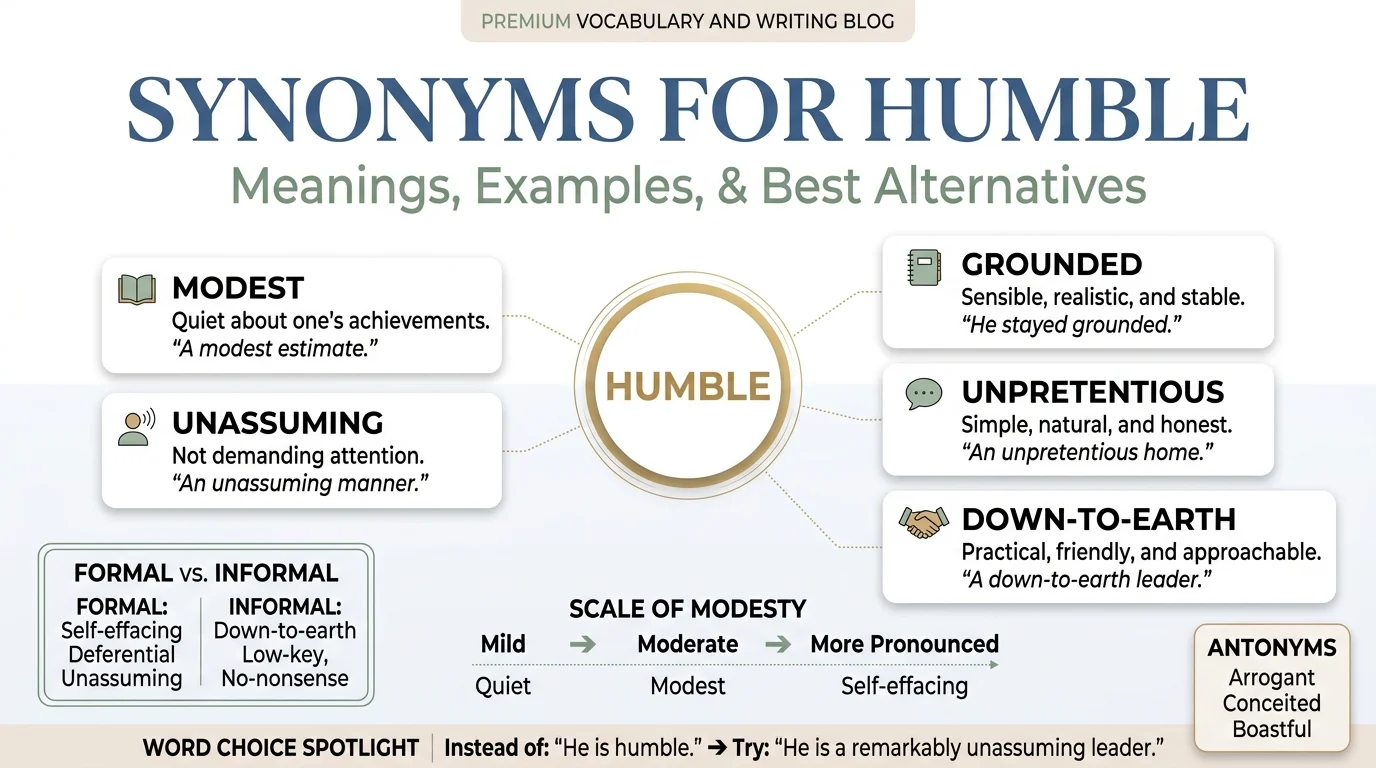
Synonyms do not form one perfect scale because they describe different qualities. The following guide shows a rough progression from a mild suggestion of modesty to a stronger emphasis on minimizing personal importance.
Mild
Modest
Avoids boasting about achievements.
Moderate
Unassuming
Does not seek special attention or importance.
More pronounced
Self effacing
Often plays down personal achievements or strengths.
Gentle or yielding
Meek
May suggest low assertiveness as well as gentleness.
Do not assume that the last word is always better or more humble. Self effacing and meek add meanings that may not suit your sentence.
Emotional vs. Neutral Synonyms
Neutral alternatives include modest and unassuming. They usually describe behavior without adding a strong emotional judgment.
Words such as gracious and selfless are warmer. They suggest kindness, generosity, or concern for other people. Meek may sound sympathetic in one context and critical in another.
Choose a neutral word for factual descriptions and an emotionally expressive word when you want readers to feel something about the person.
Antonyms of Humble
Antonyms describe the opposite of humility, such as excessive pride, arrogance, or a desire to appear more important than others. Some words below are direct opposites, while others apply to specific behaviors.
| Antonym | Meaning | Example sentence |
|---|---|---|
| 1. Arrogant | Believing oneself superior to others | The arrogant executive dismissed every suggestion. |
| 2. Conceited | Having an overly high opinion of oneself | He sounded conceited when discussing his talent. |
| 3. Boastful | Frequently talking about achievements | Her boastful remarks annoyed the audience. |
| 4. Proud | Feeling deep satisfaction or superiority, depending on context | He was too proud to admit his mistake. |
| 5. Haughty | Acting as though others are inferior | The haughty guest refused to greet the staff. |
| 6. Egotistical | Excessively focused on oneself | His egotistical behavior hurt the team’s morale. |
| 7. Vain | Overly concerned with one’s appearance or importance | She was too vain to accept criticism. |
| 8. Pretentious | Trying to appear more important or impressive | The pretentious speech used complicated words unnecessarily. |
| 9. Ostentatious | Displaying wealth or importance conspicuously | They bought an ostentatious car to impress their neighbors. |
| 10. Domineering | Seeking to control other people | The domineering supervisor ignored the team’s concerns. |
| 11. Self important | Acting as though one’s importance is greater than it is | His self important attitude made meetings unpleasant. |
| 12. Overbearing | Imposing one’s views or presence on others | Her overbearing manner discouraged open discussion. |
| 13. Supercilious | Showing disdain for people considered inferior | The supercilious critic mocked the beginner’s work. |
| 14. Presumptuous | Acting with unjustified confidence or entitlement | It was presumptuous to assume everyone would agree. |
| 15. Narcissistic | Excessively focused on oneself and one’s importance | His narcissistic behavior left little room for others. |
Important distinction: Proud is not always an antonym of humble. Someone can feel proud of an achievement while remaining humble about their abilities. The word becomes an opposite when it suggests excessive pride or superiority.
Comparison: Humble vs. Similar Words
Humble vs. Modest
Both words describe a lack of excessive pride. Humble often includes respect for other people, while modest commonly emphasizes not exaggerating one’s abilities or achievements.
Modest is a straightforward choice in formal writing. Humble may communicate a broader attitude toward life and other people.
Examples:
- Humble: Despite her success, she treats everyone with respect.
- Modest: He gave a modest account of his achievements.
Humble vs. Meek
Humble suggests a lack of arrogance. Meek describes someone who is gentle, quiet, or unlikely to stand up forcefully for themselves.
Meek can imply less assertiveness than humble. It is not necessarily more formal, but it often carries a stronger suggestion of yielding.
Examples:
- Humble: The director listens carefully to opposing views.
- Meek: The meek character rarely challenged anyone.
Humble vs. Humiliated
Humble usually describes a personal quality or attitude. Humiliated describes the painful feeling of being embarrassed or degraded.
Humiliated is much stronger emotionally, but it is not a true synonym for humble.
Examples:
- Humble: She remained humble after receiving public recognition.
- Humiliated: He felt humiliated when his mistake was announced to the class.
Humble vs. Unassuming
Both words can describe people who do not seek attention. Unassuming places more emphasis on not appearing important or impressive.
Unassuming is particularly useful for professional biographies and descriptions of successful people who avoid showing off.
Examples:
- Humble: He is humble about his achievements.
- Unassuming: The unassuming professor never sought public attention.
Humble vs. Selfless
Humble describes a modest attitude toward oneself. Selfless describes putting other people’s needs before one’s own.
Selfless is the better choice when the main point is generosity or sacrifice rather than modesty.
Examples:
- Humble: She accepted the award without boasting.
- Selfless: She gave up her free time to help a struggling student.
Humble vs. Grounded
Humble emphasizes modesty and a lack of excessive pride. Grounded suggests a realistic, sensible outlook, even when circumstances change.
Grounded is especially natural when discussing success, personal growth, and leadership.
Examples:
- Humble: He never acts as though he is better than others.
- Grounded: She remains grounded despite her growing popularity.
Common Phrases and Expressions with Humble
1. A humble beginning
Meaning: A simple or modest starting point, often followed by growth or success.
Example sentence: The company had a humble beginning in a small family garage.
2. A humble person
Meaning: Someone who does not consider themselves superior to others.
Example sentence: Everyone respects him because he is a humble person who listens carefully.
3. With humble gratitude
Meaning: With sincere appreciation and little sense of personal superiority.
Example sentence: She accepted the community award with humble gratitude.
4. A humble request
Meaning: A polite request made without demanding special treatment.
Example sentence: I have a humble request for everyone attending the meeting.
5. A humbling experience
Meaning: An experience that makes someone recognize their limitations or appreciate others more.
Example sentence: Losing the final taught the young athlete a valuable lesson.
6. Humble pie
Meaning: An informal expression for having to admit a mistake or accept that you were wrong.
Example sentence: After the prediction failed, the analyst had to eat humble pie.
7. Stay humble
Meaning: Continue to be modest and respectful despite success.
Example sentence: Her father always reminded her to stay humble and keep learning.
8. Humble oneself
Meaning: To set aside pride and act with greater modesty.
Example sentence: He humbled himself by apologizing to the people he had criticized.
Common Mistakes to Avoid
1. Treating humble and shy as the same word
A person can be confident in public and still be humble. Use shy when the main point is discomfort in social situations.
2. Using humble when you mean poor
Humble can describe a simple home or background, but it does not always mean poverty. Choose a more precise description when discussing financial circumstances.
3. Confusing humble with meek
A humble person can make firm decisions, speak confidently, and defend their beliefs. Meek more often suggests gentleness or limited assertiveness.
4. Choosing an overly formal synonym
Unostentatious may be accurate in a descriptive essay, but it can sound unnatural in a casual message. Use modest or down to earth when the context calls for simpler language.
5. Using selfless when you mean modest
A person can be modest without making sacrifices for others. Choose selfless only when the sentence emphasizes generosity or putting others first.
6. Repeating humble too often
Repeated use can make writing feel limited. Replace it with a precise alternative such as modest, grounded, unassuming, or gracious when the meaning supports the change.
FAQs
1. What is the best synonym for humble?
Modest is usually the best general synonym for humble. Use unassuming for someone who avoids attention and grounded for someone who stays realistic despite success.
2. What is a formal synonym for humble?
Unassuming is a useful formal synonym for humble when describing a person who does not seek attention. Modest is another natural choice for professional and academic writing.
3. What is an informal synonym for humble?
Down to earth is a natural informal alternative. It describes someone who is genuine, approachable, and comfortable with people regardless of their status.
4. What is another word for humble in professional writing?
Collaborative, approachable, and receptive to feedback can work in professional writing when they accurately describe a person’s behavior. Modest is better when discussing achievements.
5. What is the difference between humble and modest?
Humble often describes a broader attitude of modesty and respect toward others. Modest usually emphasizes avoiding exaggeration about personal qualities, achievements, or expectations.
6. What is the opposite of humble?
Arrogant is one of the clearest opposites of humble. Other alternatives include conceited, boastful, haughty, and egotistical, depending on the behavior being described.
Conclusion
Humble describes someone who is modest, respectful, and not overly proud of their abilities or achievements. The best synonyms for humble include modest, unassuming, grounded, unpretentious, and down to earth, but each word has a slightly different meaning.
For professional writing, choose words such as collaborative or approachable when they describe real behavior. For academic work, modest is often a clear and precise choice. In casual conversations, down to earth sounds natural, while self effacing works when someone tends to minimize their achievements.
Discover More Post:
- 50+ Synonyms for Dedication | Meanings, Examples, and Best …
- 50+ Synonyms for For | Expert Word Choices to Elevate Your …
- 50+ Synonyms for Vivid | Meanings, Examples, and Best …