Have you ever used the word revenge several times in an essay, story, social media caption, or conversation? Finding another word can make your writing clearer, more expressive, and more natural. The right choice depends on whether you mean getting even with someone, seeking justice, responding to an insult, or expressing anger after being hurt.
Understanding synonyms for revenge helps you communicate these feelings with greater accuracy. Words such as retaliation, retribution, payback, and vengeance share similar meanings, but they do not always fit the same situation. Some sound formal, others feel emotional or conversational, and a few suggest punishment rather than personal anger. This guide explains their differences, provides practical examples, and helps you choose the most suitable word for your audience and purpose.
What Does Revenge Mean?
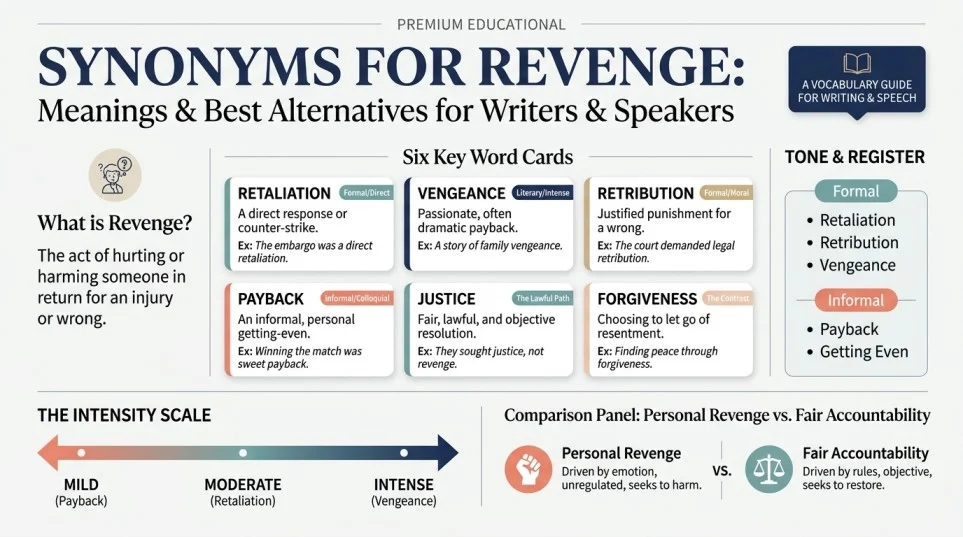
Revenge means doing something to hurt, punish, or get even with someone because they previously hurt or wronged you. Common synonyms include retaliation, vengeance, retribution, and payback. Retaliation suits formal discussions, vengeance adds emotional intensity, retribution suggests deserved punishment, and payback works in casual conversation.
Meaning, Tone and Context
What does revenge mean?
Revenge is the act of trying to hurt or punish someone in response to a perceived wrong. It often comes from anger, resentment, humiliation, or a desire to make another person experience similar suffering.
For example, someone who spreads embarrassing information about a colleague because that colleague criticized them may be acting out of revenge.
Part of speech
Revenge is primarily a noun, but it can also function as a verb.
- Noun: She wanted revenge for the betrayal.
- Verb: He planned to revenge himself on those who had deceived him.
In everyday American English, people more commonly say get revenge, take revenge, or seek revenge than use revenge as a verb.
Tone and emotional meaning
Revenge usually has a negative or emotionally charged tone. It suggests personal resentment and a desire to settle a score rather than resolve a problem peacefully.
However, its tone depends on context. In fiction, revenge can describe a dramatic character motivation. In everyday conversation, it can refer to anything from a playful response to a serious personal conflict.
Formality level
Revenge is a common word suitable for conversation, storytelling, essays, and general writing. More precise alternatives may work better in academic or professional settings.
| Word | Tone | Best Context |
|---|---|---|
| Revenge | Emotional, direct | Everyday conversation and storytelling |
| Retaliation | Formal, factual | Business, law, and academic writing |
| Vengeance | Intense, dramatic | Literature and emotional writing |
| Retribution | Serious, judgment focused | Ethics, law, and discussions of punishment |
| Payback | Casual, sometimes playful | Informal conversation and captions |
Important related word forms
- Revenge: The act of getting even with someone.
- Revengeful: Describes someone who wants revenge.
- Vengeful: Describes a person or action driven by a desire for vengeance.
- Retaliate: To respond to an attack or harmful action.
- Retaliatory: Describes an action taken in response to a previous action.
- Vengeance: Punishment or harm inflicted in response to a perceived wrong.
When and How to Use Revenge
Use revenge when the main idea is responding to a personal wrong with a desire to make the other person suffer or pay for what happened.
The word is especially common in personal conflicts, dramatic stories, crime fiction, and discussions of human behavior.
1. Personal context
She wanted revenge after her closest friend betrayed her trust.
2. Academic context
The essay examines how revenge influences decisions and damages personal relationships.
3. Creative writing
The prince returned to his kingdom, determined to take revenge on the people who had destroyed his family.
4. Social media context
Sometimes, moving forward is better than wasting your energy on revenge.
These examples show that revenge can express a personal feeling, describe a character’s motivation, or introduce a broader discussion about behavior.
Another Word for Revenge
The best single replacement for revenge is usually retaliation when you want a neutral or formal word. However, the best choice changes with the meaning, emotional intensity, and situation.
| Situation | Best Alternative | Why It Works |
|---|---|---|
| Professional writing | Retaliation | Sounds factual and precise |
| Academic writing | Retribution | Emphasizes punishment for wrongdoing |
| Casual conversation | Payback | Sounds natural and conversational |
| Emotional writing | Vengeance | Expresses intense anger and resentment |
| Creative writing | Vengeance | Adds drama and emotional depth |
| Resume or workplace use | Response to misconduct | Describes a workplace issue without emotional wording |
| Social media captions | Payback | Short, punchy, and familiar |
| Stronger meaning | Vengeance | Suggests a powerful desire to punish |
| Softer meaning | Response | Describes an action without necessarily implying revenge |
My recommendation: Choose retaliation for formal explanations, payback for casual speech, and vengeance for dramatic or emotional writing. Use justice when you mean fair treatment rather than personal revenge.
When Not to Use Revenge
Revenge is not the right word for every response to unfair treatment. Sometimes it suggests anger or a desire to cause harm when your real meaning is simply to correct a problem.
Consider these examples.
| Less Precise Sentence | Better Sentence | Why It Is Better |
|---|---|---|
| She wanted revenge through the legal system. | She sought justice through the legal system. | Justice focuses on fairness and lawful accountability. |
| The company took revenge against the employee. | The company retaliated against the employee. | Retaliation is more precise in a workplace context. |
| He wanted revenge by correcting the mistake. | He wanted to set the record straight. | Correcting false information is not necessarily revenge. |
| Her revenge was to forgive him. | Her response was to forgive him. | Forgiveness is the opposite of seeking revenge. |
| The team got revenge by winning again. | The team got payback by winning again. | Payback often fits competitive situations and sports talk. |
Avoid revenge when you want to sound objective, especially in reports, workplace complaints, research papers, or discussions of legal rights. Choose words that explain what actually happened rather than assuming someone’s motive.
Words Commonly Confused With Revenge
Several related words describe responses to wrongdoing, but they differ in purpose and intensity.
| Word | Main Difference | When to Use It |
|---|---|---|
| Justice | Focuses on fairness and accountability | Legal, ethical, or social issues |
| Retaliation | A response to a harmful action | Workplace, political, or personal conflict |
| Retribution | Punishment viewed as deserved | Moral debates, law, and literature |
| Vengeance | A strong desire to punish someone personally | Emotional stories and dramatic situations |
| Payback | Informal language for getting even | Casual conversation and competition |
| Resentment | Lasting bitterness about a perceived wrong | Emotional reflection and psychology |
The key distinction is that revenge usually involves personal motives, while justice can be pursued without personal hostility. Retaliation describes a response, and resentment describes a feeling rather than an act.
Best Synonym by Context for Revenge
The best synonym depends on what you want your sentence to communicate. Use this table to choose a word that matches your audience and purpose.
| Context | Best Synonym | Why It Works | Example |
|---|---|---|---|
| Formal writing | Retaliation | Clear and objective | The report examined retaliation after the complaint. |
| Academic writing | Retribution | Supports discussion of punishment and morality | The paper explores the idea of retribution. |
| Professional or business use | Retaliation | Common in workplace discussions | Employees should not face retaliation for reporting misconduct. |
| Resume or workplace statement | Accountability | Focuses on responsibility rather than personal conflict | I promoted accountability through clear communication. |
| Casual conversation | Payback | Familiar and natural | He wanted payback after losing the game. |
| Creative writing | Vengeance | Creates dramatic tension | Her quest for vengeance consumed her life. |
| Emotional writing | Vindictiveness | Highlights a desire to hurt someone | His vindictiveness damaged every friendship he had. |
| Strong intensity | Vengeance | Communicates deep anger | Vengeance became his only goal. |
| Softer or moderate tone | Response | Avoids assuming harmful intent | She chose a calm response to the insult. |
| Social media captions | Payback | Short and memorable | Success was the best payback. |
| Legal discussion | Retribution | Emphasizes punishment for wrongdoing | The debate focused on retribution and fairness. |
| Conflict resolution | Resolution | Moves attention toward solving the problem | They chose resolution instead of revenge. |
| Personal relationships | Forgiveness | Offers an alternative to getting even | She chose forgiveness over revenge. |
| Sports and competition | Payback | Fits a rematch or competitive victory | The final win felt like payback. |
| Literary analysis | Vengeance | Highlights a character’s motivation | Vengeance drives the central conflict. |
Note that accountability, response, resolution, and forgiveness are not exact synonyms for revenge. They are useful alternatives when the intended meaning shifts from getting even toward responsibility, action, or peaceful resolution.
Which Synonym Should You Choose?
Use these five questions to identify the best word for your sentence.
1. What do you mean? If someone wants to hurt a person who hurt them, revenge or vengeance may fit. If they respond to an earlier action, retaliation may be more accurate.
2. How formal is the situation? Choose retaliation or retribution for formal analysis. Use payback in casual conversation.
3. How intense is the emotion? Vengeance sounds stronger and more dramatic than a general response. Retribution focuses more on punishment.
4. Who is your audience? Academic readers may prefer precise language. Social media readers may respond better to familiar words such as payback.
- 5. What is the real goal? If you mean fairness, choose justice. If you mean taking responsibility, choose accountability. If you mean ending conflict, choose reconciliation.
A simple rule helps: choose the word that explains the action or feeling most accurately, not merely one that sounds more impressive.
Real Life Examples of Revenge in Sentences
Here are practical examples showing how revenge and its alternatives work across everyday situations.
School: Instead of seeking revenge on a classmate who spread a rumor, Maya reported the problem to her teacher.
Workplace: The manager warned the team that retaliation against employees who raise concerns would not be tolerated.
Writing: The author uses vengeance to explain why the main character refuses to abandon the past.
Conversation: He called the victory payback after his team lost the first match.
Social media: Her success was the best response to people who doubted her.
Resume: I helped establish fair review procedures and accountability across the team.
Email: I would like to address this concern professionally and find a fair resolution.
Storytelling: Years of resentment pushed the character toward vengeance, even when reconciliation remained possible.
These examples demonstrate an important point: the best replacement often depends on whether you are describing an action, an emotion, a punishment, or a constructive alternative.
18 Synonyms for Revenge
The following 18 words and expressions cover formal, informal, emotional, academic, and creative contexts. Some are close synonyms, while others work only when the sentence expresses a related idea.
| Synonym | Simple Meaning | Best Used For | Example Sentence |
|---|---|---|---|
| 1. Retaliation | Responding to a harmful action | Formal and professional writing | The employee reported retaliation after filing a complaint. |
| 2. Vengeance | Strong personal punishment for a wrong | Emotional writing and fiction | Vengeance became the hero’s main motivation. |
| 3. Retribution | Punishment believed to be deserved | Ethics, law, and academic discussion | The novel explores retribution for past crimes. |
| 4. Payback | Getting even with someone | Casual speech and captions | He saw the win as payback for last season. |
| 5. Reprisal | An action taken in response to an earlier action | Formal, political, or military writing | The officials feared reprisals after the announcement. |
| 6. Counterattack | An attack made in response to another attack | Conflict and competitive situations | The team launched a counterattack in the second half. |
| 7. Reciprocation | Returning an action or treatment | Neutral or academic contexts | She refused to reciprocate his hostility. |
| 8. Requital | A return for treatment received | Formal or literary writing | He viewed the punishment as requital for his betrayal. |
| 9. Vindictiveness | A strong desire to hurt someone in return | Character analysis and emotional writing | Her vindictiveness made the disagreement worse. |
| 10. Retaliatory action | An action intended to answer a previous wrong | Business and formal reports | The investigation found evidence of retaliatory action. |
| 11. Getting even | Making someone experience a similar setback | Everyday conversation | He wanted to get even after the prank. |
| 12. Settling the score | Correcting a perceived imbalance or defeat | Sports, personal conflict, and fiction | The boxer returned to settle the score. |
| 13. Returning the favor | Giving someone similar treatment in return | Casual or sometimes ironic speech | He returned the favor by helping her move. |
| 14. Payback time | A moment to get even or respond | Informal speech and entertainment | After months of training, it was payback time. |
| 15. Retaliation campaign | Repeated actions against a perceived opponent | Political or organizational analysis | The report described a retaliation campaign against critics. |
| 16. Avenging | Acting to punish a wrong or defend someone who was harmed | Stories and emotional writing | She devoted herself to avenging her brother. |
| 17. Redress | A remedy for a wrong or unfair situation | Legal and formal writing | The family sought redress for the harm they suffered. |
| 18. Vindication | Proof that someone was right or wrongly accused | Formal writing and personal accounts | The new evidence brought vindication after years of doubt. |
Important usage note: Redress and vindication are not direct synonyms for revenge. Redress means obtaining a remedy for a wrong, while vindication means proving that someone was right or clearing their name. Use them when that is the intended meaning.
Synonym Groups and Usage Differences
Professional vs. Personal Synonyms
Professional writing benefits from words that describe observable actions rather than assumed feelings.
Use retaliation when discussing a harmful response to a complaint, reprisal when describing punitive action, and redress when someone seeks a remedy for wrongdoing.
In personal writing, vengeance, payback, and getting even may better express anger, hurt, or the desire to settle a score.
Formal vs. Conversational Synonyms
Formal and conversational alternatives differ in tone, not just meaning.
| Formal Expression | Conversational Expression |
|---|---|
| Retaliation | Getting even |
| Retribution | Payback |
| Reprisal | Returning the favor |
| Seeking redress | Trying to make things right |
| Pursuing vengeance | Wanting revenge |
Use formal expressions in reports, essays, presentations, and professional emails. Conversational expressions work better in texts, personal stories, and informal discussions.
Academic Synonyms
Academic writing should distinguish between personal revenge, punishment, and fair accountability.
- Retribution: Useful in discussions of punishment and moral responsibility.
- Retaliation: Appropriate when examining a response to an earlier action.
- Vengeance: Useful when analyzing emotions or character motivations in literature.
- Reciprocation: Appropriate when discussing returned actions or behavior, although it does not necessarily imply revenge.
- Redress: Useful when discussing remedies for injustice.
For example, an essay about conflict could explain how retaliation creates further hostility, while a paper on criminal punishment might examine retribution.
Professional and Business Synonyms
In workplace communication, revenge can sound accusatory or overly emotional. Select a word that describes the conduct or the outcome you want to address.
| Situation | Recommended Term | Example |
|---|---|---|
| Harmful response to a complaint | Retaliation | The employee raised concerns about possible retaliation. |
| Remedy for unfair treatment | Redress | The employee requested redress through the formal process. |
| Responsibility for misconduct | Accountability | The organization strengthened accountability procedures. |
| Resolving a disagreement | Resolution | Both parties agreed to seek a resolution. |
| Establishing what happened | Investigation | The company opened an investigation into the complaint. |
For resumes, focus on achievements, fairness, and problem solving. Avoid presenting revenge as a professional goal because it may suggest poor judgment or unresolved conflict.
Creative or Literary Synonyms
Creative writing often benefits from words with stronger emotional meaning.
Vengeance suggests a powerful desire to punish someone. Reprisal often implies a response to an earlier attack. Retribution emphasizes punishment that someone believes is deserved.
For a quieter emotional tone, resentment can show lingering bitterness without describing an actual act of revenge.
Example: The character’s resentment grew quietly until vengeance became more important than the truth.
Slang or Modern Synonyms
Some informal expressions are useful in everyday American English.
- Payback: A common term for getting even, often used in sports and entertainment.
- Getting even: A familiar phrase for responding to a perceived wrong.
- Settling the score: An expression for resolving a past defeat or grievance.
- Payback time: A dramatic, informal expression suggesting that the moment to respond has arrived.
These expressions work well in dialogue, captions, and casual stories. Avoid them in formal research or serious workplace complaints unless you are quoting someone’s words or analyzing informal language.
Strongest vs. Weaker Synonyms
The intensity of these words depends on the situation, but this general scale can help.
Mild
Response, reciprocation
Can describe a reaction without implying a desire to cause harm.
Moderate
Payback, retaliation
Suggest getting even or responding to an earlier action.
Strong
Retribution, reprisal
Emphasize punishment or a serious response to a perceived wrong.
Intense
Vengeance
Often conveys deep anger and a powerful desire for personal punishment.
This is a guide to typical tone, not a fixed ranking. Retaliation can describe a serious event, while payback can sound harmless or playful in a sports context.
Emotional vs. Neutral Synonyms
Emotional words reveal a person’s feelings or motives. Neutral words focus more on actions and outcomes.
| Emotional Language | More Neutral Language |
|---|---|
| Vengeance | Retaliation |
| Vindictiveness | Response |
| Resentment | Grievance |
| Getting even | Responding |
| Hatred | Opposition |
| Desire for revenge | Intention to respond |
Choose emotional language for fiction, personal essays, and character descriptions. Choose neutral wording for workplace reports, academic writing, and factual explanations.
Antonyms of Revenge
Revenge has no single perfect opposite in every situation. The following 15 words describe contrasting attitudes or actions, especially when someone chooses peace, fairness, or forgiveness instead of getting even.
| Antonym | Meaning | Example Sentence |
|---|---|---|
| 1. Forgiveness | Letting go of resentment toward someone | She chose forgiveness instead of revenge. |
| 2. Reconciliation | Restoring a damaged relationship | Their reconciliation ended years of hostility. |
| 3. Mercy | Choosing not to punish harshly | The judge showed mercy during sentencing. |
| 4. Compassion | Concern for another person’s suffering | Compassion replaced her anger. |
| 5. Kindness | Treating others with care | He responded to the insult with kindness. |
| 6. Peace | A state without conflict | Both sides worked toward peace. |
| 7. Restraint | Controlling an impulse or reaction | She showed restraint when provoked. |
| 8. Tolerance | Accepting differences or unpleasant behavior without hostility | Tolerance helped prevent another argument. |
| 9. Acceptance | Acknowledging a situation without seeking payback | He found acceptance after the disagreement. |
| 10. Benevolence | A desire to do good for others | Benevolence guided her response to the conflict. |
| 11. Goodwill | Friendly and cooperative feelings | The neighbors restored goodwill after the dispute. |
| 12. Generosity | Willingness to give or help others | He answered their criticism with generosity. |
| 13. Understanding | Recognizing another person’s perspective | Understanding helped them move past the conflict. |
| 14. Pardon | Official or personal release from punishment | The governor granted a pardon. |
| 15. Amity | A friendly relationship between people or groups | The agreement restored amity between the communities. |
Some words in this table are opposites in attitude rather than strict dictionary antonyms. Forgiveness and reconciliation are especially useful when describing a conscious choice not to seek revenge.
Comparison: Revenge vs. Similar Words
Revenge vs. Retaliation
The main difference is that revenge often emphasizes personal feelings, while retaliation describes an action taken in response to another action.
Retaliation usually sounds more formal and factual, although it can describe serious or harmful conduct.
- Revenge: She wanted revenge for the insult.
- Retaliation: The employee reported retaliation after raising concerns.
Revenge vs. Vengeance
Both words express a desire to punish someone for a perceived wrong. Vengeance often sounds more intense, dramatic, and literary.
- Revenge is more common in everyday American English.
- Revenge: He planned revenge against his rival.
- Vengeance: She pursued vengeance after her family was betrayed.
- Revenge vs. Retribution
Revenge often reflects a personal desire to get even. Retribution emphasizes punishment viewed as deserved, often in a moral, legal, or philosophical discussion.
Retribution generally sounds more formal.
- Revenge: He wanted revenge against the person who betrayed him.
- Retribution: The story explores whether the villain deserves retribution.
Revenge vs. Payback
Revenge can describe a serious desire to punish someone. Payback is more conversational and can describe either a serious response or a playful victory.
- Revenge usually sounds more emotionally charged.
- Revenge: She spent years planning her revenge.
- Payback: Winning the rematch felt like payback.
- Revenge vs. Justice
- Revenge focuses on personal satisfaction through getting even. Justice focuses on fairness, rights, and appropriate accountability.
Justice is generally the better choice in formal legal or ethical discussions.
- Revenge: He wanted revenge for the damage.
- Justice: He sought justice through the legal system.
Revenge vs. Resentment
Revenge involves an intention or action aimed at getting even. Resentment is a feeling of lasting anger or bitterness.
Resentment can exist without anyone taking action.
- Revenge: She acted out of revenge.
- Resentment: She still felt resentment years after the disagreement.
Common Phrases and Expressions with Revenge
1. Take revenge
Meaning: To act against someone because they previously harmed you.
Example sentence: He decided not to take revenge after the argument.
2. Seek revenge
Meaning: To try to find a way to get even with someone.
Example sentence: The character returns to seek revenge for his family’s suffering.
3. Exact revenge
Meaning: To carry out revenge against someone.
Example sentence: She planned to exact revenge on the person who betrayed her.
4. Plot revenge
Meaning: To secretly plan an act of revenge.
Example sentence: The villain spent years plotting revenge against his former partner.
5. Revenge is sweet
Meaning: Getting even can feel satisfying to the person who was wronged.
Example sentence: After winning the final, he joked that revenge was sweet.
6. A taste of their own medicine
Meaning: Giving someone similar treatment to what they gave others, usually negative treatment.
Example sentence: The prankster finally got a taste of his own medicine.
7. Get revenge on someone
Meaning: To do something to get even with a particular person.
Example sentence: She wanted to get revenge on her rival but chose to move forward instead.
8. Revenge is best served cold
Meaning: A saying suggesting that revenge is more satisfying when delayed and carefully planned.
Example sentence: The thriller uses the idea that revenge is best served cold to build suspense.
These phrases appear in conversation, fiction, films, and popular culture. In serious professional communication, direct and factual language is usually more effective.
Common Mistakes to Avoid
1. Using revenge when you mean justice
Revenge involves getting even, while justice focuses on fairness and accountability.
Incorrect: She wanted revenge through the court.
Better: She sought justice through the court.
2. Confusing revenge with resentment
Resentment is a feeling of bitterness. Revenge involves a desire or action aimed at getting even.
Example: He felt resentment toward his former friend but never sought revenge.
3. Using casual words in formal writing
Payback and getting even are natural in conversation but may sound too informal in research papers or business reports.
Better choice: Use retaliation when describing a response to a harmful action.
4. Choosing an overly dramatic synonym
Vengeance may sound excessive when describing a small disagreement or a playful competition.
Better choice: Use payback for a casual competition or response when the context supports it.
5. Repeating revenge too often
Repeating the same word makes writing less engaging. Choose a suitable alternative when the meaning remains accurate.
Example: Instead of repeating revenge in every sentence, use retaliation, vengeance, or payback where appropriate.
6. Treating every related word as an exact synonym
Justice, redress, resentment, and vindication have different meanings. Replacing revenge with any of these words can change your intended message.
Better choice: Check whether you mean punishment, a feeling, a response, or a fair remedy before selecting a replacement.
FAQs
1. What is the best synonym for revenge?
Retaliation is a strong general alternative, especially in formal writing. Vengeance suits intense emotions, retribution emphasizes deserved punishment, and payback works in casual conversation.
2. What is a formal synonym for revenge?
Retaliation is a useful formal synonym for revenge. Retribution is appropriate when discussing punishment, while reprisal describes an action taken in response to an earlier action.
3. What is an informal synonym for revenge?
Payback is a common informal synonym for revenge. Getting even and settling the score are also natural expressions in casual conversations, sports discussions, and storytelling.
4. What is another word for revenge in professional writing?
Retaliation is often the best choice when describing a harmful response to an earlier action. Redress is better when someone seeks a remedy for wrongdoing.
5. What is the difference between revenge and retaliation?
Revenge often emphasizes personal anger and the desire to get even. Retaliation describes a response to an earlier action and is more common in formal discussions.
6. What is the opposite of revenge?
Forgiveness is one of the clearest opposites of revenge. Reconciliation, mercy, and compassion are also useful alternatives when describing a peaceful response to wrongdoing.
Conclusion
Synonyms for revenge help you express anger, punishment, and responses to wrongdoing with greater accuracy. Retaliation is useful in formal writing, vengeance conveys intense emotion, retribution emphasizes punishment, and payback works well in everyday conversation.
The most effective word depends on your meaning, audience, and tone. If you are describing fairness rather than personal anger, justice or redress may be more appropriate. If you want to show that a conflict has ended peacefully, forgiveness or reconciliation may communicate your message better.
Vocabulary tip: Before replacing revenge, ask yourself whether you mean an emotional desire, an actual response, deserved punishment, or a fair solution. Choosing the right meaning makes your writing clearer and more convincing.
Discover More Post:
- 50+ Synonyms for Dedication | Meanings, Examples, and Best …
- 50+ Synonyms for For | Expert Word Choices to Elevate Your …
- 50+ Synonyms for Vivid | Meanings, Examples, and Best …