Do you keep using the word expert in your emails, essays, resume, or everyday conversations? Although it describes someone with strong knowledge or skill, repeating it too often can make your writing feel less natural. The right alternative can help you describe a person’s abilities more clearly and professionally.
Understanding synonyms for expert is about more than finding similar words. A specialist may have deep knowledge of one subject, a professional may have experience in a particular field, and a master may demonstrate exceptional skill. Each word creates a slightly different impression, so choosing carefully makes your message more effective.
This guide explains the meaning of expert, explores useful alternatives, and shows how to select the best word for academic writing, business communication, resumes, social media, and everyday speech. You will also learn common mistakes, related words, antonyms, and practical examples.
What Does Expert Mean?
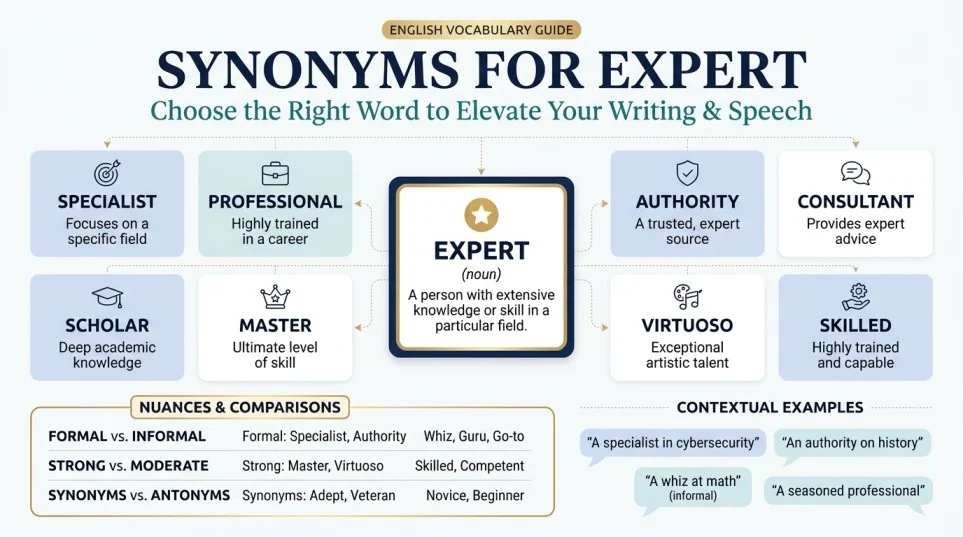
An expert is someone with extensive knowledge, advanced skills, or considerable experience in a particular subject. Common synonyms include specialist, authority, professional, skilled person, and master. Use specialist for focused knowledge, professional for workplace experience, and authority for recognized expertise.
Meaning, Tone and Context
The word expert describes a person who knows a subject very well or can perform a task with a high level of skill.
Simple definition
An expert is someone who has developed strong knowledge or ability through education, training, practice, or experience.
For example, a cybersecurity expert understands digital threats and knows how to protect computer systems.
Part of speech
Expert can function as both a noun and an adjective.
| Word form | Meaning | Example |
|---|---|---|
| Expert as a noun | A person with specialized knowledge or skill | We consulted an expert about the problem. |
| Expert as an adjective | Showing a high level of skill | She provided expert advice. |
| Expertise | Advanced knowledge or skill | He has expertise in digital marketing. |
| Expertly | In a highly skilled way | The technician expertly repaired the device. |
Tone and formality
Expert usually has a positive or neutral tone. It communicates competence, knowledge, and experience without automatically suggesting that someone is the best in the world.
The word works well in professional reports, academic discussions, job applications, interviews, and everyday conversations.
Common use cases
You can use expert when describing:
- Someone with deep knowledge of a specific subject.
- A person who can solve difficult technical problems.
- A professional who provides specialized advice.
- Someone who performs a task with exceptional skill.
- A recognized authority in a particular field.
The most suitable synonym depends on what you want to emphasize: knowledge, practical ability, professional experience, or public recognition.
When and How to Use Expert
Use expert when a person’s knowledge or skill is directly relevant to the subject being discussed. Choose a more specific word when you know whether the person is a specialist, experienced practitioner, or recognized authority.
Professional example
Our company hired a cybersecurity expert to review its security systems.
Academic example
The researchers consulted an authority on early American literature.
Casual conversation
My brother is a whiz at fixing computers.
Resume example
Experienced marketing professional with strong skills in campaign planning and audience research.
Another Word for Expert
The best single replacement for expert is usually specialist when you mean someone with deep knowledge of a particular subject. However, other alternatives may communicate experience, authority, or exceptional ability more accurately.
| Situation | Best alternative | Why it works |
|---|---|---|
| Professional writing | Specialist | Emphasizes focused knowledge |
| Academic writing | Scholar | Highlights advanced study and research |
| Casual conversation | Whiz | Sounds friendly and informal |
| Emotional or expressive writing | Master | Conveys exceptional ability |
| Creative writing | Virtuoso | Suggests outstanding artistic or technical skill |
| Resume or workplace | Experienced professional | Highlights relevant work experience |
| Social media captions | Pro | Short, familiar, and confident |
| Stronger meaning | Authority | Suggests recognized knowledge and credibility |
| Softer meaning | Skilled individual | Communicates ability without overstating expertise |
Choosing the right alternative
For business communication, specialist and consultant are useful when they match the person’s role. For research, scholar or subject matter authority may be more precise. In casual speech, whiz and pro sound natural.
For a resume, avoid calling yourself a master unless your achievements support that description. Specific skills, measurable results, and relevant experience usually provide stronger evidence of competence.
When Not to Use Expert
Although expert is useful in many situations, it can sound too general when the reader needs specific information about a person’s knowledge or ability.
1. When a specific job title is better
Instead of saying:
She is an expert in medical care.
Write:
She is a registered nurse with experience in emergency care.
The second sentence provides clearer information about her qualifications and role.
2. When experience does not prove expertise
Someone may have years of experience without advanced knowledge in every part of a field. Use experienced professional when you want to describe work history without making a stronger claim.
3. When the tone is too casual
Calling someone a whiz may work in conversation, but it can sound too informal in a research paper or business report. Use specialist or skilled professional instead.
4. When the word sounds too vague
The sentence He is an expert at work does not explain what the person does well.
A more precise version is He is a skilled project manager who consistently delivers projects on time.
Specific details make the statement more useful and convincing.
Words Commonly Confused With Expert
Several words are related to expert, but they do not always mean the same thing.
| Word | Main difference | When to use it |
|---|---|---|
| Specialist | Has focused knowledge in a particular area | Medical care, technology, law |
| Professional | Works in a field or meets its professional standards | Careers and business communication |
| Consultant | Provides advice or guidance | Business, management, and strategy |
| Scholar | Has advanced knowledge, often through academic study | Research and education |
| Authority | Is recognized as knowledgeable on a subject | Public statements and specialist discussions |
| Skilled | Can perform a task well | Practical abilities and job descriptions |
The important distinction is that expert emphasizes knowledge or ability, while the other words may emphasize a person’s role, training, academic work, or reputation.
Best Synonym by Context for Expert
The best synonym depends on the situation, the person’s actual qualifications, and the impression you want to create.
| Context | Best synonym | Why it works | Example |
|---|---|---|---|
| Formal writing | Specialist | Sounds precise and professional | The specialist reviewed the proposal. |
| Academic writing | Scholar | Highlights academic knowledge | The scholar examined historical records. |
| Business communication | Consultant | Suggests an advisory role | We hired a consultant to improve operations. |
| Resume | Experienced professional | Emphasizes relevant work history | Experienced professional in customer relations. |
| Casual conversation | Whiz | Friendly and conversational | Maya is a whiz at spreadsheets. |
| Creative writing | Virtuoso | Suggests extraordinary skill | The pianist performed like a virtuoso. |
| Emotional praise | Master | Expresses admiration for exceptional ability | She is a master of her craft. |
| Strong authority | Leading authority | Suggests recognized expertise | He is a leading authority on climate policy. |
| Moderate skill | Skilled individual | Describes ability without exaggeration | A skilled individual completed the repair. |
| Social media captions | Pro | Short and familiar | Tips from a photography pro. |
| Technical work | Technician or specialist | Identifies practical or focused competence | The technician repaired the equipment. |
| Medical settings | Specialist | Identifies a focused area of practice | She visited a heart specialist. |
| Legal discussions | Legal professional | Emphasizes professional background | Ask a legal professional for guidance. |
| Research projects | Subject matter expert | Highlights knowledge of a defined topic | The team consulted a subject matter expert. |
These recommendations are based on typical usage. A person’s actual role and qualifications should determine which title is appropriate.
Which Synonym Should You Choose?
Use these simple questions to select a suitable alternative.
Are you describing knowledge?
Choose specialist, scholar, or authority, depending on the person’s field and level of recognition.
Are you describing a work role?
Choose professional, consultant, or technician when the person’s job or service matters.
Are you writing for school or research?
Choose scholar, researcher, or specialist when the description matches the person’s work.
Are you speaking casually?
Choose pro, whiz, or ace when the relaxed tone suits the audience.
Do you need a stronger description?
Choose master or virtuoso only when exceptional skill is genuinely supported by the context.
Always consider the sentence as a whole. A synonym should improve clarity, not simply make a sentence sound more impressive.
Real Life Examples of Expert in Sentences
Here are practical examples showing how different alternatives work across common situations.
| Situation | Example sentence |
|---|---|
| School | The teacher invited a science specialist to explain the experiment. |
| Workplace | Our team consulted an experienced professional before changing the process. |
| Writing | The article features insights from a leading authority on nutrition. |
| Conversation | My cousin is a whiz at solving puzzles. |
| Social media | Learn these simple editing tricks from a photography pro. |
| Resume | Digital marketing specialist with experience in search optimization and content strategy. |
| We would appreciate your advice on this technical issue. | |
| Storytelling | The master craftsman shaped the wood with remarkable precision. |
These examples show why one synonym cannot replace expert in every sentence. The best choice depends on whether you are describing knowledge, practical ability, professional status, or exceptional performance.
18 Synonyms for Expert
The following 18 words and expressions offer useful alternatives. Some describe a person directly, while others emphasize a particular kind of skill, knowledge, or professional experience.
| Synonym | Simple meaning | Best used for | Example sentence |
|---|---|---|---|
| Specialist | Someone with focused knowledge | Technical and professional fields | The specialist identified the software issue. |
| Authority | A person widely recognized for knowledge | Research and public discussion | She is an authority on modern architecture. |
| Professional | Someone working in a field with relevant skills | Careers and workplace writing | We hired a professional to assess the damage. |
| Master | Someone with exceptional skill | Crafts, arts, and advanced abilities | He is a master of classical piano. |
| Virtuoso | A highly accomplished performer | Music and artistic skills | The violinist performed like a virtuoso. |
| Scholar | A person with advanced academic knowledge | Education and research | The scholar published a study of ancient history. |
| Consultant | Someone who provides specialized advice | Business and management | A consultant helped us improve customer service. |
| Connoisseur | Someone with refined knowledge and taste | Art, food, wine, and collectibles | She is a connoisseur of fine art. |
| Professional practitioner | Someone trained to perform work in a field | Formal and workplace contexts | The professional practitioner explained the process. |
| Technician | Someone skilled in technical tasks | Equipment, systems, and repairs | A technician fixed the damaged network cable. |
| Skilled individual | Someone who performs tasks well | General ability and job descriptions | A skilled individual completed the installation. |
| Experienced professional | Someone with substantial work experience | Resumes and recruitment | An experienced professional led the project. |
| Ace | Someone exceptionally good at something | Informal conversation | Jordan is an ace at troubleshooting computers. |
| Whiz | Someone naturally or highly skilled at a task | Casual speech | She is a math whiz. |
| Pro | A skilled person or professional | Casual speech and captions | Ask a photography pro for lighting advice. |
| Savant | Someone with exceptional ability in a specific area | Carefully qualified descriptions | The film portrays him as a musical savant. |
| Adept | Highly skilled at a particular activity | Describing ability | She is adept at handling difficult negotiations. |
| Subject matter expert | Someone with deep knowledge of a defined topic | Business, research, and technical work | The subject matter expert reviewed the training materials. |
Usage tip: Specialist, professional, consultant, and subject matter expert are practical choices for workplace writing. Ace, whiz, and pro suit casual situations. Master and virtuoso suggest a particularly high level of skill, so use them when the context supports that meaning.
Synonym Groups and Usage Differences
Different groups of synonyms serve different purposes. Understanding these differences helps you choose a word that fits the audience and communicates the right level of ability.
Professional vs. Personal Synonyms
Professional synonyms describe expertise in a work related setting. Specialist, consultant, professional, and subject matter expert are useful when discussing careers, services, and business responsibilities.
Personal descriptions can sound warmer or more expressive. Whiz, ace, and master may communicate admiration for someone’s ability without focusing on their formal job title.
Example: She is a specialist in data analysis is appropriate for a professional profile. She is a whiz at analyzing data sounds more relaxed and conversational.
Formal vs. Conversational Synonyms
Formal words are useful in reports, essays, proposals, and professional emails. Conversational words work better in everyday speech, informal messages, and friendly captions.
| Formal option | Conversational option | Best setting |
|---|---|---|
| Specialist | Whiz | Technical ability |
| Authority | Pro | Knowledgeable person |
| Consultant | Ace | Someone especially good at a task |
| Scholar | Brainiac | Academic knowledge in casual conversation |
| Experienced professional | Skilled person | General work experience |
Brainiac is informal and may sound playful or even dismissive, depending on the situation. Use it carefully.
Academic Synonyms
Academic writing benefits from words that describe a person’s actual role or contribution.
- Scholar: Best for someone engaged in advanced study or academic research.
- Researcher: Best for someone who investigates questions and develops evidence.
- Specialist: Best for someone with focused knowledge in a subject.
- Authority: Best when the person has recognized credibility in the field.
- Subject matter expert: Best when a person contributes detailed knowledge of a specific topic.
Do not use scholar simply because someone knows a lot about a subject. The word usually carries an academic meaning.
Professional and Business Synonyms
In workplace communication, the best word often depends on the service the person provides.
A consultant advises an organization. A technician handles technical tasks. A specialist focuses on a defined area. A subject matter expert contributes deep knowledge to a project or decision.
For resumes, describe your skills directly. Instead of writing I am an expert in customer service, consider Experienced customer service professional with a record of resolving complex customer issues. Add measurable results when you can support them.
Creative or Literary Synonyms
Creative writing often benefits from more expressive alternatives.
- Virtuoso: Suggests remarkable technical or artistic performance.
- Master: Communicates exceptional command of a craft.
- Connoisseur: Suggests refined taste and detailed appreciation.
- Ace: Creates a lively, informal description of ability.
- Savant: Suggests unusual or extraordinary ability in a particular area.
Choose words that match the character, setting, and intended tone. A virtuoso fits a brilliant musician better than an experienced office administrator.
Slang or Modern Synonyms
Pro, whiz, and ace are familiar, informal alternatives in American English.
Examples include:
- He is a pro at editing videos.
- My sister is a whiz with numbers.
- She is an ace at organizing events.
These words work well in conversations, friendly messages, and social media captions. For academic papers, formal reports, or serious business proposals, use a more precise term.
Strongest vs. Weaker Synonyms
There is no universal ranking because these words describe different kinds of expertise. However, the following guide shows how their typical emphasis differs.
From general ability to exceptional skill
1
Skilled
Shows that someone can perform a task well.
2
Experienced professional
Highlights practical work experience.
3
Specialist
Emphasizes focused knowledge.
4
Authority
Suggests recognized expertise and credibility.
5
Master or virtuoso
Expresses exceptional command of a skill or craft.
This is a practical guide, not a strict scale. An authority may have greater recognition than a master in some fields, while a virtuoso usually refers to exceptional performance rather than broad knowledge.
Emotional vs. Neutral Synonyms
Neutral words describe ability without adding much emotion. Specialist, professional, technician, and researcher are useful when accuracy matters most.
More expressive words communicate admiration or a particular impression. Master and virtuoso suggest outstanding achievement, while whiz and ace add a friendly tone.
For example, The technician repaired the system is factual. The master craftsman restored the antique cabinet suggests exceptional skill and invites admiration.
Antonyms of Expert
Expert does not have one perfect opposite in every context. The following 15 words and expressions describe limited knowledge, low skill, or a lack of experience. Some are contextual opposites rather than exact dictionary antonyms.
| Antonym | Meaning | Example sentence |
|---|---|---|
| Beginner | Someone just starting to learn | The beginner needed help with the software. |
| Novice | Someone with little experience | As a novice, he practiced the basics daily. |
| Amateur | Someone who lacks professional status or training in a field | The amateur photographer was still learning studio lighting. |
| Layperson | Someone without specialized knowledge of a subject | The guide explains the science for a layperson. |
| Nonexpert | Someone who is not an expert | The presentation was designed for nonexperts. |
| Inexperienced person | Someone with limited practical experience | An inexperienced person may need additional guidance. |
| Unskilled person | Someone lacking the skills needed for a task | The job requires training for an unskilled person. |
| Trainee | Someone learning how to perform a job | The trainee observed the technician carefully. |
| Apprentice | Someone learning a trade under guidance | The apprentice learned traditional woodworking techniques. |
| Learner | Someone acquiring knowledge or skills | Every learner needs time to practice. |
| Ignoramus | An insulting term for someone considered ignorant | He unfairly called his colleague an ignoramus. |
| Amateurish person | Someone whose work lacks professional quality | The reviewer described the presentation as amateurish. |
| Incompetent person | Someone unable to perform a task adequately | An incompetent manager may struggle to meet basic goals. |
| Unqualified person | Someone without the required qualifications | An unqualified person should not perform the procedure. |
| Untrained person | Someone who has not received the necessary training | An untrained person should seek instruction before using the equipment. |
Choose the opposite that matches the intended meaning. Beginner refers to learning stage, inexperienced refers to limited practice, and unqualified refers to missing required credentials. Ignoramus is insulting and should generally be avoided in respectful communication.
Comparison: Expert vs. Similar Words
Expert vs. Specialist
A specialist focuses on a particular area, while expert describes a high level of knowledge or skill more generally. Specialist is often more specific about a person’s field.
Example: She is an expert in technology. She is a specialist in cloud security.
Expert vs. Professional
Expert emphasizes knowledge or ability. Professional often describes someone’s occupation, training, conduct, or work standards.
Example: He is an expert at repairing watches. He is a professional watchmaker.
Expert vs. Authority
An expert has strong knowledge or skill. An authority is generally recognized as a credible source of knowledge on a subject.
Example: She is an expert in renewable energy systems. She is a leading authority on renewable energy policy.
Expert vs. Consultant
Expert describes a person’s level of knowledge. Consultant describes a role that often involves advising clients or organizations.
Example: The expert explained the technical problem. The consultant recommended a new business strategy.
Expert vs. Scholar
An expert may gain knowledge through practical work, education, or experience. A scholar usually has a strong connection to academic study, research, or intellectual work.
Example: The mechanic is an expert in engine repair. The scholar researches the history of engineering.
Expert vs. Master
Expert is a broad term for someone with advanced knowledge or skill. Master often suggests exceptional command of a craft or discipline.
Example: She is an expert in graphic design. She is a master of traditional calligraphy.
These distinctions are useful, but the words can overlap. Always choose the term that best reflects the person’s actual skills, role, and recognition.
Common Phrases and Expressions with Expert
1. Subject matter expert
Meaning: A person with deep knowledge of a particular topic.
Example sentence: We invited a subject matter expert to review the training materials.
2. Expert advice
Meaning: Guidance provided by someone with relevant knowledge or experience.
Example sentence: Seek expert advice before making a major structural change.
3. Expert opinion
Meaning: An assessment from someone with specialized knowledge.
Example sentence: The committee requested an expert opinion on the proposed design.
4. Expert knowledge
Meaning: Detailed understanding of a particular subject.
Example sentence: The role requires expert knowledge of network security.
5. Expert witness
Meaning: A qualified person who provides specialized evidence or opinions in a legal proceeding.
Example sentence: The court heard testimony from an expert witness.
6. Expert analysis
Meaning: A detailed assessment based on relevant knowledge and experience.
Example sentence: The report includes expert analysis of market trends.
7. Expert guidance
Meaning: Direction or support from someone with relevant expertise.
Example sentence: Expert guidance helped the team avoid costly mistakes.
8. Expert level
Meaning: A level of knowledge or performance associated with advanced ability.
Example sentence: The course teaches advanced techniques for expert level users.
In formal writing, these phrases work best when the person’s relevant qualifications or experience support the claim.
Common Mistakes to Avoid
1. Using expert when a more precise word is available
Calling someone an expert does not explain their exact area of knowledge.
Better: Replace He is a computer expert with He specializes in network security when that description is accurate.
2. Confusing expertise with experience
Experience refers to time spent doing something. Expertise refers to advanced knowledge or skill. A person may have years of experience without being an expert in every aspect of a field.
3. Using casual words in formal writing
Words such as whiz and ace can sound unprofessional in research papers, business proposals, and formal reports. Choose specialist, professional, or authority when appropriate.
4. Overstating someone’s ability
Master, virtuoso, and leading authority can make strong claims. Do not use them simply to make a description more impressive.
5. Repeating expert too often
Repeated wording can make an article or resume feel monotonous. Alternate between expert, specialist, experienced professional, and other accurate terms when the meaning supports them.
6. Choosing the wrong emotional tone
A word such as ignoramus can insult someone, while virtuoso can sound overly dramatic in an ordinary workplace setting. Consider the audience and purpose before selecting a synonym.
FAQs
1. What is the best synonym for expert?
Specialist is often the best synonym for expert when describing focused knowledge. Authority, professional, and master may work better when recognition, work experience, or exceptional skill matters.
2. What is a formal synonym for expert?
Specialist, authority, and subject matter expert are useful formal alternatives. Choose the one that accurately reflects the person’s knowledge, qualifications, and professional role.
3. What is an informal synonym for expert?
Whiz, ace, and pro are common informal alternatives in American English. They work well in conversations, friendly messages, and casual captions.
4. What is another word for expert in professional writing?
Specialist is a strong general choice. Consultant suits advisory roles, while experienced professional highlights work history and subject matter expert emphasizes detailed knowledge.
5. What is the difference between an expert and a specialist?
An expert has advanced knowledge or skill, while a specialist focuses on a particular field. A specialist may also be an expert in that area.
6. What is the opposite of expert?
Beginner, novice, and nonexpert are useful opposites, depending on context. Inexperience describes limited practical experience, while unqualified means someone lacks required qualifications.
Conclusion
The best synonyms for expert depend on what you want to communicate. Specialist works well for focused knowledge, professional suits workplace descriptions, authority suggests recognized credibility, and master or virtuoso expresses exceptional skill.
When writing a resume, essay, business email, or social media caption, consider the person’s actual abilities and the tone your audience expects. A precise word is more effective than an impressive word that does not fit.
Discover More Post:
- 50+ Synonyms for Dedication | Meanings, Examples, and Best …
- 50+ Synonyms for For | Expert Word Choices to Elevate Your …
- 50+ Synonyms for Vivid | Meanings, Examples, and Best …