Do you find yourself using the word later again and again in emails, essays, conversations, or social media captions? Although it is simple and useful, repeating the same word can make your writing less clear or less interesting. Choosing a better alternative can help you express time, plans, and future events more precisely.
Learning synonyms for later helps you match your words to the situation. For example, subsequently works well in formal writing, afterward sounds natural in everyday conversation, and eventually suggests that something happens after a period of time. This guide explains the meaning of later, its best alternatives, common mistakes, and practical examples. You will learn how to choose words that sound natural in American English and fit your purpose.
What Does Later Mean?
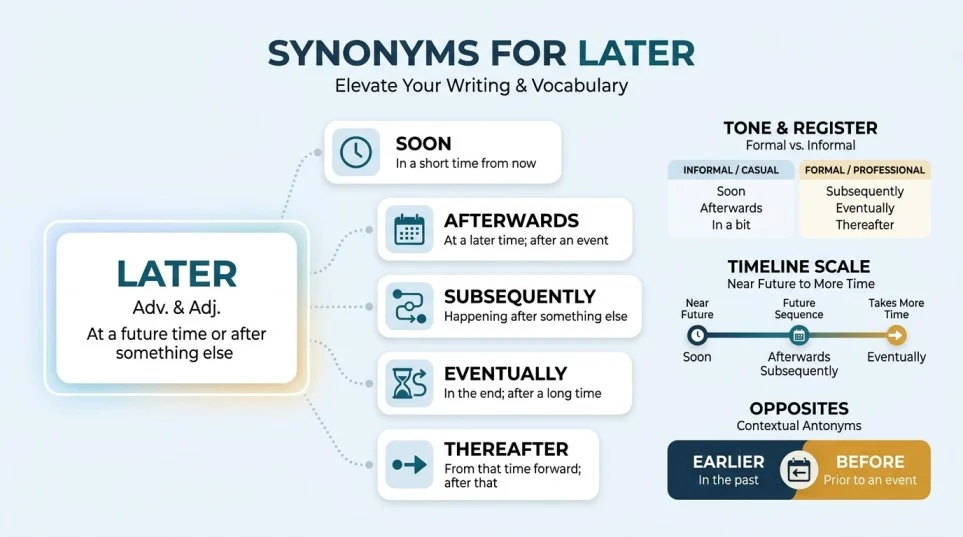
Later means at a time after the present moment or after another event. Common synonyms include afterward, subsequently, eventually, and at a later time. Use subsequently in formal writing, afterward in conversation, and eventually when an outcome takes time to happen.
Meaning, Tone and Context
The word later is commonly used to describe a time that comes after now or after a specific event. It can refer to a few minutes, several days, or a much longer period.
Simple Definition
Later means after the current time or after something else has happened.
Example: I will finish my homework later.
This sentence means the homework will be completed at a future time, but the exact time is not specified.
Part of Speech
Later is most commonly used as an adverb. It is also the comparative form of the adjective late.
Examples:
- We talked later that evening. Here, later is an adverb.
- I arrived later than my friends. Here, later compares the arrival times.
Tone and Formality
Later usually has a neutral tone. It works in casual conversations, professional emails, school assignments, and everyday writing.
However, its meaning can change slightly depending on the sentence. In some contexts, it describes a planned delay. In others, it refers to an event that happens after a long period.
Common Use Cases
You can use later when talking about:
- Future plans, such as calling someone later.
- Events that happen in sequence, such as reviewing a report later.
- Delayed actions, such as completing a task later.
- Changes over time, such as learning a skill later in life.
- A future point in a story, such as meeting a character later in the novel.
Important Word Forms
| Word | Meaning | Example |
|---|---|---|
| Late | After the expected time | She arrived late. |
| Later | At a time after now or another event | We will discuss it later. |
| Latest | Most recent or occurring after all others | Read the latest report. |
| Lately | Recently or during the recent period | I have been busy lately. |
| Lateness | The state of arriving or happening late | His lateness delayed the meeting. |
Remember that later and lately are not interchangeable. Later refers to a future or subsequent time, while lately usually refers to the recent past.
When and How to Use Later
The word later is useful when the exact time does not matter or when the speaker wants to leave the schedule flexible.
Here are realistic examples from different situations.
Professional: We will review the proposal later this afternoon.
Personal: I am busy right now, but I can call you later.
Academic: The study examines this question later in the discussion.
Social media: More photos from the trip coming later!
Creative writing: Later that night, she noticed a light in the distance.
Each example uses later to connect an action or event with a future point in time. If the timing or sequence needs to be more precise, another word may work better.
Another Word for Later
The best single replacement for later is often afterward. However, the right choice depends on whether you mean a future time, a sequence of events, a delayed action, or an outcome that takes time.
| Context | Best Alternative | Example |
|---|---|---|
| Professional writing | Subsequently | The team subsequently revised the proposal. |
| Academic writing | Thereafter | The samples were stored and thereafter examined. |
| Casual conversation | Afterward | We can talk afterward. |
| Emotional writing | In time | In time, she learned to trust herself again. |
| Creative writing | Eventually | Eventually, the truth came to light. |
| Resume or workplace use | At a later stage | I reviewed the results at a later stage. |
| Social media captions | Soon | New updates coming soon. |
| Stronger sense of delay | Much later | He returned much later than expected. |
| Softer, flexible timing | At some point | We should catch up at some point. |
These alternatives are not interchangeable in every sentence. Choose the one that expresses your intended timing most clearly.
When Not to Use Later
Later is useful, but it can be too vague when a reader needs a specific time or a clear sequence.
1. When a deadline matters
Vague: I will send the report later.
Clearer: I will send the report by 3 PM.
2. When you describe a sequence in formal writing
Basic: The team collected the data. Later, it analyzed the results.
More formal: The team collected the data and subsequently analyzed the results.
3. When you mean a result that takes time
Basic: She later became a successful writer.
More expressive: She eventually became a successful writer.
4. When the action happens immediately after something else
Vague: We finished dinner and talked later.
More precise: We finished dinner and talked afterward.
5. When writing professional plans
Vague: We will address the issue later.
More useful: We will address the issue during the next review meeting.
The main lesson is simple. Use later when the timing can remain flexible. Choose a more precise expression when deadlines, order, or outcomes matter.
Words Commonly Confused With Later
Several words are close in meaning but communicate different timing or emphasis.
| Word | Main Difference | Example |
|---|---|---|
| Lately | Refers to the recent past | I have been working late lately. |
| Late | Means after the expected time | The train arrived late. |
| Afterwards | Refers to a time following an event | We went for coffee afterward. |
| Eventually | Emphasizes an outcome after time or effort | They eventually reached an agreement. |
| Soon | Means in the near future | The results will arrive soon. |
| Subsequently | Describes something happening after an earlier event, often formally | The policy was subsequently revised. |
Best Synonym by Context for Later
The best synonym depends on the sentence, the intended time, and the reader.
| Context | Best Synonym | Why It Works | Example |
|---|---|---|---|
| Formal writing | Subsequently | Clearly connects events | The agreement was subsequently updated. |
| Academic writing | Thereafter | Marks the next stage | The samples were tested and thereafter examined. |
| Business communication | At a later time | Sounds clear and professional | We can discuss the proposal at a later time. |
| Resume writing | Subsequently | Connects career developments | I subsequently led the regional team. |
| Casual conversation | Afterward | Sounds natural | Let us get lunch afterward. |
| Creative writing | Eventually | Builds a sense of progress | Eventually, the door opened. |
| Emotional writing | In time | Suggests gradual change | In time, the pain became easier to manage. |
| Emphasizing a long delay | Much later | Highlights a significant gap | Much later, they discovered the truth. |
| Gentle or flexible plans | At some point | Leaves timing open | We should meet at some point. |
| Social media captions | Soon | Creates anticipation | New project reveal coming soon. |
| Historical sequence | Thereafter | Shows what followed | Thereafter, the town began to grow. |
| Step by step instructions | Next | Identifies the following action | Next, add the remaining ingredients. |
In American English, afterward is especially common. Afterwards is also correct and widely understood, although it is often associated with British English. Both forms can work in US writing.
Which Synonym Should You Choose?
Use these five checks to select the right alternative.
1. Meaning: If you mean a time after an event, choose afterward. If you mean a result that happens over time, choose eventually.
2. Formality: Use subsequently or thereafter in suitable formal contexts. Use afterward in everyday writing and conversation.
3. Time and intensity: Use soon for the near future. Use much later when a substantial delay matters.
4. Professional value: Replace vague timing with a specific deadline or meeting time whenever possible.
5. Sentence context: Use next for the following step, afterward for the period following an event, and eventually for an outcome reached after time or effort.
A good synonym improves the sentence without changing the intended meaning.
Real Life Examples of Later in Sentences
School: We will review the chapter afterward, once everyone finishes the quiz.
Workplace: The manager subsequently approved the revised budget.
Writing: The author explains the main character’s decision later in the novel.
Conversation: I am finishing an assignment now. Let us talk afterward.
Social media: The full photo collection will be posted soon.
Resume: I subsequently took responsibility for training new employees.
Email: We can arrange a follow up meeting at a later time.
Storytelling: Eventually, the traveler found the village he had been searching for.
Personal growth: In time, she became more confident speaking in public.
Instructions: Next, open the settings menu and select your preferred option.
These examples show that choosing a more exact word can make the timing easier to understand.
18 Synonyms for Later
The following alternatives are useful in different situations. Some express a time after an event, while others emphasize delay, sequence, or a future outcome.
| Synonym | Simple Meaning | Best Used For | Example Sentence |
|---|---|---|---|
| 1. Afterward | After an event | Everyday conversation | We went shopping afterward. |
| 2. Afterwards | At a time following something | General writing | She called me afterward. |
| 3. Subsequently | After something else happens | Formal writing | The company subsequently changed its policy. |
| 4. Thereafter | From that time onward or after that event | Formal and historical writing | Thereafter, the region experienced steady growth. |
| 5. Eventually | After some time or effort | Outcomes and developments | He eventually found a better solution. |
| 6. Soon | In the near future | Immediate future plans | The new website will launch soon. |
| 7. Next | Immediately following in order | Instructions and sequences | Next, enter your account details. |
| 8. Following that | After the specified event | Explanations and reports | Following that, the team reviewed its findings. |
| 9. At a later time | At a future point | Professional communication | We will revisit the issue at a later time. |
| 10. At a later stage | During a future phase | Projects and planning | We will test the feature at a later stage. |
| 11. In due course | At the appropriate future time | Formal communication | You will receive the results in due course. |
| 12. In time | After a period, or before it is too late | Personal growth and outcomes | In time, she learned to manage the workload. |
| 13. Much later | After a considerable delay | Storytelling and timelines | Much later, the family learned what happened. |
| 14. Sometime later | At an unspecified future point relative to an event | Narratives | Sometime later, he returned to the same town. |
| 15. At some point | At an unspecified time | Flexible plans | We should discuss this at some point. |
| 16. Down the road | At a future point | Informal conversation | We may move to a larger office down the road. |
| 17. In the future | At a time that has not yet come | Plans and predictions | We hope to expand the program in the future. |
| 18. In the aftermath | During the period following an important event | Serious events and their consequences | In the aftermath of the storm, residents began rebuilding. |
Important distinction: In the aftermath is appropriate when discussing the consequences or period following a significant event. It is not a general replacement for later in every sentence.
Synonym Groups and Usage Differences
Professional vs. Personal Synonyms
Professional writing benefits from precise timing. Subsequently, at a later stage, and at a later time can help explain project progress or future plans.
Personal communication usually sounds more natural with afterward, soon, or sometime later. Choose a phrase that fits your relationship with the reader and the purpose of the message.
Formal vs. Conversational Synonyms
| Writing Style | Suitable Alternatives | Example |
|---|---|---|
| Reports | Subsequently, thereafter | The results were subsequently reviewed. |
| Essays | Subsequently, eventually | The movement eventually gained support. |
| Speeches | In time, eventually | In time, we will see the results. |
| Casual messages | Afterward, soon | I will text you afterward. |
| Emails | At a later time, in due course | We will share an update in due course. |
Do not make simple sentences unnecessarily formal. In most everyday situations, afterward communicates the message clearly.
Academic Synonyms
Academic writing often describes processes, evidence, and developments in a specific order.
Use subsequently when explaining what happened after a previous finding. Use thereafter when describing a continuing timeline. Use eventually when discussing a result reached after several stages.
Example: The researchers collected the responses and subsequently analyzed the data.
This sentence clearly connects two actions without repeating later.
Professional and Business Synonyms
Business communication requires clear expectations. If you know the deadline, state it directly instead of relying on a vague word.
For example, write We will review the proposal tomorrow rather than We will review the proposal later if tomorrow is the intended time.
For project updates, at a later stage works when the timing depends on progress. In due course works when an update will arrive at an appropriate time, but the exact date is not yet specified.
Creative or Literary Synonyms
Creative writing sometimes needs more than a simple time reference.
Eventually can create suspense before a character reaches a goal. Much later can show a long gap between events. In time can suggest healing, growth, or gradual understanding.
Example: Much later, she returned to the house where her childhood memories began.
This phrase establishes a sense of elapsed time without giving an exact date.
Slang or Modern Synonyms
Some informal expressions communicate future timing in a relaxed way.
| Expression | Meaning | Best Use |
|---|---|---|
| Down the road | At some future point | Casual conversation |
| Catch you later | Goodbye with an expectation of meeting or speaking again | Friendly conversations |
| See you soon | Expectation of meeting in the near future | Informal messages |
| Hit me up later | Contact me at a future time | Very casual American English |
These expressions are suitable for friendly texts and informal conversations. Avoid them in formal essays, academic research, and most professional reports.
Strongest vs. Weaker Synonyms
Later does not have a fixed level of intensity. The alternatives below express different degrees of delay or certainty rather than a strict scale of synonyms.
| Timing or Effect | Expression | Example |
|---|---|---|
| Near future | Soon | I will reply soon. |
| Flexible future | At some point | We should discuss it at some point. |
| After an event | Afterward | We talked afterward. |
| Extended delay | Much later | He returned much later. |
| Outcome after time | Eventually | They eventually agreed. |
Choose an expression based on the actual timing, not simply to make the sentence sound stronger.
Emotional vs. Neutral Synonyms
Neutral expressions describe time without adding much emotion. Subsequently, afterward, and at a later time are useful when factual accuracy matters.
Emotional or reflective expressions can suggest patience, change, or uncertainty. In time often implies gradual personal development, while eventually can suggest relief after a long wait.
Example: In time, she learned to accept the change.
The expression adds a sense of emotional progress that a simple later may not convey.
Antonyms of Later
Later has no single set of direct antonyms because its meaning depends on the sentence. The following table lists 15 contextual opposites and contrasts. Some are opposites in timing, while others contrast with delay or future sequence.
| Antonym or Contrast | Meaning | Example Sentence |
|---|---|---|
| 1. Earlier | Before a particular time | We arrived earlier than expected. |
| 2. Before | At a preceding time | Finish the form before the meeting. |
| 3. Previously | At an earlier time | The policy was previously approved. |
| 4. Formerly | At an earlier period | The building was formerly a school. |
| 5. Previously to | Before a specified event, though less natural than before | The inspection occurred before the launch. |
| 6. Already | By the present time | She has already submitted the report. |
| 7. Now | At the present moment | We need to decide now. |
| 8. Immediately | Without delay | Please respond immediately. |
| 9. Right away | At once | I will handle the request right away. |
| 10. Promptly | Without unnecessary delay | The team responded promptly. |
| 11. Early | Before the expected time | He arrived early for class. |
| 12. In advance | Before a planned event | Please register in advance. |
| 13. Ahead of time | Before the expected time | We completed the project ahead of time. |
| 14. At once | Immediately | Everyone left at once. |
| 15. First | Before other steps or events | Read the instructions first. |
Some expressions are more natural than others in specific sentences. For instance, before is generally preferable to previously to in everyday American English. These are contextual contrasts, not 15 interchangeable dictionary antonyms.
Comparison: Later vs. Similar Words
Later vs. Lately
Later refers to a future or subsequent time. Lately refers to the recent past.
Neither is stronger or more formal in every situation. Both are common in everyday English.
Examples:
Later: I will finish the assignment later.
Lately: I have been finishing assignments late lately.
Later vs. Eventually
Later identifies a time after now or another event. Eventually emphasizes that something happens after a period of time, often following effort or delay.
Eventually often creates a stronger sense of a final outcome. Both words can be used in formal or informal writing.
Examples:
Later: We will discuss the issue later.
Eventually: We eventually solved the issue.
Later vs. Afterward
Both can describe a time following an event. Afterward directly connects the timing to what happened before, while later can be more flexible.
Afterward is often clearer when describing the next part of a sequence.
Examples:
Later: I will call you later.
Afterward: We had dinner and went for a walk afterward.
Later vs. Subsequently
Both can describe an event that occurs after another. Subsequently is more formal and often suits reports, research, and professional writing.
Later is simpler and more conversational.
Examples:
Later: The company changed its plans later.
Subsequently: The company subsequently changed its plans.
Later vs. Soon
Later does not specify how near the future event is. Soon usually suggests that it will happen in the near future.
Soon is more useful when the speaker wants to create an expectation of relatively little waiting.
Examples:
Later: The results will be available later.
Soon: The results will be available soon.
Later vs. Next
Later refers to a time after now or another event, without necessarily identifying the immediate next step. Next often identifies what comes directly after the current step or event.
Next is especially useful for instructions and ordered processes.
Examples:
Later: We will review the remaining chapters later.
Next: Next, review the second chapter.
Common Phrases and Expressions With Later
1. See You Later
Meaning: A casual way to say goodbye, often when you expect to meet or speak again.
Example sentence: I have to get back to work. See you later!
2. Talk to You Later
Meaning: A friendly way to end a conversation when you plan to talk again.
Example sentence: I am heading into a meeting, so I will talk to you later.
3. Sooner or Later
Meaning: At some point in the future, whether soon or after a delay.
Example sentence: Sooner or later, every team must adapt to change.
4. Better Late Than Never
Meaning: It is better to do something late than not do it at all.
Example sentence: You finally submitted your application. Better late than never!
5. Later on
Meaning: At a time further in the future or after another event.
Example sentence: We can watch the movie later on.
6. Much Later
Meaning: After a considerable amount of time.
Example sentence: Much later, the author explained why the story ended that way.
7. See You Soon
Meaning: A friendly goodbye suggesting that you expect to meet again in the near future.
Example sentence: Thanks for visiting. See you soon!
8. Catch You Later
Meaning: An informal way to say goodbye to someone you expect to see or contact again.
Example sentence: I have to leave now. Catch you later!
Common Mistakes to Avoid
1. Confusing Later With Lately
Incorrect: I will call you lately.
Correct: I will call you later.
Use later for a future time and lately for something that has happened recently.
2. Using Later When You Know the Deadline
Unclear: Please send the file later.
Clearer: Please send the file by noon.
Specific times reduce confusion and help people plan their work.
3. Choosing an Overly Formal Synonym
Awkward in casual conversation: I will contact you subsequently.
More natural: I will contact you afterward.
Formal vocabulary is useful only when it fits the audience and purpose.
4. Treating Eventually and Later as Identical
Later simply places something after another time or event. Eventually emphasizes that an outcome happens after some time.
Choose eventually when the process or final result matters.
5. Repeating Later Too Often
Repetitive: We met later, ate later, and went home later.
Improved: We met in the afternoon, ate afterward, and went home that evening.
Vary your wording only when the alternatives preserve the intended meaning.
6. Using Slang in Formal Writing
Expressions such as hit me up later are fine in friendly messages but may sound unsuitable in a business report.
Use contact me afterward or we can discuss this at a later time when a professional tone is needed.
FAQs About Synonyms for Later
1. What is the best synonym for later?
Afterward is often the best general alternative when referring to a time following an event. Eventually is better when you want to emphasize a result reached after time or effort.
2. What is a formal synonym for later?
Subsequently is a strong formal alternative. It works well in reports, academic writing, business documents, and explanations that describe events in sequence.
3. What is an informal synonym for later?
Afterward, soon, and later on are natural informal alternatives. Expressions such as catch you later work well in friendly conversations and casual messages.
4. What is another word for later in professional writing?
Subsequently, at a later time, and at a later stage are useful choices. When a deadline is known, giving the exact date or time is even clearer.
5. What is the difference between later and eventually?
Later identifies a time after now or another event. Eventually emphasizes that something happens after a period of time, often following effort, uncertainty, or delay.
6. What is the opposite of later?
Earlier is one of the closest contextual opposites of later. Before, previously, and immediately can also express contrasting timing, depending on the sentence.
Conclusion
Learning synonyms for later helps you communicate timing more clearly in everyday conversations, academic assignments, professional emails, and creative writing. Afterward works well for events that follow one another, subsequently suits formal writing, and eventually emphasizes an outcome reached over time.
The best synonym depends on your meaning, audience, and intended tone. When timing matters, use a precise expression or give a specific date instead of leaving the reader uncertain.
A simple vocabulary tip: before replacing later, ask yourself whether you mean the next event, the near future, or a result that takes time. That small decision can make your writing more natural and effective.
Discover More Post:
Discover More Post:
- 50+ Synonyms for Dedication | Meanings, Examples, and Best …
- 50+ Synonyms for For | Expert Word Choices to Elevate Your …
- 50+ Synonyms for Vivid | Meanings, Examples, and Best …