When you use the word role repeatedly in an essay, resume, email, or business report, your writing can start to sound repetitive. Choosing a more precise word can make your message clearer and help readers understand exactly what you mean. The right alternative depends on whether you are describing a job, a responsibility, a character in a story, or someone’s influence.
This guide explains synonyms for role with simple meanings, natural examples, and practical advice. You will learn which words work best in professional communication, academic writing, casual conversations, and creative projects. You will also discover common mistakes, useful antonyms, and the differences between similar words. These tips will help you choose vocabulary that sounds natural, accurate, and appropriate for your audience.
What Does Role Mean?
A role is a position, function, responsibility, or character that someone or something has in a particular situation. Common synonyms include position, function, responsibility, duty, part, capacity, and assignment, depending on the context.
Meaning, Tone and Context
What Does Role Mean?
The word role describes the part someone or something plays in a situation. It can refer to a job, a set of responsibilities, a character in a performance, or the effect someone has on an outcome.
For example, a teacher’s role includes helping students learn, while an actor’s role involves portraying a character. In a business project, a team member may have a specific role in reaching a goal.
Part of Speech
Role is a noun. Its plural form is roles.
Examples:
- Her role in the company involves managing customer relationships.
- The actor prepared carefully for his latest role.
- Technology plays an important role in modern education.
Tone and Formality
Role is a neutral word. It works in casual conversations, academic essays, business documents, professional emails, and creative writing.
Its tone depends on the surrounding sentence. The word responsibility emphasizes an obligation, while position often refers to someone’s place in an organization. The word part can sound more conversational or describe participation in an event.
Common Uses of Role
The word appears in several everyday situations.
- Employment: She accepted a leadership role at the company.
- Education: Parents play an important role in children’s learning.
- Entertainment: He received a leading role in the movie.
- Relationships: Trust has a central role in a healthy friendship.
- Projects: Each employee has a defined role on the team.
- Society: Community organizations play a valuable role in local development.
Related Word Forms
| Word | Meaning | Example |
|---|---|---|
| Role | A position, function, or part | Her role involves training new employees. |
| Role based | Organized around specific roles | The team uses role based access controls. |
| Role player | Someone who performs a particular function or character | Each role player received clear instructions. |
| Role playing | Acting out a situation or character | The students practiced through role playing. |
When and How to Use Role
Use role when you want to explain someone’s function, position, participation, or responsibilities. It is especially useful when the exact nature of a person’s contribution depends on the situation.
Here are four realistic examples.
Professional: Her role includes reviewing reports and coordinating with other departments.
Academic: The study examines the role of sleep in student performance.
Personal: My role in the family has changed as the children have grown older.
Creative: The actor played a challenging role in the historical drama.
In each example, role describes a different kind of involvement. A suitable synonym can make the intended meaning more specific.
Another Word for Role
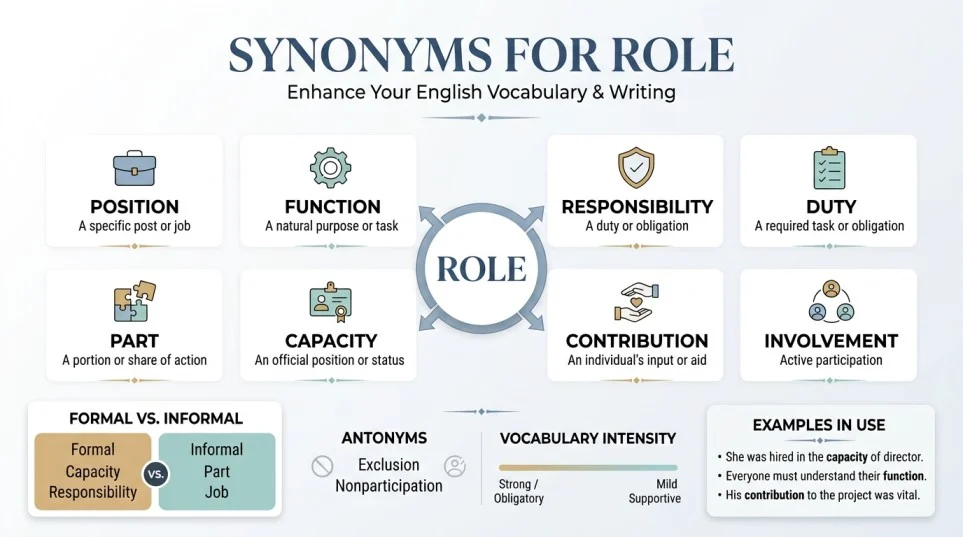
The best alternative depends on what you want to communicate. Position works well for employment, responsibility emphasizes duties, and function describes what someone or something does.
| Context | Best alternative | Example |
|---|---|---|
| Professional writing | Position | She applied for a management position. |
| Academic writing | Function | The research explores the function of memory. |
| Casual conversation | Part | I played a small part in the project. |
| Emotional writing | Contribution | Her contribution meant a great deal to us. |
| Creative writing | Character | The actor developed a memorable character. |
| Resume or workplace | Responsibility | Led the responsibility for coordinating team schedules. |
| Social media captions | Journey or part | Proud to be part of this journey. |
| Stronger meaning | Responsibility | He accepted responsibility for the outcome. |
| Softer meaning | Involvement | Her involvement helped the team succeed. |
For resumes, use natural wording rather than forcing a synonym into every sentence. For example, instead of saying you played a role in improving sales, explain that you helped increase sales or led a sales improvement project, if those statements accurately describe your work.
When Not to Use Role
Although role is versatile, it can sometimes sound too general. A more specific word helps readers understand what a person actually does.
Too vague: She played an important role in the project.
More precise: She coordinated the project schedule and managed communication with clients.
The second sentence identifies her contribution rather than leaving readers to guess.
Too general in academic writing: The role of exercise is important.
More precise: Exercise supports cardiovascular health and helps maintain physical fitness.
The best replacement adds useful information instead of simply changing one word.
Words Commonly Confused With Role
Several words have meanings close to role, but they are not interchangeable in every sentence.
| Word | Main difference | Best use |
|---|---|---|
| Position | A place in an organization or hierarchy | Jobs, titles, and employment |
| Responsibility | A duty or obligation | Tasks and accountability |
| Function | What someone or something does | Systems, processes, and practical purposes |
| Duty | A specific task or obligation | Assigned work and formal obligations |
| Part | Someone’s contribution or place in an activity | Everyday conversation and creative writing |
| Capacity | The particular status or capacity in which someone acts | Legal, professional, and formal situations |
For example, a manager’s position may be department head, their responsibilities may include budgeting, and their functions may include planning and supervision. These words describe related but different aspects of the same job.
Best Synonym by Context for Role
The most useful synonym depends on the setting, the intended meaning, and the level of detail you need.
| Context | Best synonym | Why it works | Example |
|---|---|---|---|
| Formal writing | Capacity | Describes the status in which someone acts | She attended in her capacity as director. |
| Academic writing | Function | Emphasizes purpose or operation | The paper examines the function of language. |
| Business communication | Responsibility | Highlights accountability | Budget planning is one of her responsibilities. |
| Resume | Contribution | Shows the value someone added | My contribution improved customer satisfaction. |
| Job title | Position | Clearly describes employment status | He accepted a senior position. |
| Casual conversation | Part | Sounds natural and conversational | I had a small part in organizing the event. |
| Creative writing | Character | Identifies a person portrayed in a story | Her character drives the central conflict. |
| Emotional writing | Contribution | Recognizes someone’s positive influence | Your contribution made the celebration special. |
| Strong meaning | Duty | Emphasizes an obligation | Protecting the records is a key duty. |
| Softer meaning | Involvement | Describes participation without overstating it | His involvement was limited to research. |
| Social media captions | Part | Fits short, personal messages | Grateful to be part of this team. |
| Legal or official use | Capacity | Clarifies someone’s official status | She signed in her capacity as trustee. |
| Technology | Function | Describes what a component does | This function checks the user’s access. |
| Education | Responsibility | Emphasizes a person’s obligations | Supporting learners is a teacher’s responsibility. |
| Team projects | Assignment | Identifies a specific allocated task | Her assignment was to review the final draft. |
What About US and UK Usage?
Role is common in both American and British English. The spelling does not change between the two varieties.
Words such as job, position, responsibility, and function are also widely understood in both countries. The best choice depends more on meaning and context than on regional spelling.
Which Synonym Should You Choose?
Use these five practical checks before replacing role with another word.
1. Check the meaning. If you mean someone’s job, use position. If you mean what they do, consider function.
2. Consider formality. Capacity may suit official writing, while part often sounds more natural in conversation.
3. Think about responsibility. Use duty or responsibility when someone is expected to complete specific tasks.
4. Show professional value. On a resume, describe your contribution, achievements, or responsibilities instead of using vague wording.
5. Read the whole sentence. A synonym should fit naturally and preserve the original meaning.
The best synonym is not always the most sophisticated one. Clear and accurate wording is usually more effective than an impressive sounding replacement.
Real Life Examples of Role in Sentences
These examples show how to use synonyms for role in everyday situations.
| Situation | Example sentence |
|---|---|
| School | The teacher’s responsibility is to help students understand difficult topics. |
| Workplace | My position requires regular communication with clients. |
| Writing | The function of this paragraph is to introduce the main argument. |
| Conversation | I played a small part in planning the trip. |
| Social media | Happy to be part of such a supportive community. |
| Resume | Coordinated schedules and improved communication across three departments. |
| Please confirm your responsibilities before the project begins. | |
| Storytelling | The character brings humor and warmth to the story. |
| Business | Her contribution helped the company reach its quarterly target. |
| Research | The study investigates the influence of sleep on memory. |
Notice that some examples replace role with a synonym, while others remove the general word entirely. In professional writing, describing the actual task or achievement is often the strongest option.
18 Synonyms for Role
The following 18 words cover employment, responsibilities, participation, creative work, and professional communication. Each has a distinct use.
| Synonym | Simple meaning | Best used for | Example sentence |
|---|---|---|---|
| 1. Position | A place in an organization | Jobs and titles | She accepted a senior position at the firm. |
| 2. Function | The purpose or activity of someone or something | Systems and practical work | The function of this tool is to organize records. |
| 3. Responsibility | Something a person must manage or complete | Work and accountability | Customer support is one of his main responsibilities. |
| 4. Duty | A task or obligation | Formal assignments | It is the nurse’s duty to monitor the patient. |
| 5. Part | Someone’s involvement in an activity | Casual writing and teamwork | Everyone played a part in the success. |
| 6. Capacity | The status in which someone acts | Official and legal contexts | He signed the document in his capacity as owner. |
| 7. Assignment | A task given to someone | School and workplace projects | Her assignment involved reviewing the proposal. |
| 8. Contribution | Something valuable someone adds | Teamwork and achievements | His contribution strengthened the final report. |
| 9. Involvement | Participation in an activity | General participation | Their involvement helped the event run smoothly. |
| 10. Positioning | The way something is placed or presented | Strategy and marketing | The brand’s positioning appeals to younger buyers. |
| 11. Character | A person portrayed in a story or performance | Film, theater, and fiction | She portrayed a complex character on stage. |
| 12. Office | An official position or post | Government and formal organizations | He was elected to public office. |
| 13. Occupation | A person’s regular work or profession | Employment and personal profiles | Teaching is her chosen occupation. |
| 14. Assignment of duties | The allocation of tasks | Management and administration | The assignment of duties was completed before launch. |
| 15. Task | A specific piece of work | Projects and daily activities | My first task was to check the figures. |
| 16. Obligation | Something a person is required to do | Formal and ethical duties | Meeting the deadline is our obligation. |
| 17. Influence | The power to affect an outcome | Social and academic discussion | Family influence can shape early learning. |
| 18. Purpose | The reason something exists or is done | Explanations and analysis | The purpose of this section is to explain the process. |
Some entries are close alternatives only in specific contexts. For example, positioning describes how something is presented, while purpose describes why something exists. Neither replaces role in every sentence.
Synonym Groups and Usage Differences
Professional vs. Personal Synonyms
Professional writing often needs precise terms such as position, responsibility, function, and contribution. These words help explain duties, authority, and measurable work.
Personal writing may benefit from part, involvement, or contribution. These choices can sound warmer when describing someone’s place in a family, friendship, or community.
Compare these examples:
Professional: Her responsibilities include staff training and quality checks.
Personal: She played a special part in our family’s celebration.
Formal vs. Conversational Synonyms
Formal language is useful when precision and accountability matter. Capacity, function, obligation, and responsibility often fit reports, academic work, and official communication.
Conversational language usually favors simple words such as part, job, and task. These words make everyday messages easy to understand.
For example, say I played a part in the event in a casual conversation. In a formal report, explain your specific contribution instead.
Academic Synonyms
Academic writing benefits from function, influence, contribution, and responsibility. These words can make an argument more precise when they match the evidence.
Consider the difference:
General: The role of sleep in learning is important.
More precise: Sleep influences memory formation and learning.
The revised sentence gives readers a clearer idea of the relationship being discussed. For research writing, make sure the statement reflects what the evidence actually supports.
Professional and Business Synonyms
In workplace communication, choose words that identify actual duties or results.
Use position for a job, responsibility for an obligation, assignment for allocated work, and contribution for value added to a project.
Resume example:
General: Played an important role in improving team performance.
Stronger: Coordinated weekly training sessions and helped improve team performance.
The second version is more informative because it identifies the action taken. Only include results you can support with accurate details.
Creative or Literary Synonyms
Creative writing uses words that help readers picture a character or understand someone’s importance in a story.
Character is ideal for a person in a novel or movie. Part works for someone’s place in a larger story, while influence highlights how one person affects another.
Example: Her character brings courage and humor to an otherwise serious story.
Slang or Modern Synonyms
There is no single slang word that accurately replaces role in every situation. Informal expressions such as gig, job, or part may work when discussing temporary work or casual participation.
For example, gig commonly describes a temporary job or paid performance. It should not replace role in a formal report unless the meaning fits.
Avoid trendy expressions when a clear, familiar word communicates the idea better.
Strongest vs. Weaker Synonyms
Synonyms differ in emphasis, but they do not form a perfect scale in every context.
| Level of emphasis | Word | What it emphasizes |
|---|---|---|
| Mild | Involvement | Participation |
| Moderate | Part | A place in an activity |
| Clear | Function | Purpose or activity |
| Strong | Responsibility | Accountability |
| Very strong | Obligation | A duty that must be fulfilled |
A stronger word is not automatically better. Use obligation only when a genuine requirement exists, rather than simply to make a sentence sound more forceful.
Emotional vs. Neutral Synonyms
Neutral words describe facts without adding much emotion. Position, function, task, and assignment usually work this way.
Words such as contribution and influence can suggest that someone’s actions mattered. Their emotional effect depends on the surrounding sentence.
Neutral: She completed her assigned tasks.
More appreciative: Her contribution helped the entire team succeed.
Choose the second version when recognition or appreciation is part of your message.
Antonyms of Role
Role has several meanings, so it does not have one universal opposite. The following words can express contrasting ideas in particular contexts, such as participation versus exclusion or responsibility versus freedom from obligation.
| Antonym or contrast | Meaning | Example sentence |
|---|---|---|
| 1. Exclusion | Being left out | His exclusion from the team limited his participation. |
| 2. Nonparticipation | Not taking part | Her nonparticipation affected the group discussion. |
| 3. Inactivity | Lack of activity | Inactivity prevented the project from progressing. |
| 4. Irrelevance | Lack of connection or importance | The detail’s irrelevance made it unnecessary. |
| 5. Disengagement | Withdrawal from involvement | Employee disengagement reduced team collaboration. |
| 6. Neglect | Failure to give proper attention | Neglect of the task caused delays. |
| 7. Abandonment | Giving up a task or responsibility | Abandonment of the project left the team without direction. |
| 8. Withdrawal | Removing oneself from participation | Her withdrawal changed the team’s plans. |
| 9. Unemployment | The state of not having a job | Unemployment affected his financial stability. |
| 10. Uninvolvement | Lack of participation | His uninvolvement in the decision was clear. |
| 11. Powerlessness | Lack of authority or control | Powerlessness prevented her from changing the policy. |
| 12. Incapacity | Inability to perform a function | Temporary incapacity kept him from completing the task. |
| 13. Exemption | Freedom from a duty or requirement | The exemption released her from that obligation. |
| 14. Irresponsibility | Failure to act responsibly | Irresponsibility damaged trust within the team. |
| 15. Misconduct | Improper or unacceptable behavior | The investigation examined the employee’s misconduct. |
These are contextual contrasts, not exact dictionary antonyms of role. For example, unemployment contrasts with an employment role, while exclusion contrasts with participation. Choose an opposite based on the specific meaning you intend.
Comparison: Role vs. Similar Words
Role vs. Position
A role describes what someone does or the part they play. A position identifies their place in an organization or hierarchy.
Position is more specific when discussing job titles. Role is broader because it can describe responsibilities, social relationships, or a character in a performance.
Examples:
Role: Her role involves training new staff.
Position: Her position is training manager.
Role vs. Responsibility
Role describes a broader area of involvement. Responsibility identifies a particular duty or obligation within that area.
Responsibility is more specific when accountability matters, while role is useful when describing someone’s overall contribution.
Examples:
Role: His role includes supporting the sales team.
Responsibility: His responsibility is to prepare the weekly sales report.
Role vs. Function
Role describes the part something plays in a larger situation. Function focuses on what it does or what purpose it serves.
Function is often more technical and precise in academic or business explanations.
Examples:
Role: The department plays a central role in company planning.
Function: The department’s main function is to coordinate company planning.
Role vs. Duty
A role can include several activities, relationships, and expectations. A duty is a particular task or obligation.
Duty can sound more formal and may suggest that a task is required.
Examples:
Role: Her role includes managing the office.
Duty: One of her duties is to maintain accurate records.
Role vs. Part
Part often describes participation or a contribution to an event. Role can also describe a character, a job, or a set of responsibilities.
Part usually sounds more conversational, while role works in both formal and informal settings.
Examples:
Role: He plays a leadership role in the project.
Part: He played a part in organizing the event.
Role vs. Capacity
Role describes a person’s function or responsibilities. Capacity identifies the status or authority under which the person acts.
Capacity is particularly useful in legal, administrative, and official writing.
Examples:
Role: She has a role in approving company policies.
Capacity: She signed the agreement in her capacity as company director.
Common Phrases and Expressions with Role
1. Play a Role
Meaning: To contribute to a situation or outcome.
Example sentence: Regular exercise plays a role in maintaining good health.
2. Play an Important Role
Meaning: To have a meaningful effect or contribution.
Example sentence: Clear communication plays an important role in successful teamwork.
3. Take on a Role
Meaning: To accept a new position or set of responsibilities.
Example sentence: Maya agreed to take on a leadership role.
4. Assume a Role
Meaning: To begin acting in a particular position or capacity.
Example sentence: He assumed the role of project coordinator.
5. Fulfill a Role
Meaning: To perform the expected duties of a position.
Example sentence: The supervisor worked hard to fulfill her role effectively.
6. Define a Role
Meaning: To explain the responsibilities and boundaries of a position.
Example sentence: The company needs to define each employee’s role clearly.
7. Role Model
Meaning: A person whose behavior others admire or seek to follow.
Example sentence: Her former teacher became a role model for her career.
8. Leading Role
Meaning: The main character or most prominent position in a performance or activity.
Example sentence: The young actor earned a leading role in the production.
Common Mistakes to Avoid
1. Using Role When a Specific Word Is Better
Weak: My role was important to the project.
Better: I managed the project schedule and coordinated the team.
Name the actual task when you want to explain your contribution.
2. Confusing Role With Position
A position often describes a job title, while a role describes what someone does within that job.
For example, project manager is a position. Planning deadlines and coordinating employees are parts of that person’s role.
3. Using Casual Language in Formal Writing
Words such as gig or job may fit a conversation but may be too informal for an academic report or official document.
Choose position, responsibility, or function when the context requires more formal language.
4. Making a Simple Situation Sound Too Dramatic
Obligation can imply a firm duty. Do not use it when you simply mean participation or assistance.
Instead of saying, Her obligation was to attend the gathering, write, Her part was to help organize the gathering, if that reflects the situation.
5. Repeating Role Too Often
Repeated wording can make an essay or report less engaging. Replace some instances with precise alternatives such as function, responsibility, contribution, or position.
Do not replace every occurrence automatically. Repetition is acceptable when role remains the clearest word.
6. Choosing a Synonym With the Wrong Meaning
Influence describes the ability to affect something, while function describes a purpose or activity. They are not interchangeable in every sentence.
Always check whether the replacement preserves the original meaning.
FAQs
1. What Is the Best Synonym for Role?
Position is a strong choice for employment, responsibility works for duties, and function suits practical purposes. The best alternative depends on the sentence.
2. What Is a Formal Synonym for Role?
Capacity, position, and function are useful formal alternatives. Choose capacity for official status, position for organizational standing, and function for a practical purpose.
3. What Is an Informal Synonym for Role?
Part is a natural informal alternative when discussing participation. Job can work when referring to employment, while task describes a specific piece of work.
4. What Is Another Word for Role in Professional Writing?
Responsibility, position, function, and contribution are useful in professional writing. Use responsibility for duties and contribution when describing your value to a team.
5. What Is the Difference Between Role and Responsibility?
A role is a broader function or part someone plays, while a responsibility is a specific duty or obligation within that role.
6. What Is the Opposite of Role?
Role has no single universal opposite. Depending on the meaning, exclusion, nonparticipation, or disengagement can express the opposite of involvement in a situation.
Conclusion
The word role describes a person’s position, function, responsibility, or part in a situation. Its best synonyms depend on what you want to express and how formal your writing needs to be.
Use position for employment, function for purpose, responsibility for duties, contribution for achievements, and part for everyday participation. In creative writing, character may be the better choice when describing someone in a story.
The most useful vocabulary tip is to choose the word that explains the meaning most clearly. Before replacing role, ask yourself whether you are describing a job, a task, an obligation, or someone’s influence. This simple habit can make your writing more natural, precise, and professional.
Discover More Post:
- 50+ Synonyms for Dedication | Meanings, Examples, and Best …
- 50+ Synonyms for For | Expert Word Choices to Elevate Your …
- 50+ Synonyms for Vivid | Meanings, Examples, and Best …