Have you ever used the word character several times in an essay, story, email, or social media caption? Finding a better word can make your writing clearer, more natural, and more interesting. The right alternative depends on what you want to describe, such as a person’s personality, moral values, role in a story, or the qualities that make someone unique.
This guide explores synonyms for character with simple definitions, natural examples, and practical advice. You will learn when to use words such as personality, nature, integrity, temperament, and individuality. Whether you are an English learner, student, writer, or professional, these alternatives will help you express your ideas more accurately. You will also discover related words, antonyms, common phrases, and ways to choose the best word for each situation.
What Does Character Mean?
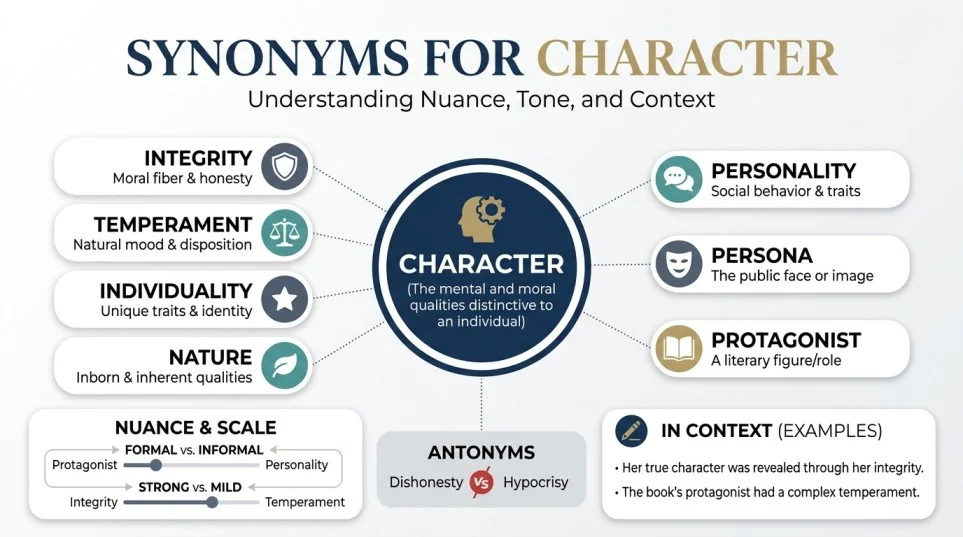
Character refers to a person’s qualities, personality, and moral values. The best synonyms include personality for general traits, integrity for strong moral values, temperament for emotional behavior, protagonist for a main story figure, and figure for a person represented in fiction.
Meaning, Tone and Context
The word character has several meanings. Choosing the right synonym requires understanding which meaning you intend.
1. Simple Definition
Character can describe the qualities that make a person who they are. It may refer to someone’s behavior, values, strengths, weaknesses, or personality.
It can also mean a person in a book, movie, play, or television show. In writing and technology, it may refer to a letter, number, or symbol.
Examples:
- Her honesty shows her strong character.
- The main character learns to trust others.
- Enter your password using at least eight characters.
2. Part of Speech
Character is a noun. Its meaning changes according to the sentence.
| Form | Meaning | Example |
|---|---|---|
| Character | A person’s qualities or a figure in a story | Her character impressed the team. |
| Characters | More than one person in a story or multiple symbols | The novel has several memorable characters. |
| Characteristic | A typical quality or feature | Patience is a useful characteristic. |
| Characterize | To describe someone’s qualities or the nature of something | The author uses dialogue to characterize the hero. |
| Characterization | The way a person or fictional figure is presented | The novel’s characterization feels realistic. |
3. Tone and Formality
Character is a neutral word that works in casual conversation, academic writing, professional communication, and creative work.
Its emotional meaning depends on the context. Strong character often suggests admirable values, while a flawed character may suggest weaknesses or questionable decisions.
4. Common Uses
The word character commonly appears in these situations:
- Personal qualities: She has a generous character.
- Moral values: His character became clear when he admitted his mistake.
- Fiction: The detective is an important character in the novel.
- Public identity: The town has a distinctive character.
- Text and computing: The form accepts 100 characters.
When and How to Use Character
Use character when you want to describe someone’s deeper qualities, discuss a fictional person, or explain the distinctive nature of a place or thing.
Here are four practical examples.
Personal context: Her character became clear when she helped a stranger without expecting anything in return.
Professional context: The hiring manager valued his character, honesty, and willingness to accept responsibility.
Academic context: The author develops the central character through dialogue, conflict, and personal growth.
Creative context: The old neighborhood has a warm character that makes visitors feel welcome.
Notice that character can refer to moral qualities, a fictional person, or the distinctive qualities of a place. The surrounding sentence determines its meaning.
Another Word for Character
The best single replacement for character in a discussion about a person’s general traits is usually personality. However, other words are more accurate when you want to express a specific quality.
| Situation | Best alternative | Example |
|---|---|---|
| Professional writing | Integrity | Her integrity earned the team’s trust. |
| Academic writing | Personality | The study examines personality differences. |
| Casual conversation | Nature | He has a friendly nature. |
| Emotional writing | Spirit | Her spirit remained strong during difficult times. |
| Creative writing | Persona | The narrator adopts a mysterious persona. |
| Resume or workplace | Professionalism | His professionalism impressed the client. |
| Social media captions | Individuality | Celebrate your individuality. |
| Stronger moral meaning | Virtue | Courage is an important virtue. |
| Softer personal meaning | Disposition | She has a cheerful disposition. |
Choosing the Right Alternative
Personality works best when describing someone’s general behavior, preferences, and social style.
Integrity is more precise when you mean honesty, fairness, and strong moral principles.
Temperament is useful when discussing someone’s typical emotional responses.
Persona describes the identity or image someone presents to others. It is particularly useful in storytelling, branding, and public communication.
Individuality emphasizes the qualities that make someone different from other people.
When Not to Use Character
Although character is flexible, it can sound vague when the reader needs a more specific description.
1. When You Mean Personality
Vague: She has a good character.
Clearer: She has a warm, outgoing personality.
Use personality when you are describing how someone behaves or interacts with others.
2. When You Mean Honesty
Vague: His character is excellent.
Clearer: His integrity is evident in the way he handles mistakes.
Integrity communicates a specific moral quality rather than a general impression.
3. When You Mean Emotional Behavior
Vague: He has a difficult character.
Clearer: He has an unpredictable temperament.
Temperament works better when the main issue involves emotional reactions or mood.
4. When You Mean a Fictional Person
Vague: The character in the book is important.
Clearer: The protagonist drives the main conflict in the novel.
Use protagonist when you mean the central figure in a story. Not every character is a protagonist.
5. When You Mean a Distinctive Quality
Vague: The building has character.
Clearer: The building has distinctive architectural charm.
Use charm, style, or personality when you want to explain what makes a place or object appealing.
Words Commonly Confused With Character
Several related words overlap with character, but they do not always mean the same thing.
| Word | Main difference | Best used when |
|---|---|---|
| Personality | Describes typical traits, preferences, and social behavior | Discussing how someone acts around others |
| Nature | Refers to someone’s basic qualities or tendencies | Describing a person’s usual disposition |
| Temperament | Focuses on emotional responses and mood | Explaining how someone reacts to stress |
| Integrity | Refers to honesty and moral principles | Discussing trust and ethical behavior |
| Identity | Describes who someone is, including personal or social aspects | Exploring self understanding or belonging |
| Persona | Describes the image or identity someone presents | Discussing public image, performance, or fiction |
For example, a person may have a quiet personality, a generous nature, a calm temperament, and strong integrity. These qualities are related, but each describes a different aspect of the person.
Best Synonym by Context for Character
The following table identifies useful alternatives for different writing and communication needs.
| Context | Best Synonym | Why It Works | Example |
|---|---|---|---|
| Formal writing | Disposition | Describes someone’s usual tendencies | Her thoughtful disposition encouraged cooperation. |
| Academic writing | Personality | Clearly describes general personal traits | The research explores personality differences. |
| Professional communication | Integrity | Emphasizes ethical behavior | Integrity is essential in leadership. |
| Resume | Professionalism | Highlights workplace conduct | Her professionalism improved client relationships. |
| Casual conversation | Nature | Sounds natural and familiar | He has a helpful nature. |
| Creative writing | Persona | Adds depth to a presented identity | The hero hides behind a confident persona. |
| Emotional writing | Spirit | Highlights courage and inner strength | Her spirit remained unbroken. |
| Strong moral meaning | Virtue | Names a positive moral quality | Patience is a valuable virtue. |
| Gentle personal description | Disposition | Communicates a general tendency without harsh judgment | His cheerful disposition lifted everyone’s mood. |
| Social media captions | Individuality | Celebrates personal differences | Let your individuality shine. |
| Literary analysis | Protagonist | Identifies the main figure in a story | The protagonist faces a difficult choice. |
| Describing a villain | Antagonist | Identifies a figure opposing the protagonist | The antagonist challenges the hero’s beliefs. |
| Describing emotional reactions | Temperament | Focuses on emotional patterns | Her steady temperament helped during the crisis. |
| Describing moral weaknesses | Flaw | Identifies a specific weakness | Pride becomes his greatest flaw. |
| Describing a community | Identity | Reflects shared or distinctive qualities | Music shapes the city’s cultural identity. |
| Describing a place | Charm | Highlights attractive qualities | The village has a quiet charm. |
US and UK English generally use the same meanings and alternatives for character. There is no major regional difference that requires a different synonym in ordinary writing.
Which Synonym Should You Choose?
Choosing the right synonym becomes easier when you consider five things.
1. Start With the Meaning
Ask yourself what character means in your sentence.
If you mean someone’s general traits, choose personality. You mean honesty and ethical behavior, choose integrity. If you mean a fictional person, consider character, protagonist, or antagonist.
2. Consider Formality
Use familiar words in everyday conversation and precise terms in academic or professional writing.
For example, friendly nature sounds natural in conversation, while professional integrity is more suitable for a workplace evaluation.
3. Check Emotional Intensity
Some words carry stronger emotional meaning than others.
Virtue praises a moral quality, while flaw highlights a weakness. Temperament is more descriptive and usually does not express approval or disapproval by itself.
4. Match the Professional Purpose
For resumes and workplace reviews, choose words that describe observable behavior.
Professionalism, integrity, accountability, and reliability can be more useful than a vague statement about someone’s character.
5. Read the Complete Sentence
A synonym may be correct in meaning but awkward in context.
For instance, the phrase main protagonist is often unnecessarily repetitive because protagonist already identifies the central character. Choose the simplest accurate expression.
Real Life Examples of Character in Sentences
These examples show how character and its alternatives work in different situations.
School: The teacher praised Maya’s integrity after she returned a lost wallet.
Workplace: His professionalism helped resolve a disagreement between coworkers.
Writing: The author’s description reveals the protagonist’s growing confidence.
Conversation: I like her friendly nature because she makes everyone feel welcome.
Social media: Your individuality is what makes your story special.
Resume: Demonstrated integrity and accountability while managing customer records.
Email: I appreciate your honesty and professionalism throughout this project.
Storytelling: The hero’s greatest flaw is his refusal to ask for help.
Personal reflection: Her calm temperament helped her handle an unexpected challenge.
Community description: The neighborhood’s unique identity comes from its history, local art, and traditions.
18 Synonyms for Character
These 18 alternatives cover personal traits, moral qualities, behavior, fictional figures, and distinctive qualities. They are related words rather than perfect replacements in every sentence.
| Synonym | Simple Meaning | Best Used For | Example Sentence |
|---|---|---|---|
| Personality | A person’s typical traits and behavior | General personal description | Her cheerful personality made new students feel welcome. |
| Nature | A person’s basic qualities or tendencies | Everyday descriptions | His generous nature inspired others to help. |
| Disposition | A person’s usual mood or attitude | Formal descriptions | Her calm disposition helped settle the disagreement. |
| Temperament | Typical emotional reactions | Psychology and personal behavior | His patient temperament made him a good mentor. |
| Integrity | Honesty and strong moral principles | Ethics and professional trust | She demonstrated integrity by admitting the error. |
| Individuality | Qualities that make someone unique | Personal expression | The artist’s individuality shines through every painting. |
| Persona | An identity or image presented to others | Public image and storytelling | The speaker adopted a confident persona. |
| Identity | The qualities that define who someone is | Personal or cultural description | Her identity reflects years of learning and experience. |
| Spirit | Inner energy, courage, or attitude | Emotional and inspirational writing | His adventurous spirit led him to explore new places. |
| Virtue | A morally good quality | Ethics and positive traits | Honesty is a virtue worth practicing. |
| Trait | One particular quality | Specific descriptions | Patience is a valuable leadership trait. |
| Attribute | A quality or feature of a person | Professional and analytical writing | Reliability is an important attribute in this role. |
| Quality | A feature or characteristic | General evaluation | Kindness is one of her strongest qualities. |
| Disposition | A person’s general tendency or attitude | Formal personal descriptions | He has a positive disposition toward learning. |
| Protagonist | The central figure in a story | Literature and film | The protagonist learns to accept responsibility. |
| Antagonist | A figure who opposes the protagonist | Fiction and storytelling | The antagonist creates obstacles for the hero. |
| Figure | A person represented or discussed in a particular context | History, literature, and public life | The novel centers on a mysterious figure. |
| Essence | The central or most important nature of something | Reflective or creative writing | Compassion captures the essence of her character. |
Note: Disposition appears twice in this list because it can emphasize both a person’s usual mood and their general attitude. For a final published table requiring 18 distinct words, replace the second occurrence with demeanor, which describes the way someone appears or behaves outwardly.
Synonym Groups and Usage Differences
Professional vs. Personal Synonyms
Professional communication often focuses on behavior, trust, and responsibility. Personal descriptions usually focus on feelings, habits, and social qualities.
| Professional use | Personal use |
|---|---|
| Integrity | Kind nature |
| Professionalism | Friendly personality |
| Accountability | Thoughtful disposition |
| Reliability | Generous spirit |
| Ethical conduct | Individuality |
Example: Her integrity earned the client’s trust. Her friendly personality helped her build strong relationships with coworkers.
Formal vs. Conversational Synonyms
Formal writing benefits from words that communicate a precise idea without sounding overly dramatic.
| Formal option | Conversational option |
|---|---|
| Disposition | Nature |
| Temperament | Personality |
| Integrity | Honesty |
| Attribute | Trait |
| Demeanor | Manner |
In an academic paper, disposition may suit a discussion of behavior. In casual conversation, nature or personality is usually easier to understand.
Academic Synonyms
Academic writing should favor accuracy over complicated vocabulary.
Use personality when discussing general personal traits, temperament when discussing emotional responses, trait when identifying a specific feature, and protagonist when analyzing fiction.
Example: The protagonist’s growing confidence reveals a change in personality throughout the novel.
Professional and Business Synonyms
Workplace writing should connect personal qualities with actions whenever possible.
Integrity describes ethical behavior. Accountability refers to taking responsibility. Reliability means being dependable. Professionalism describes appropriate workplace conduct.
Example: Her reliability and accountability made her a trusted member of the project team.
Creative or Literary Synonyms
Creative writing allows more descriptive choices.
Persona can suggest a deliberately presented identity. Spirit can convey courage or energy. Essence emphasizes the central nature of a person or thing. Flaw can reveal a weakness that drives a story.
Example: Beneath his confident persona, the hero hides a deep fear of failure.
Slang or Modern Synonyms
There is no single modern slang word that accurately replaces character in every meaning.
Words such as vibe may describe the impression someone gives, especially in casual speech or social media. They do not fully express moral character.
Example: Her relaxed vibe made the gathering feel comfortable.
Use vibe in informal captions or conversations, not as a substitute for integrity in a formal report.
Strongest vs. Weaker Synonyms
These words differ in emphasis rather than forming a strict scale.
| Intensity | Word | Meaning |
|---|---|---|
| Mild | Trait | One feature of a person |
| Mild | Quality | A general feature |
| Moderate | Personality | A broad pattern of traits |
| Moderate | Temperament | A person’s typical emotional responses |
| Strong moral emphasis | Integrity | Firm ethical principles |
| Strong positive emphasis | Virtue | A morally good quality |
Integrity and virtue are not simply stronger versions of personality. They describe moral qualities rather than general behavior.
Emotional vs. Neutral Synonyms
Neutral words describe without strong judgment. Emotional words can express admiration, concern, or criticism.
| Neutral or descriptive | More emotional |
|---|---|
| Trait | Virtue |
| Temperament | Spirit |
| Personality | Flaw |
| Attribute | Strength |
| Disposition | Weakness |
For a balanced report, write that someone has a reserved temperament. For an inspirational story, describe that person’s resilient spirit.
Antonyms of Character
Character has several meanings, so its antonyms depend on the intended sense. When discussing moral character, words such as dishonesty and corruption may express the opposite of positive character. When discussing fiction or personality, there is no single universal antonym.
The following table contains contrasting words and phrases, not exact opposites for every meaning of character.
| Antonym or Contrast | Meaning | Example Sentence |
|---|---|---|
| Dishonesty | A lack of truthfulness | Dishonesty damaged the team’s trust. |
| Corruption | Abuse of power for personal gain | Corruption weakened public confidence. |
| Deceit | Deliberate misleading behavior | His deceit became clear during the investigation. |
| Hypocrisy | Claiming values one does not follow | Her hypocrisy upset her colleagues. |
| Cowardice | Lack of courage in a difficult situation | Cowardice prevented him from defending the victim. |
| Selfishness | Putting personal interests first without regard for others | Selfishness harmed their friendship. |
| Cruelty | Causing suffering without compassion | Cruelty has no place in responsible leadership. |
| Irresponsibility | Failure to act responsibly | Irresponsibility caused avoidable delays. |
| Unreliability | Failure to be dependable | Unreliability made planning difficult. |
| Immorality | Behavior that violates moral standards | The story explores the consequences of immorality. |
| Depravity | Extreme moral corruption | The novel depicts the depravity of the villain. |
| Weakness | A limitation or lack of strength | His weakness was an unwillingness to accept criticism. |
| Inconsistency | Lack of steady behavior or principles | Inconsistency made her promises difficult to trust. |
| Indifference | Lack of interest or concern | Indifference toward others created tension. |
| Spinelessness | An informal term for a lack of courage or firmness | His spinelessness prevented him from speaking up. |
These words contrast with positive moral character, but some can also describe a specific flaw or behavior. Use the one that accurately expresses the meaning you intend.
Comparison: Character vs. Similar Words
Character vs. Personality
Main difference: Character often includes moral qualities, while personality focuses on typical behavior, traits, and social style.
Which is stronger: Character can carry a stronger moral meaning.
Which is more formal: Both work in formal writing, depending on context.
Examples:
- Her character was tested when she faced an ethical dilemma.
- Her outgoing personality helped her make friends.
Character vs. Nature
Main difference: Character can refer to moral qualities or a fictional person. Nature often describes basic tendencies.
Which is stronger: Character can sound more evaluative when discussing ethics.
Which is more formal: Both are suitable for formal and informal use.
Examples:
- His character showed through his honest actions.
- Her caring nature made her a supportive friend.
Character vs. Temperament
Main difference: Character is broader, while temperament focuses on emotional responses and mood.
Which is stronger: Neither is universally stronger. Character may carry more moral weight.
Which is more formal: Both work in professional and academic writing.
Examples:
- Her character reflected honesty and courage.
- His calm temperament helped him manage stress.
Character vs. Integrity
Main difference: Character covers many personal qualities. Integrity specifically refers to honesty and moral principles.
Which is stronger: Integrity is more specific and direct when discussing ethics.
Which is more formal: Both are appropriate for professional writing.
Examples:
- Her character impressed the entire team.
- Her integrity earned the team’s respect.
Character vs. Persona
Main difference: Character may describe someone’s underlying qualities or a fictional person. Persona refers to an identity or image presented to others.
Which is stronger: Neither is inherently stronger. They express different ideas.
Which is more formal: Both are useful in literary and professional analysis.
Examples:
- The character gradually learns to trust others.
- The celebrity’s public persona is confident and polished.
Character vs. Identity
Main difference: Character often describes personal qualities or a fictional figure. Identity refers to who someone is, including personal, cultural, and social aspects.
Which is stronger: Neither is stronger in every context.
Which is more formal: Both are common in academic writing.
Examples:
- Her character became clear during the crisis.
- Her cultural identity shaped her view of the world.
Common Phrases and Expressions With Character
1. Strong Character
Meaning: Having courage, integrity, and the ability to make responsible choices.
Example sentence: She showed strong character by admitting her mistake.
2. Good Character
Meaning: Having positive moral qualities, such as honesty and kindness.
Example sentence: The community trusted him because he was known for his good character.
3. Character Development
Meaning: The process through which a person or fictional figure changes or grows.
Example sentence: The novel’s character development makes the ending more meaningful.
4. Character Flaw
Meaning: A weakness that affects someone’s decisions or behavior.
Example sentence: The hero’s stubbornness is his greatest character flaw.
5. A Person of Character
Meaning: Someone who demonstrates strong moral values and responsibility.
Example sentence: Everyone respected her as a person of character.
6. Out of Character
Meaning: Unlike someone’s usual behavior.
Example sentence: His sudden anger was completely out of character.
7. Character Reference
Meaning: A statement from someone who can describe another person’s qualities and conduct.
Example sentence: The employer requested a character reference from her former supervisor.
8. Build Character
Meaning: To develop qualities such as resilience, patience, and responsibility through experience.
Example sentence: Working through difficult challenges can help build character.
Common Mistakes to Avoid
1. Treating Every Synonym as an Exact Replacement
Personality and integrity are related to character, but they are not interchangeable in every sentence.
Incorrect: Her personality proved that she always told the truth.
Better: Her integrity showed that she valued honesty.
2. Confusing Character With Personality
Personality describes how someone tends to think, feel, or behave. Character often includes moral qualities and principles.
Choose the word that matches the point you want to make.
3. Using Casual Words in Formal Writing
Words such as vibe may be suitable for social media, but they can sound vague in academic or professional documents.
Instead of writing that a manager has a good vibe, explain that the manager communicates clearly and treats employees fairly.
4. Making a Simple Description Too Dramatic
Virtue, depravity, and moral corruption carry strong meanings. Do not use them when a neutral word such as trait or quality is enough.
5. Repeating Character Too Often
Repeated wording can make an essay or story feel dull.
Instead of repeating character in every sentence, consider personality, trait, temperament, protagonist, or integrity when the meaning fits.
6. Choosing the Wrong Meaning in Literary Writing
A protagonist is the central figure in a story, while an antagonist opposes that figure. A character flaw is a weakness, not another name for a fictional person.
Use the term that best describes the role or quality you are discussing.
FAQs
1. What is the best synonym for character?
Personality is often the best synonym when describing general personal traits. Use integrity for moral principles, temperament for emotional responses, and protagonist for a story’s central figure.
2. What is a formal synonym for character?
Disposition, temperament, and integrity can work in formal writing. The best choice depends on whether you mean general behavior, emotional tendencies, or moral principles.
3. What is an informal synonym for character?
Nature and personality are natural choices in everyday conversation. Vibe can describe someone’s general impression, but it does not fully capture moral character.
4. What is another word for character in professional writing?
Integrity is useful when discussing ethics, while professionalism describes workplace conduct. Reliability and accountability may be more precise when describing specific work habits.
5. What is the difference between character and personality?
Character often includes moral values and principles, while personality describes typical traits and behavior. The words overlap, but their emphasis differs.
6. What is the opposite of character?
There is no single opposite for every meaning of character. Dishonesty, corruption, and hypocrisy can contrast with positive moral character, depending on the sentence.
Conclusion
Character can describe a person’s moral qualities, general traits, a fictional figure, or the distinctive nature of something. The best synonym depends on which meaning you want to express.
Choose personality for general traits, integrity for ethical behavior, temperament for emotional responses, and protagonist for a central figure in a story. Words such as individuality, persona, and spirit can also add useful detail when the context supports them.
Before choosing an alternative, read the complete sentence and consider its tone, purpose, and audience. The best synonym is not the most complicated word. It is the word that communicates your meaning clearly and naturally.
Discover More Post:
- 50+ Synonyms for Dedication | Meanings, Examples, and Best …
- 50+ Synonyms for For | Expert Word Choices to Elevate Your …
- 50+ Synonyms for Vivid | Meanings, Examples, and Best …