Do you find yourself using the word address repeatedly in emails, essays, business reports, or everyday conversations? You might address a customer’s concern, write down a home address, or address an important issue at work. Although the word is common, its best replacement depends on what you want to say.
Learning synonyms for address can make your writing clearer and more natural. Words such as discuss, handle, tackle, speak to, and location can work in different situations, but they are not interchangeable in every sentence. The key is to understand the meaning, tone, and purpose behind each choice.
This guide explains the meaning of address, its most useful alternatives, common mistakes, and practical examples. You will learn how to choose the right word for professional emails, academic writing, everyday conversations, and creative work.
What Does Address Mean?
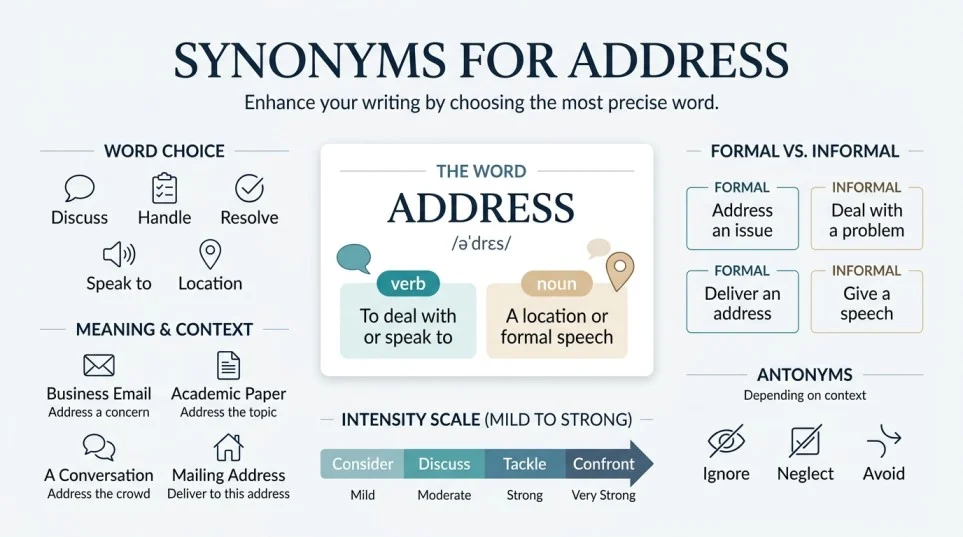
Address can mean to speak to someone, deal with an issue, or identify where someone lives or where something is located. Common synonyms include discuss, approach, tackle, handle, speak to, location, and residence, depending on the intended meaning.
Meaning, Tone and Context
The word address has several meanings. Choosing the right synonym starts with understanding how the word functions in a sentence.
1. Simple Definition
Address can mean to speak directly to a person or audience, deal with a problem, or write down information that identifies a place.
Examples:
- The manager will address the team. Here, address means speak to.
- We must address the complaint. Here, address means deal with.
- Please confirm your mailing address. Here, address means the location where mail is delivered.
2. Part of Speech
Address can function as both a verb and a noun.
| Part of Speech | Meaning | Example |
|---|---|---|
| Verb | To speak to someone | She addressed the audience. |
| Verb | To deal with an issue | We addressed the safety concern. |
| Noun | Information identifying a place | I changed my home address. |
| Noun | A formal speech | The president delivered an address. |
3. Tone and Formality
Address is generally neutral and works in both formal and everyday communication. However, its tone changes with context.
- Professional: Address a concern, address a client, address a complaint.
- Academic: Address a research question, address a limitation.
- Casual: Talk to someone, deal with a problem.
- Emotional: Confront a difficult feeling, discuss a personal concern.
- Practical: Mailing address, home address, business address.
4. Common Word Forms
| Word Form | Meaning | Example |
|---|---|---|
| Address | To speak to, handle, or identify a place | We need to address the issue. |
| Addressed | Past tense of address | She addressed the concern yesterday. |
| Addressing | The act of speaking to or dealing with something | He is addressing the problem. |
| Addressee | The person receiving a letter or message | The addressee must sign the form. |
| Addressable | Able to be identified or dealt with | The issue is addressable with better planning. |
When and How to Use Address
Use address when you want to communicate with a person, respond to a concern, discuss an important subject, or identify a physical or mailing location.
Here are realistic examples showing how the meaning changes.
Professional: The supervisor addressed the team’s concerns during the meeting.
Academic: This paper addresses the main causes of language change.
Personal: I need to address a misunderstanding with my friend.
Practical: Please enter your current mailing address on the application form.
The first three examples use address as a verb. The final example uses address as a noun. That distinction matters when choosing a replacement.
Another Word for Address
The best alternative depends on what address means in your sentence. There is no single synonym that works for every use.
| Situation | Best Alternative | Example |
|---|---|---|
| Professional writing | Discuss | We will discuss the client’s concerns. |
| Academic writing | Examine | This study examines the issue. |
| Casual conversation | Talk to | I need to talk to my neighbor. |
| Emotional writing | Confront | She decided to confront her fears. |
| Creative writing | Speak to | He spoke to the crowd with confidence. |
| Resume or workplace use | Resolve | Resolved customer concerns efficiently. |
| Social media captions | Talk about | Let’s talk about something important. |
| Stronger meaning | Tackle | The team tackled the problem immediately. |
| Softer meaning | Consider | We should consider the concern carefully. |
For a physical address, use alternatives such as location, residence, mailing details, or place of residence when they match the intended meaning.
When Not to Use Address
Address is useful, but it can sound vague when a sentence needs a more specific action or detail.
1. When you mean solve a problem
Less precise: We addressed the technical issue.
More precise: We fixed the technical issue.
Use fixed when the issue has actually been corrected. Addressed only means that someone dealt with it.
2. When you mean speak to a person
Less natural: I addressed my friend about the movie.
More natural: I talked to my friend about the movie.
Discuss or talk to sounds more natural in many everyday situations.
3. When you mean a physical location
Less precise: Please send me your address location.
Better: Please send me your address.
Address already identifies the relevant location information, so adding location is unnecessary in this sentence.
4. When you need a specific response
Less precise: The company addressed the complaint.
More precise: The company investigated the complaint and issued a refund.
The second sentence explains exactly what the company did.
Words Commonly Confused With Address
Several related words overlap with address but carry different meanings.
| Word | Main Difference | When to Use It |
|---|---|---|
| Discuss | Exchange ideas about a subject | When talking about a topic |
| Handle | Manage a task or situation | When describing responsibility |
| Resolve | Bring a problem to a solution | When the problem is settled |
| Confront | Face a difficult issue directly | When direct action is needed |
| Mention | Refer to something briefly | When giving a short reference |
| Locate | Find or identify a place | When searching for a location |
For example, you can address a complaint without resolving it. You can mention a problem without discussing it in detail. These differences help you choose a more accurate word.
Best Synonym by Context for Address
The most useful synonym for address depends on whether you mean speaking to someone, dealing with an issue, or identifying a place.
| Context | Best Synonym | Why It Works | Example |
|---|---|---|---|
| Formal writing | Discuss | Clear and professional | We will discuss the proposal tomorrow. |
| Academic writing | Examine | Suggests careful study | The research examines social change. |
| Business communication | Handle | Emphasizes managing a situation | She handles customer complaints. |
| Resume | Resolve | Highlights a result | Resolved customer concerns promptly. |
| Casual conversation | Talk to | Sounds natural and friendly | I need to talk to my teacher. |
| Creative writing | Speak to | Emphasizes communication | The speaker spoke to the crowd. |
| Emotional writing | Confront | Suggests facing a difficult matter | He confronted his fears. |
| Strong action | Tackle | Shows active effort | We tackled the biggest challenge first. |
| Gentle suggestion | Consider | Sounds thoughtful and less direct | Please consider the issue carefully. |
| Social media captions | Talk about | Works well for accessible content | Today, let’s talk about confidence. |
| Customer service | Respond to | Emphasizes a reply | We responded to the customer’s complaint. |
| Conflict management | Resolve | Focuses on settling a disagreement | They resolved the dispute peacefully. |
| Public speaking | Deliver | Fits a prepared speech | She delivered an address to the audience. |
| Mail and deliveries | Mailing address | Identifies where mail should go | Confirm your mailing address before checkout. |
| Finding a place | Locate | Focuses on finding a place | We located the new office. |
| Research limitations | Acknowledge | Recognizes a weakness or concern | The study acknowledges its limitations. |
For US English, address is standard in both professional and everyday use. These alternatives are also widely understood in British English, although particular phrases may vary by context.
Which Synonym Should You Choose?
Use these five steps to select the best synonym for address.
1. Identify the meaning. You mean speaking to someone, choose talk to or speak to. If you mean dealing with a problem, consider handle, tackle, or resolve. If you mean a place, choose location or residence when appropriate.
2. Match the level of formality. Use discuss, examine, or respond to in formal communication. Choose talk to or talk about for everyday conversation.
3. Check the intensity. Consider is gentle, discuss is neutral, tackle suggests active effort, and confront implies facing something directly.
4. Think about the result. Addressed does not always mean solved. Use resolve, fix, or settle when the problem has actually been dealt with successfully.
5. Read the whole sentence. A synonym must fit the grammar as well as the meaning. For example, a mailing address cannot normally be replaced with discuss or handle.
Real Life Examples of Address in Sentences
These examples show how to replace address with a more precise word in common situations.
| Situation | Original Sentence | Improved Alternative |
|---|---|---|
| School | The teacher addressed the question. | The teacher answered the question. |
| Workplace | I addressed the scheduling problem. | I resolved the scheduling problem. |
| Writing | The article addresses online privacy. | The article examines online privacy. |
| Conversation | I addressed my brother about the noise. | I talked to my brother about the noise. |
| Social media | This post addresses healthy habits. | This post discusses healthy habits. |
| Resume | Addressed customer complaints. | Resolved customer complaints efficiently. |
| I am writing to address your concern. | I am writing to respond to your concern. | |
| Storytelling | She addressed the crowd. | She spoke to the crowd. |
The improved versions are not always better in every situation. They are more precise when their specific meaning matches the action being described.
18 Synonyms for Address
The following table contains 18 useful alternatives for the different meanings of address. Some replace the verb, while others apply to the noun meaning a location or speech.
| Synonym | Simple Meaning | Best Used For | Example Sentence |
|---|---|---|---|
| Discuss | Talk about a subject | Meetings and essays | We discussed the new policy. |
| Talk to | Speak with someone | Casual communication | I need to talk to my coach. |
| Speak to | Communicate with someone | Formal or personal situations | The director spoke to the staff. |
| Mention | Refer to something briefly | Short references | She mentioned the issue in her email. |
| Handle | Manage a task or concern | Workplace situations | He handled the request professionally. |
| Manage | Control or organize something | Business and daily tasks | She manages customer inquiries. |
| Tackle | Work actively on a problem | Challenges and projects | The team tackled the delay. |
| Resolve | Settle or solve a problem | Disputes and complaints | We resolved the billing issue. |
| Examine | Study something closely | Academic and analytical writing | The report examines the evidence. |
| Consider | Think carefully about something | Polite suggestions | Please consider our proposal. |
| Confront | Face a problem directly | Difficult situations | He confronted the issue honestly. |
| Respond to | Give an answer or reaction | Emails and complaints | We responded to every question. |
| Answer | Provide a reply | Questions and requests | The teacher answered the question. |
| Acknowledge | Recognize a point or concern | Formal communication | The report acknowledges the risks. |
| Approach | Begin dealing with a subject or problem | Planning and problem solving | We approached the challenge carefully. |
| Location | A particular place | Finding or describing places | The location is easy to reach. |
| Residence | A place where someone lives | Formal descriptions | The form asks for your residence. |
| Deliver | Present a speech or message | Public speaking | The mayor delivered an address. |
Remember that these words are not interchangeable in every sentence. Location and residence relate to the noun meaning of address, while most other entries relate to one of its verb meanings.
Synonym Groups and Usage Differences
Professional vs. Personal Synonyms
Professional communication benefits from clear, action focused words. Discuss, respond to, examine, and resolve can make workplace messages more precise.
In personal conversations, talk to, speak with, and discuss often sound more natural. Confront may suit a serious disagreement, but it can sound too forceful for a minor misunderstanding.
Formal vs. Conversational Synonyms
Formal writing often uses examine, address, acknowledge, and respond to. These words fit reports, academic papers, presentations, and official emails.
Conversational English tends to favor talk to, talk about, handle, and sort out. Choose the phrase that sounds natural for your audience.
Examples:
- Formal: The committee examined the proposed changes.
- Conversational: We talked about the proposed changes.
Academic Synonyms
Academic writing requires words that explain exactly what a paper or study does.
- Examine: Study a topic carefully.
- Analyze: Break information into parts to understand it.
- Discuss: Present ideas and evidence about a topic.
- Investigate: Seek information to discover facts.
- Acknowledge: Recognize a limitation, finding, or argument.
Use analyze when the work involves detailed interpretation. Investigate when the focus is on finding out more. Use discuss when the paper considers a subject from one or more viewpoints.
Professional and Business Synonyms
For emails, resumes, reviews, and presentations, choose words that show the action and its result.
| Professional Goal | Recommended Word | Example |
|---|---|---|
| Reply to a concern | Respond to | Responded to client inquiries within one business day. |
| Fix a problem | Resolve | Resolved order issues for customers. |
| Manage a task | Handle | Handled scheduling and customer requests. |
| Review information | Examine | Examined sales reports for errors. |
| Recognize a concern | Acknowledge | Acknowledged customer feedback. |
On a resume, resolved is stronger than addressed when you can show that the issue was successfully settled. If you only reviewed or referred the issue to another team, choose a verb that accurately describes your role.
Creative or Literary Synonyms
Creative writing benefits from verbs that communicate action, mood, and relationships.
- Speak to creates a direct communication scene.
- Confront suggests tension or courage.
- Explore introduces a subject in a reflective way.
- Reveal shows information that was previously hidden.
- Whisper to suggests quiet or private communication.
For example, instead of writing that a character addressed her fears, you might write that she confronted her fears. This creates a stronger sense of personal struggle.
Slang or Modern Synonyms
There is no single modern slang word that replaces every meaning of address. Informal expressions such as talk about, bring up, and deal with are more useful in everyday speech.
Bring up means introduce a subject into conversation. Deal with means manage a situation. Both can sound too casual in some formal reports, so match your wording to the audience.
Strongest vs. Weaker Synonyms
The intensity depends on the sentence, but this general guide can help.
Gentle
Consider, mention
A light reference or suggestion.
Neutral
Discuss, examine, handle
Ordinary communication or practical action.
Active
Tackle, confront
Direct effort or engagement with a challenge.
Outcome
Resolve, settle, fix
A solution or completed action, when successful.
This is a practical guide rather than a strict ranking. Resolve describes an outcome, while confront describes an action, so their strength depends on what the sentence needs to express.
Emotional vs. Neutral Synonyms
Neutral words describe an action without adding much emotion. Discuss, examine, respond to, and handle usually fit this purpose.
More emotional words include confront, challenge, and appeal to. They can suggest conflict, urgency, or a personal connection.
Compare these sentences:
- Neutral: She discussed the disagreement with her colleague.
- More direct: She confronted her colleague about the disagreement.
The second sentence suggests a more forceful interaction.
Antonyms of Address
Address has several meanings, so it does not have one universal opposite. The following table lists 15 context based contrasts. Some are practical opposites rather than strict dictionary antonyms, and the best choice depends on the sentence.
| Antonym or Contrast | Meaning | Example Sentence |
|---|---|---|
| Ignore | Pay no attention to something | The manager ignored the complaint. |
| Neglect | Fail to give proper attention | The team neglected an important concern. |
| Avoid | Stay away from a subject or situation | She avoided the difficult conversation. |
| Overlook | Fail to notice something | We overlooked a serious error. |
| Dismiss | Reject or treat as unimportant | He dismissed the suggestion. |
| Suppress | Prevent something from being expressed | The organization suppressed the criticism. |
| Conceal | Keep information hidden | They concealed the problem from the public. |
| Withhold | Refuse to provide information | The office withheld the requested details. |
| Evade | Avoid dealing with a question or responsibility | The official evaded the question. |
| Sidestep | Avoid dealing with an issue directly | She sidestepped the difficult topic. |
| Mislead | Give someone an incorrect impression | The report misled its readers. |
| Confuse | Make something harder to understand | The vague instructions confused the applicants. |
| Obscure | Make something difficult to see or understand | The wording obscured the main point. |
| Misidentify | Identify someone or something incorrectly | The system misidentified the location. |
| Displace | Move someone or something from its place | The construction project displaced several families. |
These contrasts apply to different meanings of address. For example, ignore may oppose addressing a concern, while misidentify may contrast with correctly identifying an address. They are not all direct antonyms of the noun meaning a person’s mailing details.
Comparison: Address vs. Similar Words
Understanding the differences between address and related words helps you avoid awkward or inaccurate sentences.
Address vs. Discuss
Main difference: Address can mean deal with a concern or speak to someone. Discuss means talk about a subject in detail.
Stronger word: Address can suggest taking action, while discuss focuses on conversation.
More formal: Both work in formal writing.
- Address: The report addresses the risks.
- Discuss: The report discusses the risks in detail.
Address vs. Handle
Main difference: Address means deal with or give attention to an issue. Handle emphasizes managing it.
Stronger word: Handle can suggest practical responsibility, but neither word is always stronger.
More formal: Address often sounds more formal in reports.
- Address: We addressed the client’s concern.
- Handle: She handled the client’s request.
Address vs. Resolve
Main difference: Address means deal with an issue, while resolve means settle or solve it.
Stronger word: Resolve is more specific about achieving a solution.
More formal: Both are suitable for professional writing.
- Address: The team addressed the complaint.
- Resolve: The team resolved the complaint.
Address vs. Mention
Main difference: Address can involve detailed attention or action. Mention usually means referring to something briefly.
Stronger word: Address generally implies more engagement.
More formal: Both can work in professional settings.
- Address: The report addresses several safety concerns.
- Mention: The report mentions a recent safety concern.
Address vs. Confront
Main difference: Address is generally neutral. Confront suggests facing a difficult situation or person directly.
Stronger word: Confront usually sounds more forceful.
More formal: Both can appear in formal writing, but confront carries a stronger tone.
- Address: She addressed the disagreement calmly.
- Confront: She confronted her colleague about the disagreement.
Address vs. Location
Main difference: Address usually identifies a specific place through details such as a street name and number. Location refers more broadly to where something is.
Stronger word: Neither is inherently stronger. Address is more specific when exact postal details are required.
More formal: Both are standard in formal communication.
- Address: Please confirm your mailing address.
- Location: Please confirm the meeting location.
Common Phrases and Expressions with Address
1. Address an Issue
Meaning: Deal with a problem or give it attention.
Example sentence: The school introduced new rules to address the issue of classroom disruptions.
2. Address a Concern
Meaning: Respond to something that worries a person.
Example sentence: The customer service team addressed my concern about the delayed order.
3. Address Someone Directly
Meaning: Speak to a particular person rather than speaking generally.
Example sentence: Please address your question directly to the project manager.
4. Mailing Address
Meaning: The place where letters and packages should be delivered.
Example sentence: Update your mailing address before placing your next order.
5. Home Address
Meaning: The location where someone lives.
Example sentence: Keep your home address current on important records.
6. Address the Audience
Meaning: Speak to a group of people.
Example sentence: The guest speaker addressed the audience before the presentation began.
7. Address the Root Cause
Meaning: Deal with the main reason a problem occurs.
Example sentence: The company changed its training process to address the root cause of repeated errors.
8. Forwarding Address
Meaning: A new address where mail should be sent after someone moves.
Example sentence: She provided a forwarding address before leaving her apartment.
Common Mistakes to Avoid
1. Using Address When You Mean Solve
Addressing a problem does not necessarily mean solving it.
Incorrect choice: We addressed the error, so it is fixed.
Better: We fixed the error.
Use resolved or fixed when the problem has actually been corrected.
2. Confusing Address With Discuss
Discuss emphasizes conversation, while address can mean taking broader action.
For example, a report may address a policy issue by examining evidence and proposing changes. It may discuss the issue without recommending any action.
3. Using Casual Language in Formal Writing
Talk about and deal with are natural expressions, but a formal report may benefit from examine, analyze, or respond to.
Choose the word that fits your audience and purpose rather than automatically choosing the most formal sounding option.
4. Using Confront for a Minor Matter
Confront can sound forceful or suggest conflict.
For a small misunderstanding, discuss or talk to may communicate your meaning more calmly.
5. Repeating Address Too Often
Repeatedly using address in an essay or report can make the writing sound repetitive.
Replace it with a precise word such as examine, resolve, discuss, or acknowledge when the meaning supports that choice.
6. Confusing Address With Location
A location is a place, while an address usually provides identifying details for that place.
For example, a city park is a location. Its street address identifies where visitors can find it.
FAQs
1. What is the best synonym for address?
The best synonym depends on meaning. Discuss works for topics, handle suits practical tasks, resolve describes solving problems, and location applies to places.
2. What is a formal synonym for address?
Examine, discuss, respond to, and acknowledge work in formal writing. Use examine for detailed analysis and respond to when describing a reply.
3. What is an informal synonym for address?
Talk to, talk about, and bring up are useful informal alternatives. Bring up works when introducing a subject into conversation.
4. What is another word for address in professional writing?
Resolve, handle, discuss, and respond to are common choices. Resolve is especially useful when describing a problem that has been successfully solved.
5. What is the difference between address and discuss?
Address can mean deal with a concern, speak to someone, or identify a place. Discuss specifically means talk about a subject in detail.
6. What is the opposite of address?
There is no single opposite for every meaning. Ignore or neglect can contrast with addressing a concern, while misidentify contrasts with correctly identifying an address.
Conclusion
Address can mean speaking to someone, dealing with a problem, or identifying a place. The best synonyms for address include discuss, handle, tackle, resolve, speak to, and location, but each fits a different situation.
For professional writing, choose words that describe the action clearly. Use discuss for exchanging ideas, resolve for solving a problem, and examine for studying a topic. For everyday conversations, talk to and talk about often sound more natural.
The most useful vocabulary tip is to check what your sentence actually means before replacing a word. A precise synonym improves clarity, tone, and confidence without making your writing complicated.article.
Discover More Post:
- 50+ Synonyms for Investigate | Meanings, Examples, and Best …
- 50+ Synonyms for Other | Meanings, Examples, and Best …
- 50+ Synonyms for Truly | Meanings, Examples, and Best …