The word acceptance appears in everyday conversations, school assignments, workplace emails, and personal writing. However, using it repeatedly can make your sentences sound less natural. Sometimes you mean approval, sometimes agreement, and sometimes the feeling of making peace with a difficult situation. Choosing the right alternative helps you express your thoughts more clearly.
This guide explores synonyms for acceptance, their meanings, and the situations where each word works best. You will learn how to choose formal terms for professional communication, simple alternatives for everyday conversations, and more expressive words for emotional or creative writing. With practical examples and clear comparisons, you can build your vocabulary and communicate with greater confidence.
What Does Acceptance Mean?
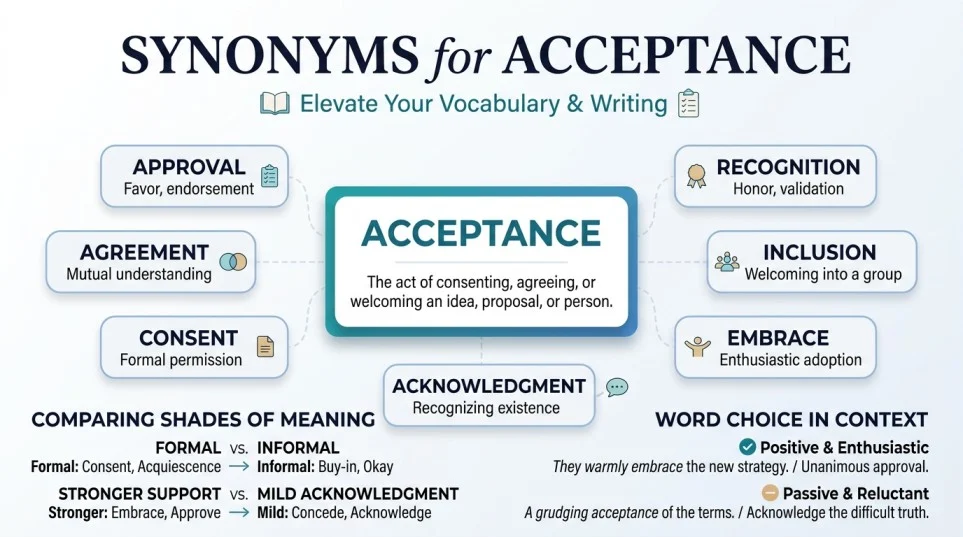
Acceptance means agreeing to something, approving it, receiving it willingly, or recognizing a situation as real. Common synonyms include approval, agreement, consent, acknowledgment, admission, recognition, and embrace. The best choice depends on whether you mean permission, understanding, inclusion, or emotional peace.
Meaning, Tone and Context
What Does Acceptance Mean?
Acceptance is the act of agreeing to something, receiving something willingly, recognizing a fact, or allowing someone to belong. Its exact meaning depends on the situation.
For example, acceptance of a job offer means agreeing to take the position. Acceptance of a difficult truth means recognizing reality rather than denying it.
Part of Speech
Acceptance is a noun. It describes an action, decision, response, or state of mind.
Related word forms include:
| Word Form | Meaning | Example |
|---|---|---|
| Accept | To receive or agree to something | I accept your invitation. |
| Accepted | Received, approved, or agreed upon | Her proposal was accepted. |
| Acceptable | Good enough or suitable | The revised plan is acceptable. |
| Accepting | Willing to receive or recognize something | He is accepting of different opinions. |
| Unacceptable | Not suitable or allowed | The behavior was unacceptable. |
| Acceptance | The act or state of accepting | Her acceptance brought relief. |
Tone and Formality
Acceptance is generally neutral or positive. Its tone becomes more emotional when it describes belonging, self respect, or peace with difficult circumstances.
The word is suitable for academic writing, business communication, personal discussions, and everyday conversation. Some alternatives, such as acquiescence, sound more formal and suggest reluctant agreement.
Common Uses of Acceptance
Acceptance commonly appears in these situations:
- Professional: Acceptance of a job offer or business proposal.
- Academic: Acceptance into a college or university.
- Legal: Acceptance of contractual terms.
- Social: Acceptance of people from different backgrounds.
- Emotional: Acceptance of change, loss, or personal limitations.
- Personal: Acceptance of an apology or an invitation.
The important point is that acceptance does not always mean enthusiastic approval. A person can accept a fact without liking it.
When and How to Use Acceptance
Use acceptance when you want to describe agreement, approval, inclusion, or recognition of reality. Before choosing a synonym, identify exactly what is being accepted.
Here are four realistic examples.
Professional: The manager confirmed her acceptance of the revised contract.
Academic: His acceptance into the graduate program marked an important achievement.
Emotional: Acceptance of the situation helped her focus on what she could change.
Social: The school promotes acceptance of students with different abilities and backgrounds.
Each sentence uses acceptance differently. In professional writing, it may describe a decision. In emotional writing, it often describes an internal process. Understanding that distinction helps you choose a more precise alternative.
Another Word for Acceptance
The best single replacement for acceptance is usually approval when you mean a favorable decision. However, agreement, consent, acknowledgment, recognition, and embrace can be more accurate in other situations.
| Context | Best Alternative | Example |
|---|---|---|
| Professional writing | Approval | The director granted approval for the project. |
| Academic writing | Recognition | The research earned recognition from experts. |
| Casual conversation | Agreement | We reached an agreement about the plans. |
| Emotional writing | Embrace | She learned to embrace change. |
| Creative writing | Reconciliation | He found reconciliation with his past. |
| Resume or workplace | Approval | Received approval for a new workflow. |
| Social media captions | Embracing | Embracing growth, change, and individuality. |
| Stronger meaning | Endorsement | The organization gave its full endorsement. |
| Softer meaning | Acknowledgment | Her acknowledgment of the problem was a start. |
Professional Writing
Choose approval when a person or organization officially agrees to a request, plan, or proposal. Use authorization when the emphasis is on permission to act.
Example: The department received approval for additional funding.
Academic Writing
Recognition works well when discussing the acknowledgment of facts, achievements, or contributions. Agreement is better when describing shared conclusions.
Example: The study supports recognition of the problem across different communities.
Casual Conversation
Agreement is often the most natural alternative when two people share an opinion or decision.
Example: We finally reached an agreement about where to eat.
Emotional Writing
Embrace suggests actively welcoming a situation or personal truth. Acknowledgment is more restrained and simply means recognizing something.
Example: She found peace through acceptance of her past, or she learned to embrace her past.
Creative Writing
Reconciliation can describe making peace with a person, experience, or part of yourself. It is not a universal synonym, so use it when the idea of resolving conflict fits.
Example: The final chapter describes his reconciliation with his childhood memories.
Resume or Workplace Use
Approval, endorsement, and recognition can work in professional documents, but they describe different outcomes.
Example: Secured leadership approval for a process improvement initiative.
Social Media Captions
Embrace, inclusion, and belonging can communicate personal growth or community values.
Example: Choosing growth, embracing change, and celebrating belonging.
Stronger Meaning
Endorsement suggests active support, while commitment suggests a willingness to stand by a decision or course of action.
Example: The board announced its endorsement of the new policy.
Softer Meaning
Acknowledgment is useful when someone recognizes a concern without necessarily agreeing with it.
Example: His acknowledgment of her concerns opened the door to discussion.
When Not to Use Acceptance
Acceptance is useful, but it can sound too general when you need to describe a specific action or feeling.
1. When You Mean Official Permission
Avoid using acceptance when authorization is more accurate.
Less precise: We received acceptance to begin construction.
Better: We received authorization to begin construction.
Authorization emphasizes permission to take action.
2. When You Mean Shared Opinions
Acceptance does not always mean that two people agree.
Less precise: The team reached acceptance on the proposed schedule.
Better: The team reached agreement on the proposed schedule.
Agreement clearly communicates a shared decision.
3. When You Mean Enthusiastic Support
Acceptance can suggest willingness without strong enthusiasm.
Less precise: The committee showed acceptance of the proposal.
Better: The committee endorsed the proposal.
Endorsement communicates active support rather than simple willingness to accept.
4. When You Mean Emotional Peace
Acceptance may be too broad when describing personal growth.
Less precise: He found acceptance of his mistakes.
Better: He came to terms with his mistakes.
The second sentence emphasizes the process of recognizing and making peace with past actions.
5. When You Mean Social Inclusion
Acceptance can describe inclusion, but belonging may better express feeling welcomed as part of a group.
Less precise: She wanted acceptance in her new school.
More specific: She wanted to feel that she belonged at her new school.
Choose the alternative that expresses the actual experience you want to describe.
Words Commonly Confused With Acceptance
Several related words overlap with acceptance but have different meanings.
| Word | Main Difference | When to Use It |
|---|---|---|
| Approval | A favorable judgment or decision | When someone considers a plan suitable |
| Agreement | Shared understanding or opinion | When people reach the same conclusion |
| Consent | Permission given voluntarily | When someone allows an action |
| Acknowledgment | Recognition that something exists or happened | When recognizing a fact or concern |
| Admission | Allowing entry or acknowledging something is true | When entering an institution or confessing a fact |
| Tolerance | Allowing something despite disagreement or discomfort | When people coexist with differences |
For example, a university may grant admission to an applicant, while the applicant expresses acceptance of its offer. A manager may approve a proposal, while employees agree to follow it.
These distinctions matter because replacing acceptance with a related word can change the meaning of an entire sentence.
Best Synonym by Context for Acceptance
The best synonym depends on the situation, the intended meaning, and the tone of your writing.
| Context | Best Synonym | Why It Works | Example |
|---|---|---|---|
| Formal writing | Approval | Communicates a favorable decision | The proposal received approval. |
| Academic writing | Recognition | Highlights awareness or acknowledgment | The paper examines recognition of the issue. |
| Professional communication | Endorsement | Shows active support | The director expressed endorsement of the plan. |
| Resume | Recognition | Emphasizes acknowledged contributions | Received recognition for outstanding service. |
| Casual conversation | Agreement | Sounds natural and direct | We reached an agreement. |
| Creative writing | Embrace | Suggests welcoming an experience | She chose to embrace uncertainty. |
| Emotional writing | Reconciliation | Expresses making peace with conflict or the past | He sought reconciliation with his past. |
| Strong support | Endorsement | Signals public or active backing | The proposal gained broad endorsement. |
| Mild recognition | Acknowledgment | Recognizes something without full approval | Her acknowledgment helped resolve the issue. |
| Social media captions | Inclusion | Emphasizes welcoming different people | Inclusion makes every voice matter. |
| College applications | Admission | Describes permission to enter an institution | She celebrated her admission to college. |
| Legal documents | Consent | Describes voluntary permission | The procedure requires informed consent. |
| Negotiations | Agreement | Shows that parties have reached common terms | Both sides signed the agreement. |
| Personal growth | Self acceptance | Emphasizes recognizing and valuing yourself | Self acceptance helped him move forward. |
| Customer service | Confirmation | Indicates that information or a request has been verified | We received confirmation of the booking. |
| Community relationships | Belonging | Emphasizes feeling included in a group | The program created a sense of belonging. |
There is no single US or UK spelling difference for acceptance that requires a different synonym. Most alternatives work in both varieties of English. Differences usually come from local phrasing and the situation rather than spelling.
Which Synonym Should You Choose?
Choosing a synonym becomes easier when you identify what acceptance means in your sentence.
1. Start With the Meaning
Ask yourself what is being accepted.
- • A plan or proposal: approval or endorsement.
- • An idea or shared opinion: agreement.
- • Permission for an action: consent.
- • A fact or problem: acknowledgment or recognition.
- • A difficult personal experience: acceptance, acknowledgment, or coming to terms with it.
- • Membership in a group: inclusion or belonging.
2. Consider Formality
Use approval, authorization, consent, or endorsement in formal communication when the meaning fits.
For everyday conversations, agreement, understanding, and belonging often sound more natural.
3. Check Emotional Intensity
Acknowledgment is usually restrained. Embrace sounds more positive and active. Endorsement communicates support, while acquiescence can suggest giving in reluctantly.
Choose a word that matches the feeling you want to express.
4. Think About Professional Value
In resumes and workplace documents, describe the actual achievement rather than using acceptance as a vague success term.
For example, write that your proposal received approval, your work earned recognition, or your recommendation gained endorsement. Each phrase communicates a different result.
5. Read the Entire Sentence
A synonym may be correct in isolation but sound unnatural in context.
For example, people usually say acceptance of an apology, but forgiveness may better express the emotional decision to let go of resentment. Read the full sentence to make sure the replacement preserves your intended meaning.
Real Life Examples of Acceptance in Sentences
These examples show how acceptance and its alternatives work in everyday situations.
| Situation | Example Sentence |
|---|---|
| School | Her acceptance into the honors program made her family proud. |
| Workplace | The manager approved the revised budget on Friday. |
| Academic writing | The author acknowledges that further research is needed. |
| Conversation | We finally agreed on a time for dinner. |
| Social media | Learning to embrace change has made this year meaningful. |
| Resume | Earned recognition for improving customer satisfaction. |
| Please confirm your acceptance of the meeting invitation. | |
| Storytelling | After years of regret, he came to terms with his past. |
| College applications | She received admission to her preferred university. |
| Community | The organization promotes inclusion and equal opportunity. |
| Legal communication | All participants must provide informed consent. |
| Personal development | Self acceptance helped her focus on realistic goals. |
The most effective replacement is the one that explains what actually happened. Approval describes a decision, recognition describes acknowledgment, and inclusion describes welcoming people into a group.
18 Synonyms for Acceptance
The following 18 alternatives cover common meanings of acceptance. Some are direct replacements, while others fit only specific contexts.
| Synonym | Simple Meaning | Best Used For | Example Sentence |
|---|---|---|---|
| 1. Approval | A favorable decision | Work, plans, and proposals | The director gave approval for the new project. |
| 2. Agreement | A shared decision or opinion | Conversations and negotiations | Both neighbors reached an agreement. |
| 3. Consent | Voluntary permission | Legal, medical, and personal situations | The study required consent from every participant. |
| 4. Acknowledgment | Recognition that something exists or happened | Concerns, facts, and contributions | Her acknowledgment of the error was appreciated. |
| 5. Recognition | Identifying or appreciating something | Achievements, facts, and contributions | His work earned recognition from the company. |
| 6. Admission | Permission to enter or acknowledgment of a truth | Colleges and confessions | She received admission to the university. |
| 7. Endorsement | Active support or public approval | Policies, ideas, and products | The proposal received endorsement from senior leaders. |
| 8. Embrace | Willing acceptance or welcoming | Personal growth and change | He decided to embrace a new challenge. |
| 9. Inclusion | The act of making people part of a group | Communities and workplaces | Inclusion remained a central goal of the program. |
| 10. Tolerance | Allowing differences or behavior | Social and cultural discussions | Tolerance can help people live peacefully together. |
| 11. Acquiescence | Reluctant agreement without resistance | Formal or critical writing | Her acquiescence did not mean she was happy. |
| 12. Compliance | Acting according to a rule or requirement | Business, law, and regulations | Compliance with safety rules is essential. |
| 13. Concurrence | Agreement with an opinion or decision | Formal and academic writing | The committee expressed concurrence with the recommendation. |
| 14. Confirmation | Verification that something is correct or arranged | Bookings, details, and requests | We received confirmation of the reservation. |
| 15. Belonging | Feeling included and connected | Personal and social writing | The club gave him a sense of belonging. |
| 16. Reconciliation | Making peace after conflict or disagreement | Relationships and emotional writing | Reconciliation helped the family rebuild trust. |
| 17. Submission | Yielding to authority or a decision | Situations involving power or control | His submission to the ruling ended the dispute. |
| 18. Self acceptance | Recognizing and accepting yourself | Personal development and emotional writing | Self acceptance helped her appreciate her strengths. |
Usage tip: Approval, agreement, consent, and acknowledgment are among the most useful everyday alternatives. Words such as acquiescence, concurrence, and submission have narrower meanings and should be chosen carefully.
Synonym Groups and Usage Differences
Different synonyms for acceptance serve different purposes. Grouping them by tone and context helps you find a word that sounds natural rather than simply replacing one word with another.
Professional vs. Personal Synonyms
Professional writing often focuses on decisions, permissions, and outcomes. Personal writing more often explores emotions, relationships, and individual experiences.
| Professional Synonyms | Personal Synonyms |
|---|---|
| Approval | Self acceptance |
| Endorsement | Embrace |
| Authorization | Coming to terms |
| Agreement | Belonging |
| Recognition | Reconciliation |
For example, approval is appropriate when a supervisor accepts a proposal. Self acceptance is more suitable when someone learns to value themselves despite imperfections.
Formal vs. Conversational Synonyms
Formal language can add precision to reports, essays, and business documents. Conversational language makes everyday communication easier to understand.
| Formal Word | Conversational Alternative | Example |
|---|---|---|
| Concurrence | Agreement | We agree with the recommendation. |
| Acquiescence | Giving in | He finally gave in to the request. |
| Acknowledgment | Recognition | She recognized the problem. |
| Endorsement | Support | They support the proposal. |
| Reconciliation | Making peace | The siblings made peace after their argument. |
Use formal words when precision matters. In texts, friendly emails, and casual conversations, simpler expressions are often more effective.
Academic Synonyms
Academic writing benefits from precise language. The best alternative depends on whether the writer is describing agreement, awareness, or the acceptance of evidence.
- • Recognition: Use it when discussing awareness of a problem or an established fact.
- • Acknowledgment: Use it when noting a limitation, contribution, or existing issue.
- • Agreement: Use it when researchers share a conclusion or interpretation.
- • Concurrence: Use it when formally describing agreement with another person’s judgment.
- • Admission: Use it when a person is allowed into an academic institution.
Example: The researchers acknowledge the study’s limitations before presenting their conclusions.
This sentence is more specific than saying the researchers show acceptance of the limitations.
Professional and Business Synonyms
Workplace communication should identify the exact action or outcome.
| Situation | Recommended Word | Example |
|---|---|---|
| A manager agrees to a proposal | Approval | The manager approved the proposal. |
| A company publicly supports a policy | Endorsement | The company announced its endorsement. |
| A customer agrees to terms | Agreement | The customer signed the agreement. |
| An employee follows a requirement | Compliance | The audit confirmed compliance. |
| A team recognizes an issue | Acknowledgment | The team acknowledged the delay. |
| An employer appreciates achievement | Recognition | Her performance earned recognition. |
For resumes, avoid vague statements such as gained acceptance. Instead, describe the actual result, such as secured approval, earned recognition, or obtained authorization, when those statements are accurate.
Creative or Literary Synonyms
Creative writing sometimes needs more emotional or descriptive language than formal reports.
Embrace suggests welcoming something with an open mind.
Reconciliation suggests making peace after a period of conflict.
Belonging expresses the feeling of being connected to a person or community.
Coming to terms with describes the gradual process of recognizing and living with a difficult reality.
Example: After years of resisting change, she finally embraced the life she had built.
This wording gives the reader a clearer emotional picture than a general statement about acceptance.
Slang or Modern Synonyms
Acceptance does not have one universal slang equivalent. Informal expressions can communicate agreement or willingness, but they may change the meaning.
| Informal Expression | Meaning | Example |
|---|---|---|
| Cool with it | Comfortable with a decision | I am cool with the new plan. |
| On board | Willing to support or participate | The whole team is on board. |
| Fine with it | Willing to allow something | She is fine with the arrangement. |
| Roll with it | Adapt to a situation | Plans changed, so we rolled with it. |
These expressions work in casual conversations, texts, and friendly messages. For academic essays, legal documents, and formal business reports, choose a more precise term.
Strongest vs. Weaker Synonyms
The strength of a synonym depends on what it communicates. This scale compares the level of support or willingness, not the overall value of each word.
Mild
Acknowledgment
Recognizing something without necessarily agreeing with it.
Moderate
Acceptance
Willingness to receive, allow, or recognize something.
Positive
Approval
A favorable judgment about a decision or proposal.
Strong
Endorsement
Active support for an idea, decision, or policy.
This is a guide to different meanings rather than a strict ranking. For example, consent may be legally essential without expressing enthusiasm, while acquiescence may indicate reluctant agreement.
Emotional vs. Neutral Synonyms
Neutral words communicate facts and decisions. Emotional alternatives reveal how someone feels about an experience.
| Neutral Synonym | Emotional Synonym | Main Difference |
|---|---|---|
| Acknowledgment | Embrace | Recognizing something versus welcoming it |
| Agreement | Reconciliation | Sharing a decision versus making peace after conflict |
| Recognition | Belonging | Identifying or appreciating something versus feeling included |
| Acceptance | Self acceptance | General willingness or recognition versus accepting yourself |
| Approval | Forgiveness | Favorable judgment versus releasing resentment toward someone |
Choose neutral language for factual reports. Choose emotional language when the reader needs to understand someone’s feelings, personal growth, or relationships.
Antonyms of Acceptance
Acceptance has several possible opposites because its meaning changes with context. The following 15 words describe rejection, disagreement, resistance, exclusion, or other forms of nonacceptance. They are contextual antonyms, not interchangeable opposites in every sentence.
| Antonym | Meaning | Example Sentence |
|---|---|---|
| 1. Rejection | Refusing to accept something | The committee rejected the proposal. |
| 2. Refusal | The act of saying no | Her refusal surprised the team. |
| 3. Denial | Refusing to acknowledge a fact or claim | His denial did not change the evidence. |
| 4. Disapproval | An unfavorable judgment | The plan met with public disapproval. |
| 5. Disagreement | A difference of opinion | Their disagreement delayed the decision. |
| 6. Resistance | Opposition to change or action | Resistance to the new policy continued. |
| 7. Opposition | Active disagreement or resistance | The proposal faced strong opposition. |
| 8. Exclusion | Keeping someone or something out | Exclusion can damage a sense of belonging. |
| 9. Rejectionism | A tendency to reject a proposal, position, or compromise | The debate became marked by rejectionism. |
| 10. Intolerance | Unwillingness to respect differences | Intolerance can create conflict within communities. |
| 11. Disregard | Failure to consider or respect something | The decision showed disregard for employee concerns. |
| 12. Dismissal | Treating an idea or concern as unworthy of attention | Her suggestion received immediate dismissal. |
| 13. Noncompliance | Failure to follow a requirement | Noncompliance with the rules resulted in a warning. |
| 14. Alienation | A state of feeling isolated or separated | Repeated exclusion led to alienation. |
| 15. Condemnation | Strong expression of disapproval | The report drew widespread condemnation. |
Some words in this table are opposites only in specific contexts. For instance, noncompliance contrasts with acceptance when acceptance means following requirements, while exclusion contrasts with acceptance when acceptance means inclusion in a group.
Comparison: Acceptance vs. Similar Words
Understanding small differences between related words helps you select the most accurate expression.
Acceptance vs. Approval
Main difference: Acceptance can mean willingness to receive or recognize something, while approval means judging it favorably.
Which is stronger? Approval generally expresses a clearer positive judgment.
Which is more formal? Both are suitable for formal writing.
Examples:
Acceptance: She expressed acceptance of the revised terms.
Approval: The director gave approval for the revised terms.
Acceptance vs. Agreement
Main difference: Acceptance may mean recognizing a situation without liking it. Agreement usually means sharing an opinion or decision.
Which is stronger? Neither is always stronger. Agreement indicates a shared position, while acceptance can indicate willingness without full agreement.
Which is more formal? Both work in professional and academic settings.
Examples:
Acceptance: He reached acceptance of the unexpected outcome.
Agreement: The team reached agreement on the final schedule.
Acceptance vs. Consent
Main difference: Acceptance means receiving, recognizing, or agreeing to something. Consent specifically means voluntarily giving permission.
Which is stronger? Consent has a more specific meaning and can carry important legal or ethical implications.
Which is more formal? Consent is especially important in legal, medical, and research contexts.
Examples:
Acceptance: She confirmed her acceptance of the invitation.
Consent: Each participant provided informed consent.
Acceptance vs. Acknowledgment
Main difference: Acceptance can involve willingness or agreement. Acknowledgment means recognizing that something exists, happened, or deserves attention.
Which is stronger? Acceptance may imply willingness to move forward. Acknowledgment alone does not imply agreement.
Which is more formal? Both work well in formal writing.
Examples:
Acceptance: He accepted the outcome of the review.
Acknowledgment: He acknowledged the concerns raised during the review.
Acceptance vs. Tolerance
Main difference: Acceptance often suggests willingness to recognize or welcome something. Tolerance means allowing something, even when you may disagree with it.
Which is stronger? Acceptance can suggest a more welcoming attitude, but the context determines the difference.
Which is more formal? Both are suitable for academic and professional writing.
Examples:
Acceptance: The school encourages acceptance of different backgrounds.
Tolerance: The discussion emphasized tolerance of differing opinions.
Acceptance vs. Embrace
Main difference: Acceptance can simply mean recognizing reality or agreeing to something. Embrace suggests actively welcoming an idea, change, or experience.
Which is stronger? Embrace often communicates more enthusiasm or personal commitment.
Which is more formal? Both are acceptable in formal writing, although embrace can sound more expressive.
Examples:
Acceptance: She reached acceptance of the changes.
Embrace: She chose to embrace the changes with confidence.
Common Phrases and Expressions With Acceptance
These expressions appear in everyday English, workplace communication, and discussions about personal growth.
1. Acceptance of Responsibility
Meaning: Willingness to recognize your role in an action or outcome.
Example sentence: The manager showed acceptance of responsibility for the team’s mistake.
2. Acceptance of the Facts
Meaning: Recognizing information as true, even when it is difficult to hear.
Example sentence: Acceptance of the facts helped the family make a practical decision.
3. Social Acceptance
Meaning: Being recognized and welcomed by a group or community.
Example sentence: Social acceptance can help students feel more comfortable at school.
4. Self Acceptance
Meaning: Recognizing yourself, including your strengths, weaknesses, and imperfections.
Example sentence: Self acceptance helped her stop comparing herself with others.
5. Acceptance Letter
Meaning: A formal letter confirming that someone has been accepted into a program, institution, or opportunity.
Example sentence: He received his college acceptance letter in the spring.
6. Acceptance Criteria
Meaning: Conditions that must be met before a product, task, or result is considered satisfactory.
Example sentence: The development team reviewed the acceptance criteria before releasing the software.
7. Acceptance Speech
Meaning: A speech given when someone receives an award or honor.
Example sentence: Her acceptance speech thanked the colleagues who supported her career.
8. Unconditional Acceptance
Meaning: Accepting someone without making that acceptance depend on meeting certain conditions.
Example sentence: She valued the unconditional acceptance she received from her closest friends.
Common Mistakes to Avoid
Even a correct synonym can weaken your writing if it changes the intended meaning. Avoid these common errors.
1. Using Acceptance When You Mean Approval
Acceptance does not always indicate that someone thinks something is good.
Incorrect: The manager showed acceptance of the proposal by praising its quality.
Better: The manager expressed approval of the proposal.
Use approval when the sentence emphasizes a favorable judgment.
2. Confusing Acceptance With Agreement
A person can accept a situation without agreeing with the decision behind it.
Incorrect: She agreed with the disappointing outcome, even though she opposed the decision.
More precise: She accepted the disappointing outcome, even though she opposed the decision.
Acceptance can describe recognizing reality without supporting the choice that produced it.
3. Using Casual Language in Formal Writing
Expressions such as cool with it and fine with it are natural in conversation but often unsuitable for formal reports.
Casual: The director was cool with the new arrangement.
Formal: The director approved the new arrangement.
Choose language that matches the audience and purpose.
4. Making a Simple Situation Sound Dramatic
Words such as acquiescence and reconciliation carry specific meanings. They can sound inappropriate when the situation involves a simple everyday decision.
Overstated: His acquiescence to the lunch invitation surprised everyone.
Natural: He agreed to join everyone for lunch.
Use complex or emotionally strong terms only when their meanings fit.
5. Repeating Acceptance Too Often
Repeated use can make a paragraph sound monotonous.
Repetitive: Acceptance of change requires acceptance of new ideas and acceptance of different people.
Improved: Embracing change requires openness to new ideas and respect for different people.
Vary your vocabulary while preserving the original meaning.
6. Choosing a Synonym With the Wrong Emotional Tone
Tolerance and embrace do not express the same attitude.
For example, tolerating a change means allowing it, while embracing a change suggests welcoming it.
Before replacing acceptance, ask whether the sentence should communicate neutrality, willingness, support, or emotional growth.
FAQs About Synonyms for Acceptance
1. What is the best synonym for acceptance?
Approval is often the best synonym when acceptance means a favorable decision. Agreement, consent, acknowledgment, and embrace work better in other contexts.
2. What is a formal synonym for acceptance?
Concurrence, approval, endorsement, and acknowledgment are formal alternatives. Choose concurrence for agreement with a judgment and endorsement for active support.
3. What is an informal synonym for acceptance?
Agreement, being fine with something, and being on board are natural informal alternatives. Their suitability depends on whether you mean willingness, support, or shared opinion.
4. What is another word for acceptance in professional writing?
Approval is useful for decisions, authorization for permission, and endorsement for active support. Use the term that accurately describes the workplace outcome.
5. What is the difference between acceptance and approval?
Acceptance can mean recognizing or allowing something, while approval indicates a favorable judgment. You can accept a situation without believing it is good.
6. What is the opposite of acceptance?
Rejection is the most common opposite of acceptance. Depending on the context, refusal, disapproval, resistance, exclusion, or denial may be more accurate.
Conclusion
Acceptance means agreeing to something, receiving it willingly, recognizing reality, or allowing someone to belong. Its best synonyms include approval, agreement, consent, acknowledgment, recognition, endorsement, and embrace.
The right choice depends on your purpose. Use approval for favorable decisions, consent for permission, acknowledgment for recognizing facts, and embrace for welcoming change. In emotional writing, self acceptance and belonging may communicate more than a general term.
A practical vocabulary tip is to identify the exact meaning before replacing a word. This simple habit makes your writing clearer, more natural, and more effective.
Discover More Post:
- 50+ Synonyms for Investigate | Meanings, Examples, and Best …
- 50+ Synonyms for Other | Meanings, Examples, and Best …
- 50+ Synonyms for Truly | Meanings, Examples, and Best …