Finding the right words can make your writing clearer and more engaging. If you often use the word opportunities in emails, essays, resumes, social media captions, or everyday conversations, your sentences may start to sound repetitive. Choosing a more precise word can help you express your ideas with greater confidence.
The best alternative depends on what you want to say. A job application may call for career prospects, a business report may use possibilities, and a personal message may sound more natural with chances. This guide explains synonyms for opportunities, their meanings, and their differences. You will learn which words work best in formal writing, professional communication, academic work, and casual conversations, with practical examples to help you choose the right expression.
What Does Opportunities Mean?
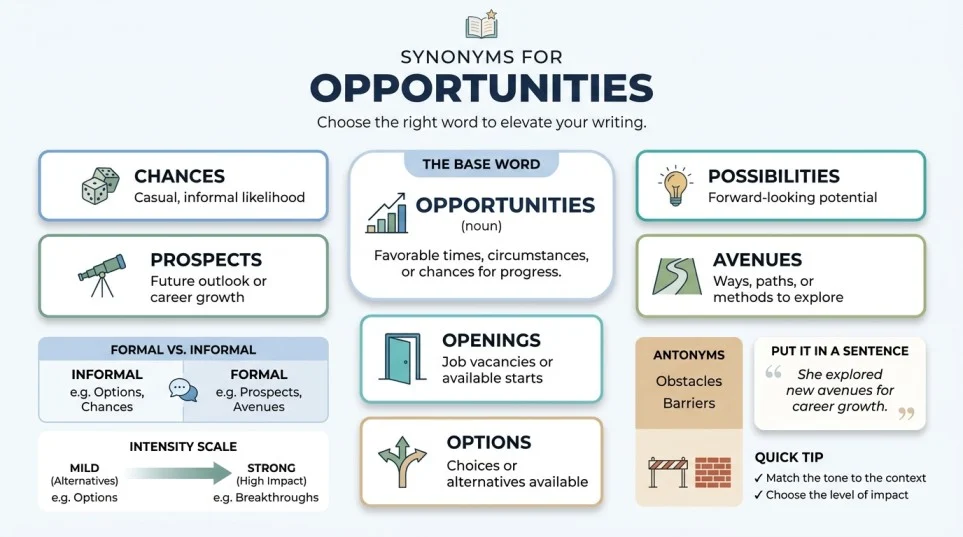
Opportunities are favorable situations or chances to do something, achieve a goal, learn, or make progress. The best synonyms include chances in casual speech, prospects in professional writing, openings for available positions, and possibilities for potential outcomes.
Meaning, Tone and Context
What Does Opportunities Mean?
An opportunity is a situation that makes it possible to do something useful, achieve a goal, develop a skill, or improve your circumstances. Opportunities can appear in education, employment, business, relationships, and personal growth.
For example, a scholarship creates an opportunity to study, while a promotion offers an opportunity to advance your career.
Part of Speech
Opportunities is the plural form of the noun opportunity.
- Singular: opportunity
- Plural: opportunities
- Related adjective: opportune, meaning suitable or well timed
- Related expression: take the opportunity, meaning to make use of a favorable situation
Tone and Formality
The word opportunities generally has a positive or neutral tone. It often suggests potential benefits, although an opportunity is not always guaranteed to produce a good result.
It works in both formal and informal settings. You can use it in a business proposal, a college essay, a job interview, or a conversation with a friend.
Common Uses
| Situation | Example |
|---|---|
| Education | Students need opportunities to practice their skills. |
| Employment | The company offers opportunities for career growth. |
| Business | The new market creates opportunities for expansion. |
| Personal growth | Traveling provides opportunities to learn about other cultures. |
| Relationships | Volunteering creates opportunities to meet new people. |
| Creative work | Writers find opportunities to explore new ideas. |
When and How to Use Opportunities
Use opportunities when you want to describe favorable circumstances, possible achievements, or situations that allow someone to take action.
The word is especially useful when several paths or possibilities are available.
Professional example: The company provides opportunities for employees to develop leadership skills.
Academic example: Research opportunities help students understand scientific methods.
Personal example: Moving to a new city gave her opportunities to meet people and explore different interests.
Email example: Thank you for sharing these opportunities. I look forward to discussing the next steps.
Notice that each sentence focuses on a different benefit. Choosing a synonym becomes easier when you identify the exact benefit or situation you want to describe.
Another Word for Opportunities
There is no single best replacement for every sentence. The right choice depends on whether you mean a favorable chance, a possible future outcome, an available position, or a path to improvement.
| Context | Best Alternative | Example |
|---|---|---|
| Professional writing | Prospects | The role offers strong career prospects. |
| Academic writing | Avenues | The project opens new avenues for research. |
| Casual conversation | Chances | We have several chances to improve. |
| Emotional writing | New beginnings | This move feels like one of life’s new beginnings. |
| Creative writing | Possibilities | The open road held endless possibilities. |
| Resume or workplace use | Growth opportunities | I am seeking growth opportunities in management. |
| Social media captions | New horizons | Here is to exploring new horizons. |
| Stronger meaning | Breakthroughs | The team’s discoveries led to major breakthroughs. |
| Softer meaning | Options | We still have a few options to consider. |
A useful rule is to choose the word that describes the situation most accurately instead of replacing opportunities with a longer or more impressive sounding expression.
When Not to Use Opportunities
Although opportunities is useful, it can sound vague when readers need specific details. Replacing it with a more precise word can make your message easier to understand.
1. When you mean an available job
Vague: The company has several opportunities.
Clearer: The company has several job openings.
Job openings tells readers exactly what is available.
2. When you mean a possible future outcome
Vague: The project offers many opportunities for success.
Clearer: The project has strong prospects for success.
Prospects emphasizes the likelihood of a future result rather than the general availability of options.
3. When you mean a specific choice
Vague: We have many opportunities to choose from.
Clearer: We have several options to consider.
Options is more direct when the focus is on choosing between alternatives.
4. When you mean an important achievement
Vague: The discovery created new opportunities.
Clearer: The discovery led to a major breakthrough.
A breakthrough suggests an important advance, not simply a favorable situation.
5. When you mean a way to improve
Vague: Employees need more opportunities to develop.
Clearer: Employees need more training and mentoring.
Specific actions make workplace communication more useful than general statements.
Words Commonly Confused With Opportunities
Several words are related to opportunities, but they do not always mean the same thing.
| Word | Main Difference | When It Works Best |
|---|---|---|
| Chances | Emphasizes the possibility of doing or achieving something. | Everyday conversation and uncertain outcomes. |
| Possibilities | Refers to things that might happen or be done. | Brainstorming and planning. |
| Prospects | Focuses on future potential or likely outcomes. | Careers, business, and long term plans. |
| Openings | Often means available positions or vacant places. | Hiring, admissions, and available roles. |
| Options | Refers to choices available to someone. | Decisions and comparisons. |
| Occasions | Refers to particular events or suitable times. | Special events and specific circumstances. |
For example, a company may have three job openings, but a candidate may have several career prospects. The first describes available positions, while the second describes possible future success.
Best Synonym by Context for Opportunities
The most effective synonym depends on your audience and the point you want to communicate.
| Context | Best Synonym | Why It Works | Example |
|---|---|---|---|
| Formal writing | Prospects | Sounds professional and emphasizes future potential. | The program offers excellent prospects for advancement. |
| Academic writing | Avenues | Describes possible ways to explore a subject. | The findings open new avenues for research. |
| Professional communication | Growth opportunities | Connects available experiences with development. | The position offers growth opportunities for new managers. |
| Resume | Advancement | Emphasizes progress in a career. | Seeking advancement through leadership and training. |
| Business | Market openings | Identifies available space in a market. | The report identifies new market openings. |
| Casual conversation | Chances | Sounds natural and familiar. | We have plenty of chances to try again. |
| Creative writing | Possibilities | Suggests imagination and potential. | The empty notebook was full of possibilities. |
| Emotional writing | New beginnings | Communicates hope and a fresh start. | She viewed the move as a chance for new beginnings. |
| Strong impact | Breakthroughs | Highlights significant progress or discovery. | The research produced several breakthroughs. |
| Moderate tone | Options | Presents choices without overstating their value. | We have a few options for next year. |
| Social media captions | New horizons | Creates an optimistic, inspiring feeling. | Exploring new horizons, one step at a time. |
| Job applications | Career prospects | Focuses on long term professional potential. | I am interested in roles with strong career prospects. |
| Entrepreneurship | Business ventures | Suggests planned commercial activities. | They are exploring new business ventures. |
| Education | Learning experiences | Emphasizes skill development and knowledge. | Internships provide valuable learning experiences. |
| Timing | Suitable moments | Focuses on the right time to act. | Wait for suitable moments to introduce your idea. |
| Personal growth | Paths | Suggests different routes toward improvement. | There are many paths to personal growth. |
Which Synonym Should You Choose?
Choosing the right synonym becomes easier when you ask five simple questions.
1. What Do You Actually Mean?
Start with the meaning rather than the word itself.
If you mean an available job, choose opening. You mean a possible outcome, choose possibility. If you mean future success, choose prospect.
2. Who Is Your Audience?
Formal writing often benefits from prospects, avenues, or possibilities. Conversations with friends usually sound more natural with chances or options.
For professional emails, clear and familiar wording is usually better than unnecessarily complex vocabulary.
3. How Strong Is the Meaning?
Some words communicate ordinary possibilities, while others suggest major achievements.
Use options for available choices, prospects for future potential, and breakthroughs for important advances.
4. Does the Word Add Professional Value?
For resumes and job applications, connect opportunities with measurable experience, skills, or achievements.
Instead of writing that you had opportunities to lead, explain that you led a team, managed a project, or trained new employees.
5. Does It Fit the Sentence?
Read the full sentence after replacing the original word. Check whether the meaning remains accurate and the sentence sounds natural.
For example, new avenues for research sounds natural in an academic paper. New job openings is more suitable for a recruitment announcement.
Real Life Examples of Opportunities in Sentences
Here are practical examples showing how the word and its alternatives work in different situations.
| Situation | Example Sentence |
|---|---|
| School | The science fair gave students opportunities to present their discoveries. |
| Workplace | Our manager encourages opportunities for professional development. |
| Writing | The article explores several possibilities for improving reading habits. |
| Conversation | You will have more chances to practice after class. |
| Social media | Every new chapter brings new possibilities. |
| Resume | Pursued professional development and leadership advancement. |
| I appreciate you sharing these career prospects with me. | |
| Storytelling | Beyond the mountains lay possibilities she had never imagined. |
| Business | The company identified promising openings in the regional market. |
| Personal growth | Learning a new language opened doors to different cultures. |
The resume example uses concise wording, but the strongest resume statements usually include specific actions and results. Whenever possible, explain what you accomplished rather than simply listing opportunities you received.
18 Synonyms for Opportunities
The following 18 alternatives cover common situations in education, employment, business, creative writing, and everyday communication.
| Synonym | Simple Meaning | Best Used For | Example Sentence |
|---|---|---|---|
| 1. Chances | Possibilities of doing or achieving something. | Casual conversation | We have several chances to improve our results. |
| 2. Possibilities | Things that might happen or be done. | Planning and creative thinking | The new technology creates exciting possibilities. |
| 3. Prospects | Potential future outcomes or success. | Careers and business | Her career prospects improved after graduation. |
| 4. Openings | Available positions or spaces. | Hiring and admissions | The school announced two openings for teachers. |
| 5. Options | Choices available to someone. | Decision making | We considered all our options before investing. |
| 6. Avenues | Ways to approach or develop something. | Academic and professional writing | The study explores new avenues for treatment research. |
| 7. Paths | Routes toward a goal. | Personal growth and careers | Mentoring can create paths to leadership. |
| 8. Prospects for advancement | Potential for professional progress. | Career planning | The position offers strong prospects for advancement. |
| 9. Breakthroughs | Important advances or discoveries. | Research and innovation | The team celebrated breakthroughs in renewable energy. |
| 10. Open doors | Creates access to new possibilities. | Personal and professional development | Her internship opened doors to a new career. |
| 11. Ventures | Planned activities, often involving risk. | Business and entrepreneurship | The founders launched two new ventures. |
| 12. Alternatives | Other choices or ways of acting. | Problem solving | We explored alternatives to the original plan. |
| 13. Prospects for growth | Potential to develop or expand. | Business and careers | The company has strong prospects for growth. |
| 14. Learning experiences | Situations that help people gain knowledge. | Education and personal development | The internship offered valuable learning experiences. |
| 15. Invitations | Offers to participate or become involved. | Events and collaboration | The conference brought invitations to collaborate. |
| 16. New beginnings | Fresh starts or new phases of life. | Emotional and personal writing | The move gave him hope for new beginnings. |
| 17. Possibilities for advancement | Ways to move forward or improve. | Professional communication | The role includes possibilities for advancement. |
| 18. Breakout moments | Events that bring sudden recognition or progress. | Informal and creative writing | The performance became her breakout moment. |
Some entries are phrases rather than single word synonyms. They are included because natural English often expresses the idea of opportunities through a short phrase. Choose the alternative that matches the intended meaning, not simply the one that sounds impressive.
Synonym Groups and Usage Differences
Professional vs. Personal Synonyms
Professional synonyms focus on career development, business progress, or future results. Personal synonyms often emphasize choices, experiences, and new directions.
| Professional | Personal |
|---|---|
| Career prospects | New beginnings |
| Advancement | Personal growth |
| Business ventures | New experiences |
| Growth opportunities | Paths to improvement |
| Professional openings | Chances to learn |
For a job application, career prospects is usually more appropriate than new beginnings. For a personal essay about starting over, new beginnings may communicate the feeling more clearly.
Formal vs. Conversational Synonyms
Formal writing often uses prospects, avenues, and possibilities. These words work well in reports, academic essays, business proposals, and professional presentations.
Conversational English usually favors chances, options, and ways to improve. These expressions are easy to understand and sound natural in texts, informal emails, and everyday discussions.
For example, a business report might say the investment creates new avenues for expansion. A colleague might simply say the investment gives us more chances to grow.
Academic Synonyms
Academic writing benefits from words that describe research, learning, and possible approaches precisely.
Useful choices include:
- Avenues: Different ways to investigate a topic.
- Possibilities: Potential outcomes or explanations.
- Research prospects: The potential for future investigation.
- Learning experiences: Activities that develop knowledge and skills.
- Alternatives: Other methods or approaches that can be evaluated.
Example: The findings suggest new avenues for future research.
This sentence is more precise than saying the findings create many opportunities because it explains how researchers can build on the results.
Professional and Business Synonyms
In the workplace, the best synonym depends on whether you are discussing hiring, promotion, expansion, or collaboration.
| Business Need | Recommended Expression | Example |
|---|---|---|
| Hiring | Job openings | We currently have three job openings. |
| Career development | Advancement | The program supports employee advancement. |
| Business expansion | Growth prospects | The region has strong growth prospects. |
| Collaboration | Partnerships | We are exploring new partnerships. |
| Sales | Market potential | The product has considerable market potential. |
| Training | Development options | Employees can choose from several development options. |
In emails and presentations, concrete wording builds trust. Instead of promising endless opportunities, explain which positions, projects, training programs, or partnerships are actually available.
Creative or Literary Synonyms
Creative writing often uses expressions that suggest discovery, hope, movement, or change.
- New horizons: New experiences or directions.
- New beginnings: A fresh start after a change.
- Open doors: Access to new experiences or possibilities.
- Paths: Routes toward goals or personal change.
- Possibilities: Potential events or outcomes.
Example: Beyond the familiar streets, a world of possibilities waited for her.
This sentence creates a sense of exploration without using opportunities repeatedly.
Slang or Modern Synonyms
There is no single slang word that replaces opportunities in every situation. However, informal expressions can work well in conversation and social media.
| Expression | Meaning | Suitable Context |
|---|---|---|
| A shot | A chance to try or succeed | Casual conversation |
| A break | A helpful chance, sometimes involving luck | Entertainment or career discussions |
| A foot in the door | An initial chance to enter a field | Job seeking and networking |
| A big break | An important chance that brings recognition | Creative careers and entertainment |
| A way in | A route into a group, industry, or activity | Informal advice |
For example, Getting an internship gave Maya a foot in the door.
These expressions are useful in everyday English, but formal essays and academic reports usually benefit from more precise alternatives.
Strongest vs. Weaker Synonyms
Words differ in strength because they describe different kinds of situations. The following scale moves from a simple choice to a major development.
Mild
Options
Choices that are available.
Moderate
Chances and possibilities
Potential ways to act or succeed.
Strong
Promising prospects
A favorable outlook for future progress.
Major impact
Breakthroughs
Important advances or discoveries, not just available chances.
Remember that this is a practical guide, not a strict ranking. A breakthrough is an achievement, while an opportunity is a favorable situation. Use the stronger term only when the facts support it.
Emotional vs. Neutral Synonyms
Neutral words describe situations without adding much emotion. Emotional expressions communicate hope, excitement, or the feeling of a fresh start.
| Neutral Expression | More Emotional Expression |
|---|---|
| Options | Exciting possibilities |
| Prospects | A hopeful future |
| Available positions | A chance to change your life |
| Paths to progress | New beginnings |
| Possible next steps | Open doors to a brighter future |
Use neutral language in reports and factual emails. Choose emotional language when writing a personal story, an inspirational caption, or a message about overcoming challenges.
Antonyms of Opportunities
Opportunities does not have one perfect opposite in every context. The best antonym depends on whether you mean a lack of chances, restricted choices, or an unfavorable situation.
The following 15 words and expressions describe different opposing ideas.
| Antonym | Meaning | Example Sentence |
|---|---|---|
| 1. Obstacles | Things that make progress difficult. | Financial obstacles delayed the project. |
| 2. Barriers | Things that block access or progress. | Language barriers limited communication. |
| 3. Limitations | Conditions that restrict what is possible. | Budget limitations reduced our choices. |
| 4. Restrictions | Rules or conditions that limit action. | Travel restrictions affected the program. |
| 5. Setbacks | Problems that delay progress. | Unexpected setbacks slowed the launch. |
| 6. Disadvantages | Conditions that place someone in a weaker position. | Limited experience created disadvantages for new applicants. |
| 7. Difficulties | Problems that make something harder. | The team faced difficulties securing funding. |
| 8. Hardships | Serious conditions that cause suffering or difficulty. | Economic hardships affected the entire community. |
| 9. Impediments | Factors that prevent or slow progress. | Outdated systems became impediments to growth. |
| 10. Roadblocks | Problems that stop or delay action. | Approval delays created roadblocks for the project. |
| 11. Dead ends | Paths that lead nowhere useful. | Their investigation reached several dead ends. |
| 12. Exclusions | Situations in which people are left out. | The policy resulted in the exclusion of qualified applicants. |
| 13. Rejections | Decisions that refuse an application or request. | Several rejections discouraged the candidate. |
| 14. Closures | Situations in which access or activity ends. | Factory closures reduced local employment options. |
| 15. Impossibilities | Things that cannot be done or achieved. | Without the required equipment, the task seemed impossible. |
For the clearest opposite of opportunities, use a phrase such as lack of opportunities when you mean that favorable chances are unavailable. Use barriers or obstacles when you mean that something is preventing progress.
Comparison: Opportunities vs. Similar Words
Opportunities vs. Chances
The main difference is formality. Opportunities often suggests a useful or favorable situation, while chances can refer to either a possibility of success or an attempt.
Chances is more conversational. Opportunities usually sounds more suitable in professional writing.
Examples:
- Opportunities: The program offers opportunities for career development.
- Chances: You have several chances to improve your score.
Opportunities vs. Possibilities
Possibilities describe things that might happen or be done. Opportunities usually suggests situations that allow someone to take action or gain a benefit.
Neither word is always stronger. Possibilities is especially useful for brainstorming, while opportunities is more direct when discussing favorable circumstances.
Examples:
- Opportunities: The internship provides opportunities to gain experience.
- Possibilities: We discussed several possibilities for the next project.
Opportunities vs. Prospects
Prospects focuses on future potential, expected results, or the likelihood of success. Opportunities focuses on available situations or chances to act.
Prospects often sounds more formal and is especially common in career and business discussions.
Examples:
- Opportunities: The company offers opportunities to learn new skills.
- Prospects: The candidate has excellent prospects for advancement.
Opportunities vs. Openings
Openings often refers to vacant positions, available places, or gaps that someone can fill. Opportunities is broader and may include projects, experiences, or possible achievements.
Openings is more precise when discussing hiring.
Examples:
- Opportunities: The organization offers opportunities for professional growth.
- Openings: The organization has four openings in its marketing department.
Opportunities vs. Options
Options are choices available to someone. Opportunities are favorable circumstances that may help someone make progress.
Options is better when discussing decisions, while opportunities is better when discussing potential benefits.
Examples:
- Opportunities: The fellowship creates opportunities for young researchers.
- Options: Students can choose from three courses.
Opportunities vs. Breakthroughs
A breakthrough is an important advance or discovery. An opportunity is a situation that may make progress possible.
Breakthroughs imply a meaningful result has occurred, while opportunities often exist before a result is achieved.
Examples:
- Opportunities: The new equipment creates opportunities for further testing.
- Breakthroughs: The new equipment helped researchers achieve major breakthroughs.
Common Phrases and Expressions with Opportunities
These expressions are useful in everyday English, professional writing, and academic communication.
1. Career Opportunities
Meaning: Chances to develop professionally or move forward in a career.
Example sentence: The company provides career opportunities for recent graduates.
2. Equal Opportunities
Meaning: Fair access to chances, resources, or advancement.
Example sentence: Every student deserves equal opportunities to succeed.
3. Growth Opportunities
Meaning: Ways to improve skills, performance, or results.
Example sentence: The new role offers excellent growth opportunities.
4. Missed Opportunities
Meaning: Chances that were available but were not used.
Example sentence: Delaying the application led to several missed opportunities.
5. Create Opportunities
Meaning: Take action to make useful possibilities available.
Example sentence: Networking can help you create opportunities in your field.
6. Seize an Opportunity
Meaning: Act quickly when a favorable chance appears.
Example sentence: She seized the opportunity to present her research at a national conference.
7. Explore Opportunities
Meaning: Investigate available choices or possible directions.
Example sentence: The team will explore opportunities for international expansion.
8. A Window of Opportunity
Meaning: A limited period when something becomes possible or especially favorable.
Example sentence: The funding announcement created a window of opportunity for small businesses.
Common Mistakes to Avoid
1. Using Opportunities When You Mean Job Openings
Incorrectly vague: The company has many opportunities available.
More precise: The company has several openings for software engineers.
The second sentence tells readers exactly what is available.
2. Confusing Opportunities With Possibilities
Possibilities describe things that might happen. Opportunities usually refer to favorable circumstances that allow action or progress.
Use possibilities when exploring potential outcomes. Use opportunities when emphasizing a chance to do something useful.
3. Using Casual Language in Formal Writing
Expressions such as a shot or a big break can sound natural in conversation but may feel too informal in a research paper or business report.
Choose prospects, openings, or avenues when those words accurately express your meaning.
4. Making a Simple Situation Sound Too Dramatic
Not every opportunity is a breakthrough or a life changing moment.
Use options or chances for ordinary situations. Save stronger expressions for events that genuinely represent significant progress.
5. Repeating Opportunities Too Often
Repeated wording makes writing less engaging.
Instead of writing that a program provides opportunities to learn, opportunities to grow, and opportunities to connect, try: The program helps participants develop skills, build relationships, and explore career paths.
6. Choosing a Synonym With the Wrong Meaning
An opening may be a vacant job, while a prospect describes future potential. A breakthrough is an important achievement, not simply another available choice.
Check the meaning before replacing a word. A natural sentence is more valuable than an unusual synonym.
FAQs
1. What is the best synonym for opportunities?
The best synonym is chances for casual conversation, prospects for career growth, possibilities for planning, and openings when discussing available jobs or positions.
2. What is a formal synonym for opportunities?
Prospects and avenues are useful formal alternatives. Prospects emphasizes future potential, while avenues describes possible approaches to research, development, or problem solving.
3. What is an informal synonym for opportunities?
Chances is the most natural informal synonym in many situations. Expressions such as a shot or a break also work in casual conversations.
4. What is another word for opportunities in professional writing?
Use prospects for career potential, openings for vacant positions, and growth opportunities for employee development. Choose the term that best matches the intended meaning.
5. What is the difference between opportunities and possibilities?
Possibilities are things that might happen or be done. Opportunities are favorable situations that allow someone to take action, gain experience, or make progress.
6. What is the opposite of opportunities?
There is no single opposite for every context. Lack of opportunities is the clearest general expression, while obstacles, barriers, and restrictions describe things that prevent progress.
Conclusion
Opportunities refers to favorable situations that allow people to learn, grow, achieve goals, or move forward. The best synonym depends on the message you want to communicate and the audience you are addressing.
Use chances in casual conversation, prospects in professional writing, openings for available positions, possibilities when discussing potential outcomes, and avenues in academic work. For major achievements, breakthroughs may be appropriate when the situation supports that meaning.
The most useful vocabulary tip is simple: identify what makes the situation valuable before choosing a replacement. Precise words make your writing easier to understand, more natural, and more effective.
Discover More Post:
- 50+ Synonyms for Investigate | Meanings, Examples, and Best …
- 50+ Synonyms for Other | Meanings, Examples, and Best …
- 50+ Synonyms for Truly | Meanings, Examples, and Best …