Have you ever repeated the word being several times in an essay, email, caption, or professional message? Finding a better alternative can make your writing clearer, more natural, and easier to read. The right word depends on what you want to express.
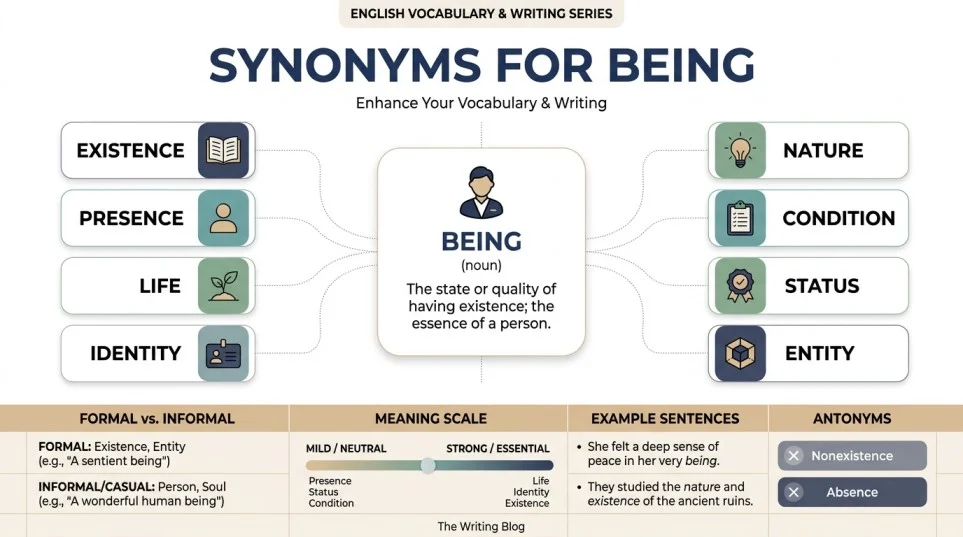
Understanding synonyms for being helps you choose words that fit different situations. For example, existence may describe the state of living, presence may refer to someone being in a place, and nature may describe a person’s character. In professional writing, words such as status, condition, and identity may work better in specific sentences. This guide explains their meanings, differences, examples, and common mistakes so you can choose the most accurate word for your message.
What Does Being Mean?
Being can refer to existence, life, a living person, or the state of something. Useful alternatives include existence, presence, life, identity, nature, condition, and status. The best choice depends on whether you are discussing life, location, personal qualities, or a particular situation.
Meaning, Tone and Context
The word being has several meanings in English. Its meaning changes depending on how it appears in a sentence.
1. Simple Definition
Being can describe the state of existing, a living person, or the condition of something. It can also function as a form of the verb be.
For example, human being means a person, while being honest describes someone’s behavior at a particular time.
2. Part of Speech
Being has three common grammatical uses.
- Noun: Refers to existence or a living creature. Example: Every human being deserves respect.
- Verb form: The present participle of be. Example: She is being careful.
- Gerund: Refers to the state or action of existing or behaving. Example: Being patient takes practice.
3. Tone and Meaning
Being is generally neutral. However, the surrounding words can make it sound emotional, philosophical, formal, or critical.
For example, human being is a neutral expression, while being selfish describes behavior negatively.
4. Formality Level
Being is suitable for casual conversation, academic writing, creative work, and professional communication. However, some sentences become clearer when you replace it with a more specific noun or verb.
Instead of writing, Being responsible is important, you could write, Responsibility matters.
5. Common Uses
Being appears frequently in:
- Everyday conversations about behavior.
- Academic discussions about existence and identity.
- Professional writing about status and responsibility.
- Creative writing about life and human nature.
- Emotional writing about personal growth and relationships.
6. Related Word Forms
| Word | Meaning | Example |
|---|---|---|
| Be | To exist or have a particular state | Be honest with yourself. |
| Been | Past participle of be | I have been busy. |
| Being | Existing or behaving | He is being helpful. |
| Existence | The state of existing | Their existence changed the debate. |
| Entity | Something that exists as a distinct unit | The company is a separate entity. |
| Nonbeing | The state of not existing | The poem explores being and nonbeing. |
When and How to Use Being
Use being when you mean existence, refer to a living creature, or describe temporary behavior. Choose another word when a more exact meaning improves the sentence.
Professional: Being clear in a report helps readers understand the recommendation.
Personal: Being kind can strengthen a friendship.
Academic: The philosopher examined the meaning of being and existence.
Emotional: Being apart from her family made the journey difficult.
Notice that these examples use being in different grammatical roles. A suitable replacement must preserve the intended meaning and sentence structure.
Another Word for Being
There is no single synonym that works in every sentence. The best replacement depends on the meaning you intend.
| Context | Best alternative | Example |
|---|---|---|
| Professional writing | Status | Her employment status has changed. |
| Academic writing | Existence | The study explores the existence of life beyond Earth. |
| Casual conversation | Life | Life can surprise us. |
| Emotional writing | Presence | His presence made her feel safe. |
| Creative writing | Essence | The story captures the essence of childhood. |
| Resume or workplace use | Responsibility | My responsibilities included training new staff. |
| Social media captions | Life | Choosing joy and enjoying life. |
| Stronger meaning | Existence | Their existence challenged the old theory. |
| Softer meaning | State | She was in a peaceful state of mind. |
These alternatives are not interchangeable in every situation. For example, status usually refers to a position or condition, while existence refers to the fact that something is real.
When Not to Use Being
Being is a useful word, but excessive use can make writing vague or awkward.
1. When a Clear Noun Is Better
Weak: Being responsible is a key part of the job.
Better: Responsibility is a key part of the job.
The second sentence is shorter and more direct.
2. When You Mean Someone’s Location
Weak: Her being here made the meeting easier.
Better: Her presence made the meeting easier.
Presence communicates the intended meaning more naturally.
3. When You Mean a Current Situation
Weak: The being of the project is uncertain.
Better: The status of the project is uncertain.
Status is the appropriate word when discussing progress or a current situation.
4. When You Mean Someone’s Character
Weak: His being was admired by everyone.
Better: His character was admired by everyone.
Character is clearer when you mean a person’s moral qualities or personality.
5. When You Describe Temporary Behavior
Weak: She is being a kindness.
Better: She is being kind.
Being must work with the correct grammatical form. In this example, the adjective kind describes her behavior.
Words Commonly Confused With Being
Several words have meanings related to being, but each serves a different purpose.
| Word | Meaning | When to Use It |
|---|---|---|
| Existence | The state of being real or alive | Philosophical or factual discussions |
| Presence | The fact of being in a place | People, meetings, and events |
| Life | The condition of being alive | Living things and personal experiences |
| Nature | The basic qualities of a person or thing | Personality or essential qualities |
| Identity | Who someone is | Personal, cultural, or social discussions |
| Condition | The state something is in | Health, objects, or circumstances |
For example, existence describes the fact that something is real, while presence describes being somewhere. Nature refers to essential qualities, whereas identity concerns who someone is.
Best Synonym by Context for Being
The following table shows which alternative works best in common writing situations.
| Context | Best Synonym | Why It Works | Example |
|---|---|---|---|
| Formal writing | Existence | Sounds precise when discussing whether something exists | The report examines the existence of a problem. |
| Academic writing | State | Describes a particular condition or situation | The study considers the state of human awareness. |
| Professional communication | Status | Explains a current position or situation | Please confirm the status of the application. |
| Resume writing | Responsibility | Highlights duties and work contributions | My responsibilities included managing schedules. |
| Casual conversation | Life | Refers naturally to everyday living | Life feels easier with good friends. |
| Creative writing | Essence | Expresses the central qualities of something | Her music captured the essence of freedom. |
| Emotional writing | Presence | Emphasizes someone’s effect through being there | Your presence brought me comfort. |
| Strong meaning | Existence | Emphasizes the fact of being real or alive | The discovery challenged the existence of the species. |
| Mild or neutral meaning | State | Describes a condition without strong emotion | He was in a relaxed state. |
| Social media captions | Life | Works well for personal reflections | Enjoying life one day at a time. |
| Philosophy | Being | Refers directly to existence as a concept | The class discussed the meaning of being. |
| Personal identity | Identity | Focuses on who a person is | She expressed her identity through art. |
There is no special US or UK difference for these basic alternatives. Both varieties use words such as existence, presence, identity, and status in broadly similar ways.
Which Synonym Should You Choose?
Choose a replacement by checking what being means in your sentence.
- Meaning: Use existence when you mean that something is real, presence when someone is somewhere, and life when discussing living or personal experience.
- Formality: Use status or condition in reports and professional communication when those terms match the subject.
- Emotional intensity: Use presence to highlight someone’s effect, or essence to describe the qualities that make something special.
- Professional value: Use specific nouns such as responsibility, role, or status when explaining workplace duties or progress.
- Sentence structure: Check whether the sentence needs a noun, an adjective, or a verb form. A synonym may require rewriting the sentence.
The best synonym is the one that preserves the original meaning while making the sentence easier to understand.
Real Life Examples of Being in Sentences
Here are practical examples showing how related words can improve everyday communication.
School: The essay explores the existence of life on other planets.
Workplace: Please provide an update on the status of the project.
Writing: The poem captures the essence of growing up.
Conversation: Her presence made everyone feel welcome.
Social media: Celebrating life, friendship, and new beginnings.
Resume: My responsibilities included organizing records and supporting the team.
Email: Could you confirm the current status of my request?
Storytelling: His quiet presence gave the frightened child a sense of safety.
Academic discussion: The researcher examined the nature of human identity.
Personal reflection: Being patient helped me handle the difficult situation.
18 Synonyms for Being
The following 18 alternatives cover different meanings of being. Some replace the idea of existence, while others work only for specific uses of the word.
| Synonym | Simple Meaning | Best Used For | Example Sentence |
|---|---|---|---|
| Existence | The fact of existing | Philosophy and factual writing | The discovery raised questions about the existence of life elsewhere. |
| Presence | The fact of being in a place | Meetings and personal situations | Her presence improved the atmosphere. |
| Life | The state of being alive | Personal experiences and living things | Life offers opportunities to learn. |
| State | A particular condition | Formal and academic writing | The patient was in a stable state. |
| Condition | The way something is at a given time | Health and circumstances | The building was in good condition. |
| Status | A current position or situation | Business and administration | His application status changed yesterday. |
| Nature | The essential qualities of someone or something | Character and philosophy | Her generous nature impressed the team. |
| Identity | The qualities that define who someone is | Personal and social discussions | Art became an important part of his identity. |
| Essence | The most important quality | Creative and descriptive writing | The photograph captured the essence of summer. |
| Reality | What actually exists or happens | Factual and philosophical writing | Reality differed from their expectations. |
| Entity | Something that exists as a distinct unit | Legal, technical, and academic writing | Each department operates as a separate entity. |
| Creature | A living being | Stories and descriptions | The tiny creature hid beneath a leaf. |
| Individual | One person or distinct member | Formal and social writing | Every individual deserves fair treatment. |
| Person | A human being | Everyday and professional communication | One person volunteered to lead the project. |
| Organism | A living thing | Biology and science | The organism adapted to its environment. |
| Character | A person’s qualities or moral nature | Personal descriptions and storytelling | Her character earned everyone’s trust. |
| Role | A function or part played by someone | Work and relationships | His role involved helping new employees. |
| Responsibility | A duty or obligation | Professional and personal writing | Training new staff was one of her responsibilities. |
Important distinction: These are context based alternatives, not 18 interchangeable synonyms. For instance, creature and organism refer to living things, while role and responsibility describe a person’s function or duties.
Synonym Groups and Usage Differences
Professional vs. Personal Synonyms
Professional writing often benefits from precise words such as status, role, condition, and responsibility. These words tell readers exactly what is happening or what someone does.
Personal writing may use life, presence, nature, and identity. These words help express relationships, experiences, personality, and feelings.
For example, a manager might discuss an employee’s role, while a friend might appreciate someone’s presence.
Formal vs. Conversational Synonyms
Formal writing often uses existence, entity, condition, and status when their meanings fit the subject. These words are useful in reports, academic essays, official messages, and presentations.
Conversational writing tends to favor life, person, and presence. They are familiar and easy to understand.
For example, a report might discuss the existence of a concern, while a casual conversation might focus on someone’s life experiences.
Academic Synonyms
Academic writing needs words with clear and limited meanings. Existence is useful in philosophy, organism is common in biology, and identity is valuable in psychology and social research.
State and condition work well when describing a specific situation. Nature can describe the essential qualities of a process, behavior, or subject.
Choose the term that matches the field and the claim you want to make.
Professional and Business Synonyms
In business communication, being can sometimes make sentences unnecessarily long. A more specific noun often improves clarity.
Consider these examples:
- Being in charge of the schedule becomes managing the schedule.
- Being responsible for reports becomes preparing reports.
- Being aware of a delay becomes knowing about a delay.
- Being in a leadership position becomes serving as a leader.
The revised sentences are more direct and explain the action or responsibility clearly.
Creative or Literary Synonyms
Creative writing often explores existence, essence, life, identity, and presence. These words can express deep ideas about people, relationships, and personal experiences.
For example, The essence of home was not the building but the people inside it.
In storytelling, creature can describe a living figure, while character can refer to a person’s qualities or a fictional person. Choose the word that supports the image or idea you want readers to imagine.
Slang or Modern Synonyms
Being does not have one universal slang replacement. Modern alternatives depend on the full phrase.
For example, existing can sometimes mean simply getting through a difficult day, especially in informal online posts. Living can suggest actively enjoying experiences.
Examples:
- Just existing today, taking things slowly.
- Living for the weekend.
- Being myself, without trying to impress anyone.
These expressions work in casual conversation and social media captions. In academic papers, business reports, and formal emails, use more precise language.
Strongest vs. Weaker Synonyms
The following scale compares emphasis rather than treating the words as exact substitutes.
| Intensity | Word | Effect |
|---|---|---|
| Mild | State | Neutral description of a condition |
| Mild | Condition | Factual description of circumstances |
| Moderate | Presence | Emphasizes being somewhere |
| Moderate | Life | Highlights living or personal experience |
| Strong | Existence | Emphasizes the fact of being real |
| Strong | Essence | Highlights the central nature of something |
The strongest option depends on context. Essence adds emphasis to essential qualities, while existence stresses whether something is real. Neither is automatically stronger in every sentence.
Emotional vs. Neutral Synonyms
Neutral alternatives include state, status, condition, and entity. They are useful when the goal is to communicate facts without adding emotion.
Emotional or expressive alternatives include life, presence, identity, and essence. These words can bring attention to relationships, personality, or personal meaning.
Compare these examples:
Neutral: Her status at the company changed.
Emotional: Her presence made the workplace feel like home.
The difference comes from meaning and context, not simply from the word itself.
Antonyms of Being
Being has several meanings, so it does not have one universal opposite. Existence can contrast with nonexistence, while being alive can contrast with being dead. When being describes behavior, the opposite depends on the adjective or action involved.
The following table lists 15 useful opposites and contrasting terms. Some are contextual opposites rather than direct antonyms of every meaning of being.
| Antonym or Contrast | Meaning | Example Sentence |
|---|---|---|
| Nonexistence | The state of not existing | The theory considers the possibility of nonexistence. |
| Nothingness | A state in which nothing exists | The story describes a world of nothingness. |
| Nonbeing | The state of not being | The philosopher explored being and nonbeing. |
| Absence | The fact of not being present | Her absence was noticed immediately. |
| Unavailability | The state of not being available | The service’s unavailability delayed the work. |
| Death | The end of life | The novel examines life and death. |
| Lifelessness | The lack of life or vitality | The abandoned town had an air of lifelessness. |
| Inactivity | The state of not acting or moving | Inactivity can slow progress. |
| Stillness | A lack of movement or sound | Stillness filled the room after the music stopped. |
| Invisibility | The state of being unseen | The character wished for invisibility. |
| Unreality | The quality of seeming unreal | The dream had a strange sense of unreality. |
| Disappearance | The act of vanishing from view or existence | The sudden disappearance puzzled the investigators. |
| Withdrawal | The act of leaving or pulling away | His withdrawal from the project surprised the team. |
| Departure | The act of leaving a place | Her departure marked the end of the event. |
| Neglect | Failure to give proper care or attention | Neglect of basic duties harmed the project. |
Usage note: Absence is the clearest contrast when being means presence. Nonexistence is more appropriate when discussing existence itself. Death applies specifically to living things, and neglect contrasts with responsible care rather than with being in every grammatical sense.
Comparison: Being vs. Similar Words
Being vs. Existence
Main difference: Being can refer to existence, a living creature, or a grammatical form. Existence specifically refers to the fact of existing.
Which is stronger: Existence is more specific when discussing whether something is real.
Which is more formal: Existence often sounds more precise in philosophical and academic writing.
Examples:
Being: The class explored the meaning of being.
Existence: Scientists investigated the existence of water on the planet.
Being vs. Presence
Main difference: Being has several meanings, while presence focuses on being in a place or having an effect through someone’s attendance.
Which is stronger: Neither is always stronger. Presence emphasizes attendance or influence.
Which is more formal: Both are suitable for professional communication.
Examples:
Being: Being at the meeting helped her understand the plan.
Presence: Her presence helped the team feel confident.
Being vs. Life
Main difference: Being can describe existence or an individual creature. Life refers to the state of being alive or the experiences associated with living.
Which is stronger: Life often carries more emotional meaning.
Which is more formal: Both can be formal, but life is more common in everyday conversation.
Examples:
Being: Every human being deserves respect.
Life: Life can bring unexpected opportunities.
Being vs. Nature
Main difference: Being refers to existence or a living creature. Nature can describe essential qualities or the character of a person or thing.
Which is stronger: Nature is more descriptive when discussing personality or essential qualities.
Which is more formal: Both are suitable for formal writing.
Examples:
Being: Being honest is important.
Nature: Her honest nature earned the team’s trust.
Being vs. Identity
Main difference: Being can describe existence, while identity explains who someone is or what makes them distinct.
Which is stronger: Identity is more specific when discussing personal or social characteristics.
Which is more formal: Identity is common in academic, professional, and social discussions.
Examples:
Being: Being yourself can take courage.
Identity: Her identity was shaped by her family and experiences.
Being vs. Condition
Main difference: Being may refer to existence or behavior. Condition describes the state of a person, object, or situation.
Which is stronger: Condition is more precise when reporting a specific state.
Which is more formal: Condition often fits reports and technical writing.
Examples:
Being: Being calm helped him solve the problem.
Condition: The equipment was in excellent condition.
Common Phrases and Expressions with Being
1. Human Being
Meaning: A person.
Example sentence: Every human being deserves dignity and respect.
2. Being Yourself
Meaning: Acting naturally without pretending to be someone else.
Example sentence: Being yourself can help you build genuine friendships.
3. Being Honest
Meaning: Telling the truth or acting sincerely.
Example sentence: Being honest about the mistake helped resolve the issue.
4. Being There for Someone
Meaning: Supporting someone when they need help.
Example sentence: Being there for a friend can mean more than offering advice.
5. Being in the Moment
Meaning: Paying attention to the present experience.
Example sentence: Being in the moment helped her enjoy the family gathering.
6. Being Considerate
Meaning: Thinking about other people’s feelings and needs.
Example sentence: Being considerate of your coworkers makes teamwork easier.
7. Being Under Pressure
Meaning: Facing stress or demanding expectations.
Example sentence: Being under pressure taught him to manage his time carefully.
8. Being True to Yourself
Meaning: Staying honest about your values and personality.
Example sentence: Being true to yourself matters more than pleasing everyone.
Common Mistakes to Avoid
1. Using Being When a More Precise Word Is Better
Weak: Being of the application is unclear.
Better: The status of the application is unclear.
Use status when discussing progress or a current position.
2. Confusing Being With Existence
Being can describe existence, but it also refers to people and behavior. Existence specifically emphasizes the fact that something exists.
Use existence for philosophical or factual claims about whether something is real.
3. Using Casual Language in Formal Writing
Expressions such as just existing may work in a personal caption, but they may sound vague in an academic essay.
Replace them with a precise description of the condition, action, or experience you mean.
4. Choosing an Overly Dramatic Word
Essence, nothingness, and nonexistence can sound too abstract for a simple workplace message.
For everyday communication, choose familiar words such as status, condition, role, or presence when they fit.
5. Repeating Being Too Often
Weak: Being organized and being prepared are important for being successful.
Better: Organization and preparation are important for success.
Turning repeated verb phrases into clear nouns can make writing shorter and smoother.
6. Choosing a Synonym With the Wrong Meaning
Presence cannot replace being in every sentence. Likewise, responsibility does not mean existence.
Check the whole sentence before replacing a word. A synonym is useful only when it preserves the intended meaning.
FAQs
1. What is the best synonym for being?
Existence is a strong choice when being refers to the fact of existing. Presence, life, identity, and condition work better in other contexts.
2. What is a formal synonym for being?
Existence is a formal alternative when discussing reality or life. Status and condition are more appropriate when referring to a situation.
3. What is an informal synonym for being?
Life and presence are familiar alternatives in everyday language. The best choice depends on whether you mean living, being somewhere, or personal experience.
4. What is another word for being in professional writing?
Use status for a current situation, responsibility for a duty, and presence for attendance. These words make professional messages more precise.
5. What is the difference between being and existence?
Being can refer to existence, a living creature, or behavior. Existence specifically describes the fact or state of existing.
6. What is the opposite of being?
Nonexistence is an opposite when being means existence. Absence contrasts with presence, while death contrasts with life in the context of living organisms.
Conclusion
Synonyms for being include existence, presence, life, nature, identity, condition, and status. Each word expresses a different idea, so the best choice depends on the sentence and the meaning you want to communicate.
For professional writing, choose precise terms such as status or responsibility when appropriate. For personal and creative writing, life, presence, and essence may express your meaning more naturally.
The most useful vocabulary tip is simple: understand the meaning first, then choose the synonym that fits your context. Clear word choices make your writing more natural, accurate, and engaging.
Discover More Post:
- 50+ Synonyms for Investigate | Meanings, Examples, and Best …
- 50+ Synonyms for Other | Meanings, Examples, and Best …
- 50+ Synonyms for Truly | Meanings, Examples, and Best …