The word other appears everywhere. You may use it in an essay, email, resume, conversation, caption, or workplace message without noticing how often it appears.
Sometimes, however, other is too general. A more precise word can make your sentence clearer, more natural, or more professional.
This guide explains synonyms for other by meaning and context. You will learn which alternatives work in academic writing, business communication, casual conversation, creative writing, and everyday speech.
Because other can express difference, addition, alternatives, remaining items, or people and things beyond the one already mentioned, the best replacement depends heavily on the sentence.
What Does Other Mean?
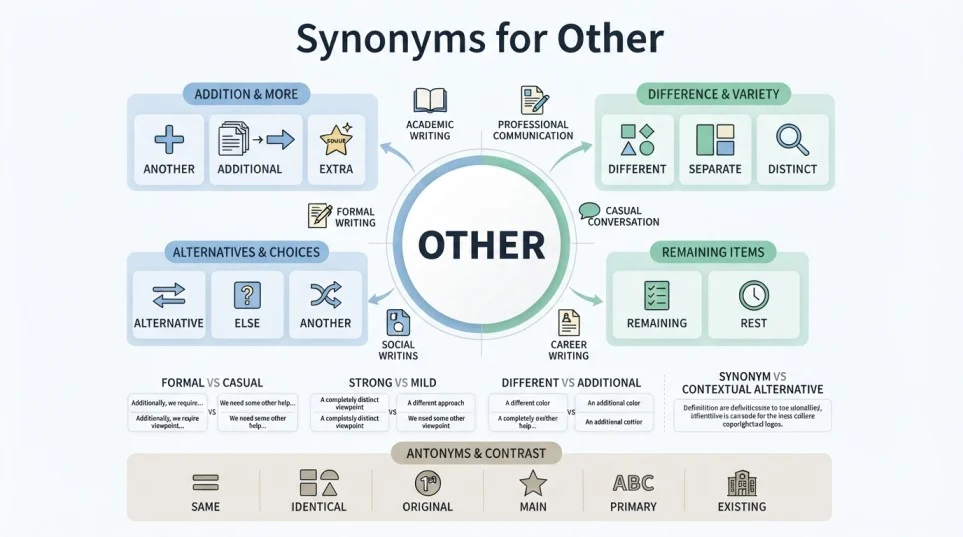
Other refers to a person or thing that is different from, additional to, or separate from one already mentioned. Depending on context, useful alternatives include another, additional, alternative, different, remaining, extra, separate, distinct, further, subsequent, and else.
Meaning, Tone and Context
What does other mean?
Other generally identifies someone or something that is different from the person, thing, group, or idea already being discussed.
For example:
I have another question about the project.
Here, another refers to an additional question.
In this sentence:
We considered other options.
Other refers to options different from the ones already discussed.
The word can therefore communicate either difference or addition, depending on the sentence.
Part of speech
Other can function in several grammatical roles.
As a determiner:
We need to discuss other possibilities.
- As a pronoun:
Some students preferred the first option, while others chose the second.
As an adjective in traditional grammatical descriptions:
The other room is available.
- As a noun:
Some people like the idea, while others disagree.
Tone
Other is usually neutral.
It does not normally express approval, criticism, excitement, or disapproval by itself. Its meaning comes from the surrounding sentence.
Compare:
We need other solutions.
We need better solutions.
The first sentence simply asks for different solutions. The second suggests that the existing solutions are inadequate.
Formality level
Other works comfortably in almost every type of English.
It is appropriate in:
- Academic essays
- Business emails
- Professional reports
- Resumes
- Conversations
- Social media
- Creative writing
- Everyday communication
Its main weakness is not formality. It is lack of precision when the exact relationship between ideas matters.
Common uses of other
Other commonly expresses:
- Difference
- Addition
- Alternatives
- Remaining people or things
- Separate categories
- Additional information
- Contrasting choices
- People or things beyond those already mentioned
Related word forms
Important related forms include:
Another: one more or an additional one.
Others: additional or different people or things.
Otherwise: in a different way or under different circumstances.
Else: another or additional person, thing, or possibility.
Each other: one another in a reciprocal relationship.
When and How to Use “Other”
Other is useful when the reader already understands what group, category, or choice you are discussing.
Professional example
We should review other approaches before making a final decision.
Here, other clearly indicates approaches different from those already considered.
Personal example
Do you have other plans for the weekend?
Other refers to plans in addition to the ones already discussed.
Academic example
Other studies have reported similar findings.
This is common in academic writing when referring to studies beyond the one currently being discussed.
Social media example
What other places should I visit while I am in Chicago?
Other sounds natural because the speaker is asking for additional suggestions.
Resume example
Collaborated with other departments to improve customer service.
Other works naturally when the specific departments have already been identified elsewhere or do not need to be named.
Another Word for “Other”
The best replacement depends on what you actually mean.
| Situation | Recommended alternative |
|---|---|
| One additional item | Another |
| Additional information | Further |
| More of something | Additional |
| A different choice | Alternative |
| Something different | Different |
| Items left in a group | Remaining |
| More than expected | Extra |
| A separate category | Separate |
| Clearly different | Distinct |
| Another person or thing | Else |
| A later item or event | Subsequent |
| More items or information | More |
| A different option | Another option |
| A different kind | Different kind |
| A second possibility | Alternative |
Professional writing
Use additional, alternative, separate, further, or different when they communicate the exact relationship more clearly.
Please provide additional documentation.
This is more precise than:
Please provide other documentation.
Academic writing
Further, additional, alternative, distinct, and different can be useful depending on meaning.
Further research is necessary.
Here, further means more research, not research that is necessarily different.
Casual conversation
Another, different, else, more, and other are usually natural.
Would you like another coffee?
Emotional writing
Different, separate, distant, unfamiliar, or another may work when the sentence has an emotional dimension.
She wanted a different life.
Different communicates a stronger sense of contrast than the neutral other.
Creative writing
Writers may choose different, unfamiliar, distant, separate, alternate, or distinct when they want more imagery or specificity.
Resume or workplace use
Use additional, cross functional, separate, related, or a precise department or role name when possible.
Instead of:
Worked with other teams.
Consider:
Collaborated with marketing, sales, and customer support teams.
The second sentence gives the reader useful information.
Social media captions
Other, another, different, and else are usually the most natural.
Where should I travel next? Any other suggestions?
Stronger meaning
For a stronger sense of difference, consider:
distinct, separate, contrasting, alternative, or different.
Softer meaning
For a softer sense of addition, consider:
another, additional, further, or more.
When Not to Use “Other”
Other becomes less effective when the reader needs to know exactly what kind of difference or addition you mean.
When precision matters
Weak:
We need other information.
Better:
We need additional financial information.
When you mean a specific alternative
Weak:
We need other solutions.
Better:
We need alternative solutions.
When you mean something clearly different
Weak:
She wanted an other approach.
Better:
She wanted a different approach.
When you mean something remaining
Weak:
The other students stayed behind.
This can be correct, but if you mean students who remained after a particular group left, remaining students may be clearer.
When the word becomes repetitive
If a paragraph uses other several times, replacing some instances with precise nouns or alternatives can improve readability.
Words Commonly Confused With “Other”
Other vs. Another
Other generally refers to a different person or thing, often in relation to a known group.
Another usually means one more or an additional single item.
I need another example.
I need other examples.
The first usually asks for one more example. The second can refer to different examples generally.
Other vs. Different
Other identifies something beyond the one already mentioned.
Different emphasizes contrast.
Do you have other ideas?
Do you have different ideas?
The second sentence more strongly emphasizes that the ideas differ.
Other vs. Additional
Additional means added to what already exists.
We need additional information.
Other can mean additional, but it can also mean different.
We need other information.
This could mean different information rather than simply more information.
Other vs. Alternative
Alternative usually refers to another possibility or choice.
We need an alternative solution.
Other is broader.
We need other solutions.
The first specifically suggests replacement options.
Other vs. Else
Else commonly follows words such as someone, something, anywhere, what, who, and where.
Who else is coming?
What else do you need?
Other normally does not work in these constructions.
Other vs. Remaining
Remaining means still present after some people or things have been removed, used, selected, or discussed.
The remaining students completed the test.
Other simply identifies people or things beyond those already mentioned.
Best Synonym by Context for “Other”
| Context | Best Synonym | Why It Works | Example |
|---|---|---|---|
| Formal writing | Additional | Clearly expresses added information | Additional evidence supports the conclusion. |
| Academic writing | Further | Natural for research and discussion | Further research is needed. |
| Professional use | Alternative | Clearly communicates another option | We need an alternative strategy. |
| Resume | Additional | Professional and concise | Provided additional support to clients. |
| Casual conversation | Another | Natural for one more item | Can I have another question? |
| Creative writing | Different | Highlights contrast | She wanted a different life. |
| Emotional tone | Distant | Can suggest separation when context supports it | He felt distant from the others. |
| Strong contrast | Distinct | Clearly indicates difference | The two methods are distinct. |
| Soft or moderate tone | Another | Suggests an additional choice without strong contrast | Let’s try another approach. |
| Social media | Else | Natural in questions and casual expressions | What else should I see? |
| Business communication | Additional | Precise for added material | Please send additional details. |
| Research writing | Further | Common when referring to continued investigation | Further analysis revealed a pattern. |
| Multiple choices | Alternative | Directly indicates another choice | We need an alternative plan. |
| Remaining items | Remaining | Identifies what is left | The remaining items were donated. |
| Separate categories | Separate | Clearly communicates distinction | Keep the files in separate folders. |
| US usage | Other | Standard and highly versatile | Do you have any other questions? |
| UK usage | Other | Also standard and widely used | Are there any other options? |
Which Synonym Should You Choose?
Start by asking what you mean by other.
- If you mean one more, choose another.
- If you mean more information or material, choose additional.
- If you mean more research or continued consideration, choose further.
- If you mean a different choice, choose alternative.
- If you mean not the same, choose different.
- If you mean what is left, choose remaining.
- If you mean a clearly separate category, choose separate or distinct.
- If you are asking about an additional person, place, thing, or possibility, else may be the natural choice.
The best synonym is therefore not necessarily the most sophisticated word. It is the word that communicates your intended relationship most accurately.
Real Life Examples of “Other” in Sentences
School
Students can choose other topics if their first choice has already been selected.
Workplace
The manager asked employees to suggest other ways to improve the process.
Writing
The introduction discusses several other factors that influence the outcome.
Conversation
Do you have any other questions?
Social media
What other cities should I add to my travel list?
Resume
Collaborated with other departments to coordinate major projects.
Please let me know if you need any other information.
Storytelling
While everyone returned home, the other travelers continued toward the coast.
18 Synonyms for “Other”
Because other has several meanings, these are best understood as contextual synonyms and close alternatives rather than perfectly interchangeable replacements in every sentence.
| Synonym | Simple Meaning | Best Used For | Example Sentence |
|---|---|---|---|
| Another | One more or an additional one | A single additional item | Could you give me another example? |
| Additional | Added to what already exists | Formal and professional writing | Please provide additional information. |
| Further | More or continuing beyond what exists | Academic and professional contexts | Further analysis may clarify the issue. |
| Alternative | Another available choice | Options and decisions | We need an alternative solution. |
| Different | Not the same | Clear contrast | She chose a different approach. |
| Else | Another person, thing, place, or possibility | Questions and casual language | What else should we consider? |
| Remaining | Still left after some have been removed | Groups and quantities | The remaining documents were archived. |
| Extra | More than necessary or expected | Casual and everyday language | Do you have an extra copy? |
| Separate | Kept apart or treated independently | Categories, groups, and objects | Keep the two files in separate folders. |
| Distinct | Clearly different or recognizable | Formal and analytical writing | The report identifies two distinct problems. |
| Alternate | A substitute or different option | Choices and replacement plans | We created an alternate route. |
| Subsequent | Following something earlier | Formal and academic writing | Subsequent studies produced similar results. |
| More | A greater quantity or amount | Quantity and additions | We need more information before deciding. |
| Differentiate | To distinguish one thing from another | Analytical and technical contexts | The test helps differentiate the two conditions. |
| Unrelated | Not connected to the matter being discussed | Clear lack of connection | The comments were unrelated to the topic. |
| Contrasting | Showing a noticeable difference | Analysis and creative description | The article presents two contrasting viewpoints. |
| Miscellaneous | Made up of various unrelated items | Lists and collections | The drawer contains miscellaneous supplies. |
| Novel | New or unfamiliar | Academic and creative contexts | The researchers proposed a novel approach. |
Synonym Groups and Usage Differences
Professional vs. Personal Synonyms
Professional writing often benefits from precise alternatives such as additional, alternative, further, distinct, separate, and subsequent.
Personal communication can use simpler words such as another, different, more, other, and else.
Compare:
Do you have any other questions?
with:
Please contact us if you require additional information.
Both are correct, but the second has a more professional tone.
Formal vs. Conversational Synonyms
Formal writing may favor:
additional
further
alternative
subsequent
distinct
Conversational English often favors:
another
other
different
else
more
A formal word is not automatically better. Choose the word that fits the audience and purpose.
Academic Synonyms
Academic writing frequently uses further, additional, distinct, alternative, subsequent, and different.
For example:
Further research is required to understand the long term effects.
The word further is particularly useful when describing research, investigation, analysis, or discussion that continues beyond the current point.
Professional and Business Synonyms
Business communication benefits from precise wording.
Instead of:
Please send other documents.
Try:
Please send the additional documents.
If you mean replacement choices:
Please provide alternative proposals.
If you mean separate groups:
The project involves several distinct teams.
Creative or Literary Synonyms
Creative writing often benefits from words that create a clearer image or emotional contrast.
Different can highlight change.
Distant can suggest emotional separation.
Unfamiliar can create a sense of uncertainty.
Distinct can emphasize a recognizable quality.
Alternate can suggest another possible reality, route, or outcome.
Slang or Modern Synonyms
There are no major slang replacements for other that work reliably across standard American English.
Casual expressions such as something else, someone else, another one, and anything else are more useful in everyday conversation.
Use standard alternatives in academic and professional writing.
Strongest vs. Weaker Synonyms
There is no universal intensity scale because these words express different relationships rather than different degrees of the same idea.
A useful context based scale is:
Another: mild addition.
Additional: neutral addition.
Further: continued addition.
Different: noticeable contrast.
Alternative: another choice.
Distinct: clearly separated or different.
Contrasting: strong emphasis on difference.
Emotional vs. Neutral Synonyms
Other, additional, another, further, and more are generally neutral.
Different can create a sense of change.
Distant can suggest emotional separation.
Unfamiliar can suggest uncertainty.
Separate can imply physical, social, or conceptual division.
The surrounding sentence determines whether the word feels emotional.
Antonyms of “Other”
Strictly speaking, other does not have 15 direct antonyms. It is a relational word, and its opposite changes according to what other means in a particular sentence.
To avoid inventing false dictionary antonyms, the following table provides 15 contextual contrast terms that can oppose particular meanings of other.
| Antonym or Contrast Term | Meaning | Example Sentence |
|---|---|---|
| Same | Identical rather than different | We selected the same option. |
| Identical | Exactly alike | The two documents are identical. |
| This | The specific item being indicated | This option is the one we selected. |
| These | The specific items being indicated | These files belong to the same project. |
| That | A particular item already identified | That answer is correct. |
| Those | Particular items already identified | Those examples are relevant. |
| Original | The first or initial version | We returned to the original plan. |
| Primary | First in importance or priority | The primary objective is customer satisfaction. |
| Main | Most important or central | The main issue has been resolved. |
| Singular | Existing as one rather than additional items | The report focuses on a singular objective. |
| One | A specific single item | One option remains available. |
| Identified | Specifically known or named | The identified issue requires attention. |
| Central | Located at or related to the main point | The central argument is clear. |
| Included | Already part of the group or discussion | The included examples support the claim. |
| Existing | Already present rather than additional or different | We should improve the existing system. |
These are contextual contrasts, not 15 universal dictionary antonyms of other.
Comparison: “Other” vs. Similar Words
Other vs. Another
The main difference is grammatical and numerical.
Another commonly refers to one additional item.
Other is broader and can refer to different or additional people or things.
Example with other:
We considered other options.
Example with another:
We considered another option.
Other vs. Different
Other can indicate difference without strongly emphasizing it.
Different directly emphasizes that something is not the same.
Example with other:
Let’s discuss other ideas.
Example with different:
Let’s discuss different ideas.
Different is stronger when contrast is the main point.
Other vs. Additional
Additional specifically means added to what already exists.
Other can mean added or different.
Example with other:
We need other details.
Example with additional:
We need additional details.
Additional is more precise when you simply want more information.
Other vs. Alternative
Alternative usually means another option that can be selected instead.
Other has a much broader meaning.
Example with other:
We discussed other possibilities.
Example with alternative:
We discussed an alternative proposal.
Alternative is more specific when choices are being compared.
Other vs. Further
Further usually means more, continued, or additional.
Other usually means different or additional.
Example with other:
We considered other approaches.
Example with further:
Further research is necessary.
Further is especially natural when discussing continued research, analysis, or progress.
Other vs. Else
Else is especially common after indefinite or interrogative words.
Example with other:
Do you have other ideas?
Example with else:
What else do you have?
Else is more natural in constructions such as someone else, something else, anywhere else, and what else.
Common Phrases and Expressions with “Other”
1. The other
Meaning:
Refers to the second of two people or things.
Example sentence:
One shoe is under the bed, and the other is by the door.
2. Each other
Meaning:
Describes a reciprocal relationship between people or things.
Example sentence:
The two colleagues support each other during difficult projects.
3. In other words
Meaning:
Introduces a simpler or clearer explanation.
Example sentence:
In other words, we need to reduce unnecessary spending.
4. Other than
Meaning:
Means except for or apart from something.
Example sentence:
Other than Friday, I am available any day this week.
5. On the other hand
Meaning:
Introduces a contrasting point.
Example sentence:
The apartment is expensive. On the other hand, it is close to work.
6. Among other things
Meaning:
Indicates that something is one of several relevant items.
Example sentence:
The report discusses costs, staffing, and, among other things, customer retention.
7. Some other time
Meaning:
Refers to a different or later time.
Example sentence:
I cannot meet today, but perhaps we can talk some other time.
8. One after the other
Meaning:
Describes things happening sequentially.
Example sentence:
The students entered the room one after the other.
Common Mistakes to Avoid
1. Using other when a precise synonym is better
Weak:
We need other information.
Better:
We need additional information.
Additional tells the reader exactly what you mean.
2. Confusing other with another
Incorrect:
I need other one.
Correct:
I need another one.
Another is normally used before a singular countable noun when meaning one more.
3. Using a casual alternative in formal writing
Words such as stuff may sound too informal when you need a precise professional term.
Instead of:
Please send the other stuff.
Write:
Please send the remaining documents.
4. Using an overly dramatic synonym
Do not replace other with a stronger word simply to sound sophisticated.
For example, distinct is not always appropriate when you simply mean another.
5. Repeating other too often
A paragraph can quickly become vague if every sentence contains other.
Replace unnecessary repetitions with precise nouns or context appropriate alternatives.
6. Choosing the wrong emotional tone
Different, separate, distant, and unfamiliar can create stronger emotional impressions than other.
Make sure that emotional effect is intentional.
7. Using slang in academic or professional writing
Casual expressions may sound natural in conversation but weaken formal writing.
Choose precise standard English for reports, essays, resumes, and professional documents.
FAQs
What is the best synonym for other?
The best synonym depends on meaning. Use another for one more, additional for added material, alternative for another choice, and different for something that is not the same.
What is a formal synonym for other?
Common formal alternatives include additional, further, alternative, distinct, separate, and subsequent. The correct choice depends on whether you mean addition, difference, or sequence.
What is an informal synonym for other?
Another, different, more, and else are natural informal alternatives. In casual conversation, simple wording is usually more natural than unnecessarily formal vocabulary.
What is another word for other in professional writing?
Additional is useful when you mean more, alternative works for another choice, and separate or distinct can clarify differences between categories or groups.
What is the difference between other and another?
Other can refer to different or additional people and things, while another generally means one more or an additional single person or thing.
What is the opposite of other?
Other has no single universal antonym. Depending on context, contrasting words can include same, identical, this, that, main, primary, original, and existing.
Conclusion
Other is one of the most versatile words in English, but its broad meaning can sometimes make writing less precise.
For one additional item, choose another. Added information, consider additional. For continued research or analysis, further is often effective. For another choice, use alternative. Clear contrast, choose different or distinct.
The best synonym for other is the word that communicates the exact relationship you mean.
When editing your writing, ask yourself one simple question: Am I talking about something additional, something different, something remaining, or another available choice? Your answer will usually reveal the most precise word.
Discover More Post:
- 25+ Synonyms for Depression | Meanings, Examples, and …
- 25+ Synonyms for They | Meanings, Examples, and Best …
- 25+ Synonyms for Proficient | Meanings, Examples, and Best …