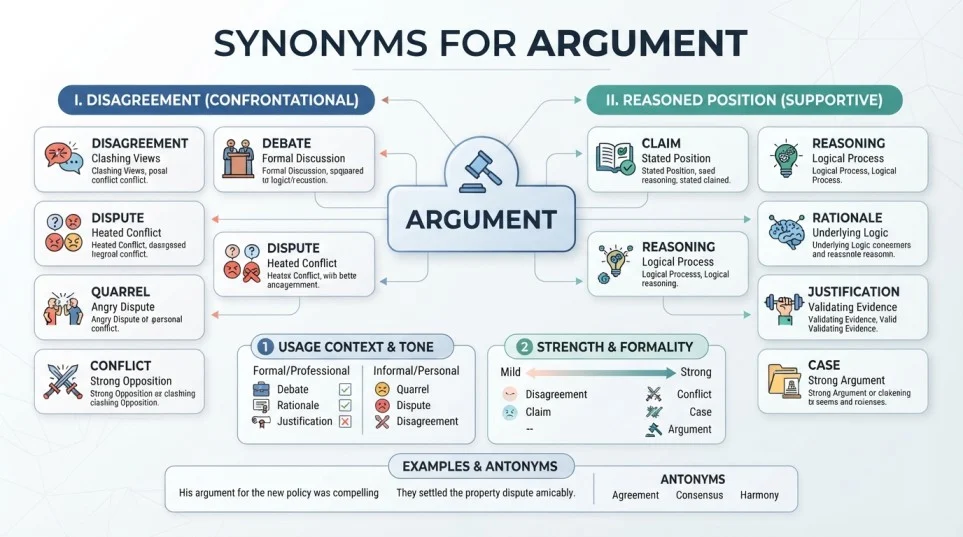
Do you keep using the word “argument” in essays, emails, conversations, or social media posts? The word is useful, but it can describe several different ideas, from a disagreement between people to a reason that supports a position.
Choosing a more precise word can make your writing clearer and more natural. This guide explains synonyms for argument by meaning, tone, formality, emotional intensity, and context.
Whether you need a formal word for an essay, a professional alternative for workplace writing, or a casual expression for conversation, the right choice depends on what you actually mean.
What Does Argument Mean?
An argument can mean a disagreement between people or a reason used to support an idea. Formal choices include contention and justification, casual choices include quarrel and squabble, and academic choices include claim, rationale, and reasoning.
Meaning, Tone and Context
Simple Definition
The word “argument” has two major meanings.
First, an argument can be a disagreement or conflict between people who have different opinions.
Example: “The couple had an argument about money.”
Second, an argument can be a reason or set of reasons used to support an idea, opinion, or conclusion.
Example: “Her argument was supported by strong evidence.”
Part of Speech
“Argument” is a noun.
Its plural form is “arguments.”
Related forms include “argue,” “argued,” “arguing,” and “argumentative.”
Tone
The tone of “argument” depends on context.
When it means a disagreement, it can sound neutral, negative, emotional, or confrontational.
When it means a reasoned position, it can sound neutral, academic, professional, or analytical.
Formality
“Argument” is appropriate in both everyday and formal English.
In academic writing, it often refers to the central position or reasoning presented by a writer.
In casual conversation, it commonly refers to a verbal disagreement.
Common Use Cases
You may use “argument” when discussing:
- Personal disagreements
- Academic reasoning
- Debates
- Legal positions
- Business disagreements
- Opinions and claims
- Emotional conflicts
- Persuasive writing
- Essays and research
- Everyday conversations
When and How to Use Argument
Use “argument” when you need a broad word that can describe either a disagreement or a reasoned position.
Professional
“The manager presented a strong argument for changing the current process.”
Here, “argument” means a reasoned case supporting a proposal.
Personal
“My brother and I had an argument about where to spend the weekend.”
Here, “argument” means a disagreement.
Academic
“The essay develops an argument about the effects of social media on communication.”
In academic writing, “argument” often means the main position supported by reasoning and evidence.
Emotional
“She left the room after their argument became too intense.”
Here, the word suggests a heated disagreement.
Another Word for Argument
The best replacement depends on which meaning you intend.
- For professional writing, “case,” “reasoning,” or “justification” can work well when discussing a supported position.
- For academic writing, “claim,” “contention,” “position,” or “reasoning” may be more precise.
- For casual conversation, “quarrel,” “squabble,” or “fight” may describe a disagreement.
- For emotional writing, “confrontation,” “altercation,” or “quarrel” can communicate greater intensity.
- For creative writing, “confrontation,” “bickering,” or “wrangle” can create a more vivid scene.
- For resumes and workplace communication, “case,” “rationale,” and “justification” are usually more useful than words describing personal conflict.
- For social media captions, “debate,” “disagreement,” or “controversy” may fit depending on the situation.
- For a stronger meaning, consider “confrontation” or “altercation.”
- For a softer meaning, “disagreement” or “difference of opinion” may sound less aggressive.
When Not to Use Argument
“Argument” can be too general when your sentence requires a more precise description.
For example:
Weak: “She gave an argument for the proposal.”
More precise: “She gave a rationale for the proposal.”
- If two people simply have different opinions, “disagreement” may be more neutral.
- If people are exchanging ideas in an organized setting, “debate” may be more appropriate.
- If you are describing evidence supporting a conclusion, “reasoning,” “case,” or “justification” may communicate the intended meaning more clearly.
Avoid using “argument” when the situation is actually a physical confrontation, unless the context clearly establishes that meaning.
Words Commonly Confused With “Argument”
Argument vs. Debate
An argument can be a disagreement or a reasoned position. A debate usually involves an organized exchange of opposing views.
Argument vs. Disagreement
A disagreement means people do not share the same opinion. An argument often suggests a more active or emotional conflict.
Argument vs. Claim
A claim is a statement someone presents as true. An argument can include a claim along with reasons and evidence.
Argument vs. Reasoning
Reasoning describes the thought process connecting evidence, reasons, and conclusions. An argument may contain reasoning.
Argument vs. Quarrel
A quarrel is generally a personal disagreement, often involving emotion. Argument is broader and can also describe academic reasoning.
Argument vs. Controversy
A controversy is a disputed issue that attracts disagreement or public attention. An argument is usually an individual exchange or a specific line of reasoning.
Best Synonym by Context for “Argument”
| Context | Best Synonym | Why It Works | Example |
|---|---|---|---|
| Formal writing | Contention | Sounds precise and formal | The author’s contention requires further evidence. |
| Academic writing | Claim | Clearly identifies a position being supported | The central claim is supported by several studies. |
| Professional or business use | Rationale | Clearly explains why a decision is being proposed | The report provides a rationale for the change. |
| Resume | Case | Presents an ability to support an idea or proposal | Built a strong case for process improvement. |
| Casual conversation | Disagreement | Sounds natural and relatively neutral | We had a disagreement about the plans. |
| Creative writing | Confrontation | Creates a stronger sense of tension | Their confrontation changed the course of the story. |
| Emotional tone | Quarrel | Suggests personal and emotional disagreement | Their quarrel continued late into the evening. |
| Strong intensity | Altercation | Suggests a serious or heated conflict | Security intervened during the altercation. |
| Soft or moderate tone | Difference of opinion | Makes disagreement sound less hostile | It was simply a difference of opinion. |
| Social media captions | Debate | Works well for public exchanges of views | The post sparked a debate about education. |
| US usage | Argument | Common and natural in everyday American English | They had an argument after dinner. |
| UK usage | Row | Common informal British usage for a disagreement | They had a row over the decision. |
Which Synonym Should You Choose?
Start by identifying what “argument” means in your sentence.
If you mean two people disagreeing, consider “disagreement,” “quarrel,” “conflict,” or “confrontation.”
If you mean a reasoned position, consider “claim,” “case,” “rationale,” “reasoning,” or “justification.”
Next, consider formality.
Use neutral words in everyday communication. Choose more precise terms such as “rationale,” “contention,” or “justification” when the context requires formal or professional language.
Finally, consider emotional intensity.
“Disagreement” is relatively mild. “Quarrel” is more personal. “Confrontation” and “altercation” suggest greater tension.
Real Life Examples of “Argument” in Sentences
School
“The student developed a clear argument and supported it with reliable evidence.”
Workplace
“The team presented a strong case for adopting the new software.”
Writing
“The author’s central argument focuses on the importance of clear communication.”
Conversation
“We had a disagreement about which restaurant to choose.”
Social Media
“Her post started a debate about the future of remote work.”
Resume
“Presented a compelling case for improving the customer support process.”
“The report provides a clear rationale for changing the current schedule.”
Storytelling
“Their confrontation revealed a secret that had remained hidden for years.”
18 Synonyms for “Argument”
The word “argument” has two important senses, so these alternatives are grouped across disagreement and reasoning. Some fit one sense much better than the other.
| Synonym | Simple Meaning | Best Used For | Example Sentence |
|---|---|---|---|
| Disagreement | A difference in opinion | Neutral personal or professional situations | We had a disagreement about the project timeline. |
| Dispute | A serious disagreement | Business, legal, or formal conflicts | The two companies settled their dispute. |
| Quarrel | A personal disagreement | Emotional or personal situations | The siblings had a quarrel over the television. |
| Debate | An exchange of opposing views | Academic, public, or organized discussion | The candidates participated in a debate about education. |
| Conflict | A serious clash of interests or opinions | Workplace, personal, or social situations | The conflict affected the entire team. |
| Contention | A disputed position or disagreement | Formal and academic writing | Her main contention was supported by strong evidence. |
| Altercation | A heated confrontation | Serious interpersonal conflict | The argument developed into an altercation. |
| Squabble | A minor or petty disagreement | Informal situations | The children had a squabble over a toy. |
| Bickering | Repeated minor arguing | Informal personal situations | Constant bickering made the trip unpleasant. |
| Confrontation | A direct and often tense encounter | Emotional or dramatic situations | The confrontation forced them to address the problem. |
| Fight | A verbal or physical conflict | Strong casual language | They had a fight about household responsibilities. |
| Controversy | A disputed public issue | Media, politics, business, or public discussion | The decision created considerable controversy. |
| Case | A set of reasons supporting a position | Professional and persuasive writing | She made a strong case for hiring another employee. |
| Rationale | The reasoning behind a decision | Professional and academic writing | The manager explained the rationale behind the policy. |
| Reasoning | The process of using reasons to reach a conclusion | Academic and analytical writing | His reasoning was easy to follow. |
| Justification | A reason that explains or defends an action | Formal and professional writing | The report offered a detailed justification for the expense. |
| Claim | A statement presented as true | Academic, analytical, and persuasive writing | The researcher supported the claim with new evidence. |
| Assertion | A confident statement or declaration | Formal and analytical writing | The article makes a strong assertion about consumer behavior. |
Synonym Groups and Usage Differences
Professional vs. Personal Synonyms
Professional writing usually benefits from neutral and precise words.
Use “rationale,” “case,” “reasoning,” or “justification” when explaining a business decision.
Personal situations may call for “disagreement,” “quarrel,” “bickering,” or “fight,” depending on the level of conflict.
Formal vs. Conversational Synonyms
Formal writing favors words such as “contention,” “justification,” “rationale,” and “assertion.”
Conversational English more naturally uses “argument,” “fight,” “quarrel,” “disagreement,” and “squabble.”
Academic Synonyms
Academic writing often uses “argument,” “claim,” “contention,” “reasoning,” and “assertion.”
The best choice depends on whether you are describing the overall position, a specific statement, or the reasoning supporting a conclusion.
Professional and Business Synonyms
In business communication, “rationale” is useful when explaining why a decision was made.
“Case” works well when persuading someone to support an idea.
“Justification” is appropriate when explaining or defending an action, expense, or decision.
Creative or Literary Synonyms
Creative writing benefits from words that communicate atmosphere and emotional intensity.
“Confrontation” can suggest tension, while “bickering” can create a lighter or more irritating mood.
“Quarrel” can give a scene a personal and traditional literary quality.
Slang or Modern Synonyms
“Fight” is common in casual American English when people describe a serious verbal disagreement.
However, it can sound too informal for academic papers, professional reports, or formal emails.
Strongest vs. Weaker Synonyms
A useful intensity scale is:
Mild: difference of opinion
Moderate: disagreement
Moderately strong: dispute
Strong: quarrel or conflict
Very strong: confrontation or altercation
The exact intensity depends on context. A word should describe the situation rather than exaggerate it.
Emotional vs. Neutral Synonyms
“Disagreement” is relatively neutral.
“Quarrel,” “bickering,” and “fight” can sound more emotional.
“Rationale,” “reasoning,” “case,” and “claim” are generally analytical rather than emotional.
Antonyms of “Argument”
These antonyms apply mainly to the disagreement sense of “argument.” They describe agreement, cooperation, peace, or the absence of conflict.
| Antonym | Meaning | Example Sentence |
|---|---|---|
| Agreement | Having the same opinion | We reached an agreement after discussing the issue. |
| Harmony | Peaceful agreement between people | The team worked together in harmony. |
| Consensus | General agreement among a group | The committee reached a consensus. |
| Accord | Formal or mutual agreement | Both sides reached an accord. |
| Cooperation | Working together toward a goal | Cooperation helped resolve the problem. |
| Understanding | Shared awareness or agreement | They reached an understanding about future plans. |
| Unity | Being joined around a common purpose | The community showed unity during the crisis. |
| Concord | Peaceful agreement | The two groups eventually lived in concord. |
| Compromise | An agreement involving mutual concessions | They found a compromise that satisfied both sides. |
| Reconciliation | Restoring a peaceful relationship | The discussion led to reconciliation. |
| Acceptance | Willingness to accept an idea or situation | Her acceptance ended the disagreement. |
| Compliance | Willingness to follow a request or rule | His compliance prevented further conflict. |
| Concession | Accepting part of another position | The concession helped move negotiations forward. |
| Peace | A state without conflict | Both sides agreed to maintain peace. |
| Collaboration | Working together constructively | Collaboration produced a better solution. |
Comparison: “Argument” vs. Similar Words
Argument vs. Disagreement
The main difference is intensity and scope. “Disagreement” simply means different opinions, while “argument” can suggest a more active conflict.
“Argument” can be stronger when describing personal conflict.
“Disagreement” is often more neutral and professional.
Example: “They had an argument about money.”
Example: “They had a disagreement about the budget.”
Argument vs. Debate
A debate is usually an organized exchange of opposing views.
An argument can be informal, emotional, academic, or analytical.
“Debate” is more appropriate for structured discussion.
Example: “The students held a debate about climate policy.”
Example: “The students had an argument after class.”
Argument vs. Dispute
A dispute often involves a serious disagreement over an issue, decision, claim, or right.
“Dispute” sounds more formal than everyday “argument.”
Example: “The companies entered a dispute over the contract.”
Example: “The coworkers had an argument about scheduling.”
Argument vs. Quarrel
A quarrel usually refers to a personal disagreement with emotional tension.
“Argument” is broader because it can also describe academic reasoning.
Example: “The friends had a quarrel over the misunderstanding.”
Example: “The essay presents a strong argument.”
Argument vs. Claim
A claim is a specific statement presented as true.
An argument may include one or several claims along with supporting reasons.
Example: “The article makes the claim that exercise improves concentration.”
Example: “The article develops an argument about healthy habits.”
Argument vs. Reasoning
Reasoning describes how someone connects evidence and ideas to reach a conclusion.
An argument is the broader position or case being presented.
Example: “Her reasoning was logical and easy to follow.”
Example: “Her argument persuaded several members of the committee.”
Common Phrases and Expressions with “Argument”
1. Have an Argument
Meaning: To disagree with someone, often in a personal or emotional way.
Example sentence: “They had an argument about how to divide the work.”
2. Make an Argument
Meaning: To present reasons supporting a position.
Example sentence: “The author makes an argument for expanding public transportation.”
3. Strong Argument
Meaning: A position supported by convincing reasons or evidence.
Example sentence: “There is a strong argument for improving the current system.”
4. Winning Argument
Meaning: A position that successfully persuades others.
Example sentence: “She presented a winning argument during the discussion.”
5. Argument Against
Meaning: A reason opposing an idea or proposal.
Example sentence: “One argument against the proposal is its cost.”
6. Argument For
Meaning: A reason supporting an idea or proposal.
Example sentence: “The main argument for the change is improved efficiency.”
7. Build an Argument
Meaning: To develop a position using reasons and evidence.
Example sentence: “Students should learn how to build an argument from reliable sources.”
8. Heated Argument
Meaning: A highly emotional disagreement.
Example sentence: “The meeting ended after a heated argument between the two representatives.”
Common Mistakes to Avoid
1. Using “Argument” When a More Precise Word Is Better
“Argument” can be vague.
If you mean a reason behind a decision, “rationale” may be more precise.
2. Confusing an Argument With a Debate
A debate is usually structured around opposing views.
An argument can happen spontaneously between two people.
3. Using a Casual Synonym in Formal Writing
Words such as “fight” and “bickering” can sound too informal in academic or professional writing.
Use “disagreement,” “dispute,” “contention,” or another precise alternative when appropriate.
4. Making a Simple Disagreement Sound Dramatic
Calling a minor difference of opinion an “altercation” can exaggerate the situation.
Choose a word that accurately reflects the intensity.
5. Repeating “Argument” Too Often
Repeating the same word can make writing feel flat.
Where the meaning remains accurate, vary your language with words such as “claim,” “case,” “reasoning,” “disagreement,” or “debate.”
6. Choosing the Wrong Emotional Tone
“Quarrel” and “fight” can sound more emotional than “disagreement.”
If you want a neutral tone, choose a calmer alternative.
7. Using Slang in Academic or Professional Writing
Casual expressions can weaken formal writing.
Instead of “They got into a fight,” a professional report might say, “They had a disagreement.”
FAQs
What is the best synonym for “argument”?
The best synonym depends on meaning. Use “disagreement” for a neutral conflict, “debate” for organized discussion, and “case” or “reasoning” for a supported position.
What is a formal synonym for “argument”?
“Contention,” “rationale,” “justification,” and “assertion” can work as formal alternatives, depending on whether you mean a position, reason, defense, or statement.
What is an informal synonym for “argument”?
“Fight,” “quarrel,” “squabble,” and “bickering” are informal alternatives. The appropriate choice depends on how serious or emotional the disagreement is.
What is another word for “argument” in professional writing?
“Rationale,” “case,” “reasoning,” “justification,” and “position” are useful professional alternatives when discussing reasons, decisions, proposals, or viewpoints.
What is the difference between “argument” and “debate”?
An argument can be a disagreement or a reasoned position. A debate is usually a structured exchange in which opposing views are presented and discussed.
What is the opposite of “argument”?
For the disagreement sense, useful opposites include “agreement,” “consensus,” “harmony,” “accord,” “cooperation,” and “compromise.”
Conclusion
“Argument” is a flexible word with two major meanings. It can describe a disagreement between people or a reasoned position supported by evidence.
The best synonyms for argument depend on context. Use “disagreement” for a neutral conflict, “debate” for an organized exchange, “quarrel” for a personal dispute, and “rationale,” “case,” or “reasoning” for a supported position.
The most useful vocabulary tip is to choose a synonym based on meaning first, then consider formality and emotional intensity. A precise word makes your writing clearer without making it unnecessarily complicated.
Discover More Post:
- 25+ Synonyms for Depression | Meanings, Examples, and …
- 25+ Synonyms for They | Meanings, Examples, and Best …
- 25+ Synonyms for Proficient | Meanings, Examples, and Best …