Do you keep using the word “effort” in emails, essays, resumes, captions, or everyday conversations? The word is useful, but repeating it can make your writing feel predictable.
The right alternative can make your meaning more precise. You might need “attempt” for an action, “endeavor” for formal writing, “commitment” for dedication, or “exertion” for physical energy.
This guide explains synonyms for effort by meaning, tone, intensity, and context. You will learn which alternatives work best in professional, academic, personal, creative, and casual communication.
What Does Effort Mean?
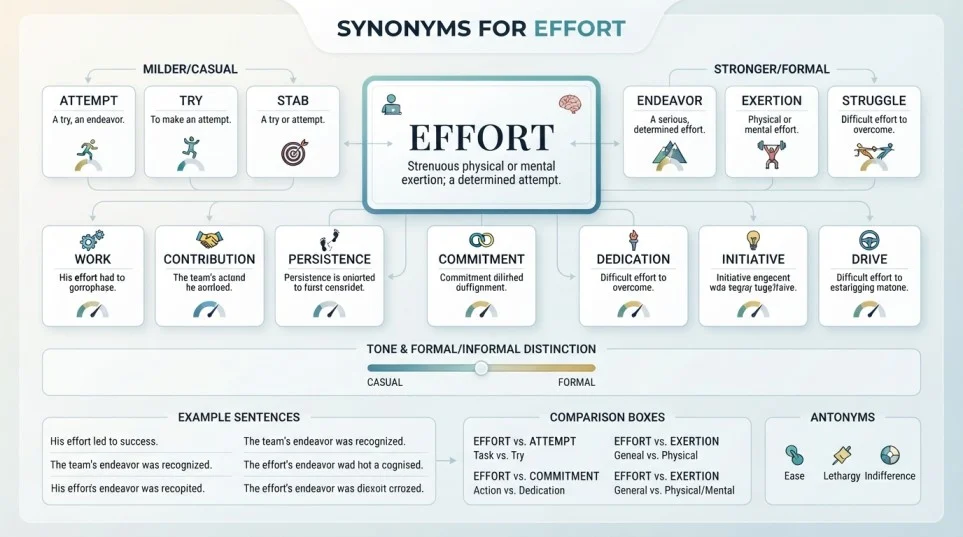
Effort means the physical or mental energy someone uses to achieve something. Depending on context, useful synonyms include attempt, endeavor, exertion, work, commitment, dedication, application, and initiative.
Meaning, Tone and Context
Simple Definition
Effort means the energy, work, time, or determination someone puts into doing something or achieving a goal.
For example:
“Her effort helped the team complete the project.”
Here, effort refers to the work and energy she contributed.
Part of Speech
“Effort” is primarily a noun.
Examples:
“His effort was impressive.”
“The project required considerable effort.”
The plural form is “efforts.”
Example:
“Her efforts improved the organization.”
Tone
Effort usually has a neutral or positive tone.
It can describe ordinary work without expressing strong emotion. It can also communicate appreciation when someone has worked hard toward a goal.
For example:
“Thank you for your effort.”
This sentence shows appreciation.
However, “effort” can sometimes suggest that the result was incomplete.
Example:
“The proposal was a good effort, but it needs more development.”
Formality Level
“Effort” is a versatile word that works in casual, academic, professional, and formal writing.
Some alternatives are more specialized.
“Attempt” is useful when focusing on an action someone tried to complete.
“Exertion” is more appropriate when discussing physical or mental energy.
“Endeavor” sounds more formal and is often used for serious goals.
“Commitment” emphasizes dedication rather than the amount of work itself.
Common Use Cases
Effort commonly appears when discussing:
- Work and productivity
- Academic performance
- Personal goals
- Physical activity
- Teamwork
- Relationships
- Creative projects
- Professional development
- Problem solving
- Achievement
Important Word Forms
Effort: the work, energy, or attempt involved in achieving something.
Efforts: multiple actions or contributions toward a goal.
Effortful: requiring considerable mental or physical work.
Effortlessly: in a way that appears to require little difficulty or energy.
When and How to Use Effort
Use “effort” when you want to describe the energy, work, or determination involved in achieving something.
Professional
“The team made a strong effort to complete the project before the deadline.”
This works well when discussing workplace performance.
Personal
“I appreciate the effort you made to help me.”
Here, effort communicates gratitude for someone’s actions.
Academic
“Students who put consistent effort into their studies often develop stronger learning habits.”
The word sounds natural in educational writing.
Emotional
“She made an honest effort to repair the relationship.”
Here, effort emphasizes sincerity and intention.
Another Word for Effort
The best single replacement depends on what you want “effort” to emphasize.
| Situation | Recommended Word |
|---|---|
| Professional writing | Endeavor |
| Academic writing | Application |
| Casual conversation | Work |
| Emotional writing | Commitment |
| Creative writing | Endeavor |
| Resume or workplace use | Contribution |
| Social media captions | Work |
| Stronger meaning | Exertion |
| Softer meaning | Attempt |
- If you are describing someone trying to accomplish something, “attempt” may be the most natural choice.
- If you are describing dedication over time, “commitment” or “dedication” may be more precise.
- If you are describing physical energy, “exertion” is usually better.
When Not to Use Effort
“Effort” can become vague when you actually mean a specific type of work, action, or dedication.
Instead of:
“His effort improved the company.”
Consider:
“His contribution improved the company.”
“Contribution” tells the reader that he added something valuable.
Instead of:
“She made an effort to solve the problem.”
You could write:
“She attempted to solve the problem.”
“Attempt” focuses on the action itself.
For physical activity, “exertion” may be more accurate than “effort.”
For long term dedication, “commitment” or “dedication” may communicate the intended meaning more clearly.
Words Commonly Confused With Effort
Effort vs. Attempt
Effort refers to the energy or work involved. Attempt refers to an action taken to achieve something.
“I appreciate your effort.”
“She made an attempt to contact the client.”
Effort vs. Work
Work can refer to the actual activity performed, while effort emphasizes the energy or determination behind it.
“The work took three hours.”
“The project required considerable effort.”
Effort vs. Exertion
Exertion specifically emphasizes the use of physical or mental energy.
“Climbing the mountain required significant exertion.”
Effort vs. Commitment
Commitment emphasizes dedication to a goal, responsibility, person, or activity over time.
“Her commitment to the project was clear.”
Effort vs. Contribution
Contribution refers to something a person adds to a project, group, discussion, or cause.
“His contribution helped the team succeed.”
Effort vs. Dedication
Dedication emphasizes sustained devotion and determination.
“Her dedication to teaching inspired her students.”
Best Synonym by Context for Effort
| Context | Best Synonym | Why It Works | Example |
|---|---|---|---|
| Formal writing | Endeavor | Sounds polished and serious | The initiative represents a major endeavor. |
| Academic writing | Application | Emphasizes focused use of ability | Her application of the method produced useful results. |
| Professional use | Contribution | Highlights what someone adds | His contribution strengthened the project. |
| Resume | Achievement | Focuses on an accomplished result | Led a team initiative that improved customer retention. |
| Casual conversation | Work | Simple and natural | You put a lot of work into this. |
| Creative writing | Endeavor | Gives the sentence a purposeful tone | His endeavor changed the course of his life. |
| Emotional tone | Dedication | Emphasizes personal commitment | Her dedication was deeply appreciated. |
| Strong intensity | Exertion | Emphasizes substantial energy | The climb required tremendous exertion. |
| Mild tone | Attempt | Focuses on trying | It was a reasonable attempt. |
| Social media | Work | Sounds conversational | Proud of the work we put into this project. |
| US usage | Effort | Common across everyday contexts | Thanks for your effort. |
| UK usage | Effort | Also natural and widely understood | Your effort made a difference. |
Which Synonym Should You Choose?
Start by asking what “effort” actually means in your sentence.
- If you mean trying to do something, choose “attempt.”
- If you mean hard physical or mental energy, choose “exertion.”
- If you mean long term dedication, choose “commitment” or “dedication.”
- If you mean something added to a project, choose “contribution.”
- If you need a formal word for a serious undertaking, consider “endeavor.”
- If you are writing a casual message, “work” is often more natural.
The best synonym is not necessarily the most sophisticated word. It is the word that communicates your exact meaning clearly.
Real Life Examples of Effort in Sentences
School
“Her effort throughout the semester helped her improve her grades.”
Workplace
“The manager recognized the team’s effort during the difficult project.”
Writing
“The author put considerable effort into revising the final chapter.”
Conversation
“I can see how much effort you put into this.”
Social Media
“Proud of the effort everyone put into making this event happen.”
Resume
“Demonstrated consistent effort in improving customer service processes.”
“Thank you for your effort in resolving this issue so quickly.”
Storytelling
“After months of effort, she finally reached the summit.”
18 Synonyms for Effort
| Synonym | Simple Meaning | Best Used For | Example Sentence |
|---|---|---|---|
| Attempt | An action taken to achieve something | Trying to accomplish a task | His first attempt produced a useful result. |
| Endeavor | A serious attempt or undertaking | Formal and purposeful writing | The research endeavor required careful planning. |
| Exertion | Physical or mental energy used | Exercise, demanding tasks, intense work | The final stage required considerable exertion. |
| Work | Activity or labor performed | Everyday and professional communication | The team put excellent work into the presentation. |
| Labor | Hard or demanding work | Physical work and formal descriptions | The project involved months of careful labor. |
| Application | Focused use of effort or ability | Academic and formal contexts | Her application of the technique improved the results. |
| Commitment | Dedication to a goal or responsibility | Professional and personal situations | His commitment to the project never weakened. |
| Dedication | Strong and sustained devotion | Emotional, professional, and personal contexts | Her dedication to teaching earned widespread respect. |
| Contribution | Something added to a shared goal | Teams, projects, organizations | Your contribution made the discussion more productive. |
| Initiative | Independent action taken to achieve something | Workplace and leadership contexts | She showed initiative by creating a new training guide. |
| Enterprise | A purposeful and ambitious undertaking | Business and formal contexts | Building the organization was an ambitious enterprise. |
| Pursuit | Continued effort toward a goal | Academic, professional, and personal goals | His pursuit of knowledge shaped his career. |
| Striving | Persistent attempt to reach something | Personal growth and motivational writing | Her striving for improvement became a daily habit. |
| Application | Careful use of energy, skill, or attention | Academic and formal writing | Success required the consistent application of skill. |
| Persistence | Continued effort despite difficulty | Challenges and long term goals | Her persistence eventually opened new opportunities. |
| Diligence | Careful and consistent work | Academic and professional writing | His diligence helped prevent costly errors. |
| Industry | Habit of working hard | Formal descriptions of work habits | Her industry was evident in every stage of the project. |
| Drive | Strong internal motivation | Modern professional and personal contexts | His drive helped him continue after several setbacks. |
Note: “Application” appears twice in common vocabulary usage because it can describe focused effort from slightly different angles. For a publication intended to avoid duplicate entries, use “investment” as the alternative entry instead.
Synonym Groups and Usage Differences
Professional vs. Personal Synonyms
Professional writing often benefits from words that identify the specific value or behavior behind the effort.
“Contribution,” “initiative,” “diligence,” “commitment,” and “application” work well in professional contexts.
Personal writing can use warmer words such as “dedication,” “persistence,” “work,” and “drive.”
Compare:
“Her contribution helped the department.”
“Her dedication meant a great deal to me.”
The first focuses on professional value. The second expresses personal appreciation.
Formal vs. Conversational Synonyms
“Endeavor,” “diligence,” “application,” and “enterprise” are more formal.
“Work,” “attempt,” and “drive” are generally easier to use in everyday communication.
Formal:
“The organization undertook a significant endeavor.”
Conversational:
“We put a lot of work into it.”
Choose the word that matches the overall tone of your sentence.
Academic Synonyms
Academic writing benefits from precise vocabulary.
Useful choices include “application,” “pursuit,” “diligence,” “endeavor,” and “persistence.”
For example:
“Consistent application of the research method produced reliable findings.”
This is more precise than simply saying:
“Consistent effort produced reliable findings.”
Professional and Business Synonyms
In workplace communication, “effort” is useful, but more specific terms can make your writing stronger.
- Use “contribution” when describing what someone added.
- Use “initiative” when describing independent action.
- Use “commitment” when emphasizing dedication.
- Use “diligence” when emphasizing careful work.
- Use “drive” when discussing motivation.
Creative or Literary Synonyms
Creative writing often benefits from words that communicate persistence, struggle, ambition, or purpose.
“Striving,” “pursuit,” “endeavor,” “persistence,” and “drive” can create more distinctive descriptions.
For example:
“She continued her pursuit of freedom despite every setback.”
This carries more narrative weight than:
“She continued her effort to gain freedom.”
Slang or Modern Synonyms
There are casual expressions related to effort, such as “hustle,” “grind,” and “push.”
These can work in social media, informal conversation, or motivational content.
They are usually less appropriate for academic essays, formal reports, and professional documents.
For example:
“Keep grinding” is casual and motivational.
“Maintain consistent effort” is more neutral and professional.
Strongest vs. Weaker Synonyms
A useful intensity scale is:
Mild: attempt
Moderate: work
Focused: application
Persistent: persistence
Dedicated: commitment
Highly dedicated: dedication
Intense energy: exertion
Strong internal motivation: drive
Intensity depends on context. A word that sounds strong in one sentence may sound neutral in another.
Emotional vs. Neutral Synonyms
Neutral choices include “effort,” “work,” “attempt,” and “contribution.”
More emotional choices include “dedication,” “persistence,” and “striving.”
Compare:
“Thank you for your effort.”
“Thank you for your dedication.”
The first is broadly appreciative. The second suggests deeper commitment.
Antonyms of Effort
Because “effort” describes work or energy rather than a simple opposite condition, some antonyms are contextual rather than exact dictionary opposites.
| Antonym | Meaning | Example Sentence |
|---|---|---|
| Inaction | Failure to take action | Inaction allowed the problem to grow. |
| Idleness | Lack of productive activity | His idleness prevented progress. |
| Neglect | Failure to give proper attention | Neglect damaged the relationship. |
| Inactivity | Lack of physical or purposeful activity | Prolonged inactivity can reduce productivity. |
| Indifference | Lack of concern | Her indifference surprised the team. |
| Apathy | Lack of interest or motivation | Apathy made it difficult to start the project. |
| Laziness | Unwillingness to work | Laziness can interfere with long term goals. |
| Passivity | Lack of active participation | Passivity prevented her from influencing the decision. |
| Disinterest | Lack of interest | His disinterest was clear during the meeting. |
| Avoidance | Deliberately staying away from something | Avoidance did not solve the underlying issue. |
| Abandonment | Giving up or leaving something | Abandonment ended the project before completion. |
| Withdrawal | Pulling away from participation | His withdrawal reduced team involvement. |
| Reluctance | Unwillingness to act | Her reluctance delayed the decision. |
| Resistance | Opposition to taking a particular action | Resistance slowed the implementation process. |
| Inattention | Failure to focus properly | Inattention caused several simple mistakes. |
Comparison: Effort vs. Similar Words
Effort vs. Attempt
Main difference: Effort focuses on energy or work. Attempt focuses on trying to accomplish something.
Which is stronger: Effort can imply more energy, while attempt does not necessarily indicate how much energy was used.
Which is more formal: Both are suitable for formal writing.
Examples:
“Her effort helped the team succeed.”
“Her attempt to solve the issue was unsuccessful.”
Effort vs. Work
Main difference: Work describes activity or labor. Effort emphasizes energy or determination.
Which is stronger: Effort can suggest greater personal investment.
Which is more formal: Both work in formal contexts, although “work” is usually more conversational.
Examples:
“The work took several hours.”
“The effort required careful planning.”
Effort vs. Exertion
Main difference: Exertion specifically emphasizes the use of energy.
Which is stronger: Exertion often suggests greater physical or mental intensity.
Which is more formal: Exertion is more specialized and formal.
Examples:
“The effort was worthwhile.”
“The physical exertion left him exhausted.”
Effort vs. Commitment
Main difference: Effort describes work or energy. Commitment describes dedication to a goal or responsibility.
Which is stronger: Commitment suggests a sustained relationship with a goal.
Which is more formal: Both are suitable for professional communication.
Examples:
“She made a strong effort.”
“She demonstrated a strong commitment.”
Effort vs. Dedication
Main difference: Effort can describe a single action. Dedication usually suggests sustained devotion.
Which is stronger: Dedication generally communicates deeper long term commitment.
Which is more formal: Both are appropriate in professional and personal writing.
Examples:
“His effort was appreciated.”
“His dedication inspired the entire team.”
Effort vs. Contribution
Main difference: Effort focuses on energy. Contribution focuses on what someone adds.
Which is stronger: Neither is universally stronger because they describe different ideas.
Which is more formal: Contribution is especially useful in professional and academic contexts.
Examples:
“Her effort helped the project.”
“Her contribution improved the final result.”
Common Phrases and Expressions with Effort
1. Make an effort
Meaning:
To actively try to accomplish something.
Example sentence:
“Please make an effort to arrive on time.”
2. Put in effort
Meaning:
To spend energy or work on something.
Example sentence:
“She put in a lot of effort before the presentation.”
3. Make every effort
Meaning:
To try as hard as reasonably possible.
Example sentence:
“We will make every effort to resolve the issue.”
4. With little effort
Meaning:
Something can be accomplished without much difficulty or energy.
Example sentence:
“He completed the task with little effort.”
5. With considerable effort
Meaning:
Something requires substantial work or energy.
Example sentence:
“The team completed the renovation with considerable effort.”
6. A team effort
Meaning:
Work performed collectively by several people.
Example sentence:
“Finishing the event on time was a team effort.”
7. Worth the effort
Meaning:
Something is valuable enough to justify the work required.
Example sentence:
“Learning the new system was difficult, but it was worth the effort.”
8. Effort counts
Meaning:
The work or intention behind an action has value even when the outcome is imperfect.
Example sentence:
“The project did not go exactly as planned, but the effort counts.”
Common Mistakes to Avoid
1. Using “Effort” When a More Precise Word Is Better
“Effort” is broad.
If you mean an action someone tried, use “attempt.”
If you mean physical energy, use “exertion.”
2. Confusing Effort With Commitment
Effort can happen once.
Commitment usually describes dedication over time.
“She made an effort” does not necessarily mean “She remained committed.”
3. Using Casual Synonyms in Formal Writing
Words such as “grind” and “hustle” can sound informal.
They may be appropriate for social media but can weaken the tone of an academic paper or formal report.
4. Using an Overly Dramatic Synonym
Not every task requires words such as “striving” or “exertion.”
For a simple task, “work” or “effort” may sound more natural.
5. Repeating “Effort” Too Often
Repeated use can make writing feel flat.
Instead, choose alternatives based on meaning.
For example, use “contribution” for team value and “dedication” for sustained commitment.
6. Choosing the Wrong Emotional Tone
“Dedication” can sound warmer than “attempt.”
“Exertion” can sound more intense than “work.”
Always consider the feeling your sentence should create.
7. Using Slang in Academic or Professional Writing
Words such as “grind” may be effective in casual posts but usually do not belong in research papers or formal business reports.
FAQs
What is the best synonym for effort?
The best synonym depends on context. “Attempt” suits trying, “commitment” suits dedication, “exertion” suits energy, and “contribution” suits added value.
What is a formal synonym for effort?
“Endeavor” is a strong formal synonym for effort when describing a serious undertaking, while “diligence” works well when emphasizing careful and consistent work.
What is an informal synonym for effort?
“Work” is a natural informal alternative to effort. In very casual contexts, “push,” “grind,” or “hustle” may also appear.
What is another word for effort in professional writing?
Useful professional alternatives include contribution, initiative, commitment, diligence, application, and endeavor, depending on the specific meaning.
What is the difference between effort and attempt?
Effort describes the energy or work involved, while attempt describes an action taken to achieve something, regardless of how much energy it required.
What is the opposite of effort?
Contextual opposites include inaction, inactivity, idleness, neglect, apathy, passivity, and avoidance. The best choice depends on the intended meaning.
Conclusion
“Effort” describes the energy, work, or determination used to achieve something. It is flexible enough for everyday conversation, professional communication, academic writing, personal messages, and creative work.
The best synonym depends on your intended meaning. Choose “attempt” for trying, “exertion” for intense energy, “commitment” for sustained dedication, “contribution” for added value, and “endeavor” for a formal undertaking.
When choosing synonyms for effort, focus on precision rather than complexity. A simple word that accurately communicates your meaning is usually more effective than an impressive word that feels unnatural.
A useful vocabulary habit is to ask yourself one question before replacing “effort”: What exactly am I trying to describe, the action, energy, dedication, contribution, or result? Your answer will usually reveal the strongest word choice.
Discover More Post:
- 25+ Synonyms for Proficient | Meanings, Examples, and Best …
- 25+ Synonyms for They | Meanings, Examples, and Best …
- 25+ Synonyms for Depression | Meanings, Examples, and …